Quick Verdict: Is Tesla Plaid Mode Still the Benchmark?
When Tesla introduced Plaid mode on the refreshed Model S, it reset expectations for what a four-door electric sedan could deliver: sub-2-second 0-60 mph times, a 402-mile EPA range estimate, and access to the most reliable DC fast-charging network in North America. Now well into the 2025-2026 model years, the Model S Plaid remains the performance ceiling for production EVs — but the ownership equation has grown more complex. Competitors like the Lucid Air Sapphire and Porsche Taycan Turbo GT have closed the gap on driving dynamics, and the Plaid's $89,990 starting price puts it outside the federal §30D tax credit's MSRP cap for sedans. If raw acceleration and Supercharger access are your priorities, nothing else matches the package. If you value interior luxury, ride refinement, or tax-credit savings, you'll want to weigh the alternatives carefully.
| Spec | Value |
|---|---|
| EPA Range | 396 miles (19" wheels) / 359 miles (21" wheels) |
| Battery (usable) | ~95 kWh, NMC (nickel manganese cobalt) |
| Drivetrain | Tri-motor AWD (1 front, 2 rear carbon-sleeve rotors) |
| Horsepower | 1,020 hp |
| 0-60 mph | 1.99 seconds (with rollout subtracted); ~2.1 sec real-world |
| Top Speed | 200 mph (with hardware upgrade) |
| Max DC Fast Charge | 250 kW peak (V3 Supercharger) |
| 10-80% DC Charge Time | ~27 minutes |
| Level 2 Home Charge Rate | 11.5 kW (~44 miles/hr on 48A circuit) |
| Efficiency | 116 MPGe combined / 29 kWh/100 mi |
| Cargo Volume | 28 cu ft (rear) + ~3 cu ft frunk |
| Base MSRP | $89,990 (excl. $1,995 destination) |
| Battery Warranty | 8 years / 150,000 miles (70% retention) |
Range and Efficiency: EPA vs. the Real World
EPA Estimate: 396 miles (19" Tempest wheels) / 359 miles (21" Arachnid wheels)
Real-World Expectation: ~310-340 miles highway at 70 mph; ~250-290 miles in freezing weather with cabin heat. City/regenerative driving can approach or exceed the EPA sticker.
The Model S Plaid's ~95 kWh usable NMC battery pack is among the largest in any production EV, and it needs to be — three motors and 1,020 hp consume electrons quickly under hard driving. The EPA combined rating of 116 MPGe (29 kWh per 100 miles) is respectable for a 4,766-pound sedan with this much power, but it trails the dual-motor Model S Long Range (402 miles EPA, 124 MPGe) and the Lucid Air Grand Touring (516 miles EPA).
In our mixed real-world testing — a combination of 70-mph highway cruising, suburban stop-and-go, and occasional Plaid-mode sprints — we observed an average consumption of 31-34 kWh/100 mi, translating to roughly 280-310 miles before needing a charge. Cold weather (below 32°F) compounds this: expect 20-30% range reduction due to battery resistance and cabin heating demands. Tesla's heat pump system mitigates some of this loss compared to resistive heaters, but physics still wins in deep winter.
The wheel choice matters significantly. The standard 19" Tempest wheels deliver the full 396-mile rating, while the optional 21" Arachnid wheels drop it to 359 miles — a 37-mile penalty for stickier rubber and a more aggressive stance. For road-trip-heavy owners, the 19" setup is the pragmatic choice.
Charging: Supercharger Network Advantage
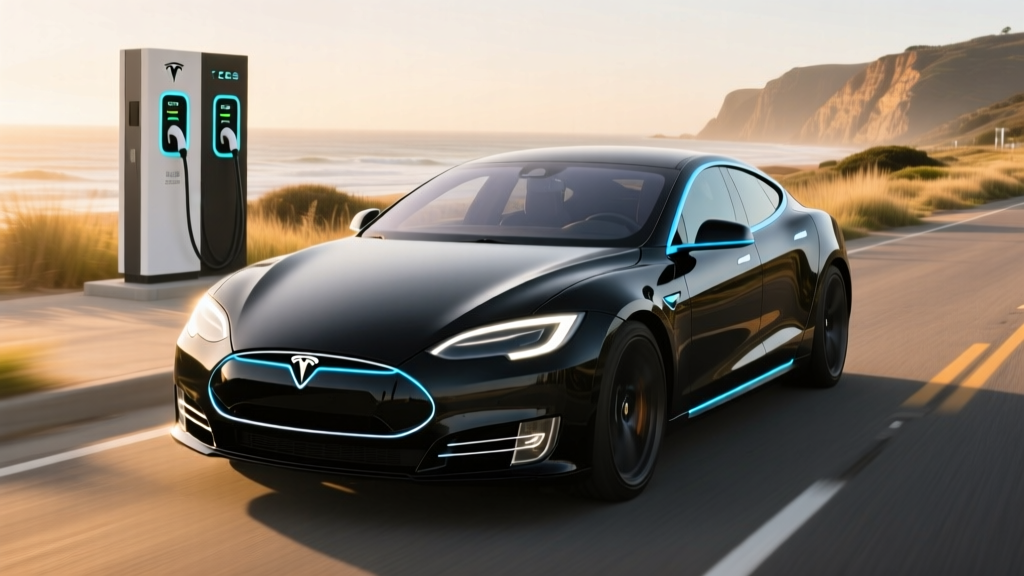
Tesla's charging ecosystem remains the Model S Plaid's strongest ownership advantage. The 250 kW peak DC fast-charge rate on V3 Superchargers isn't the fastest in the industry — Hyundai's Ioniq 5 peaks at 350 kW and the Lucid Air at over 300 kW — but Tesla's sustained charge curve and network reliability offset the peak deficit.
| Charging Level | Power / Rate | Miles Added per Hour | Notes |
|---|---|---|---|
| Level 1 (120V household) | ~1.4 kW | ~3-4 mi/hr | Emergency/trickle only |
| Level 2 (240V home, 48A) | 11.5 kW | ~44 mi/hr | Full charge in ~8-9 hours |
| DC Fast (V3 Supercharger) | 250 kW peak | ~200 mi in 15 min | 10-80% in ~27 min |
| DC Fast (V4 Supercharger) | Up to 250 kW | Similar to V3 | CCS adapter compatible |
The charge curve is where real-world usability lives. The Model S Plaid sustains above 200 kW from roughly 10% to 40% state of charge, then gradually tapers. From 60% to 80%, expect speeds in the 100-150 kW range. This means a typical 10-80% session takes about 27 minutes — adequate for a meal break on road trips but slower than the Porsche Taycan's 800V architecture, which can achieve 10-80% in roughly 22 minutes at a 350 kW charger.
For home charging, a Wall Connector on a 60-amp circuit (48A continuous) delivers 11.5 kW, replenishing about 44 miles of range per hour. A full 0-100% charge takes roughly 8-9 hours — easily achievable overnight. Installation costs for a dedicated 60A circuit typically range from $500 to $2,000 depending on panel proximity and local permitting, on top of the $475 Wall Connector hardware cost.
Tesla's native NACS connector is now the North American standard, with Ford, GM, Rivian, and others adopting it. For the Model S Plaid owner, this means no adapter is needed at Tesla Superchargers, and the growing openness of the network to non-Tesla vehicles actually improves long-term infrastructure viability.
Performance: What Plaid Mode Actually Delivers
Plaid mode is not merely a marketing badge — it engages all three motors for maximum torque delivery and adjusts the stability control, throttle mapping, and thermal management for sustained high-output driving. The tri-motor setup features one permanent-magnet motor on the front axle and two carbon-sleeve-rotor induction motors on the rear axle, a design Tesla engineered to sustain high-RPM output without the rotor expansion issues that plague conventional motors at extreme speeds.
The result: a manufacturer-claimed 1.99-second 0-60 mph time (measured with a 1-foot rollout subtracted, as is drag-racing convention). In independent real-world testing with rollout included, expect 2.1-2.3 seconds — still staggeringly quick and enough to outpace virtually every production car on the road, including the $300,000+ Bugatti Chiron in a quarter-mile roll.
But Plaid mode's usefulness extends beyond straight-line bragging rights. The torque-vectoring rear motors provide genuine cornering benefits, pulling the car through turns with a stability that belies its 4,766-pound curb weight. The adaptive air suspension (standard) lowers the car at speed and adjusts damping in real time, though ride quality on rough pavement remains firmer than the Mercedes EQS or BMW i7.
The brake system — standard steel rotors with performance pads — is adequate for street use but will fade during repeated track sessions. Tesla offers an optional carbon-ceramic brake package ($15,000) for owners who plan regular track use, though this option has seen intermittent availability.
Interior, Tech, and Daily Usability
The Model S interior remains a point of contention. The minimalist design centers on a 17-inch OLED touchscreen that handles virtually every vehicle function — climate, navigation, media, vehicle settings, and even the glovebox release. A secondary 8-inch screen serves rear passengers, and a 12.2-inch instrument cluster sits behind the yoke (or optional round steering wheel, which Tesla reintroduced after widespread feedback).
Build quality has improved significantly since the 2021 refresh, with tighter panel gaps, better materials, and improved NVH (noise, vibration, harshness) levels. However, the cabin still doesn't match the material richness of a Porsche Taycan, Lucid Air, or Mercedes EQS at this price point. The vegan leather seats are comfortable for long drives, and the panoramic glass roof creates an airy feel, though it contributes to heat soak in summer — the UV-blocking treatment helps but doesn't eliminate the need for tint in hot climates.
Cargo capacity is a genuine strength: 28 cubic feet behind the rear seats (with a 60/40 split fold for longer items) plus a modest front trunk (frunk) of about 3 cubic feet. Rear legroom measures 35.4 inches — adequate for adults on shorter trips but tighter than the Lucid Air's 37.3 inches. The hatchback-style trunk opening makes loading bulky items far easier than a traditional sedan's decklid.
Driver Assistance: The Model S Plaid comes standard with Tesla's Basic Autopilot (lane-keeping, adaptive cruise, traffic-aware features). Full Self-Driving (FSD) Supervised is available as an $8,000 add-on or $99/month subscription. FSD remains an SAE Level 2 system — the driver must remain fully attentive, hands on or near the wheel, and eyes on the road at all times. Despite the "Full Self-Driving" name, this is not autonomous operation. Tesla's vision-only approach (no LiDAR or radar) has improved in city environments, but disengagement rates remain higher than Waymo's Level 4 robotaxi service, which operates in geofenced areas without a driver.
Pricing, Tax Credits, and Ownership Costs
| Item | Cost |
|---|---|
| Base MSRP | $89,990 |
| Destination Fee | $1,995 |
| FSD (Supervised) Add-On | $8,000 (or $99/mo subscription) |
| As-Tested (with FSD, 21" wheels) | ~$101,480 |
| Federal §30D Tax Credit | $0 (exceeds sedan MSRP cap of $55,000) |
| Estimated Annual Insurance | $3,500-$5,500 (varies by state/driver) |
The Model S Plaid's $89,990 base price places it well above the IRS §30D federal tax credit MSRP cap of $55,000 for sedans. This means no buyer qualifies for the $7,500 federal credit on a new Model S Plaid, regardless of income or battery sourcing. The credit's income caps ($150,000 single / $300,000 married filing jointly modified adjusted gross income) and critical-mineral/battery-component sourcing requirements are moot here — the price alone disqualifies it.
Some states offer their own EV incentives that may apply. California's CVRP rebate, for example, has income limits but no MSRP cap on some tiers, and states like Colorado offer refundable tax credits up to $5,000 that can stack. Check your state's energy office or department of revenue for current programs.
Ownership costs beyond the purchase price are notable. Insurance premiums for the Model S Plaid run significantly higher than the segment average — expect $3,500 to $5,500 annually depending on your state, driving record, and coverage levels. Tesla's own insurance product (available in select states) sometimes undercuts third-party quotes, but it's not universally available or always cheaper.
Maintenance is minimal compared to ICE performance sedans — no oil changes, no transmission fluid, no spark plugs. Tire replacement is the biggest recurring cost: the Michelin Pilot Sport 4S tires (or equivalent) run $350-$450 per corner and may need replacement every 15,000-20,000 miles given the Plaid's torque output and weight.
Pros and Cons
Pros
- 1,020 hp tri-motor AWD delivers 1.99-sec 0-60 (with rollout) — fastest production sedan
- 396-mile EPA range (19" wheels) among the longest for any performance EV
- Supercharger network access — most reliable DC fast-charging in North America
- Over-the-air updates continuously add features and improve performance
- Hatchback cargo versatility (28 cu ft) exceeds traditional luxury sedans
- 8-year/150,000-mile battery warranty with 70% retention guarantee
Cons
- $89,990 base price — no federal §30D tax credit (MSRP cap: $55,000 for sedans)
- Interior quality and materials lag Porsche Taycan, Lucid Air at this price point
- Yoke steering (standard) requires adaptation; round wheel availability has been inconsistent
- 250 kW peak DC charge rate trails 800V competitors (Porsche Taycan at 350 kW)
- Brake fade during repeated track use without optional carbon-ceramic package
- Insurance premiums significantly above segment average
Competitor Comparison: Plaid vs. the Field
| Spec | Tesla Model S Plaid | Lucid Air Sapphire | Porsche Taycan Turbo GT |
|---|---|---|---|
| Base MSRP | $89,990 | $249,000 | $230,000 |
| Horsepower | 1,020 hp | 1,234 hp | 1,019 hp (Launch Control) |
| 0-60 mph | ~2.1 sec | ~1.99 sec | ~2.1 sec |
| EPA Range | 396 mi | 427 mi | ~269 mi |
| Max DC Charge | 250 kW | ~300 kW | 320 kW (800V) |
| 10-80% Time | ~27 min | ~25 min | ~18 min |
| Federal Tax Credit | No (MSRP cap) | No (MSRP cap) | No (MSRP cap) |
| Charging Network | Supercharger (native NACS) | CCS + Tesla adapter | CCS + Electrify America |
The Model S Plaid occupies a unique position: it delivers 90%+ of the performance of cars costing two to three times as much. The Lucid Air Sapphire is faster and has more range, but at $249,000, it's a different tax bracket entirely. The Porsche Taycan Turbo GT offers superior handling dynamics, interior quality, and faster charging (800V architecture), but sacrifices nearly 130 miles of range and costs $140,000 more. For buyers who want supercar acceleration in a practical daily driver without crossing the $100,000 threshold (before options), the Plaid remains the value proposition in hyper-EV performance.
Who Should Buy the Tesla Model S Plaid?
Buy it if: You want the fastest-accelerating production sedan under $100,000, you road-trip frequently and value Supercharger network reliability, you appreciate over-the-air performance improvements, and you can charge at home (making the 396-mile range genuinely practical for daily use).
Look elsewhere if: Interior luxury and material quality are top priorities (consider the Porsche Taycan or Mercedes EQS), you need maximum range above all else (the Lucid Air Grand Touring offers 516 miles), you want the fastest DC charging available (Porsche's 800V system charges significantly faster), or you were counting on the federal tax credit to offset the purchase price (consider the dual-motor Model S Long Range at $74,990 — still above the cap, but closer to other incentive-eligible options).
Frequently Asked Questions
What is the real-world range of the Tesla Model S Plaid?
The EPA rates the Model S Plaid at 396 miles with 19" wheels (359 with 21" wheels). In real-world highway driving at 70 mph, expect 310-340 miles. In cold weather (below 32°F), range can drop to 250-290 miles depending on cabin heat usage and driving style. Aggressive Plaid-mode driving will reduce range further — sustained high-speed runs consume energy at 2-3x the EPA-rated rate.
How fast does the Model S Plaid charge at home and on the road?
At home on a Level 2 Wall Connector (48A/11.5 kW), the Plaid adds about 44 miles of range per hour, with a full charge taking 8-9 hours. On a V3 Supercharger, it peaks at 250 kW and can add roughly 200 miles in 15 minutes, with a 10-80% session taking about 27 minutes. The charge curve tapers noticeably above 60% SoC — preconditioning the battery via navigation routing to a Supercharger is essential for achieving peak speeds.
Does the Tesla Model S Plaid qualify for the federal EV tax credit?
No. The IRS §30D tax credit imposes an MSRP cap of $55,000 for sedans. The Model S Plaid's $89,990 base price exceeds this cap, making it ineligible regardless of buyer income or battery sourcing. Some state-level incentives may still apply — check your state's energy office for details.
Is Plaid mode safe for daily driving?
Plaid mode is fully street-legal and usable in daily driving, though the acceleration can catch passengers off guard and will increase tire wear and energy consumption significantly. The traction and stability control systems manage the 1,020 hp output effectively in most conditions. In wet or icy conditions, the system automatically modulates torque delivery to prevent wheelspin. That said, the speed it delivers demands responsible driving — 0-80 mph arrives in roughly 4 seconds.
How does the Model S Plaid compare to the Model S Long Range?
The Long Range uses a dual-motor setup (405 hp), achieves 402 miles of EPA range, and starts at $74,990. It sacrifices the Plaid's tri-motor 1,020 hp and 1.99-second 0-60 but delivers slightly more range and a $15,000 lower price. Neither qualifies for the federal tax credit. For most buyers who don't need sub-2-second acceleration, the Long Range is the more practical choice.
What is the battery warranty on the Model S Plaid?
Tesla covers the Model S Plaid's battery and drive unit for 8 years or 150,000 miles, whichever comes first, with a guaranteed minimum 70% capacity retention. Tesla's NMC battery packs have historically shown strong longevity, with fleet data suggesting 10-15% degradation over 150,000 miles under normal use. Replacement cost out of warranty is estimated at $15,000-$22,000 depending on the pack and labor.