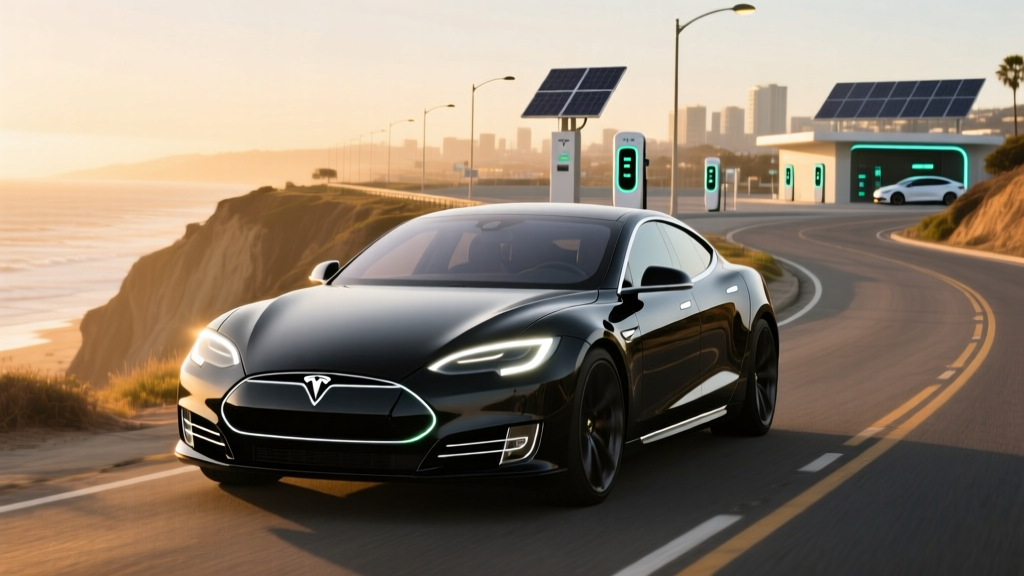
The Tesla Model S Plaid sits in a category of one: a four-door sedan that hits 60 mph in under two seconds while offering over 350 miles of range. But for buyers researching Model S Plaid mileage, the headline EPA sticker number only tells part of the story. Tri-motor performance sedans consume energy differently than efficiency-tuned EVs, and real-world driving — especially at highway speeds or in cold climates — shifts the equation significantly.
This review dissects the 2026 Tesla Model S Plaid's range, efficiency, charging behavior, and ownership economics with the exact numbers you need to decide whether it fits your driving life.
2026 Tesla Model S Plaid Specifications at a Glance
| Specification | 2026 Tesla Model S Plaid |
|---|---|
| EPA Range | 359 miles |
| Battery (usable) | ~95 kWh (NMC chemistry, ~100 kWh gross) |
| Drivetrain | Tri-Motor AWD |
| Horsepower | 1,020 hp |
| 0–60 mph | 1.99 seconds |
| Top Speed | 200 mph (with Track Package) |
| MPGe (combined) | 116 MPGe |
| Efficiency | 29 kWh/100 mi |
| Max DC Fast Charge | 250 kW (V3 Supercharger) |
| 10–80% DC Charge Time | ~30 minutes |
| Level 2 Charge Rate | 11.5 kW (~41 mi/hr) |
| Cargo Volume | 28 cu ft (rear seats up), 79 cu ft (folded) + 3.1 cu ft frunk |
| Rear Legroom | 35.4 inches |
| Battery Warranty | 8 years / 150,000 miles |
| Base MSRP | $89,990 |
Model S Plaid Mileage: EPA Range vs. Real-World Results
Real-World Highway (70–75 mph, moderate temps): ~280–310 miles
Cold Weather (below 32°F, highway): ~230–260 miles
City / Mixed Commute (mild weather): ~330–350 miles
The 359-mile EPA estimate is impressive for a 1,020-horsepower tri-motor sedan. However, the Model S Plaid's efficiency profile means real-world mileage depends heavily on how and where you drive.
Highway driving is the Plaid's biggest range variable. The tri-motor powertrain and wide 265-section rear tires create more rolling resistance and parasitic drag than a dual-motor Long Range variant. At sustained 75 mph, expect to consume roughly 32–35 kWh/100 mi — meaning a realistic highway range of approximately 280 to 310 miles before you need to stop. According to fueleconomy.gov, the combined efficiency rating sits at 116 MPGe (29 kWh/100 mi), but that blends city and highway cycles.
Cold weather compounds the situation. Lithium-ion batteries lose available capacity in freezing temperatures, and cabin heating draws heavily from the pack. Tesla's heat pump (standard on current Model S) mitigates this compared to older resistive-heater EVs, but you should still budget 25–35% range loss in sustained sub-freezing highway driving. That puts winter highway range in the 230–260 mile corridor.
City and mixed driving is where the Plaid shines. Regenerative braking recovers significant energy in stop-and-go traffic, and the tri-motor system is efficient at lower speeds. Commuters in mild climates routinely report 330+ miles of usable range in everyday mixed use.
For context on how this compares to the broader EV landscape, the Model S Long Range achieves 402 miles EPA with its dual-motor setup — a 43-mile advantage that comes from fewer motors, less weight, and narrower tires.
Charging Speed: DC Fast Charging and Home Level 2
| Charging Level | Power / Rate | Miles Added per Hour | Notes |
|---|---|---|---|
| Level 1 (120V) | ~1.4 kW | ~3–4 mi/hr | Emergency/trickle only |
| Level 2 (240V, 48A) | 11.5 kW | ~41 mi/hr | Full charge in ~9 hours |
| DC Fast (V3 Supercharger) | Peak 250 kW | ~200 mi in 15 min | 10–80% in ~30 minutes |
| DC Fast (V4 Supercharger) | Peak 250 kW (current Plaid cap) | Similar to V3 | Plaid architecture limited to ~250 kW |
The Model S Plaid charges at a peak of 250 kW on Tesla V3 and V4 Superchargers. That's a strong rate, though it trails the 350 kW peak of some 800V-architecture competitors like the Hyundai Ioniq 5 or Porsche Taycan.
Understanding the charge curve: The Plaid sustains its peak ~250 kW rate from roughly 10% to about 35% state of charge (SoC). From there, the rate tapers progressively — dropping to around 150 kW near 50% SoC, and further to 60–80 kW above 70%. This is why the 10–80% time is approximately 30 minutes rather than the theoretical minimum. The final 80–100% stretch is deliberately slow to protect battery health.
For home Level 2 charging, the Plaid accepts up to 11.5 kW using a Tesla Wall Connector on a 60-amp circuit (48 amps continuous). That translates to roughly 41 miles of range per hour of charging, or a full 0–100% session in about 9 hours. Most owners who charge overnight will start each morning with a full battery — effectively eliminating daily range concerns.
Preconditioning matters. If you navigate to a Supercharger using the car's built-in navigation, the Model S Plaid will automatically warm the battery to optimal charging temperature before you arrive. Skipping this step (e.g., driving to a charger without using Tesla nav) can add 5–10 minutes to your session, especially in cold weather, because the battery must warm before accepting peak power.
Performance: 1,020 HP and a 1.99-Second 0–60
There is no polite way to describe the Model S Plaid's acceleration: it is violent. The tri-motor setup — one motor on the front axle, two on the rear — produces a combined 1,020 horsepower and delivers it with zero lag. The official 1.99-second 0–60 mph time requires a prepared surface and launch mode engaged, but even in everyday "Sport" mode, the Plaid dispatches 0–60 in roughly 2.5 seconds.
Power delivery is managed through torque vectoring across all three motors, giving the Plaid remarkable corner-exit grip for a 4,766-pound sedan. The carbon-sleeved rotors in the rear motors allow them to spin at up to 20,000+ RPM without expanding and contacting the stator — an engineering detail that enables both the extreme power and sustained high-speed performance.
The Track Package (a ~$15,000 option) adds carbon-ceramic brakes, track-tuned suspension, and raises the top speed from 175 mph to 200 mph. Without it, the Plaid is still blisteringly fast but better suited to grand-touring than sustained track abuse.
For comparison, the closest performance competitor — the Porsche Taycan Turbo GT — produces up to 1,019 hp with Launch Control and hits 60 mph in 2.1 seconds, but starts at over $185,000 with substantially less range.
Pricing, Trims, and Federal Tax Credit Eligibility
| Item | Amount |
|---|---|
| Base MSRP (Model S Plaid) | $89,990 |
| Destination Fee | $1,995 |
| FSD (Supervised) Option | $8,000 |
| Track Package | ~$15,000 |
| Typical As-Tested Price | $95,000–$115,000 |
| Federal Tax Credit (§30D) | $0 — exceeds MSRP cap |
The 2026 Model S Plaid starts at $89,990 before destination and options. That positions it in ultra-premium territory, competing with the Porsche Taycan, Lucid Air, and Mercedes-AMG EQS.
Federal tax credit: The Model S Plaid does not qualify for the $7,500 IRS §30D federal EV tax credit. Under current rules, sedans must have an MSRP at or below $55,000 to be eligible. At nearly $90,000, the Plaid exceeds this cap by a wide margin. The same applies to all Model S trims. For full details on income caps, MSRP limits, and battery sourcing requirements, consult the IRS clean vehicle credits page.
Some states offer additional incentives that are not MSRP-capped (California's Clean Fuel Reward, for example, has been discontinued, but certain utility rebates may apply). Always check your local utility and state energy office for current programs.
Interior, Cargo, and Technology
The Model S interior blends minimalist design with genuine practicality. The 17-inch center touchscreen runs Tesla's latest software and handles everything from climate control to gaming (a PlayStation 5-level GPU is built in). A secondary 8-inch screen serves rear-seat passengers for climate and entertainment.
Cargo space is a Model S advantage over many EV sedans: 28 cubic feet behind the rear seats, expanding to 79 cu ft with the 60/40 split folded. The rear hatch (not a traditional trunk lid) makes loading bulky items easy. The front trunk (frunk) adds 3.1 cu ft — enough for a charging cable bag or small groceries.
Rear legroom measures 35.4 inches — adequate for adults but tighter than a Lucid Air (37.4 inches) or Mercedes EQS (42.1 inches). The floor-mounted battery does create a slightly elevated seating position in the rear, which some passengers notice on longer trips.
Autopilot and FSD (Supervised): Every Model S ships with basic Autopilot (traffic-aware cruise control and lane centering). Tesla's FSD (Supervised) remains a SAE Level 2 driver-assistance system — the driver must remain fully engaged, hands on or near the wheel, and eyes on the road at all times. FSD Supervised can navigate highway interchanges, handle city intersections, and manage parking maneuvers, but it is not autonomous driving. Tesla's camera-only approach (no lidar or radar) continues to draw debate regarding edge-case handling in heavy rain or construction zones.
Pros
- 359-mile EPA range is exceptional for a 1,000+ hp vehicle
- Tri-motor AWD provides unmatched traction and torque vectoring
- Access to the Tesla Supercharger network (17,000+ stalls in North America)
- Hatchback cargo versatility with 79 cu ft maximum space
- Over-the-air updates continuously add features
- Strong resale value relative to luxury EV competitors
Cons
- $89,990+ price with no federal tax credit eligibility
- 250 kW peak charge rate trails 800V competitors (350 kW capable)
- Highway range drops significantly at 75+ mph
- Rear legroom tighter than Lucid Air and Mercedes EQS
- Minimalist interior lacks physical controls some drivers prefer
- FSD (Supervised) requires constant driver attention despite the name
Battery Chemistry, Degradation, and Warranty
The Model S Plaid uses an NMC (nickel manganese cobalt) battery pack with approximately 100 kWh gross capacity (~95 kWh usable). Tesla does not publish exact pack chemistry details for each model year, but the Plaid's energy density requirements and performance demands make NMC the clear choice over LFP (lithium iron phosphate), which is heavier and less energy-dense.
NMC vs. LFP trade-offs: NMC offers superior energy density (more range in a lighter pack) and better cold-weather performance, but it degrades slightly faster over thousands of cycles and is more sensitive to sustained 100% SoC storage. Tesla recommends daily charging to 80–90% for NMC packs and reserving 100% charges for road trips.
Battery warranty: Tesla covers the Model S Plaid battery and drive unit for 8 years or 150,000 miles, whichever comes first, with a minimum 70% capacity retention guarantee. Real-world data from high-mileage Model S owners suggests degradation of roughly 10–12% over the first 100,000 miles, with the curve flattening significantly after that. A full battery replacement out of warranty currently runs approximately $20,000–$25,000 at Tesla service centers.
Who Should Buy the Model S Plaid?
- You want hypercar acceleration with four-door practicality and 350+ mile range
- You regularly drive in regions with Supercharger coverage for road trips
- You value OTA software updates and a mature EV charging ecosystem
- You need hatchback cargo versatility for gear, groceries, or family hauls
- Budget is not the primary constraint ($90K+ with no federal credit)
- You prioritize maximum range over performance (Model S Long Range: 402 mi)
- Rear-seat comfort for tall adults is critical (consider Lucid Air or EQS)
- You want 350 kW DC fast charging (Porsche Taycan, Hyundai Ioniq 5 N)
- You need federal tax credit eligibility (MSRP must be ≤$55,000 for sedans)
Frequently Asked Questions
What is the real-world range of the Tesla Model S Plaid?
The EPA rates the Model S Plaid at 359 miles. In real-world highway driving at 70–75 mph in moderate temperatures, expect 280–310 miles. In freezing weather, highway range can drop to 230–260 miles. City and mixed commuting in mild weather yields the best results, often 330+ miles.
How fast does the Model S Plaid charge at home and on the road?
On a Tesla V3 Supercharger, the Plaid peaks at 250 kW and charges from 10–80% in approximately 30 minutes. At home on a Level 2 Wall Connector (11.5 kW), it adds about 41 miles of range per hour, fully recharging overnight in roughly 9 hours.
Does the Tesla Model S Plaid qualify for the federal EV tax credit?
No. Under current IRS §30D rules, sedans must have an MSRP of $55,000 or less to qualify. The Model S Plaid starts at $89,990, well above the cap. Buyer income limits and battery sourcing requirements also apply to eligible vehicles. Consult the IRS website for the latest rules.
Is the Model S Plaid worth it vs. the Lucid Air Sapphire or Porsche Taycan Turbo GT?
The Plaid offers the best balance of range (359 mi), performance (1.99s 0–60), and price ($89,990) among ultra-performance EV sedans. The Lucid Air Sapphire (1,234 hp, $249,000) is more powerful but nearly triple the price. The Porsche Taycan Turbo GT (~$185,000) handles better on track but delivers roughly 270 miles of range. For most buyers seeking extreme performance with daily usability, the Plaid remains the value leader in this rarefied segment.
What is the MPGe and efficiency of the Model S Plaid?
The EPA rates the Plaid at 116 MPGe combined, which translates to approximately 29 kWh per 100 miles. Real-world highway efficiency is typically 32–35 kWh/100 mi, depending on speed and temperature. At the national average electricity rate of ~$0.17/kWh, that's roughly $5.50–$6.00 per 100 miles of highway driving — still dramatically cheaper than a comparable gas-powered performance sedan.
How long will the Model S Plaid battery last?
Tesla warranties the battery for 8 years or 150,000 miles with at least 70% capacity retention. Based on fleet data, NMC packs in Tesla vehicles typically lose 10–12% capacity over the first 100,000 miles, then degrade more slowly. Many Model S vehicles have exceeded 200,000 miles on the original pack with 80%+ capacity remaining. Charging habits (avoiding frequent 100% charges, using preconditioning) significantly influence longevity.