The Tesla Model S Plaid doesn't just move the goalposts for electric sedans — it redefines what a four-door family car can do on a racetrack. With a claimed top speed of 200 mph (when equipped with the optional Track Pack) and a 0-60 mph time of 1.99 seconds, it remains the quickest production sedan on the planet heading into 2026. But beyond the headline-grabbing max speed, the Model S Plaid is also a daily-drivable luxury EV with over 390 miles of EPA-rated range, access to the largest fast-charging network in North America, and a tech-forward cabin anchored by a 17-inch touchscreen.
This review breaks down every number that matters: real-world range expectations at highway speeds, charging curve behavior at V4 Superchargers, the nuances of federal tax credit eligibility, and whether the Plaid's $89,990 starting price makes sense against rivals like the Lucid Air Sapphire and Porsche Taycan Turbo GT. If you've been searching for the real story behind the Tesla Model S max speed and whether it translates to everyday ownership, you're in the right place.
Tesla Model S Plaid: 2026 Spec Snapshot
| Spec | Value |
|---|---|
| Max Speed (Track Pack) | 200 mph |
| Max Speed (Standard) | 175 mph |
| 0-60 mph | 1.99 seconds |
| Horsepower | 1,020 hp (tri-motor AWD) |
| EPA Range | 396 miles (19" wheels) |
| Battery Capacity | ~100 kWh usable (NMC) |
| Max DC Fast Charge | 250 kW (V3) / ~320 kW (V4, peak) |
| 10-80% DC Charge Time | ~27 minutes |
| Level 2 Home Charge Rate | 11.5 kW (~34 mi/hr) |
| MPGe (Combined) | 116 MPGe |
| Efficiency | 29 kWh/100 mi |
| Cargo Volume | 28 cu ft (rear) + 3.1 cu ft (frunk) |
| Base MSRP | $89,990 |
| Battery Warranty | 8 years / 150,000 miles |
How Fast Is the Tesla Model S Plaid Really?
The max speed of the Tesla Model S Plaid depends on how you configure it. In standard trim, Tesla electronically limits the car to 175 mph. Option the $8,000 Track Package — which adds carbon-ceramic brake rotors, specific 21-inch arachnid wheels with Michelin Pilot Sport 4S tires, and enhanced cooling — and the limiter rises to 200 mph. That makes the Model S Plaid one of the fastest four-door sedans ever produced, regardless of powertrain.
The tri-motor all-wheel-drive powertrain features one front motor and two rear motors, producing a combined 1,020 horsepower and 1,050 lb-ft of torque. Tesla's carbon-sleeved rotors in the rear motors allow them to spin past 20,000 RPM without disintegrating from centrifugal force — a critical engineering detail that enables sustained high-speed runs without power tapering.
The 1.99-second 0-60 mph time is achieved under specific conditions: a prepped surface (high-tracktion asphalt or drag strip), launch mode enabled, and a full state of charge. On a typical public road with standard asphalt, expect roughly 2.2 to 2.4 seconds — still devastatingly quick and well ahead of any combustion-engine competitor in this price range.
Real-World Range: What to Actually Expect
EPA Rating: 396 miles (with 19-inch Tempest wheels) / 359 miles (21-inch Arachnid wheels)
Highway driving (70-75 mph): Expect ~310-330 miles on 19" wheels. Aerodynamic drag rises exponentially at speed, and the Plaid's wide rear tires add rolling resistance.
Cold weather (below 32°F): Range drops 15-25% depending on cabin heating demands. A 396-mile EPA car may deliver 280-320 miles in freezing conditions on the highway.
Track use: Sustained high-speed or aggressive driving can cut range by 50% or more. Plan Supercharger stops accordingly.
Charging Speed: V3 Superchargers, V4 Architecture, and Home Setup
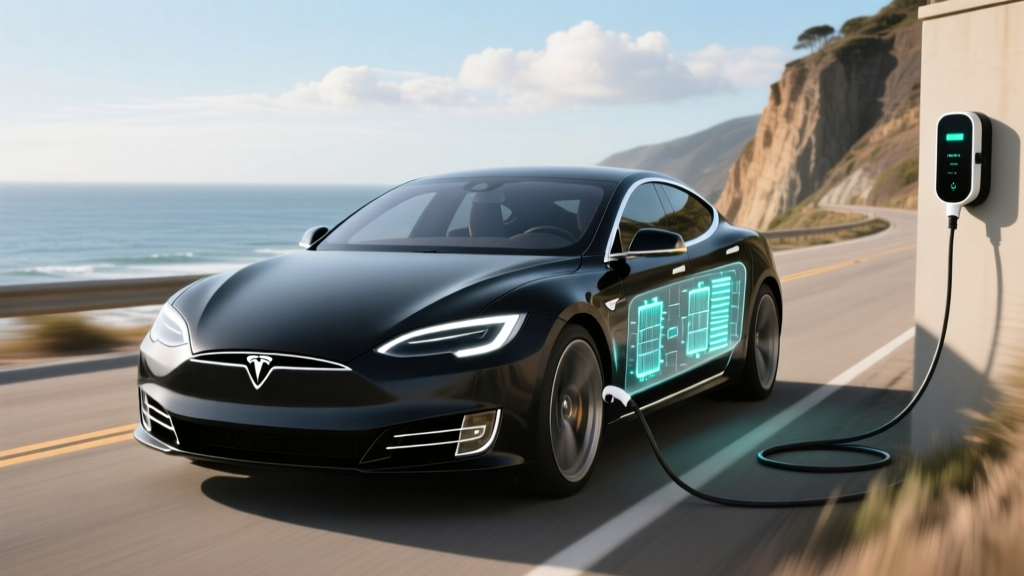
The Model S Plaid uses Tesla's proprietary NACS (North American Charging Standard) connector natively — no adapter required at Superchargers. On V3 Superchargers (the most common in Tesla's network), the Plaid peaks at 250 kW. On newer V4 Supercharger cabinets with CCS-compliant internal architecture, Tesla has demonstrated peak rates approaching 320 kW in compatible vehicles, though sustained rates depend heavily on battery temperature and state of charge.
Charging Speeds at a Glance
| Charging Level | Power | Speed / Time |
|---|---|---|
| Level 1 (120V household) | ~1.4 kW | ~4 miles per hour |
| Level 2 (240V Wall Connector) | 11.5 kW | ~34 miles per hour |
| DC Fast (V3 Supercharger) | 250 kW peak | 10-80% in ~27 min; ~200 mi in 15 min |
| DC Fast (V4 Supercharger) | ~320 kW peak | 10-80% in ~22 min (optimal conditions) |
| DC Fast (Third-party CCS w/ adapter) | Varies (50-350 kW) | Depends on station; NACS-to-CCS adapter sold by Tesla |
Charging curve reality check: The Plaid's NMC battery peaks at its maximum charge rate only between roughly 10-30% state of charge. Above 50%, the rate tapers significantly, and above 80%, charging slows dramatically to protect battery longevity. This is standard behavior for all lithium-ion packs, but it means that the last 20% of a charging session can take as long as the first 70%. For road trips, plan to charge from 10-80% and move on rather than waiting for a full battery.
At home, the Tesla Wall Connector delivers up to 11.5 kW on a 60-amp circuit (48 amps continuous). That translates to roughly 34 miles of range per hour of charging, meaning a full overnight charge (10 hours) can add ~340 miles — more than enough for most daily needs. Installation typically requires a 240V/60A dedicated circuit; budget $500-$2,000 for a licensed electrician depending on your panel's proximity to the parking spot and whether a panel upgrade is needed.
Interior, Cargo, and Tech: Luxury Meets Minimalism
The Model S cabin in 2026 continues Tesla's minimalist philosophy: a 17-inch center touchscreen (now with a faster AMD Ryzen processor), a 12.3-inch driver instrument cluster, and a rear-seat 8-inch display for climate and media controls. The yoke steering wheel remains standard, with a conventional round wheel available as a no-cost option — a welcome change after years of yoke-only availability.
Passenger space: Front legroom measures 42.7 inches; rear legroom is 35.4 inches. The rear seat comfortably fits two adults on longer trips, though the center position is best reserved for a child due to the transmission tunnel hump (used for wiring and cooling).
Cargo capacity: 28 cubic feet behind the rear seats expands to roughly 50 cubic feet with the 60/40 split rear seats folded. The front trunk (frunk) adds 3.1 cubic feet — enough for a laptop bag or charging cables. These figures are competitive with midsize luxury sedans but fall short of hatchback rivals like the Tesla Model X or Lucid Air (which offers a deeper trunk).
Standout tech features:
- Autopilot (standard): SAE Level 2 driver assist with adaptive cruise, lane centering, and automatic emergency braking. The driver must keep hands on the wheel and eyes on the road at all times.
- Full Self-Driving (Supervised): An $8,000 option (or $99/month subscription) that adds automatic lane changes, navigation-guided on/off-ramp maneuvers, and traffic-light recognition. Despite the name, FSD remains SAE Level 2 — not autonomous driving.
- Over-the-air updates: Tesla regularly pushes software updates that add features, improve efficiency, and refine the UI — a genuine advantage over legacy automakers.
- Sentry Mode and Dashcam: Continuous recording via the car's external cameras provides security and incident documentation.
- Gaming: The infotainment system supports Steam-integrated gaming while parked, leveraging the Ryzen chip for console-quality titles.
Notable drawbacks: Build quality, while improved since 2022, still shows occasional panel-gap inconsistencies. The lack of physical buttons for climate and wipers can be distracting. There is no Apple CarPlay or Android Auto — everything runs through Tesla's proprietary OS. And the yoke steering, even with the round-wheel option now available, remains polarizing for daily commuting.
Pricing, Trim Levels, and Federal Tax Credit Eligibility
For 2026, the Tesla Model S is available in two trims:
| Trim | Base MSRP | As-Tested (Typical Options) | Federal §30D Credit Eligible? |
|---|---|---|---|
| Model S (Dual-Motor AWD) | $74,990 | $78,000-$82,000 | No — exceeds $55,000 sedan MSRP cap |
| Model S Plaid (Tri-Motor AWD) | $89,990 | $95,000-$102,000 | No — exceeds $55,000 sedan MSRP cap |
Federal tax credit reality: Under current IRS §30D rules, new electric sedans must have an MSRP at or below $55,000 to qualify for the up-to-$7,500 federal tax credit. The Model S, at $74,990 and above, far exceeds this cap. Additionally, buyer income limits apply ($150,000 single / $300,000 joint MAGI), and battery critical-mineral and component sourcing requirements must be met. In short, no Model S variant qualifies for the new-vehicle federal credit.
Buyers may still benefit from state-level incentives (which vary widely — check your state's energy office or the Alternative Fuels Data Center for a state-by-state lookup), utility rebates for home charger installation, and HOV lane access in states like California.
Efficiency, Warranty, and Ownership Costs
The Model S Plaid returns an EPA-rated 116 MPGe combined (124 city / 109 highway) or roughly 29 kWh per 100 miles. For context, that's slightly less efficient than the dual-motor Model S (122 MPGe combined) due to the Plaid's wider tires, additional rear motor weight, and more aggressive performance tuning. At the national average electricity rate of ~$0.17/kWh, driving 100 miles costs approximately $4.93 — a fraction of the $14-$18 that a comparable 600-hp gasoline sedan would require.
Warranty coverage:
- Battery & Drive Unit: 8 years / 150,000 miles, whichever comes first, with minimum 70% capacity retention guaranteed over that period.
- Vehicle Limited Warranty: 4 years / 50,000 miles bumper-to-bumper.
The 150,000-mile battery warranty is generous by industry standards, though it's worth noting that Tesla's NMC chemistry typically degrades 10-15% over the first 100,000 miles based on aggregated fleet data. Proper care — avoiding frequent DC fast charging to 100%, keeping the battery between 20-80% for daily use, and preconditioning before Supercharging — can minimize degradation. Replacement cost for a Model S battery pack out of warranty has historically ranged from $12,000 to $20,000 depending on the service center and whether a refurbished pack is available.
Model S Plaid vs. the Competition
The Plaid's closest rivals in 2026 include the Lucid Air Sapphire (1,234 hp, $249,000, EPA 427 miles) and the Porsche Taycan Turbo GT (1,019 hp, $230,000, EPA 269 miles). The Sapphire is quicker to 60 (under 2.0 seconds) and has superior range, but costs nearly three times as much. The Taycan Turbo GT offers sharper handling dynamics and Porsche build quality but sacrifices over 100 miles of range and costs more than double.
Against these exotics, the Model S Plaid's value proposition becomes clear: 1,020 hp, 396 miles of range, and 200 mph capability for under $100,000 is a package no competitor matches on price. The trade-offs are Tesla's inconsistent build quality, the absence of Apple CarPlay, and a service network that, while expanding, still trails legacy luxury brands in physical locations.
Pros
- 200 mph max speed and 1.99s 0-60 are supercar-tier numbers in a sedan
- 396-mile EPA range covers most road trips with a single Supercharger stop
- Access to 6,000+ Tesla Supercharger stalls across North America
- Over-the-air updates continuously improve the vehicle post-purchase
- Undercut rivals by $100,000+ on price while matching or exceeding performance
Cons
- No federal tax credit due to $55,000 sedan MSRP cap
- Build quality and panel gaps still trail German and Lucid competitors
- No Apple CarPlay or Android Auto integration
- Yoke steering polarizing; round wheel now optional but not default
- Track Pack required for 200 mph adds $8,000 and reduces range to 359 mi
Who Should Buy the Tesla Model S Plaid?
Choose the Model S Plaid if: You want the ultimate blend of daily-drivable range (396 mi), family-sedan practicality (28 cu ft cargo, 5 seats), and supercar-level acceleration — all for under $100,000. Ideal for tech-savvy enthusiasts who road-trip regularly and value access to Tesla's Supercharger network.
Look elsewhere if: You prioritize build quality and dealership service (consider Porsche Taycan), you need maximum range above all else (Lucid Air Grand Touring offers 516 mi), or your budget is tighter (the dual-motor Model S at $74,990 delivers 405 mi of range and a still-rapid 3.1-second 0-60).
Frequently Asked Questions
What is the real-world range of the Tesla Model S Plaid?
The EPA rates the Model S Plaid at 396 miles on 19-inch wheels and 359 miles on 21-inch wheels. In real-world highway driving at 70-75 mph, expect 310-330 miles. In freezing temperatures, that can drop to 280-320 miles. Track use reduces range far more dramatically.
How fast does the Model S Plaid charge at home and on the road?
At home on a Level 2 Tesla Wall Connector (11.5 kW), the Plaid adds about 34 miles of range per hour, fully charging overnight. On V3 Superchargers, it peaks at 250 kW and charges from 10-80% in roughly 27 minutes. V4 Superchargers can push peak rates to ~320 kW, shaving a few minutes off that time.
Does the Tesla Model S Plaid qualify for the $7,500 federal EV tax credit?
No. Under IRS §30D rules, new sedans must have an MSRP of $55,000 or less to qualify. The Model S starts at $74,990 and the Plaid at $89,990, well above the cap. State incentives may still apply — check the Alternative Fuels Data Center for details in your state.
Is the Model S Plaid worth it vs. the Lucid Air Sapphire or Porsche Taycan Turbo GT?
On pure value, yes — the Plaid delivers comparable or superior performance to the Sapphire and Turbo GT at one-third to one-half the price. However, the Lucid offers better build quality and more range, and the Porsche offers superior handling precision and dealer service. Your priorities determine the winner.
What is the Tesla Model S Plaid's max speed without the Track Pack?
Without the $8,000 Track Package, the Model S Plaid is electronically limited to 175 mph. The Track Pack adds carbon-ceramic brakes, specific wheels and tires, and enhanced cooling to raise the limiter to 200 mph.
How long will the Model S Plaid battery last?
Tesla warranties the battery for 8 years or 150,000 miles with at least 70% capacity retention. Real-world fleet data suggests NMC packs in the Model S typically lose 10-15% capacity over 100,000 miles. With proper charging habits, the battery should remain functional well beyond 200,000 miles, though at reduced range.
Sources: EPA Fueleconomy.gov — Tesla Model S, Tesla Model S Official Specs, IRS §30D Clean Vehicle Credit Rules.