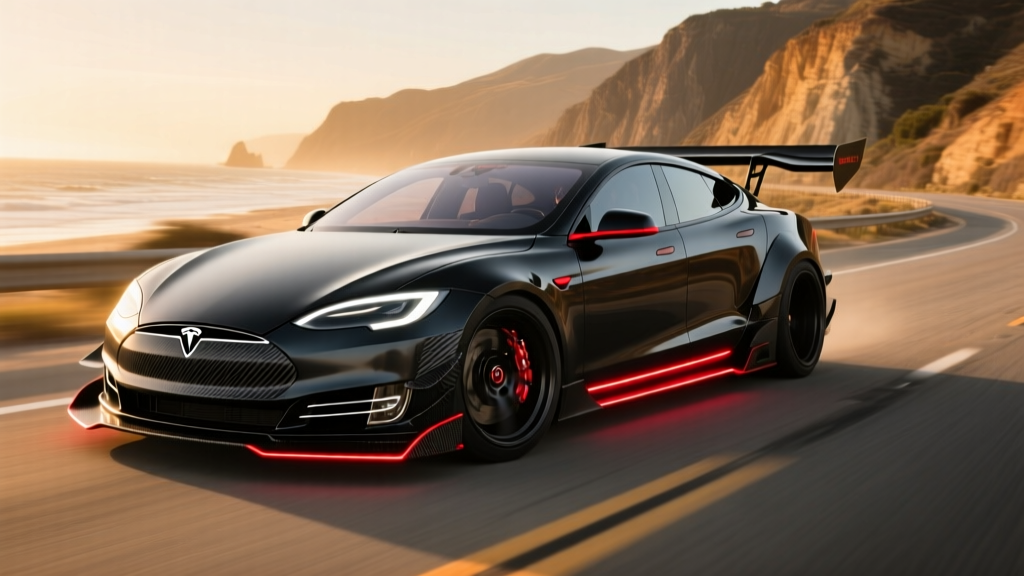
If you have spent any time in Tesla forums or watching drag-strip videos, you have probably heard the term Tesla Mad Max Mode. It is not an official Tesla software setting — you will not find it in the vehicle's touchscreen menu. Instead, it is the enthusiast-community nickname for the Model S Plaid's launch configuration: a combination of Drag Strip mode, full battery preconditioning, and the Plaid tri-motor powertrain's unfiltered 1,020-horsepower output. The result is a production sedan that Tesla claims can hit 0-60 mph in 1.99 seconds (with rollout subtracted) — a figure that, just a few years ago, belonged exclusively to seven-figure hypercars.
But the Model S Plaid is more than a straight-line party trick. For 2026, it remains the flagship of Tesla's sedan lineup, offering over 400 miles of EPA-estimated range, access to the Supercharger network (now with NACS-native hardware), and a tech-forward interior centered on a 17-inch cinematic display and a yoke steering wheel. This review covers everything a prospective buyer needs to know — from the real-world range and charging speeds to tax-credit eligibility and whether the Plaid still makes sense against rising competition from the Lucid Air, Porsche Taycan, and BMW i7.
2026 Tesla Model S Plaid: Core Specifications
| Attribute | Value |
|---|---|
| EPA Range | 396 miles (Long Range AWD) / 359 miles (Plaid) |
| Battery Capacity | ~100 kWh usable (NMC chemistry) |
| Drivetrain | Tri-Motor AWD (1 front, 2 rear carbon-sleeved rotors) |
| Horsepower | 1,020 hp (Plaid) / 670 hp (Long Range) |
| 0-60 mph | 1.99 sec (Plaid, w/ rollout) / 3.1 sec (Long Range) |
| Top Speed | 200 mph (Plaid, with track package) |
| Max DC Fast Charge | 250 kW (V3 Supercharger) |
| 10-80% DCFC Time | ~30 minutes |
| Level 2 Home Charge Rate | 11.5 kW / 44 mi/hr (48A Wall Connector) |
| Efficiency (Plaid) | 116 MPGe combined / 29 kWh/100 mi |
| Cargo Volume | 28 cu ft (rear seats up) + frunk |
| Base MSRP (Plaid) | $89,990 (before incentives) |
| Battery Warranty | 8 years / 150,000 miles (70% min retention) |
What Is 'Mad Max Mode' — and How Do You Activate It?
Tesla Mad Max Mode is not a standalone button or software toggle. It is the community shorthand for the specific sequence required to extract the Plaid's maximum launch performance. Here is what it entails:
- Drag Strip Mode: Accessed through the vehicle's Performance menu on the touchscreen. This preconditions the battery to its optimal temperature window (typically 40-50°C at the cell level) and adjusts the thermal management system to prioritize power delivery over cabin comfort.
- State of Charge: The battery must be above 95% SoC for full power availability. Below roughly 80% SoC, peak output tapers — a characteristic of all lithium-ion cells, not just Tesla's.
- Launch Sequence: With the vehicle stationary, brake pedal held firmly, and accelerator pressed to the floor, the system builds torque against the brakes. Releasing the brake engages all three motors simultaneously with traction-control calibration optimized for maximum grip.
- Surface & Tires: Tesla's published 1.99-second time assumes a prepped drag-strip surface and warm Michelin Pilot Sport 4S tires. On a public road or cold pavement, expect 2.3-2.5 seconds — still extraordinary, but measurably different.
The name "Mad Max" likely stems from the visceral, almost violent acceleration — combined with the futuristic, stripped-down interior aesthetic of the refreshed Model S. It is worth noting that repeated full-power launches generate enormous heat in the battery and drive units. Tesla's thermal management will eventually limit consecutive runs to protect hardware longevity.
Range and Efficiency: EPA vs. Real World
The Plaid's tri-motor setup adds weight and mechanical complexity compared to the dual-motor Long Range variant, which accounts for the ~37-mile EPA gap between trims. Efficiency for the Plaid sits at approximately 29 kWh per 100 miles (combined), which translates to roughly 3.4 miles per kWh. That is competitive with other large performance sedans but trails the Lucid Air Grand Touring's class-leading 4.0+ mi/kWh.
For daily commuting with home charging, the Plaid's range is more than sufficient — most owners will charge once or twice per week. For road trips, the combination of 359 miles of range and 250 kW Supercharger access means stops of roughly 25-30 minutes to reach 80% SoC, which aligns with typical rest-stop timing.
Charging Speed: DC Fast Charge and Home Level 2
| Charging Level | Power / Rate | Speed (Miles Added) | Notes |
|---|---|---|---|
| Level 1 (120V) | ~1.4 kW | ~4 mi/hr | Emergency/trickle only |
| Level 2 (240V, 48A) | 11.5 kW | ~44 mi/hr | Tesla Wall Connector; full overnight charge in ~9 hrs |
| DC Fast (V3 Supercharger) | 250 kW peak | ~200 mi in 15 min | 10-80% in ~30 min; tapers significantly above 80% |
| DC Fast (CCS adapter) | Up to 250 kW | Varies by station | Non-Tesla networks (Electrify America, EVgo) |
The Model S Plaid uses the NACS (North American Charging Standard) connector natively. Since Tesla opened the Supercharger network to other brands, the NACS ecosystem has expanded rapidly, but Model S owners benefit from seamless plug-and-charge integration with no adapter required at Tesla stalls.
Charging curve reality: The 250 kW peak rate is available only between approximately 10-30% SoC at an optimal battery temperature. From 30-60%, the rate tapers to roughly 175-200 kW. Above 80%, expect a steep taper to under 50 kW as the battery management system protects cell longevity. This is standard lithium-ion behavior — peak kW numbers on spec sheets never represent sustained rates across the full session.
For home charging, Tesla's Gen 2 Wall Connector at 48 amps (11.5 kW on a 240V/60A circuit) adds approximately 44 miles of range per hour. A full charge from 10% to 100% takes roughly 9 hours — easily achievable overnight. Installation typically requires a dedicated 60-amp circuit; if your electrical panel lacks capacity, a panel upgrade (averaging $1,500-$3,000) may be necessary. Always consult a licensed electrician for final installation specifications.
Performance: Beyond the 1.99-Second Headline
The Plaid's tri-motor architecture uses one permanent-magnet motor on the front axle and two induction-type carbon-sleeved rotor motors on the rear axle. The carbon sleeves allow the rotors to spin at extremely high RPM without expanding and contacting the stator — a critical engineering solution that enables sustained high-speed power delivery. Tesla rates the system at 1,020 horsepower and the vehicle's top speed at 200 mph (when equipped with the optional Track Package, which includes specific wheels, tires, and brake hardware).
Quarter-mile times fall in the 9.2-9.4 second range at approximately 150-152 mph trap speed, verified by multiple independent tests. For context, this places the $90,000 Model S Plaid in the territory of the Bugatti Chiron and Rimac Nevera in straight-line acceleration — vehicles costing 20 to 30 times as much.
However, the Plaid is not a track-focused sports car. On a road course, its 4,766-pound curb weight and comfort-oriented suspension tuning become apparent. The Porsche Taycan Turbo S and Lucid Air Sapphire offer sharper handling dynamics for buyers who prioritize cornering over drag-strip supremacy. The Plaid excels as a grand-touring sedan that happens to have hypercar acceleration — a duality that defines its character.
Interior, Tech, and Cargo
The refreshed Model S interior features a 17-inch center touchscreen (2200x1300 resolution), a 12.3-inch driver instrument cluster, and a rear-seat 8-inch touchscreen for climate and entertainment controls. The yoke steering wheel is standard (a conventional round wheel is available as a no-cost option). Build quality on the 2026 model has improved noticeably over early 2021-2022 Plaid deliveries, with more consistent panel gaps and upgraded materials.
Cargo capacity: 28 cubic feet behind the rear seats (seats fold 60/40), plus a front trunk (frunk) adding approximately 3-4 cubic feet. Passenger space includes 42.1 inches of front legroom and 35.4 inches of rear legroom — adequate for adults on shorter trips, though the sloping roofline limits rear headroom for taller passengers.
Driver assistance: The Model S ships with Tesla's Basic Autopilot (adaptive cruise control, lane centering, automatic emergency braking). Full Self-Driving (Supervised) is an $8,000 option or available via monthly subscription. FSD (Supervised) remains an SAE Level 2 system — the driver must remain fully engaged, hands on the yoke/wheel, and eyes on the road at all times. It is not autonomous driving. Tesla's naming convention has drawn scrutiny from the NHTSA and consumer-advocacy groups; treat it as an advanced driver-assist system, not a self-driving solution.
Pricing, Trims, and Federal Tax Credit Eligibility
| Trim | Base MSRP | As-Tested (Typical Options) | Federal §30D Credit |
|---|---|---|---|
| Model S Long Range AWD | $74,990 | $78,000-$82,000 | Eligibility varies — see below |
| Model S Plaid | $89,990 | $93,000-$105,000 | Eligibility varies — see below |
Federal tax credit (§30D) specifics: The Model S qualifies for the federal EV tax credit of up to $7,500, but eligibility depends on several factors that change annually. As of 2026, key requirements per the IRS clean vehicle credit guidelines include:
- MSRP Cap: Sedans must have an MSRP at or below $55,000. The Model S exceeds this cap at both trim levels, which means new Model S vehicles do NOT qualify for the $7,500 new-vehicle credit.
- Used EV Credit: If you purchase a pre-owned Model S (model year 2024 or earlier, priced under $25,000), you may qualify for up to $4,000 under the used-clean-vehicle provision — subject to buyer income caps ($75,000 single / $150,000 joint).
- Lease Loophole: Some lessors pass through the $7,500 commercial clean-vehicle credit as a lease incentive. This is less common for the Model S than for lower-priced EVs, but worth investigating with Tesla Financial Services.
- Income Caps (new vehicle): Even if the MSRP qualified, buyer AGI must not exceed $150,000 (single) / $300,000 (joint). Most Plaid buyers exceed these thresholds.
Bottom line: budget for the full MSRP. The Model S Plaid is a premium performance vehicle, and its pricing reflects that positioning. State and local incentives may apply — check your state's energy office or fueleconomy.gov for current programs.
Pros, Cons, and Competitive Positioning
Pros
- Sub-2-second 0-60 mph (on prepped surface, >95% SoC)
- 359-mile EPA range — among the highest for performance sedans
- Supercharger network access (native NACS, no adapter)
- Over-the-air updates continuously add features
- Class-leading infotainment and software UX
- Spacious trunk + frunk for a performance sedan
- 8-year/150,000-mile battery warranty
Cons
- No federal §30D tax credit (MSRP exceeds $55K cap)
- Yoke steering divisive; round wheel optional but not default
- Track handling lags Porsche Taycan and Lucid Air Sapphire
- 250 kW peak DCFC is slower than 800V rivals (Taycan: 320 kW)
- Rear-seat headroom limited by roofline
- Service-center wait times can be lengthy in some regions
- FSD (Supervised) remains Level 2 despite the name
Warranty and Long-Term Ownership
Tesla provides an 8-year/150,000-mile battery and drive-unit warranty with a minimum 70% capacity retention threshold. The vehicle's basic limited warranty covers 4 years / 50,000 miles. These terms are competitive within the luxury EV segment, though Hyundai's 10-year/100,000-mile powertrain warranty (on the Ioniq 6) offers longer coverage.
Battery degradation data from high-mileage Model S owners (tracked on platforms like TeslaFi) suggests approximately 8-12% capacity loss over the first 100,000 miles for NMC cells, with the curve flattening significantly thereafter. Tesla's NMC chemistry prioritizes energy density and performance over the cycle-life longevity of LFP (lithium iron phosphate) cells — a trade-off appropriate for a performance sedan. For daily charging, Tesla recommends setting the charge limit to 80-90% and only charging to 100% for long trips, which helps preserve long-term cell health.
Frequently Asked Questions
What is the real-world range of the Tesla Model S Plaid?
The EPA estimates 359 miles. In real-world highway driving at 70-75 mph in moderate temperatures, expect 310-330 miles. In cold weather (below 32°F), range drops to approximately 260-290 miles due to battery resistance and heating demands.
How fast does the Model S Plaid charge?
On a V3 Supercharger, the Plaid peaks at 250 kW and charges from 10-80% in approximately 30 minutes. At home on a 48A Level 2 Wall Connector (11.5 kW), it adds roughly 44 miles per hour, with a full charge taking about 9 hours.
Does the Tesla Model S qualify for the federal EV tax credit?
New Model S vehicles do NOT qualify for the $7,500 §30D credit because the MSRP exceeds the $55,000 sedan cap. Used Model S vehicles (under $25,000, model year 2024 or earlier) may qualify for up to $4,000 under the used-vehicle provision, subject to buyer income limits.
Is Tesla Mad Max Mode a real software setting?
No. "Mad Max Mode" is an enthusiast-community nickname for the combination of Drag Strip mode, full battery preconditioning, and >95% SoC required to achieve the Plaid's maximum launch performance. It is not a standalone menu option.
How does the Model S Plaid compare to the Lucid Air Sapphire?
The Lucid Air Sapphire (1,234 hp, 0-60 in ~1.89 sec, 427 mi EPA) exceeds the Plaid in power, range, and handling precision, but starts at $249,000. The Plaid delivers roughly 80% of the Sapphire's performance for approximately one-third the price.
Is Full Self-Driving (Supervised) actually self-driving?
No. FSD (Supervised) is an SAE Level 2 driver-assistance system. The driver must remain fully engaged with hands on the wheel and eyes on the road. It does not make the vehicle autonomous. Only Level 4 services like Waymo operate without driver supervision, and they are limited to specific geofenced areas.
Sources: fueleconomy.gov, Tesla Model S specifications, IRS §30D clean vehicle credit rules.