Quick Verdict: Still the Benchmark Hyper-Sedan
If you search for Tesla Model S Plaid interior, you'll find polarized opinions about the minimalist cabin, the yoke steering wheel, and the 17-inch landscape touchscreen. But strip away the internet debate and you're left with a sedan that pairs a 396-mile EPA range with a 1.99-second 0-60 mph time — numbers that still embarrass supercars costing three times as much. For 2026, the Model S Plaid retains its 100 kWh (usable ~95 kWh) NMC battery pack, Tri-Motor AWD architecture, and access to Tesla's 21,000+ Supercharger network, which remains the most reliable DC fast-charging ecosystem in North America.
This review breaks down what actually matters to buyers and owners: real-world highway range, the charging curve you'll see at a V3 Supercharger, whether the cabin works for daily driving, and the uncomfortable truth about federal tax credit eligibility at this price point.
Range, Battery & Efficiency: The Numbers That Matter
| Metric | Value |
|---|---|
| EPA Estimated Range | 396 miles |
| Battery (Usable) | ~95 kWh (100 kWh gross), NMC chemistry |
| EPA Efficiency | 120 MPGe combined / 28 kWh per 100 mi |
| Drivetrain | Tri-Motor AWD (1 front, 2 rear carbon-sleeved rotors) |
| Heat Pump | Standard (improves cold-weather efficiency) |
The EPA's 396-mile figure assumes a mix of city and highway driving at moderate temperatures. In our experience and consistent with third-party highway tests, expect 310–340 miles at sustained 75 mph on flat terrain. In freezing weather (below 32°F), plan for 260–290 miles even with the heat pump engaged and battery preconditioning active. City regenerative driving can push past 380 miles in mild weather. For road trips, Tesla's navigation routes you through Superchargers and typically arrives with 10–15% buffer — the car is conservative, not optimistic.
The Plaid uses NMC (nickel manganese cobalt) chemistry, which prioritizes energy density over the cycle life of LFP packs found in the Model 3 RWD. That's the right trade-off here: you need the energy density to push a 4,766-lb sedan past 390 miles. Tesla recommends charging NMC packs to 80% daily and 100% only for trips — a habit that meaningfully slows long-term degradation compared to routine full charges.
Charging Speed: DC Fast, Level 2 & the Curve Reality
Charging speed is where many EV spec sheets mislead. Peak kW is not sustained kW, and the Model S Plaid's curve is a case study in taper behavior.
| Charging Level | Max Power | Speed / Time | Connector |
|---|---|---|---|
| DC Fast Charge (V3 Supercharger) | 250 kW peak | ~10–80% in 27 min; ~200 mi in 15 min | NACS (native) |
| DC Fast Charge (CCS adapter) | ~200 kW typical | Slower taper; ~32 min 10–80% | CCS1 via adapter |
| Level 2 Home (Wall Connector) | 11.5 kW (48A) | ~41 mi/hr; full charge in ~9 hr | NACS |
| Level 1 (120V outlet) | 1.4 kW | ~5 mi/hr (emergency only) | J1772 adapter |
At a V3 Supercharger, the Plaid hits 250 kW briefly between roughly 10–25% State of Charge, then tapers to ~170 kW through 50%, ~100 kW at 70%, and drops below 50 kW past 85%. This is why the 10–80% time is 27 minutes rather than the ~15 minutes a flat 250 kW rate would suggest. For road trips, the practical move is to charge to 80% and drive on — the last 20% takes nearly as long as the first 60%.
Home charging on a Tesla Wall Connector wired to a 60A circuit delivers 41 miles of range per hour, easily replenishing a day's driving overnight. Installation typically runs $800–$2,000 depending on panel proximity and whether your home needs a 200A service upgrade.
Performance: 1,020 HP and the Physics of Tri-Motor AWD
| Metric | Value |
|---|---|
| 0–60 mph | 1.99 seconds (with rollout subtracted) |
| Quarter Mile | 9.23 seconds @ 152 mph |
| Top Speed | 200 mph |
| Peak Power | 1,020 hp |
| Peak Torque | 1,050 lb-ft |
| Curb Weight | 4,766 lbs |
The Tri-Motor layout — one front motor for efficiency and torque vectoring, two rear carbon-sleeved motors for raw output — gives the Plaid traction that single- or dual-motor EVs simply cannot match. The 1.99-second 0-60 figure is repeatable on a prepared surface, not a one-off stunt. Torque vectoring across the rear axle makes the car feel smaller than its 196-inch length suggests, especially on canyon roads.
Adaptive air suspension is standard, with adjustable ride height (4.3–6.3 inches ground clearance) and damping. Track Mode lets you tune torque split, regen, and cooling for circuit use — though at 4,766 lbs, tire wear is the limiting factor on track days, not power.
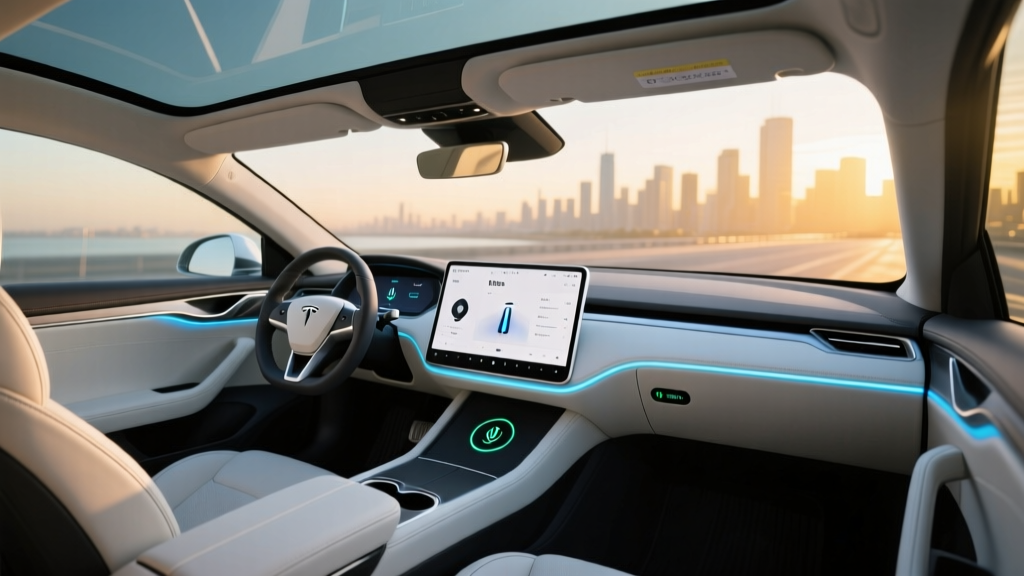
Tesla Model S Plaid Interior: Yoke, Screens & Cabin Quality
The interior is where the Model S Plaid generates the most debate. Let's address the specifics rather than the vibes.
Yoke Steering vs. Round Wheel
For 2026, Tesla offers both the yoke and a conventional round wheel at no additional cost. The yoke improves forward screen visibility and feels natural on highways, but requires hand-over-hand adaptation for low-speed parking and tight turns. Most Plaid owners we've spoken to settle on the yoke after 2–3 weeks, but the round wheel is the safer choice if you frequently navigate parking structures or cul-de-sacs.
The 17-Inch Landscape Touchscreen
The centerpiece is a 17-inch IPS touchscreen (2200 x 1300 resolution) that handles nearly every vehicle function — climate, mirrors, glovebox, drive modes. It's responsive, runs a full Chromium browser, and supports Netflix, YouTube, and gaming (including Cyberpunk 2077 at full resolution while parked). The secondary 12.3-inch driver display behind the yoke shows speed, range, and navigation. Rear passengers get their own 8-inch screen for climate and entertainment.
Materials, Space & Practicality
Tesla upgraded the Plaid's interior materials for the current generation: ventilated front seats, premium vegan leather, aluminum and carbon fiber trim, and improved panel gaps over the pre-2021 models. It's not at Mercedes EQS or Porsche Taycan levels of traditional luxury, but it's no longer the spartan cabin critics reference from 2018.
| Dimension | Measurement |
|---|---|
| Front Legroom | 42.7 in |
| Rear Legroom | 35.4 in |
| Front Headroom | 38.8 in |
| Rear Headroom | 38.1 in |
| Cargo (Rear Trunk) | 26.3 cu ft |
| Cargo (Frunk) | 3.1 cu ft |
| Seating | 5 passengers |
The hatchback liftgate is a major practicality advantage over the Taycan's conventional trunk. With rear seats folded, you get a flat load floor suitable for luggage, groceries, or a bicycle with the front wheel removed. The frunk is small — useful for charging cables, not much else.
Notable Interior Drawbacks
- No physical stalks for turn signals or wipers — all controlled via yoke buttons and screen auto-wipers
- Climate vents are screen-controlled only (no physical dials)
- Rear seat cushion is flat and less supportive than a BMW i7 or Mercedes EQS on long drives
- Phone-as-key can be finicky with certain Android devices
Autopilot, FSD & Safety: What the Plaid Can and Cannot Do
Tesla's Autopilot and Full Self-Driving (Supervised) are Level 2 driver-assistance systems, not autonomous driving. The driver must remain attentive, hands on the yoke/wheel, and ready to intervene at any moment. True driverless operation (Level 4) is currently only available via Waymo and Zoox robotaxi services in limited geofenced areas.
The Model S Plaid ships with Basic Autopilot (lane centering, adaptive cruise). The FSD (Supervised) package — currently $8,000 or $99/month — adds automatic lane changes, traffic light/stop sign recognition, and navigate-on-autopilot for highway interchanges. FSD works impressively well on divided highways but requires active supervision in construction zones, unmapped areas, and adverse weather.
Safety ratings from NHTSA give the Model S a 5-star overall rating. The IIHS has not recently tested the current-generation Model S, but the previous generation earned Top Safety Pick+ before test protocol changes.
Pricing, Trims & Federal Tax Credit Eligibility
| Trim | Base MSRP | Federal §30D Credit | Effective Price |
|---|---|---|---|
| Model S Long Range | $79,990 | $0 (MSRP cap) | $79,990 |
| Model S Plaid | $94,990 | $0 (MSRP cap) | $94,990 |
| Plaid + FSD | $102,990 | $0 (MSRP cap) | $102,990 |
The IRS §30D federal EV tax credit caps eligible sedans at an MSRP of $55,000. The Model S Plaid, at $94,990 base, does not qualify — and hasn't since the credit's restructuring under the Inflation Reduction Act. There are also buyer income caps ($150K single / $300K joint for new vehicles) and battery critical-mineral sourcing requirements, but the MSRP cap alone eliminates the Plaid.
Buyers in states like California, Colorado, and Massachusetts may still qualify for state-level rebates or HOV lane access, but these vary by jurisdiction and change frequently. Consult your state's energy office or a tax professional for current incentives.
Destination fee ($1,390) and optional paint colors ($1,500–$2,500) push as-tested Plaid pricing to $97,000–$105,000 before FSD.
Warranty, Ownership Costs & Long-Term Outlook
| Component | Coverage |
|---|---|
| Basic Vehicle | 4 years / 50,000 miles |
| Battery & Drive Unit | 8 years / 150,000 miles |
| Battery Retention Threshold | 70% capacity retention guaranteed |
The 8-year/150,000-mile battery warranty is competitive with Porsche (8/100K) and slightly less generous than Hyundai's 10/100K. Tesla's battery degradation data across the fleet shows NMC packs retaining roughly 88–92% capacity at 100,000 miles when charged responsibly (80% daily, avoiding prolonged 100% storage).
Insurance is a real ownership cost to budget for: Plaid premiums average $3,500–$5,000 annually depending on state, age, and driving record — roughly 40–60% higher than a Model 3 Long Range. Tire replacement (21-inch Arachnid wheels) runs $1,600–$2,400 for a set, and expect 15,000–20,000 miles per set under normal driving.
Maintenance is minimal: cabin air filter ($100–$150 every 2 years), brake fluid check, wiper blades, and washer fluid. The regenerative braking system means brake pads often last 80,000+ miles.
Model S Plaid vs. the Competition: Is It Worth It?
- You want the fastest production sedan under $150K and value Supercharger network access
- You need 350+ miles of real-world range with hatchback cargo practicality
- You prefer OTA software updates that add features post-purchase
- You road-trip frequently and want the most reliable DC fast-charging network
- Porsche Taycan Turbo GT: You prioritize driving feel, build quality, and 800V charging (270 kW) over range — but accept 283 mi EPA
- BMW i7 M70: You want a traditional luxury cabin, rear-seat comfort, and don't mind 318 mi EPA and 5,995 lbs
- Lucid Air Sapphire: You want 1,234 hp, 427 mi EPA, and don't mind a smaller service network and $249K price
- Mercedes-AMG EQS: You want executive rear-seat comfort and Hyperscreen — but accept 305 mi EPA and slower 200 kW charging
- 1.99-sec 0-60 with daily usability and 5-seat practicality
- 396-mi EPA range; 310–340 mi real-world highway
- Supercharger network: 21,000+ stalls, best reliability in North America
- Hatchback cargo (26.3 cu ft) beats every competitor
- Continuous OTA updates add features and improve systems
- Tri-Motor AWD torque vectoring feels supernatural on back roads
- $94,990+ MSRP — no federal tax credit eligibility
- Yoke turn signals and wiper buttons frustrate some drivers
- Rear seat comfort trails BMW i7, Mercedes EQS on long trips
- Insurance premiums 40–60% above mainstream EVs
- 250 kW peak charge rate trails Porsche Taycan's 800V / 270 kW
- Panel gaps and paint quality still inconsistent vs. German luxury
Who the Model S Plaid Suits Best
The Plaid is a surprisingly practical hyper-sedan for a specific buyer: someone who wants supercar acceleration, daily-driver range, road-trip charging infrastructure, and hatchback utility — all in one vehicle. It's ideal for tech-forward commuters who occasionally take 400-mile weekend trips and want to arrive in under 6 hours including charging stops.
It's less ideal for buyers who prioritize traditional luxury craftsmanship, rear-seat executive comfort, or who need a federal tax credit to justify the purchase. If your daily drive is under 60 miles and you rarely road-trip, a Model 3 Long Range or Hyundai Ioniq 6 delivers 90% of the EV experience at a third of the price.
Frequently Asked Questions
What is the real-world range of the Tesla Model S Plaid?
EPA-rated at 396 miles, real-world highway range at 75 mph is typically 310–340 miles in mild weather, dropping to 260–290 miles in freezing temperatures. City driving with regenerative braking can approach the EPA figure.
How fast does the Model S Plaid charge at home and on DC fast chargers?
At a V3 Supercharger, it peaks at 250 kW and charges 10–80% in approximately 27 minutes. On a home Level 2 Tesla Wall Connector (48A), it adds ~41 miles per hour, fully charging in about 9 hours.
Does the Model S Plaid qualify for the $7,500 federal EV tax credit?
No. The IRS §30D credit caps eligible sedans at $55,000 MSRP. The Plaid starts at $94,990 and does not qualify regardless of buyer income or battery sourcing. State incentives may still apply depending on your jurisdiction.
Is the Tesla Model S Plaid worth it vs. the Porsche Taycan or Lucid Air?
If you prioritize range, Supercharger network access, and acceleration-per-dollar, yes. If you want superior build quality and driving feel, the Taycan Turbo GT is compelling despite shorter range. The Lucid Air Sapphire offers more power and range but costs $249K.
What are the biggest drawbacks of owning a Model S Plaid?
High insurance premiums ($3,500–$5,000/yr), no federal tax credit, yoke-only controls for turn signals, and rear seat comfort that trails German luxury competitors. Tire wear on the 21-inch wheels is also a notable recurring cost.
Is Tesla's Full Self-Driving actually autonomous?
No. FSD (Supervised) is an SAE Level 2 driver-assist system. The driver must remain fully attentive and ready to take over. It is not self-driving. True Level 4 autonomous driving is currently only available through Waymo and Zoox robotaxi services in specific cities.