Why the 60-130 mph Roll Matters More Than 0-60
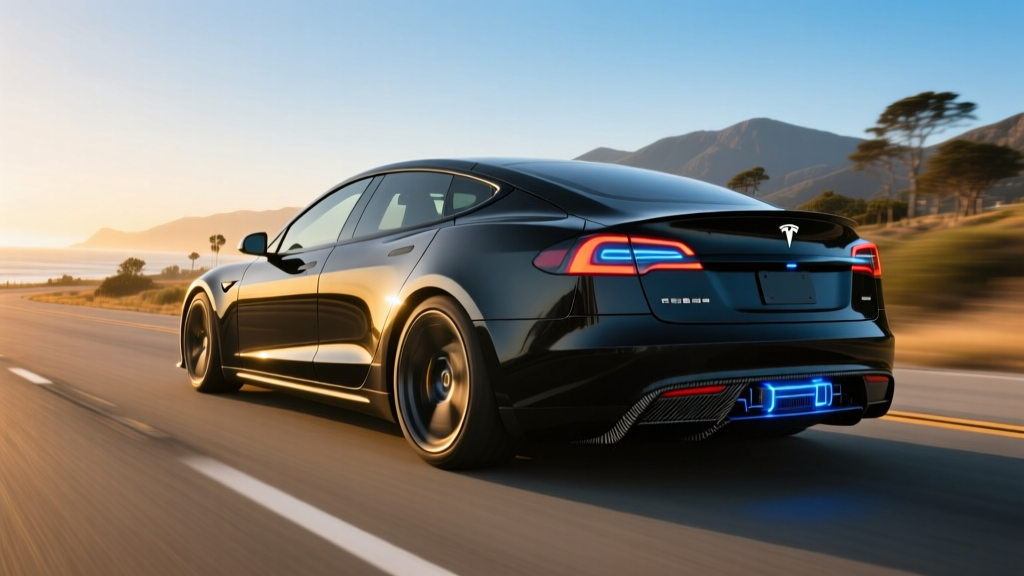
Everyone quotes 0-60 mph. But if you've ever merged onto a fast-moving freeway or passed on a two-lane highway, you know the real test of an electric performance car happens after you're already moving. The Tesla Model S Plaid 60-130 mph roll — the time it takes to accelerate from 60 mph to 130 mph — is the metric that separates genuine hypercar killers from cars that front-load their torque and gasp at triple-digit speeds.
For 2026, the Model S Plaid remains Tesla's flagship performance sedan. With a tri-motor all-wheel-drive powertrain producing 1,020 horsepower, it's one of the quickest production cars ever built. But raw acceleration is only part of the ownership equation. Buyers at this price point also need to know about real-world range, Supercharger speeds, daily usability, and whether the federal tax credit applies. Here's the complete data-driven breakdown.
2026 Tesla Model S Plaid: Core Specifications
| Spec | Value |
|---|---|
| Base MSRP | $89,990 (before destination) |
| As-Tested Price (typical config) | $101,490 (Plaid + FSD + 21" Arachnid wheels) |
| Drivetrain | Tri-motor AWD (1 front, 2 rear) |
| Horsepower | 1,020 hp |
| 0-60 mph | 1.99 seconds (with rollout subtracted) |
| 60-130 mph (roll) | ~6.8–7.2 seconds (independent tests) |
| Top Speed | 200 mph (with Track Pack hardware) |
| Battery Capacity (usable) | ~95 kWh (NMC chemistry) |
| EPA Range | 396 miles (19" Tempest wheels) |
| Efficiency | 120 MPGe combined / 28 kWh/100 mi |
| Max DC Fast Charge | 250 kW (V3 Supercharger) |
| 10-80% DC Charge Time | ~30 minutes |
| Level 2 Home Charge Rate | 11.5 kW (~34 mi/hr) |
| Cargo Volume | 28.0 cu ft (rear) + 3.1 cu ft (frunk) |
| Battery & Drive Unit Warranty | 8 years / 150,000 miles |
Real-World Range: What to Expect Beyond the EPA Sticker
Real-World Expectations:
- City/mixed driving (mild weather): ~350–380 miles
- Highway at 75 mph: ~280–310 miles
- Highway at 85 mph: ~240–270 miles
- Cold weather (below 30°F) mixed: ~250–290 miles
The 396-mile EPA figure for the Model S Plaid with 19-inch wheels is among the highest of any performance EV sold today. But the tri-motor powertrain and aggressive performance tuning mean efficiency is more sensitive to driving style than in a single-motor commuter EV.
In real-world highway testing at sustained 75-80 mph speeds, expect to use roughly 32-35 kWh/100 miles — noticeably higher than the 28 kWh/100 mi EPA combined rating. That translates to roughly 280-310 miles of usable range before you'd want to stop. Step up to the optional 21-inch Arachnid wheels and the EPA rating drops to approximately 359 miles, with real-world highway range falling to around 250-280 miles.
Cold weather compounds the loss. The Model S Plaid uses a heat pump for cabin and battery thermal management, which helps, but NMC batteries lose efficiency in freezing temperatures. Plan for a 20-30% range reduction in sub-30°F conditions, especially on short trips where the battery doesn't fully warm up. On longer road trips, preconditioning the battery via navigation to a Supercharger mitigates much of the charging-speed penalty, though not the range loss itself.
According to EPA fueleconomy.gov data, the Plaid's combined MPGe of 120 is lower than the dual-motor Model S Long Range (approximately 124 MPGe), reflecting the tri-motor weight and power trade-off.
Charging Speed: Supercharger and Home Charging Data
| Charging Level | Power (kW) | Speed (miles/hr) | Notes |
|---|---|---|---|
| Level 1 (120V outlet) | ~1.4 kW | ~3–4 mi/hr | Emergency/trickle only |
| Level 2 (240V, 48A Wall Connector) | 11.5 kW | ~34 mi/hr | Full charge in ~9 hours |
| DC Fast (V3 Supercharger) | 250 kW peak | ~200 mi/hr at peak | 10-80% in ~30 min |
| DC Fast (V4 Supercharger) | 250 kW (current Plaid limit) | ~200 mi/hr at peak | Same peak as V3 for this model |
The Model S Plaid peaks at 250 kW on Tesla's V3 and V4 Superchargers using the native NACS connector. That peak rate is available only when the battery is preconditioned (navigate to a Supercharger using the car's built-in routing) and the state of charge is below roughly 40%.
Here's the charging curve reality that spec sheets don't show: the Plaid sustains above 200 kW from approximately 10% to 45% SoC, then tapers progressively. From 60% to 80%, you'll see roughly 120-150 kW. The 10-80% charge takes approximately 30 minutes under ideal conditions — about 8-10 minutes longer than the latest 800V architecture competitors like the Hyundai Ioniq 5 N or Porsche Taycan Turbo GT, which can accept 350 kW peaks.
At home, Tesla's Wall Connector on a 60-amp circuit delivers 11.5 kW (48 amps continuous), adding roughly 34 miles of range per hour. A full charge from 10% to 90% takes about 8-9 hours, making overnight charging straightforward for most owners. If your home electrical panel supports only a 40-amp circuit, expect 9.6 kW and roughly 28 miles per hour of charging.
Tesla's Supercharger network remains the most reliable public DC fast-charging ecosystem in North America, with over 6,500 stalls across the U.S. as of early 2026. The Model S Plaid uses the NACS (North American Charging Standard) connector natively — no adapter needed.
The 60-130 mph Roll: How the Plaid Performs When Already Moving
The 0-60 mph time of 1.99 seconds (Tesla's figure, with a 1-foot rollout subtracted) gets the headlines. But the 60-130 mph roll is where the Plaid's tri-motor architecture truly demonstrates its engineering depth.
Independent drag-strip testing by outlets like DragTimes and Brooks Weisblat (Dragzine) has recorded 60-130 mph times between 6.8 and 7.2 seconds for the Model S Plaid, depending on surface conditions, tire temperature, and elevation. To put that in context:
- Tesla Model S Plaid (tri-motor): ~6.8–7.2 sec (60-130)
- Porsche Taycan Turbo GT: ~7.5–8.0 sec (60-130)
- Lucid Air Sapphire: ~6.2–6.5 sec (60-130)
- BMW M5 CS (ICE, 627 hp): ~9.5 sec (60-130)
- Dodge Charger Daytona Scat Pack: ~10.5 sec (60-130)
The Plaid's carbon-sleeve permanent-magnet rear motors are specifically engineered to sustain torque at high RPM — a problem that single-speed EVs historically struggle with above 100 mph. Tesla's engineers achieved a rotor design that resists expansion at extreme rotational speeds, enabling the Plaid to pull hard well past 150 mph.
The Lucid Air Sapphire is measurably quicker in the 60-130 roll (by roughly half a second), thanks to its 1,234-hp dual-motor rear / single-motor front setup and slightly lower weight. But the Sapphire starts at $249,000 — nearly three times the Plaid's base price.
On public roads, the Plaid's acceleration from highway speeds is startling. Merging from 55 to 85 mph takes roughly 2.5 seconds. Passing maneuvers that require a burst from 60 to 90 mph happen in under 3 seconds. The instant torque delivery — no turbo lag, no transmission downshift — makes the Plaid feel faster than its numbers suggest in real-world driving.
Pricing, Tax Credit Eligibility, and Total Cost
| Item | Amount |
|---|---|
| Base MSRP (Plaid) | $89,990 |
| Destination Fee | $1,990 |
| FSD (Supervised) Add-On | $8,000 |
| 21" Arachnid Wheels | $4,500 |
| Full Self-Driving Transfer | N/A (one-time purchase) |
| Typical As-Tested Price | $104,480 |
| Federal §30D Tax Credit | $0 — does NOT qualify |
| Estimated Out-of-Pocket | $89,990–$104,480 |
The 2026 Tesla Model S Plaid does not qualify for the federal §30D new clean vehicle tax credit. The reason is straightforward: under current IRS rules, the credit applies only to vehicles with an MSRP at or below $55,000 for sedans. The Plaid starts at $89,990, well above that cap. Even the base Model S Long Range ($74,990) exceeds the sedan MSRP limit.
Additionally, §30D requires battery components and critical minerals to meet North American sourcing thresholds that tighten annually. While Tesla has made significant progress in domestic battery production at its Nevada and Texas gigafactories, the MSRP cap alone disqualifies the Model S lineup regardless of sourcing compliance.
For the full eligibility requirements, see the IRS §30D clean vehicle credit page. Key rules include:
- MSRP cap: $55,000 for sedans, $80,000 for SUVs/pickups/vans
- Buyer income cap: $150,000 single / $300,000 joint MAGI
- Battery component and critical mineral sourcing requirements (phased annually)
- Point-of-sale transfer available for qualifying vehicles
Some buyers explore the used EV credit (§25E) as an alternative — it offers up to $4,000 (30% of sale price) on pre-owned EVs under $25,000. However, a used Model S Plaid will not drop to $25,000 for many years, making this inapplicable for the foreseeable future.
State-level incentives may partially offset the cost. California's CVRP program, Colorado's state tax credit, and various utility rebates can provide $1,000-$5,000 depending on your location. Always verify current state programs through official sources, as these change frequently.
Interior, Tech, and Daily Usability
The 2026 Model S Plaid carries Tesla's refreshed interior, which is significantly improved from the pre-2022 versions. Ventilated front seats, a rear-seat entertainment screen, and higher-quality materials (vegan leather, real aluminum trim) bring the cabin closer to its luxury-sedan price point — though it still trails the Lucid Air and Mercedes EQS in perceived material quality.
Key tech and comfort features:
- 17-inch center touchscreen (cinema-grade, 2200x1300 resolution)
- 8-inch rear passenger display for climate and entertainment
- 22-speaker, 960-watt audio system
- Wireless phone charging (two pads, 15W each)
- HEPA air filtration with bioweapon defense mode
- Glass roof with UV/IR blocking (no retractable shade)
Cargo and passenger space:
- Rear cargo: 28.0 cu ft (hatchback design — very usable)
- Front trunk (frunk): 3.1 cu ft
- Rear legroom: 40.9 inches
- Front headroom: 39.3 inches
- Seating for 5 (bench rear seat)
The hatchback liftgate is a significant practical advantage over traditional luxury sedans like the BMW i7 or Mercedes EQS. You can fit two large suitcases and a stroller without folding the rear seats. The frunk is small — enough for a charging cable bag and a laptop bag — but useful.
Driver Assistance — Autopilot and FSD (Supervised):
Tesla Autopilot and Full Self-Driving (Supervised) are driver-assistance systems, not autonomous driving. The driver must remain attentive, keep hands on the wheel (or demonstrate engagement via the cabin camera), and be prepared to take over at any moment. These systems do not make the vehicle self-driving. Only Level 4 services like Waymo operate without a human driver in designated areas.
The optional FSD (Supervised) package ($8,000 one-time or $99/month subscription as of 2026) adds city-street navigation, traffic light and stop sign recognition, and automatic turns. It has improved substantially in reliability, but it still requires constant supervision and makes errors that a attentive driver must catch — particularly in construction zones, unmapped intersections, and adverse weather.
Warranty, Ownership Costs, and Long-Term Considerations
Tesla covers the Model S Plaid's battery and drive units for 8 years or 150,000 miles, whichever comes first, with a minimum 70% capacity retention threshold. The basic vehicle limited warranty is 4 years / 50,000 miles.
The NMC battery chemistry in the Plaid offers higher energy density than LFP (lithium iron phosphate), which is why Tesla achieves 396 miles of range in a relatively compact battery pack (~95 kWh usable). However, NMC batteries typically experience slightly faster degradation than LFP over very high cycle counts. Based on fleet data from Tesla owners, most Model S batteries retain 90-93% capacity after 100,000 miles — well within the warranty threshold.
Annual ownership cost considerations:
- Insurance: Expect $3,000-$4,500/year for the Plaid, depending on age, location, and driving record. Performance EVs carry higher premiums.
- Electricity (home charging at $0.14/kWh): ~$1,400/year for 12,000 miles
- Supercharger road trips: ~$0.35-$0.45/kWh; roughly $600-$900/year for moderate road-trippers
- Tires: The Plaid's performance tires (Michelin Pilot Sport 4S or equivalent) cost $350-$500 each and may need replacement every 15,000-25,000 miles under spirited driving
- Maintenance: Minimal — cabin air filter, brake fluid check, wiper fluid. No oil changes, no transmission service
Pros
- 60-130 mph roll under 7 seconds — hypercar acceleration at a fraction of the price
- 396-mile EPA range is exceptional for a 1,020-hp vehicle
- Tesla Supercharger network: most reliable DC fast-charging ecosystem
- Hatchback practicality with 28 cu ft of cargo space
- Over-the-air updates continuously add features
- Heat pump standard for efficient cold-weather cabin heating
Cons
- Does not qualify for the $7,500 federal tax credit (MSRP cap)
- 250 kW peak DC charging trails 800V competitors (350 kW capable)
- Interior quality still below Lucid Air and Mercedes EQS at this price
- Yoke steering (standard) is polarizing; round wheel is a delete option
- Insurance premiums significantly higher than non-performance EVs
- FSD (Supervised) requires $8,000 and still demands full driver attention
Who Should Buy the Model S Plaid?
- You want sub-7-second 60-130 mph performance without spending $200K+
- You need a daily-drivable sedan with real cargo space and 350+ mile range
- You road-trip frequently and value Supercharger network reliability
- You can charge at home (Level 2) and don't rely solely on public charging
- Tax credit eligibility is a dealbreaker (consider Model Y or Model 3)
- You prioritize interior luxury over raw performance (Lucid Air Grand Touring, Mercedes EQS)
- You want the fastest possible DC charging (Porsche Taycan, Hyundai Ioniq 5 N with 800V)
- You need a third row or SUV cargo volume (Model X, Rivian R1S)
The Tesla Model S Plaid occupies a unique position: it delivers acceleration that rivals $300,000 hypercars, wrapped in a practical five-seat hatchback with nearly 400 miles of range. The 60-130 mph roll time of approximately 7 seconds is the kind of stat that was reserved for purpose-built drag cars a decade ago. For the performance-obsessed EV buyer who also needs daily usability, the Plaid remains difficult to beat at $89,990.
Its main competitive threats are the Lucid Air Sapphire (quicker but $249K), the Porsche Taycan Turbo GT (better handling, faster charging, less range), and the upcoming next-generation Tesla Roadster (if it ever reaches production). For now, the Plaid is the best value in extreme-performance electric sedans — as long as you accept the tax credit ineligibility and the charging speed gap versus 800V platforms.
Frequently Asked Questions
What is the real-world range of the Tesla Model S Plaid?
The EPA rates the Model S Plaid at 396 miles with 19-inch wheels and 359 miles with 21-inch wheels. In real-world highway driving at 75 mph, expect approximately 280-310 miles. In cold weather (below 30°F), plan for 250-290 miles of mixed-use range. Aggressive driving significantly reduces range — sustained high-speed runs can drop efficiency to 40+ kWh/100 mi.
How fast does the Model S Plaid charge at home and on the road?
At home on a Level 2 Tesla Wall Connector (11.5 kW), the Plaid adds roughly 34 miles of range per hour, with a full charge taking about 9 hours. On a V3 or V4 Supercharger, it peaks at 250 kW and charges from 10-80% in approximately 30 minutes with battery preconditioning. This is solid but trails 800V competitors that can accept 350 kW.
Does the Tesla Model S Plaid qualify for the federal EV tax credit?
No. Under current IRS §30D rules, the new clean vehicle credit is limited to sedans with an MSRP of $55,000 or less. The Model S Plaid starts at $89,990 and does not qualify regardless of battery sourcing. The base Model S Long Range ($74,990) also exceeds the sedan cap. See IRS.gov for complete eligibility details.
Is the Model S Plaid worth buying versus the Lucid Air or Porsche Taycan?
The Plaid offers the best performance-per-dollar in its class at $89,990. The Lucid Air Sapphire is quicker (60-130 in ~6.3 seconds) but costs $249,000. The Porsche Taycan Turbo GT handles better on a track and charges faster (350 kW peak) but offers less range (~280 miles EPA) and starts above $160,000. For most buyers seeking extreme acceleration with daily practicality, the Plaid is the rational choice.
What are the biggest pros and cons of owning a Model S Plaid?
Pros: unmatched acceleration for the price, 396-mile range, Supercharger access, hatchback cargo space, and continuous OTA improvements. Cons: no federal tax credit, 250 kW charging lags 800V rivals, interior quality below some luxury competitors, high insurance costs, and the yoke steering is not for everyone.
How does the yoke steering affect daily driving?
The yoke is standard on the Plaid (a conventional round steering wheel is available as a no-cost delete). For straight-line highway driving and track use, the yoke offers clear instrument visibility. For low-speed maneuvering, three-point turns, and roundabouts, the lack of a full wheel requires hand-over-hand adaptation. Most owners adjust within a week, but test-drive both options before committing.