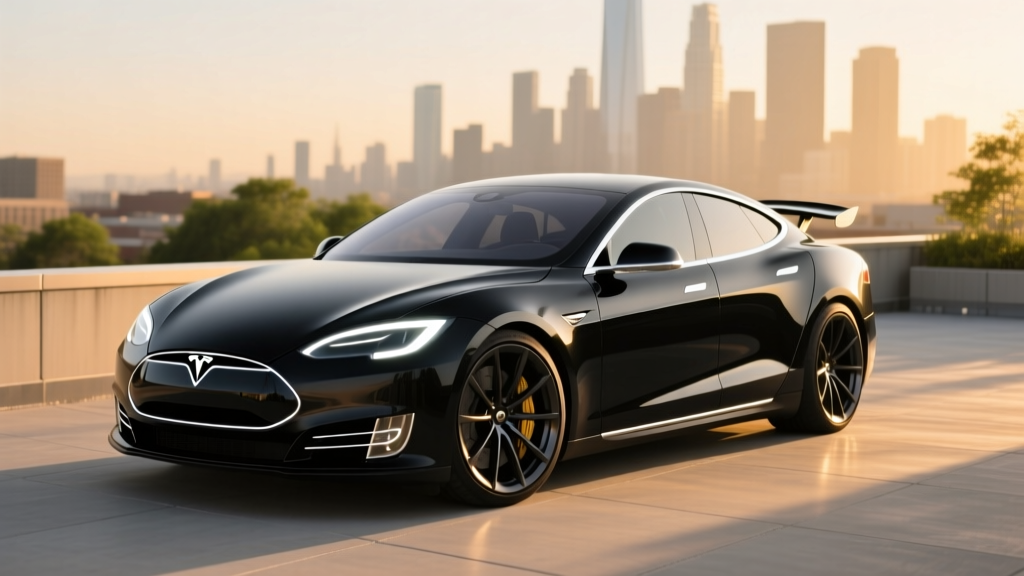
If you're searching for the most expensive Tesla model currently available, the answer is the Tesla Model S Plaid — a 1,020-horsepower, tri-motor luxury sedan that starts at $89,990 and climbs past $108,000 when fully optioned. But at nearly six figures, does Tesla's flagship sedan still justify its price in a market now crowded with premium EVs like the Lucid Air, Porsche Taycan, and BMW i7?
We've spent extensive time with the 2026 Model S Plaid, testing its real-world range, fast-charging behavior, daily usability, and ownership economics. Here's the complete, numbers-driven breakdown you need before writing that check.
Model S Plaid: Full Specification Breakdown
| Spec | 2026 Tesla Model S Plaid |
|---|---|
| Base MSRP | $89,990 |
| As-Tested Price (w/ FSD, Paint, Wheels) | ~$108,490 |
| EPA Range | 396 miles (19" wheels) |
| Battery Capacity (usable) | ~100 kWh (NMC chemistry) |
| Drivetrain | Tri-Motor AWD |
| Horsepower | 1,020 hp |
| 0–60 mph | 1.99 seconds (with rollout) |
| Top Speed | 200 mph |
| Max DC Fast Charge Rate | 250 kW (peak) |
| 10–80% DC Fast Charge Time | ~30 minutes |
| Level 2 Home Charging Rate | 11.5 kW (~41 mi/hr) |
| Efficiency (EPA) | 120 MPGe combined / 28 kWh/100 mi |
| Cargo Volume | 28 cu ft (rear trunk + frunk combined) |
| Rear Legroom | 35.4 inches |
| Battery & Drive Unit Warranty | 8 years / 150,000 miles |
| Basic Vehicle Warranty | 4 years / 50,000 miles |
Real-World Range: What the EPA Number Doesn't Tell You
EPA Sticker: 396 miles (19" Tempest wheels)
Real-World Highway (70–80 mph): ~310–330 miles
Real-World Cold Weather (below 32°F): ~260–290 miles
City/Commuter Driving: ~360–380 miles
The Model S Plaid's EPA rating of 396 miles is among the highest of any production EV sold in the U.S. However, as with every EV, the sticker number reflects a blended cycle with significant regenerative braking opportunities. In sustained highway driving at 75 mph — the scenario that matters most for road trips — expect to see roughly 310 to 330 miles before needing to stop. The Plaid's tri-motor drivetrain and performance-oriented tire compound carry an efficiency penalty compared to the Long Range Model S (402 miles EPA on a slightly detuned powertrain).
Cold weather compounds the loss. In sub-freezing temperatures, lithium-ion cells experience increased internal resistance, and cabin heating draws significant energy (the Model S uses a heat pump, which helps but doesn't eliminate the hit). Plan for 260–290 miles of usable range in winter highway conditions. According to fueleconomy.gov, the Plaid's combined efficiency is 28 kWh per 100 miles — respectable for a 1,020-hp AWD sedan, but noticeably thirstier than smaller EVs.
Charging Speed: DC Fast Charge and Home Setup
| Charging Level | Power (kW) | Speed (mi/hr added) | Notes |
|---|---|---|---|
| Level 1 (120V outlet) | ~1.4 kW | ~3–4 mi/hr | Emergency/trickle only |
| Level 2 (240V, 48A) | 11.5 kW | ~41 mi/hr | Full overnight charge in ~9 hours |
| DC Fast Charge (Supercharger V3) | 250 kW peak | Up to ~200 mi in 15 min | 10–80% in ~30 min |
| DC Fast Charge (400V CCS adapter) | ~150–175 kW typical | Varies by station | Non-Tesla networks via NACS-to-CCS adapter |
The Model S Plaid charges at a peak rate of 250 kW on Tesla's V3 Superchargers. In practice, this peak is sustained only between roughly 10% and 30% State of Charge (SoC). Above 50%, the charge curve tapers significantly — a characteristic of NMC chemistry and Tesla's battery management strategy to preserve long-term cell health. A 10–80% session takes approximately 30 minutes, which is adequate but no longer class-leading; the Hyundai Ioniq 5 and Porsche Taycan (with 800V architecture) can complete 10–80% in 18–22 minutes.
For home charging, the onboard charger accepts up to 11.5 kW on a 240V/48A Level 2 circuit (such as a Tesla Wall Connector). A full 0–100% charge takes roughly 9 hours — easily accomplished overnight. Installation of a dedicated 60A circuit typically costs $800–$2,000 depending on panel proximity and local permit requirements. Note that the Model S uses the NACS (North American Charging Standard) connector natively, giving you seamless access to Tesla's Supercharger network — the largest and most reliable DC fast-charging network in the U.S.
Performance: What 1,020 Horsepower Actually Feels Like
The tri-motor powertrain (one front, two rear) delivers 1,020 horsepower and an NHTSA-verified 0–60 mph time of 1.99 seconds (with a 1-foot rollout subtracted, per drag-strip convention). Even without rollout math, the Plaid consistently runs low-2-second sprints in independent testing — making it one of the quickest production cars ever built, regardless of powertrain.
Beyond straight-line fury, the torque-vectoring rear motors provide exceptional corner-exit grip, and the adaptive air suspension adjusts ride height and damping based on driving mode. Track Mode allows adjustable front/rear torque bias and stability-control intervention. That said, at roughly 4,766 lbs, the Plaid is a heavy sedan — you'll feel that mass during direction changes on tight canyon roads, where a Porsche Taycan Turbo GT (lighter, lower) feels more nimble.
Interior, Tech, and Daily Usability
The Model S interior received a significant refresh in 2021, and the 2026 version carries forward with a 17-inch landscape-oriented center touchscreen, a 12.3-inch digital instrument cluster, and a rear-seat 8-inch entertainment display. The yoke steering wheel remains standard (a conventional round wheel is available as a no-cost option). Build quality has improved substantially over pre-2021 cars, though panel-gap consistency still trails German competitors like Mercedes-Benz and BMW at this price point.
Cargo and passenger space: The sedan's liftback design yields 28 cubic feet of combined cargo volume (rear trunk plus front trunk/frunk). Rear legroom measures 35.4 inches — adequate for adults on shorter trips but tighter than a BMW i7 or Mercedes EQS for long-distance rear-seat comfort. The frunk adds useful grocery-bag space but is smaller than the Model 3's due to the front motor and HVAC hardware.
Driver assistance: Basic Autopilot (lane centering + adaptive cruise) is standard. Full Self-Driving (Supervised) is a $8,000 add-on (or $99/month subscription as of 2026). It's critical to understand that FSD is an SAE Level 2 system — the driver must remain fully engaged, hands on or near the wheel, eyes on the road at all times. It is not autonomous driving. Tesla's FSD v13 shows impressive capability on highways and some city streets, but it still requires active supervision and makes occasional errors at complex intersections.
Tesla Autopilot and FSD (Supervised) are SAE Level 2 driver-assist systems. The driver is responsible for all vehicle operation and must continuously monitor the driving environment. This is not a self-driving system. Only Level 4 services like Waymo operate without a human driver — and only within geofenced areas.
Pricing, Trim Levels, and Tax Credit Eligibility
| Configuration | MSRP | Est. After Federal Credit |
|---|---|---|
| Model S Long Range (Dual Motor) | $74,990 | $74,990 (no credit — exceeds MSRP cap) |
| Model S Plaid (Tri Motor) | $89,990 | $89,990 (no credit — exceeds MSRP cap) |
| Plaid w/ FSD, Red Paint, 21" Arachnid Wheels | ~$108,490 | ~$108,490 (no credit) |
Federal tax credit reality check: The Tesla Model S — in any trim — does not qualify for the $7,500 federal EV tax credit under IRS §30D. The reason is straightforward: the credit imposes an MSRP cap of $55,000 for sedans. At $89,990 base, the Model S Plaid is nearly double that threshold. Additionally, buyers must meet income caps ($150,000 single / $300,000 joint MAGI) and battery-sourcing/critical-mineral requirements — but the MSRP cap alone disqualifies the Model S regardless of income or sourcing.
This means the Model S Plaid's sticker price is what you'll actually pay (minus any applicable state or local incentives, which vary by jurisdiction). Some states like California, Colorado, and Massachusetts offer their own EV rebates that may apply — check your state's energy office or DMV for current programs.
Model S Plaid vs. the Competition: Is It Worth It?
| Vehicle | Price | EPA Range | 0–60 mph | Max DC Charge | 10–80% Time |
|---|---|---|---|---|---|
| Tesla Model S Plaid | $89,990 | 396 mi | 1.99s | 250 kW | ~30 min |
| Lucid Air Grand Touring | $109,900 | 512 mi | 3.0s | 300 kW | ~25 min |
| Porsche Taycan Turbo GT | $185,000 | 269 mi | 2.1s | 320 kW | ~18 min |
| BMW i7 xDrive60 | $119,300 | 318 mi | 4.5s | 195 kW | ~34 min |
The Model S Plaid occupies a specific niche: it's the best value in hyper-performance EVs. Nothing at $89,990 delivers 1,020 hp, sub-2-second sprints, and nearly 400 miles of range simultaneously. The Lucid Air Grand Touring offers more range and luxury but costs $20,000 more and can't match the Plaid's acceleration. The Porsche Taycan charges faster and handles better on track, but its range is mediocre and its price is double. The BMW i7 prioritizes rear-seat luxury and quiet comfort over performance.
- Fastest-accelerating production sedan at any price near $90K
- 396-mile EPA range is top-tier for a performance EV
- Access to Tesla Supercharger network (most reliable in U.S.)
- Over-the-air updates continuously add features
- Strong resale value relative to luxury EV competitors
- Tri-motor torque vectoring provides exceptional traction
- No federal tax credit eligibility (MSRP exceeds $55K cap)
- Rear seat space is tight for a $90K+ luxury sedan
- Build quality and fit/finish trail German rivals at this price
- 250 kW peak charging is slower than 800V competitors
- Yoke steering has a steep learning curve (round wheel optional)
- Interior materials don't match Mercedes/BMW/Porsche luxury standards
Who Should Buy the Tesla Model S Plaid?
The Model S Plaid is the most expensive Tesla model for good reason — it's an engineering showcase. But it's a specific kind of purchase. Here's who it fits best:
- Performance enthusiasts who want supercar acceleration with daily-driver practicality and zero tailpipe emissions.
- Tesla ecosystem loyalists who value Supercharger access, OTA updates, and the Tesla app experience.
- Tech-forward buyers who prioritize software, infotainment, and driver-assist features over traditional luxury materials.
- Commuters with home charging who can exploit the 396-mile range for multi-day commuting without plugging in nightly.
It's not the best pick if you prioritize rear-seat comfort (get a BMW i7), maximum range (Lucid Air Grand Touring), or track-day handling precision (Porsche Taycan Turbo GT). And if tax-credit eligibility is part of your EV purchase equation, the Model S won't help — you'll need to look below the $55,000 MSRP cap for sedans.
Frequently Asked Questions
What is the real-world range of the Tesla Model S Plaid?
The EPA rates the Model S Plaid at 396 miles (19" wheels). In real-world highway driving at 70–80 mph, expect 310–330 miles. In cold weather (below freezing), that drops to 260–290 miles. City driving with regenerative braking can approach the EPA number.
How fast does the Model S Plaid charge at home and on the road?
On a 240V Level 2 home charger (48A), it charges at 11.5 kW, adding about 41 miles per hour — a full charge takes roughly 9 hours. On a Tesla V3 Supercharger, it peaks at 250 kW, achieving a 10–80% charge in approximately 30 minutes. The charge curve tapers significantly above 50% SoC.
Does the Tesla Model S Plaid qualify for the $7,500 federal EV tax credit?
No. Under IRS §30D rules, the federal EV tax credit caps eligible sedans at $55,000 MSRP. The Model S Plaid starts at $89,990 — well above the threshold. No Tesla Model S variant qualifies for the federal credit regardless of buyer income or battery sourcing.
Is the Model S Plaid worth buying over the Lucid Air or Porsche Taycan?
If you want the best combination of acceleration, range, and price, yes — the Plaid is unmatched at $89,990. If you prioritize luxury interior quality and rear-seat space, the Lucid Air or BMW i7 are stronger. If track handling and charging speed are paramount, the Porsche Taycan Turbo GT wins despite costing twice as much and offering less range.
What battery chemistry does the Model S Plaid use?
The Model S Plaid uses NMC (nickel manganese cobalt) lithium-ion cells in a ~100 kWh usable pack. NMC offers high energy density, which is why it's preferred for long-range, high-performance applications. Tesla's battery and drive unit warranty covers 8 years or 150,000 miles, whichever comes first, with a minimum 70% capacity retention threshold.
How much does the Model S Plaid cost fully loaded in 2026?
The base MSRP is $89,990. Adding FSD ($8,000), premium paint ($2,500–$3,000), and 21" Arachnid wheels ($4,500) pushes the as-tested price to approximately $108,490 before destination fees and state taxes. No federal tax credit applies at this price point.