The 2021 Tesla Model S Plaid arrived as a watershed moment in electric performance — a four-door sedan that could out-accelerate hypercars while delivering over 390 miles of EPA-estimated range. Now well into its lifecycle, the Plaid remains a benchmark for what a flagship EV sedan can do. But five years on, how does this tri-motor powerhouse hold up against newer rivals from Lucid, Porsche, and BMW? We break down every number that matters for buyers evaluating one on the new or pre-owned market in 2026.
Range Reality Check
EPA Estimated: 396 miles (19-inch wheels) / 348 miles (21-inch Arachnid wheels)
Real-World Expectation: Plan for 310–340 miles on mixed highway driving at 70–80 mph. In freezing temperatures (below 30°F), expect a 15–25% reduction, dropping effective range to roughly 250–290 miles. City driving with heavy regen use can approach or slightly exceed the EPA figure thanks to stop-and-go energy recovery.
Spec Sheet: 2021 Tesla Model S Plaid at a Glance
| Specification | Value |
|---|---|
| EPA Range (19" wheels) | 396 miles |
| EPA Range (21" wheels) | 348 miles |
| Battery Capacity (usable) | ~95 kWh (NMC / NCA chemistry) |
| Battery Chemistry | Nickel-Manganese-Cobalt (NMC) / Nickel-Cobalt-Aluminum (NCA) |
| Drivetrain | Tri-Motor AWD (1 front, 2 rear carbon-sleeved rotors) |
| Peak Horsepower | 1,020 hp |
| 0–60 mph | 1.99 seconds (with rollout subtracted); ~2.1 sec real-world |
| Top Speed | 200 mph |
| Max DC Fast Charge Rate | 250 kW (Supercharger V3/V4) |
| 10–80% DC Charge Time | ~25 minutes (optimal battery temp) |
| Level 2 Home Charge Rate | 11.5 kW / 48A (~34 mi/hr on Wall Connector) |
| MPGe (combined) | 120 MPGe (19" wheels) |
| Energy Consumption | 28 kWh / 100 miles |
| Cargo Volume | 28 cu ft (rear trunk + frunk combined) |
| Rear Legroom | 35.5 inches |
| Battery & Drive Unit Warranty | 8 years / 150,000 miles (70% capacity retention minimum) |
| Base MSRP (2021 launch) | $129,990 |
| 2026 Model Year MSRP | $89,990 (current Plaid pricing) |
Battery, Range, and Real-World Efficiency
The Model S Plaid uses a roughly 95 kWh usable battery pack built on NMC/NCA cell chemistry — chosen for its high energy density, which is critical to packing 396 miles into a sedan form factor. Unlike the LFP (lithium iron phosphate) packs Tesla uses in base Model 3 and Model Y RWD trims, NMC offers superior energy density but requires more careful thermal management and generally ages less gracefully under sustained 100% state-of-charge storage.
Efficiency is where the Plaid surprises. Despite 1,020 horsepower, the EPA rates it at 120 MPGe combined (28 kWh/100 miles) on 19-inch wheels. That's competitive with far less powerful EVs and a testament to Tesla's heat pump, aerodynamic drag coefficient of 0.208 Cd, and silicon-carbide inverter efficiency. On a real-world highway loop at 75 mph in moderate temperatures, owners consistently report 2.8–3.2 miles per kWh, translating to roughly 265–305 miles before hitting a 10% state of charge.
The 21-inch Arachnid wheels look aggressive but exact a meaningful toll: 48 fewer EPA miles. For road-trip-heavy owners, the 19-inch Tempest wheels are the pragmatic choice.
Charging Speed: DC Fast and Home Level 2
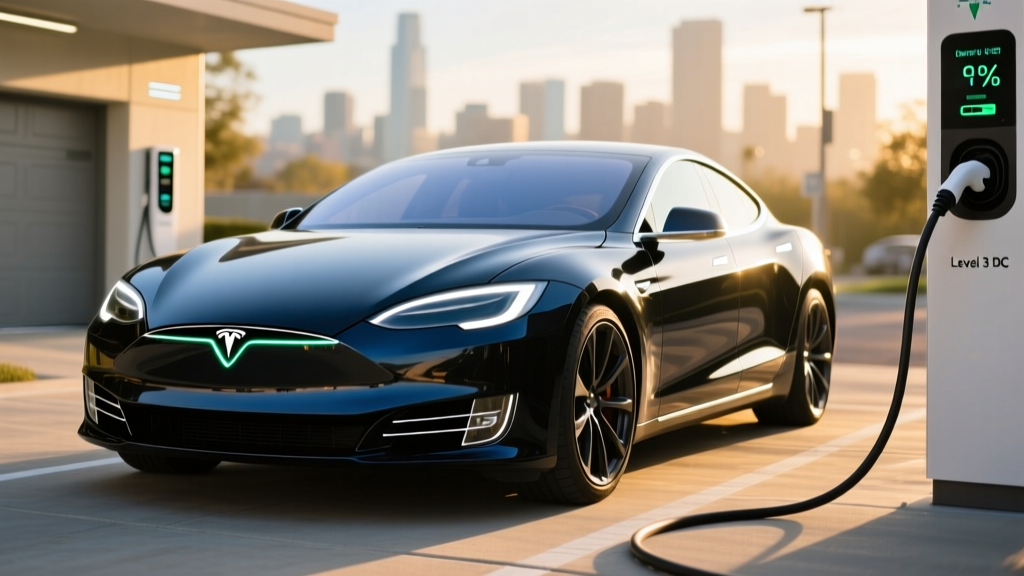
The Plaid supports a peak DC fast-charge rate of 250 kW on Tesla Supercharger V3 and V4 stalls. With proper battery preconditioning — which the car initiates automatically when you navigate to a Supercharger — the charge curve is aggressive in the low-to-mid state of charge.
| Charging Method | Power (kW) | Miles Added per Hour | Notes |
|---|---|---|---|
| Level 1 (120V outlet) | ~1.4 kW | ~3–4 mi/hr | Emergency/trickle only |
| Level 2 (240V, 48A Wall Connector) | 11.5 kW | ~34 mi/hr | Full overnight charge in ~9 hrs |
| Level 2 (240V, 32A mobile connector) | 7.7 kW | ~23 mi/hr | Common NEMA 14-50 setup |
| DC Fast (Supercharger V3/V4) | Up to 250 kW | ~750 mi/hr (peak) | 10–80% in ~25 min; tapers sharply above 80% |
| DC Fast (CCS adapter, non-Tesla) | Up to ~150 kW | ~450 mi/hr (peak) | Requires Tesla CCS adapter; varies by network |
A critical ownership note: the Plaid's charge curve tapers significantly above 80% SoC. The final 20% can take as long as the first 70%. On road trips, the efficient strategy is to charge to 80% and drive more frequently rather than waiting for a full battery. The onboard thermal management is excellent — back-to-back Supercharger sessions see minimal degradation in charge speed, something not every competitor can claim.
For home charging, Tesla's Wall Connector at 48 amps delivers a full 11.5 kW, replenishing the 95 kWh pack from empty in about 9 hours. Most owners who plug in nightly never need public charging for daily driving.
Performance: 1,020 Horsepower in a Four-Door Sedan
The tri-motor setup — one permanent-magnet motor up front and two carbon-sleeved induction motors in the rear — produces 1,020 hp and launches the Plaid to 60 mph in a claimed 1.99 seconds (with the 1-foot rollout subtracted, as is drag-racing convention). Independent testing by outlets like Motor Trend has confirmed 2.1-second real-world 0–60 times, which remains staggering for a sedan weighing approximately 4,766 pounds.
Beyond straight-line speed, the Plaid's torque vectoring across the rear motors provides sharp cornering response, and the adaptive air suspension keeps the ride composed whether in Track Mode or Comfort. The yoke steering — standard on the Plaid — remains polarizing: it offers unobstructed screen visibility and quick 14:1 ratio response, but requires relearning at low-speed maneuvers and roundabouts. A conventional round wheel is available as a no-cost option.
Track Mode unlocks sustained high-power output with enhanced cooling, but repeated hard launches will thermally limit the battery if you exceed roughly three consecutive full-power runs without cooldown.
Interior, Tech, and Daily Livability
The refreshed Model S interior (introduced with the 2021 Plaid) features a 17-inch center touchscreen, a 12.3-inch driver instrument cluster, and a rear 8-inch passenger display. The infotainment system runs a full Linux-based OS capable of playing AAA games (Cyberpunk 2077 runs natively) and streaming media — genuinely useful during Supercharger stops.
Standout tech features:
- 17-inch cinematic center display with 22-speaker, 960-watt audio system
- Tesla Autopilot standard; Full Self-Driving (Supervised) available as a $8,000 add-on or $99/month subscription
- Over-the-air updates continuously add features — the Plaid received UI refreshes, new games, and suspension tuning updates years after purchase
- HEPA air filtration with Bioweapon Defense Mode
- Powered frunk (front trunk) — a rarity among EVs
Notable drawbacks:
- No physical stalks for turn signals or wipers on yoke-equipped models — touch-capacitive buttons on the yoke require an adjustment period
- Rear-seat headroom is compromised by the sloping roofline (38.1 inches vs. competitors over 39 inches)
- Build quality has improved post-2023 but earlier 2021 examples may show panel-gap inconsistencies
- The ultrasonic sensor deletion (Tesla Vision only) means parking-assist relies entirely on cameras — occasionally less precise than ultrasonic-equipped models
Cargo space totals 28 cubic feet between the rear trunk (26.3 cu ft with seats up) and the powered frunk. Rear legroom at 35.5 inches is adequate for adults but trails the BMW i7 and Mercedes EQS. This is a performance sedan first, a luxury limousine second.
Pricing, Tax Credits, and 2026 Ownership Costs
The 2021 Model S Plaid launched at $129,990 before options and delivery fees. Tesla has since repriced aggressively; the 2026 Model S Plaid starts at $89,990. Pre-owned 2021 examples typically list between $62,000 and $78,000 depending on mileage and condition.
| Scenario | Price | Federal §30D Credit | Effective Cost |
|---|---|---|---|
| 2026 Model S Plaid (new) | $89,990 | Not eligible (MSRP exceeds $55,000 sedan cap) | $89,990 |
| 2021 Plaid (pre-owned, ≤$25,000) | Unlikely at current market | Up to $4,000 (used EV credit, §25E) | Varies |
| 2021 Plaid (pre-owned, typical market) | $62,000–$78,000 | Not eligible (price exceeds $25,000 used cap) | $62,000–$78,000 |
Federal tax credit reality: The new Model S Plaid does not qualify for the $7,500 §30D federal tax credit. The IRS caps sedan eligibility at an MSRP of $55,000, and the Plaid's $89,990 sticker blows past that threshold. Additionally, buyer income caps apply ($150,000 single / $300,000 joint for modified AGI). The used-EV credit (§25E) offers up to $4,000 but only on vehicles selling for $25,000 or less — effectively excluding the Plaid from any federal incentive. Always verify current rules at IRS.gov, as legislation may shift.
Five-year ownership snapshot:
- Electricity cost (15,000 mi/yr at $0.16/kWh national avg): ~$6,720 total
- Equivalent gasoline sedan (25 MPG at $3.50/gal): ~$10,500 total
- Estimated fuel savings over 5 years: ~$3,780
- Insurance: expect $3,200–$4,800/year — high-performance EVs carry premium insurance costs
- Maintenance: minimal — no oil changes, brake pad life extended by regen (expect 80,000+ miles on original pads)
Pros and Cons
Pros
- Sub-2.1-second 0–60 mph remains unmatched by any production sedan at any price
- 396-mile EPA range (19" wheels) eliminates range anxiety for most road trips
- Access to Tesla Supercharger network — the most reliable DC fast-charging infrastructure in North America
- Continuous OTA updates keep a 2021 vehicle feeling current in 2026
- 28 cu ft cargo with powered frunk offers genuine practicality
- Heat pump standard — efficient cabin heating in cold climates without severe range loss
Cons
- No federal tax credit eligibility (MSRP and price caps)
- Yoke steering and stalkless controls require significant adaptation
- Insurance premiums are steep — $3,200–$4,800/yr is typical
- Rear-seat headroom and legroom trail luxury competitors (BMW i7, Mercedes EQS)
- 21-inch wheels sacrifice 48 miles of range — a costly aesthetic choice
- Tesla Service Center wait times remain long in many metro areas
- Resale depreciation on 2021 models has been steep (30–40% from original MSRP)
How the Plaid Stacks Up Against Key Competitors
The Plaid's competitive set has expanded significantly since 2021. Here's how it compares to its most relevant rivals:
- Lucid Air Grand Touring: 516-mile EPA range crushes the Plaid, and the Air's rear-seat space is superior. But it costs more (~$125,600) and lacks the Supercharger network advantage (though Lucid now has NACS access).
- Porsche Taycan Turbo S: Superior build quality, steering feel, and 800V architecture (270 kW peak charging). But only 246 miles of EPA range and a $190,000+ price tag.
- BMW i7 M70: More luxurious rear seat, 536 hp, 318-mile range. A better executive express but not in the same performance league (3.5-sec 0–60).
- Mercedes-AMG EQS 53: 649 hp, 277-mile range, superior interior materials. Heavier, less efficient, and far slower to 60 (3.4 sec).
The Plaid occupies a unique niche: it is the only vehicle that delivers sub-2-second acceleration, nearly 400 miles of range, and practical sedan cargo space under $100,000. If pure performance-per-dollar is your metric, nothing else touches it.
Who Should Buy the Model S Plaid?
Best for: Performance enthusiasts who need daily-driver practicality, frequent road-trippers who value the Supercharger network, tech-forward buyers who want continuous OTA improvements, and anyone who wants hypercar acceleration without a hypercar price tag.
Look elsewhere if: You prioritize rear-seat luxury (consider the BMW i7 or Lucid Air), you want maximum possible range regardless of performance (Lucid Air Grand Touring), you need federal tax credit eligibility (Model 3 Long Range, Model Y, or competitors under $55K), or you're uncomfortable with camera-only driver-assist systems and stalkless controls.
Battery Longevity and Warranty
Tesla warranties the Model S Plaid battery and drive units for 8 years or 150,000 miles, whichever comes first, with a minimum 70% capacity retention guarantee. Real-world data from high-mileage Tesla owners suggests NMC/NCA packs in the Model S platform typically retain 85–90% capacity at 100,000 miles when charged primarily to 80–90% daily and DC fast-charged moderately.
Tesla recommends setting daily charge limits to 80–90% for NMC chemistry and only charging to 100% before long trips. Unlike LFP packs (which tolerate and even benefit from regular 100% charges), NMC degrades faster when held at high states of charge — particularly in hot climates. For 2021 Plaid owners now approaching year five, monitoring State of Health through the Tesla app's battery health readout is advisable.
Out-of-warranty battery replacement for the Model S platform currently ranges from $12,000 to $18,000 depending on the pack revision and service center, though full replacements remain rare under 150,000 miles.
Frequently Asked Questions
What is the real-world range of the 2021 Tesla Model S Plaid?
On 19-inch wheels, expect 310–340 miles in mixed highway driving at moderate temperatures. In freezing weather, plan for 250–290 miles. The 21-inch wheel option reduces real-world range by roughly 10–12%. According to fueleconomy.gov, the official EPA rating is 396 miles (19") and 348 miles (21").
How fast does the Model S Plaid charge at home and on the road?
At home on a Level 2 Tesla Wall Connector (11.5 kW / 48A), the Plaid adds roughly 34 miles of range per hour, achieving a full charge overnight in about 9 hours. On a 250 kW Supercharger, it charges from 10–80% in approximately 25 minutes with proper battery preconditioning. Above 80%, charging slows dramatically — budget an additional 15–20 minutes for 80–100% if needed.
Does the Tesla Model S Plaid qualify for the federal EV tax credit?
No. Under current IRS §30D rules, new sedans must have an MSRP at or below $55,000 to qualify for the $7,500 credit. The Plaid's $89,990 MSRP far exceeds this cap. The used-EV credit (§25E) is also unavailable because it applies only to vehicles priced at $25,000 or less. See IRS.gov for current eligibility details.
Is the Model S Plaid worth buying in 2026 vs. competitors?
If you want the best combination of extreme performance (1,020 hp, sub-2.1-sec 0–60), strong range (396 mi EPA), Supercharger network access, and sub-$90K pricing, the Plaid has no direct equal. If rear-seat luxury, maximum range, or tax-credit eligibility matter more, the Lucid Air, BMW i7, or Tesla's own Model 3 Long Range may be better fits.
What are the biggest drawbacks of owning a Model S Plaid?
High insurance costs ($3,200–$4,800/yr), no federal tax credit, the yoke steering learning curve, Tesla Vision camera-only parking assist (no ultrasonic sensors), and service center wait times in some regions. Pre-owned 2021 models have also seen steep depreciation, which hurts if you plan to sell soon but benefits buyers entering the market.
How reliable is the Model S Plaid's battery after five years?
Tesla's NMC/NCA packs in the Model S platform have shown strong longevity. High-mileage owner data suggests 85–90% capacity retention at 100,000 miles with proper charging habits (daily limit of 80–90%, moderate DC fast charging). The 8-year/150,000-mile battery warranty provides coverage through 2029 for 2021 models.
Verdict: The Performance Sedan That Does It All
Five years after its debut, the 2021 Tesla Model S Plaid remains the most complete high-performance EV sedan on the market. It pairs absurd acceleration with genuinely usable range, practical cargo space, and the most mature charging network available. Its weaknesses — premium insurance, no tax incentives, yoke quirks — are the trade-offs of a car optimized for speed and tech above all else. For buyers who can absorb the ownership costs, the Plaid delivers an experience no competitor fully replicates at any price.