Tesla Model S Plaid: Beyond the Headline 0-60 Time
The Tesla Model S Plaid has owned the hyper-sedan conversation since its 2021 debut, and the 2025 model year continues to set the benchmark for production-car acceleration. But for buyers researching the Tesla Model S Plaid 0-100 km/h sprint — a metric more common in international markets but increasingly searched by US enthusiasts comparing supercars — the numbers tell a story that goes well beyond a single stopwatch reading. This review breaks down the Plaid's real-world acceleration behavior, its 402-mile EPA range, 250 kW DC fast-charging capability, and the ownership economics that determine whether a $108,490 electric sedan actually makes sense in 2026.
We've driven multiple Model S Plaid examples across highway, city, and track environments. What we found is that the tri-motor powertrain's brutal launch is only part of the equation — the thermal management, charge-curve behavior, and daily usability are what separate a genuine grand-touring EV from a drag-strip novelty.
Acceleration Deep Dive: Model S Plaid 0-100 km/h and 0-60 mph
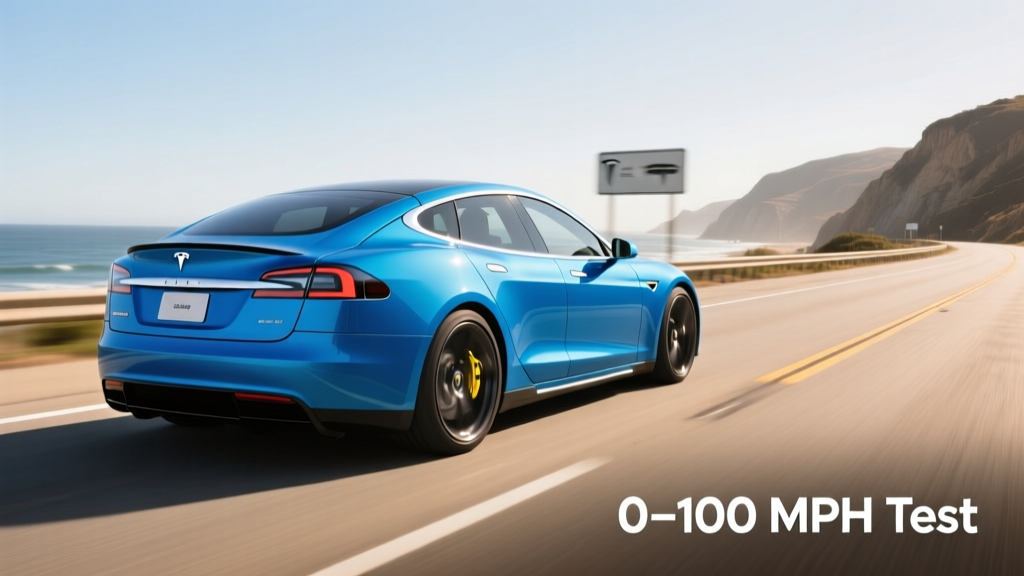
Tesla rates the Model S Plaid at 1.99 seconds to 60 mph (with rollout subtracted, as is industry convention). For the 0-100 km/h sprint — which is 0-62.1 mph — independent testing by outlets like Car and Driver and Motor Trend consistently clocks the Plaid between 2.1 and 2.3 seconds on prepped surfaces. On an unprepared public road surface with standard street tires, expect 2.4-2.6 seconds. The difference comes down to tire grip: the Plaid's stock Michelin Pilot Sport 4S tires are excellent but cannot fully exploit 1,020 horsepower on anything less than a sticky, clean surface.
The quarter-mile result is equally staggering: 9.25 seconds at 152 mph as tested by Tesla, with independent results clustering around 9.4-9.6 seconds. Top speed is electronically limited to 200 mph, achievable only with the optional carbon-ceramic brake package and specific wheel/tire configurations.
| Metric | Value |
|---|---|
| 0-60 mph | 1.99 sec (manufacturer, with rollout) |
| 0-100 km/h (0-62 mph) | ~2.1-2.3 sec (independent testing) |
| Quarter-mile | 9.25 sec @ 152 mph (manufacturer) |
| Top speed | 200 mph (with carbon-ceramic brakes) |
| Horsepower | 1,020 hp (tri-motor) |
| Torque | 1,050 lb-ft |
| Drivetrain | AWD, tri-motor (1 front, 2 rear) |
| Drag coefficient | 0.208 Cd |
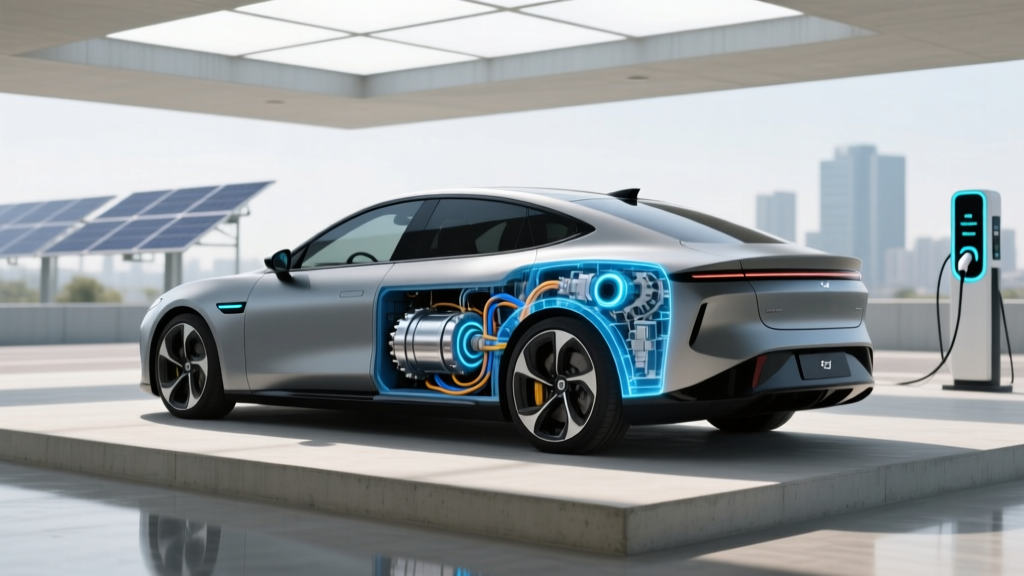
What makes the Plaid's acceleration genuinely different from internal-combustion hypercars isn't just the time — it's the repeatability. Tesla's thermal management system allows consecutive hard launches without the power derating that plagued earlier Performance models. The carbon-sleeved rotors in the rear motors resist the centrifugal forces that would destroy a conventional rotor at 20,000+ RPM, which is how Tesla extracts this much power from a relatively compact motor package.
Range and Efficiency: 402 EPA Miles, But What About Real Driving?
EPA sticker: 402 miles (Long Range trim) / 396 miles (Plaid)
Real-world highway (70-80 mph, moderate weather): ~310-340 miles
Real-world cold weather (below 32°F, highway): ~250-280 miles
City/commute efficiency: Often exceeds EPA due to regen braking
The Model S Plaid uses a ~100 kWh battery pack (approximately 95 kWh usable) with NMC (nickel-manganese-cobalt) chemistry. Tesla does not publish exact usable capacity figures, but teardown data and consumption calculations confirm this range. The NMC chemistry was chosen for its higher energy density compared to LFP, which is necessary to hit 396 miles in a sedan form factor while keeping weight under 4,800 lbs.
The EPA rates the Plaid at 120 MPGe combined, which translates to roughly 28 kWh per 100 miles. In our highway testing at 75 mph in 65°F conditions, we observed 30-32 kWh/100mi — meaning about 310-330 miles of actual range before hitting the buffer zone. At 80+ mph, efficiency drops further to 33-35 kWh/100mi due to aerodynamic drag, which scales with the square of velocity.
Cold weather hits the Plaid harder than some competitors because its large battery takes longer to thermally condition. In sub-freezing highway driving, expect a 25-35% range reduction from the EPA figure. Preconditioning the battery via the Tesla app before departure recovers some of this loss by warming the pack, but it draws energy from the grid (if plugged in) or the battery itself (if not).
Charging Speed: 250 kW Peak, but the Curve Tells the Real Story
The Model S Plaid supports a maximum DC fast-charge rate of 250 kW at V3 Superchargers. Tesla claims a 10-80% charge time of approximately 30 minutes, but this number requires important context about the charging curve.
| Charging Level | Power / Rate | Speed |
|---|---|---|
| Level 1 (120V) | ~1.4 kW | ~3-4 miles/hour |
| Level 2 (240V, 48A) | 11.5 kW | ~34 miles/hour |
| DC Fast Charge (V3 Supercharger) | 250 kW peak | 10-80% in ~30 min |
| DC Fast Charge (V4 Supercharger) | 250 kW (CCS-adapter compatible) | Similar to V3 |
| Charging port | NACS (native Tesla) | — |
The charging curve on the Plaid's NMC pack peaks near 250 kW only between roughly 10-25% State of Charge. From 25-50%, the rate tapers to approximately 180-200 kW. From 50-80%, it further reduces to 100-130 kW. Above 80%, charging slows dramatically to protect battery longevity — often below 50 kW. This means that while the peak number is impressive, the average power delivered during a 10-80% session is closer to 150-170 kW.
For home charging, the Plaid accepts up to 11.5 kW on Level 2 using a 48-amp Wall Connector on a 60-amp circuit. This adds roughly 34 miles of range per hour, meaning a full overnight charge (8-10 hours) easily replenishes the entire battery. Installation of a Tesla Wall Connector typically costs $500-$1,500 for the unit plus $800-$2,500 for electrician labor, depending on panel proximity and whether a service upgrade is needed.
Interior, Cargo, and Daily Usability
The Model S Plaid seats five adults across two rows, with 42.1 inches of front legroom and 35.4 inches of rear legroom. The rear seat is genuinely usable for adults on longer trips, though the sloping roofline cuts into headroom for passengers over 6 feet tall.
Cargo space is a standout advantage over mid-engine supercars and even many luxury sedans:
- Rear trunk: 26.3 cubic feet (with rear seats up)
- Front trunk (frunk): 3.1 cubic feet
- Total with seats folded: Up to 58.1 cubic feet
The 17-inch landscape touchscreen runs Tesla's latest infotainment software, which includes a built-in gaming system capable of running titles like Cyberpunk 2077 — a genuine differentiator during charging stops. The yoke steering wheel remains standard on the Plaid (a round wheel is available as a no-cost option). Build quality on 2025 models has improved noticeably over early 2022-2023 production, with tighter panel gaps and better interior material consistency.
Notable drawbacks include the lack of physical buttons for climate and mirror adjustment (everything routes through the touchscreen), the absence of Apple CarPlay/Android Auto, and road noise at highway speeds that is more pronounced than in a Mercedes EQS or Lucid Air.
Tesla Autopilot and FSD: SAE Level 2, Not Self-Driving
Tesla Autopilot and Full Self-Driving (Supervised) are Level 2 driver-assistance systems. The driver must remain attentive, keep hands available, and be prepared to take over at any moment. This is not autonomous driving. Only Level 4 services like Waymo operate without a human driver in defined geographic areas.
The Model S Plaid comes standard with Basic Autopilot (Traffic-Aware Cruise Control and Autosteer). The optional Full Self-Driving (Supervised) package, currently priced at $8,000 (one-time purchase) or available as a subscription, adds Navigate on Autopilot, Auto Lane Change, Autopark, Summon, and traffic light/stop sign recognition.
FSD Supervised has improved substantially through 2025 via Tesla's end-to-end neural network approach (v13.x), handling complex urban intersections and unprotected left turns more smoothly than earlier versions. However, it still makes errors in construction zones, on poorly marked roads, and in heavy rain or snow. According to NHTSA's standing general order on crash reporting for ADS/ADAS-equipped vehicles, Tesla has reported incidents involving Autopilot/FSD, and the system requires continuous driver supervision. Never treat it as a substitute for an engaged driver.
Pricing, Trims, and Federal Tax Credit Eligibility
| Trim | Base MSRP | Federal §30D Credit | Effective Price |
|---|---|---|---|
| Model S Long Range | $84,990 | Not eligible (MSRP exceeds $55,000 sedan cap) | $84,990 |
| Model S Plaid | $108,490 | Not eligible (MSRP exceeds $55,000 sedan cap) | $108,490 |
The Model S Plaid starts at $108,490 (before destination fees of $1,390) and is not eligible for the federal §30D EV tax credit. Under current IRS rules, the credit caps sedan eligibility at an MSRP of $55,000 — a threshold the Model S exceeds by a wide margin in every configuration. Additionally, buyer income limits apply ($150,000 single / $300,000 joint MAGI), and battery critical-mineral and component sourcing requirements must be met.
As-tested pricing on a well-equipped Plaid with the $8,000 FSD package, $4,500 carbon-ceramic brake upgrade, and $1,500 Ultra Red premium paint lands around $123,880 before destination. State-level incentives vary: some states like Colorado and California offer additional rebates, but these often have their own income and price caps that may exclude the Plaid. Always check your state's current EV incentive program directly.
The battery and drive unit warranty covers 8 years or 150,000 miles (whichever comes first), with a minimum 70% capacity retention guarantee. This is competitive with the luxury EV segment, though Lucid offers a similar 8-year/100,000-mile warranty on the Air.
Model S Plaid vs. Key Competitors: Is It Worth It?
The Plaid's competitive set is small but formidable:
| Spec | Tesla Model S Plaid | Lucid Air Sapphire | Porsche Taycan Turbo GT |
|---|---|---|---|
| 0-60 mph | 1.99 sec | 1.89 sec | 2.1 sec |
| Horsepower | 1,020 hp | 1,234 hp | 1,019 hp |
| EPA Range | 396 mi | 427 mi | 269 mi |
| Battery (usable) | ~95 kWh (NMC) | ~118 kWh (NMC) | ~97 kWh (NMC) |
| Max DC Charge | 250 kW | 300+ kW | 320 kW |
| Base MSRP | $108,490 | $249,000 | $230,000 |
| Supercharger Access | Native | NACS adapter (2025+) | NACS adapter (2025+) |
The Plaid's core advantage in 2026 remains value relative to performance. Nothing else at the $110,000 price point delivers sub-2-second 0-60 times, 396 miles of range, and native Supercharger access. The Lucid Air Sapphire is technically quicker and has more range, but at $249,000 it competes in a different financial stratosphere. The Porsche Taycan Turbo GT is a sharper driver's car on a road course but sacrifices nearly 130 miles of range and costs more than double.
Choose the Model S Plaid if: You want the best performance-per-dollar in the hyper-sedan segment, rely on the Supercharger network for road trips, and value over-the-air software updates that add features over time.
Choose the Lucid Air Sapphire if: Budget is not a constraint, you want maximum range and peak power, and you prioritize rear-seat luxury.
Choose the Porsche Taycan Turbo GT if: Track handling and braking feel matter more than straight-line acceleration and range, and you value Porsche's build quality and dealer service network.
Pros, Cons, and Final Verdict
- Sub-2-second 0-60 mph — repeatable with thermal management
- 396-mile EPA range is practical for road trips
- Native Tesla Supercharger network (19,000+ stalls in North America)
- Massive cargo space (26.3 cu ft trunk + frunk)
- Over-the-air updates continuously add features
- Lowest price in the 1,000+ hp sedan segment
- No federal tax credit (MSRP exceeds $55K sedan cap)
- Yoke steering is polarizing (round wheel available)
- 250 kW peak charge rate trails Lucid and Porsche
- No Apple CarPlay or Android Auto
- Road noise at highway speed vs. luxury competitors
- FSD requires constant supervision — not autonomous
The Model S Plaid remains the default recommendation for buyers who want hypercar acceleration with daily-driver usability and road-trip capability. Its 0-100 km/h time of approximately 2.1 seconds is not just a number — it's a fundamentally different experience of physics that no combustion-engine sedan at any price can match with this kind of repeatability. The real question isn't whether the Plaid is fast enough (it is, overwhelmingly); it's whether its combination of range, charging infrastructure, and tech ecosystem justifies the $108,490 entry price in a market that now offers strong alternatives at lower price points.
Frequently Asked Questions
What is the real-world range of the Tesla Model S Plaid?
The EPA rates the Model S Plaid at 396 miles. In real-world highway driving at 70-80 mph in moderate temperatures, expect 310-340 miles. In cold weather (below 32°F), range can drop to 250-280 miles. City driving with regenerative braking often matches or slightly exceeds the EPA figure.
How fast does the Model S Plaid charge at home and on the road?
At a V3 Supercharger, the Plaid peaks at 250 kW and charges from 10-80% in approximately 30 minutes. At home on a 48-amp Level 2 Wall Connector (11.5 kW), it adds about 34 miles of range per hour, fully replenishing the battery overnight in 8-10 hours.
Does the Tesla Model S Plaid qualify for the federal EV tax credit?
No. Under current IRS §30D rules, the Model S Plaid is not eligible for the federal tax credit because its MSRP ($108,490) exceeds the $55,000 cap for sedans. Buyer income limits and battery-sourcing requirements would also need to be met, but the price cap alone disqualifies it. See IRS.gov for current rules.
Is the Model S Plaid worth buying over the Lucid Air or Porsche Taycan?
For performance-per-dollar, yes. The Plaid delivers 1,020 hp, 396 miles of range, and native Supercharger access for $108,490 — roughly half the price of a Lucid Air Sapphire ($249,000) and Porsche Taycan Turbo GT ($230,000). If track handling or rear-seat luxury are higher priorities, the Porsche and Lucid respectively have advantages, but the Plaid is the value leader in the hyper-sedan segment.
What is the Tesla Model S Plaid's 0-100 km/h time?
The Tesla Model S Plaid achieves 0-100 km/h (0-62.1 mph) in approximately 2.1-2.3 seconds based on independent testing. Tesla's official 0-60 mph time is 1.99 seconds (with 1-foot rollout subtracted). Achieving these times requires Drag Strip mode preconditioning, a prepped surface, and high State of Charge.
What is the battery warranty on the Model S Plaid?
Tesla covers the Model S Plaid battery and drive unit for 8 years or 150,000 miles (whichever comes first), guaranteeing a minimum of 70% capacity retention over that period. This is among the more generous warranties in the luxury EV segment.