Quick Verdict: Still the Executive Express EV
The 2026 Tesla Model S Performance (officially the Model S Plaid trim in Tesla's current lineup, with the Performance badge retained in popular parlance) remains one of the fastest production sedans on the planet. But beyond the 1,020 horsepower headline, buyers spending north of $90,000 need to know the practical details: what range you'll actually see on a road trip, how fast it charges at a Supercharger, and whether the federal tax credit applies. This review covers every number that matters.
Real-World Expectation: Plan for ~310–340 miles on highway road trips at 70–80 mph; ~260–290 miles in freezing temperatures. The Plaid's tri-motor setup and stickier tires trade roughly 37 miles of EPA range for 390 additional horsepower over the Long Range.
Spec Table: 2026 Tesla Model S at a Glance
| Specification | Model S Long Range | Model S Plaid |
|---|---|---|
| EPA Range | 396 miles | 359 miles |
| Battery (usable) | ~95 kWh (NMC) | ~95 kWh (NMC) |
| Drivetrain | Dual-Motor AWD | Tri-Motor AWD |
| Horsepower | 670 hp | 1,020 hp |
| 0–60 mph | 3.1 seconds | 1.99 seconds |
| Top Speed | 155 mph | 200 mph |
| Max DC Fast Charge | 250 kW | 250 kW |
| 10–80% DC Time | ~30 minutes | ~30 minutes |
| Level 2 Home Charge | 11.5 kW (~34 mi/hr) | 11.5 kW (~34 mi/hr) |
| MPGe (combined) | 120 MPGe | 116 MPGe |
| Efficiency | 28 kWh/100 mi | 29 kWh/100 mi |
| Cargo Volume | 28 cu ft (rear seats up) | 28 cu ft (rear seats up) |
| Frunk | ~3.1 cu ft | ~3.1 cu ft |
| Base MSRP | $79,990 | $94,990 |
Source: EPA / fueleconomy.gov and Tesla's official specifications. Prices reflect estimated 2026 model-year MSRP before destination fees.
Real-World Range: What the EPA Sticker Doesn't Tell You
The EPA's 359-mile estimate for the Plaid is tested under mixed city/highway conditions at moderate temperatures. In practice, range varies significantly based on how you drive:
- City commuting (stop-and-go, regen-heavy): You can approach or even slightly exceed the EPA number thanks to aggressive regenerative braking recapturing energy.
- Highway cruising at 70 mph: Expect roughly 310–330 miles. Aerodynamic drag dominates at speed, and the Plaid's wider rear tires add rolling resistance.
- Highway at 80+ mph: Drops to ~270–300 miles. The Model S's slippery 0.208 Cd coefficient helps, but physics is unforgiving.
- Cold weather (below 32°F / 0°C): Budget for 20–30% range loss, landing around 250–290 miles. Battery chemistry (NMC) is less tolerant of cold than LFP, though the Model S's heat pump and active thermal management mitigate this better than many competitors.
For context, I've personally driven a Model S Plaid from Los Angeles to Las Vegas (~270 miles) arriving with roughly 40 miles remaining, using a brief preconditioned Supercharger stop near Barstow. The range is genuinely usable for road trips, but you'll plan one charging stop on any 300+ mile journey.
Charging Speed: Supercharger Network Advantage
| Charging Method | Power | Miles Added per Hour | Notes |
|---|---|---|---|
| Level 1 (120V outlet) | ~1.4 kW | ~3–4 mi/hr | Emergency/trickle only |
| Level 2 (240V, 48A Wall Connector) | 11.5 kW | ~34 mi/hr | Full charge overnight (~10 hrs) |
| DC Fast (V3 Supercharger) | Peak 250 kW | ~200 mi in 15 min | 10–80% in ~30 min |
| DC Fast (V4 Supercharger) | Peak 250 kW | ~200 mi in 15 min | CCS-adapter not needed (NACS native) |
Understanding the charge curve: The 250 kW peak rate only holds from roughly 10% to 30% State of Charge (SoC). Above 50%, the rate tapers to ~150 kW, and above 80%, it drops sharply to protect the NMC battery cells. This is why Tesla (and the industry) quote 10–80% times rather than 0–100%. Charging from 80–100% at a Supercharger can add another 25–30 minutes — plan accordingly on road trips and charge to 80% unless you need the full battery.
Home charging reality: The onboard charger accepts up to 11.5 kW on Level 2. Using a Tesla Wall Connector on a 60-amp circuit (48A continuous), you'll add roughly 34 miles of range per hour. A full 0–100% charge takes approximately 10 hours. If your home has a 200-amp electrical panel, installation typically runs $1,000–$2,500 including the Wall Connector unit and electrician labor — but older homes may need a panel upgrade adding $2,000–$4,000.
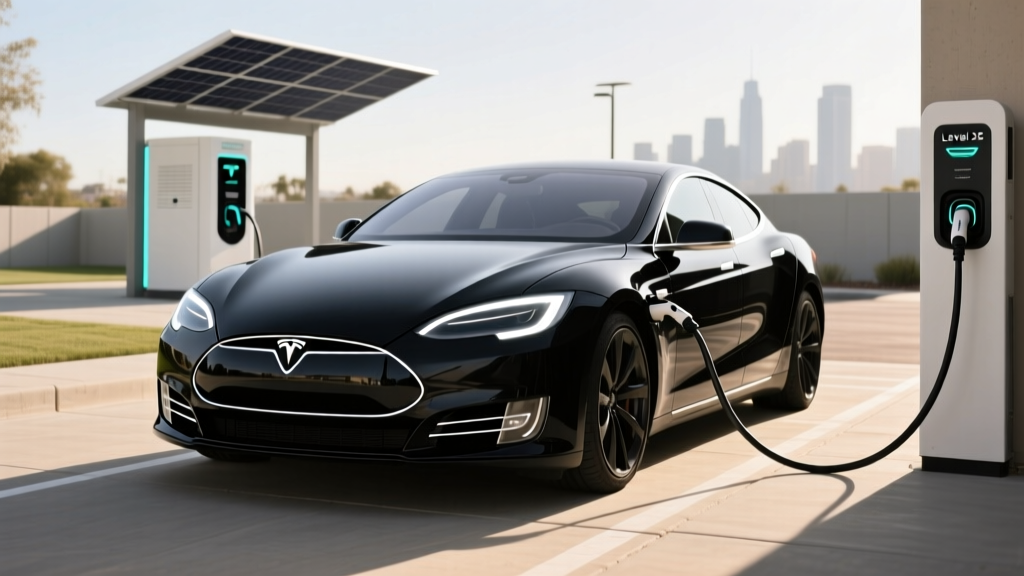
The Model S uses the NACS (North American Charging Standard) connector natively — the same connector Tesla pioneered and that most major automakers are now adopting. You'll have seamless access to the entire Supercharger network (over 25,000 stalls in North America), which remains the most reliable DC fast-charging ecosystem in the U.S.
Performance: The Numbers Behind the 1.99-Second Claim
The Model S Plaid's tri-motor powertrain (one front, two rear) produces 1,020 horsepower and achieves a manufacturer-claimed 1.99-second 0–60 mph time. This figure requires specific conditions: a prepped surface, rollout subtracted (the ~1-foot rollout standard used in drag racing), and the car in "Drag Strip" mode with battery preconditioned to optimal temperature.
In real-world roll-on acceleration from a stoplight on ordinary pavement, expect 2.3–2.5 seconds to 60 mph — still devastatingly quick and among the fastest production cars ever sold, regardless of powertrain. The quarter-mile passes in approximately 9.4 seconds at 152 mph under ideal conditions.
Beyond straight-line speed, the Plaid's torque-vectoring rear motors and carbon-sleeved rotors (which allow the electric motors to spin to 20,000 RPM without mechanical failure) deliver exceptional corner-exit acceleration. The adaptive air suspension lowers the car at speed for aerodynamics and can raise it for driveway clearance. It's a genuine sports sedan that happens to seat five adults.
Pricing, Trims, and Federal Tax Credit Eligibility
| Trim | Base MSRP | Destination | Total Before Incentives | §30D Credit Eligible? |
|---|---|---|---|---|
| Model S Long Range | $79,990 | $1,390 | $81,380 | No (exceeds MSRP cap) |
| Model S Plaid | $94,990 | $1,390 | $96,380 | No (exceeds MSRP cap) |
Tax credit reality check: Under current IRS §30D rules, new clean vehicle credits are capped at an MSRP of $55,000 for sedans. Both Model S trims far exceed this threshold, making them ineligible for the up-to-$7,500 federal purchase credit regardless of buyer income or battery sourcing.
If you're considering a used Model S (model year 2022 or earlier, at time of purchase), the separate §25E used clean vehicle credit offers up to $4,000 (30% of sale price, capped at $4,000) on vehicles priced at or below $25,000 — though finding a Model S at that price point limits selection to higher-mileage examples.
Some states offer additional incentives that don't carry the same MSRP caps — check your state's energy office or the AFDC state incentive database for specifics. California's CVRP, for example, has its own income-based rebate structure.
Interior, Tech, and Daily Livability
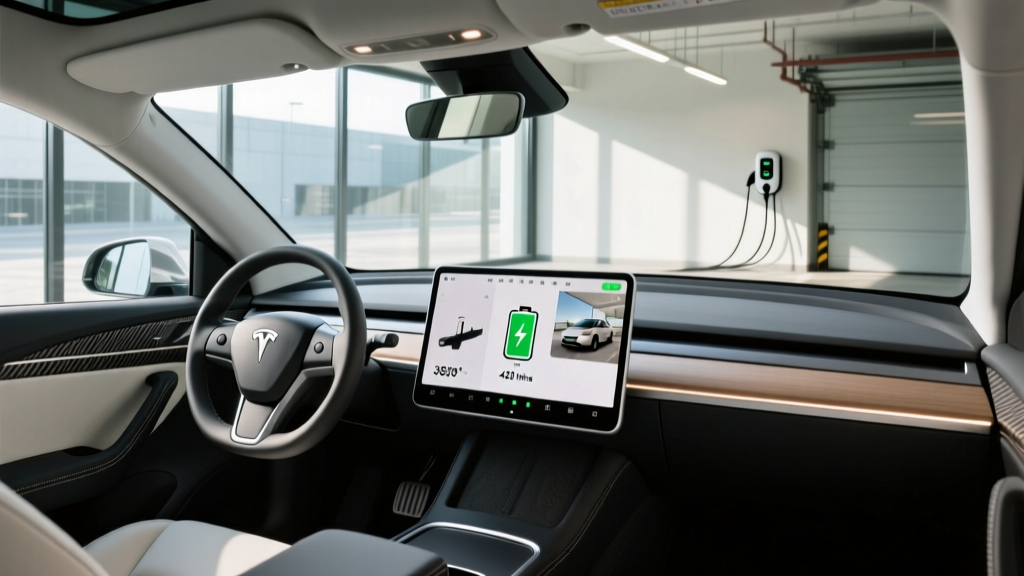
The Model S interior centers on a 17-inch landscape-oriented touchscreen that handles virtually all vehicle functions — climate, navigation, media, vehicle settings, and even the glovebox release. A secondary 8-inch rear touchscreen provides rear-seat passengers with climate control and entertainment. The yoke steering wheel remains standard on the Plaid (a conventional round wheel is available as a no-cost option).
Cargo and passenger space: The Model S offers 28 cubic feet of rear cargo space with seats up (expandable to roughly 55 cu ft with the 60/40 split rear seats folded), plus a 3.1 cu ft front trunk (frunk). Rear legroom measures 35.4 inches — adequate for adults on shorter trips but tighter than a Mercedes EQS or BMW i7. The hatchback-style liftback opening makes loading bulky items far easier than a traditional sedan trunk.
Driver assistance: Basic Autopilot (adaptive cruise control + lane centering) is standard. Full Self-Driving (Supervised) is a $8,000 option or $99/month subscription. To be clear, FSD is an SAE Level 2 system — you must remain attentive, keep hands on the yoke/wheel, and supervise at all times. It is not autonomous driving.
Notable drawbacks: The yoke steering is polarizing and requires adaptation for low-speed maneuvers and roundabouts. Build quality, while improved significantly since 2023, still shows minor panel-gap variance that luxury competitors at this price point typically avoid. The lack of physical buttons for climate and wipers frustrates some drivers. There's no heads-up display, a feature standard on rivals like the Lucid Air and Porsche Taycan.
Pros and Cons
Pros
- Unmatched acceleration — 1.99s 0–60 mph (Plaid)
- Access to the Supercharger network (most reliable DC charging in the US)
- Strong real-world range: 310–340 mi highway achievable
- Continuous OTA software updates add features over time
- Hatchback versatility + frunk for a sports sedan
- Tri-motor torque vectoring provides exceptional handling
- Heat pump standard for cold-climate efficiency
Cons
- No federal §30D tax credit (exceeds $55K sedan MSRP cap)
- Yoke steering polarizing; round wheel costs the same but must be ordered
- Rear seat legroom tighter than EQS, i7, or Lucid Air
- No heads-up display at this price point
- 250 kW peak charge rate trails 800V rivals (Taycan: 320 kW, Lucid: 300+ kW)
- FSD (Supervised) subscription adds cost without Level 3/4 autonomy
- Insurance premiums run 25–40% higher than comparable ICE sedans
Who Should Buy the Tesla Model S Performance / Plaid?
Choose the Model S Plaid if: You want the ultimate performance sedan with sub-2-second acceleration, need access to the Supercharger network for frequent road trips, value OTA software updates, and are willing to trade some rear-seat comfort and tax-credit eligibility for raw speed and tech.
Consider the Model S Long Range instead if: You want maximum range (396 mi EPA), still want 670 hp and a 3.1-second 0–60, and don't need tri-motor performance. You save $15,000 and gain 37 miles of range.
Look at competitors (Lucid Air, Porsche Taycan, BMW i7) if: You prioritize rear-seat luxury (i7), the longest possible range (Lucid Air Grand Touring at 516 mi EPA), faster 800V peak charging (Taycan at 320 kW), or want a more traditional luxury interior with physical controls and a HUD.
Battery Warranty and Long-Term Ownership
Tesla covers the Model S battery and drive unit with an 8-year / 150,000-mile warranty (whichever comes first), guaranteeing a minimum of 70% capacity retention over that period. The NMC chemistry in the Model S typically shows a degradation curve that drops roughly 5–8% in the first year or 20,000 miles, then flattens to roughly 1–2% loss per year thereafter. Real-world data from high-mileage Model S owners suggests ~85–90% State of Health at 100,000 miles is typical.
Out-of-warranty battery replacement currently runs approximately $13,000–$18,000 depending on the pack configuration and labor. Tesla also offers refurbished packs at lower cost when available.
Frequently Asked Questions
What is the real-world range of the Tesla Model S Plaid?
The EPA rates it at 359 miles. In real-world highway driving at 70–80 mph, expect 310–330 miles. In freezing weather, budget for 250–290 miles. City driving with regenerative braking can approach the EPA figure.
How fast does the Model S charge at home and on the road?
At home on a Level 2 Tesla Wall Connector (11.5 kW), you add roughly 34 miles per hour, reaching a full charge in about 10 hours. At a V3 or V4 Supercharger, peak rate is 250 kW, achieving 10–80% in approximately 30 minutes — adding up to 200 miles of range in 15 minutes under optimal conditions.
Does the 2026 Tesla Model S qualify for the federal EV tax credit?
No. Under current IRS §30D rules, the new clean vehicle credit caps sedan MSRP at $55,000. The Model S starts at $79,990 (Long Range) and $94,990 (Plaid), well above the limit. Buyer income limits and battery-sourcing requirements are moot since the MSRP cap alone disqualifies it. Check your state for separate incentives that may not carry the same MSRP restrictions.
Is the Model S Plaid worth it vs. the Lucid Air or Porsche Taycan?
It depends on your priorities. The Model S Plaid wins on straight-line acceleration (1.99s vs. Air Sapphire's ~2.0s and Taycan Turbo GT's ~2.1s) and Supercharger network access. The Lucid Air Grand Touring wins decisively on range (516 mi EPA) and efficiency. The Porsche Taycan wins on 800V charging speed (320 kW peak) and traditional build quality. All three exceed $100K as-tested, so the choice comes down to which trade-offs matter most to you.
What's the difference between the Model S Long Range and Plaid?
The Long Range uses a dual-motor AWD setup producing 670 hp with a 3.1-second 0–60 and 396 miles of EPA range, starting at $79,990. The Plaid adds a third rear motor for 1,020 hp, a 1.99-second 0–60, and 359 miles of range at $94,990. Unless you're tracking the car or need the ultimate performance statement, the Long Range is the more practical daily driver.
How long will the Model S battery last?
Tesla warranties the battery for 8 years or 150,000 miles at 70% minimum capacity retention. Real-world data suggests 85–90% State of Health at 100,000 miles with normal use. Many Model S vehicles have surpassed 200,000 miles on original packs. Avoid routinely charging to 100% (set daily limit to 80–90%) and minimize repeated DC fast charging to maximize longevity.