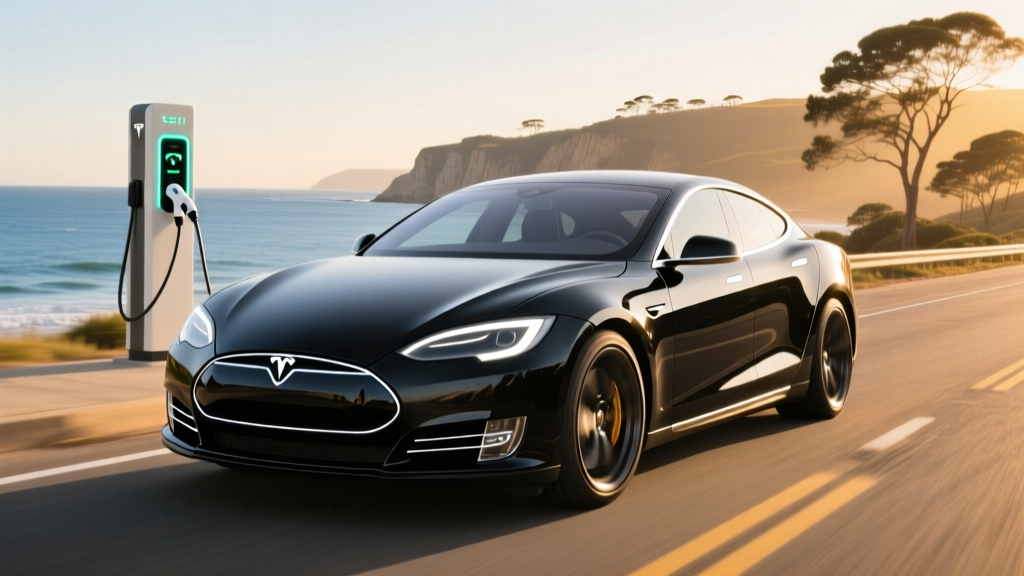
The Tesla Model S P90D occupies a unique space in the electric-vehicle market. Originally launched for the 2016 model year as Tesla's performance flagship, the P90D paired a 90 kWh battery with dual motors and the notorious "Ludicrous Mode" acceleration. By 2026, it no longer rolls off the Fremont production line — Tesla replaced it with updated powertrains and eventually the refreshed Model S architecture — but thousands remain on the road and in the used-EV market. For buyers considering a pre-owned P90D, or current owners looking to benchmark their vehicle, this profile covers the real numbers that matter: range, charging behavior, degradation realities, and whether the federal used-EV tax credit can still apply.
Quick Verdict: Who the Model S P90D Is For
The P90D suits performance-minded drivers who want a large luxury sedan with explosive acceleration and access to Tesla's Supercharger network, but who are comfortable buying used and accepting an older battery architecture. It is not the most efficient Model S Tesla ever built, and its DC fast-charge speeds trail modern 800-volt competitors significantly. However, its 0-60 mph time of 2.8 seconds (with Ludicrous Mode) still humiliates most new performance sedans, and the cabin offers genuine long-distance comfort with 26.3 cubic feet of cargo space behind the rear seats.
Choose the Model S P90D if: You want sub-3-second acceleration, a proven dual-motor AWD system, and Supercharger access at a used-EV price point below $35,000.
Look elsewhere if: You prioritize ultra-fast DC charging (250+ kW), the latest ADAS hardware (HW4), or a new-vehicle battery warranty.
Range, Efficiency, and Real-World Expectations
EPA Estimated Range: 268 miles (combined cycle)
Real-World Expectation: Expect approximately 230–250 miles in mixed highway driving at 70–80 mph. In cold weather (below 32°F), range can drop to 190–210 miles due to battery resistance and cabin heating demands. City driving with regenerative braking recovers energy more effectively, often yielding 255–270 miles in stop-and-go conditions.
The 268-mile EPA figure was impressive in 2016, but efficiency standards and competitor ranges have moved on. The P90D's 90 kWh battery pack (approximately 85 kWh usable, with the remainder reserved as a buffer to protect longevity) delivers roughly 32 kWh per 100 miles in mixed driving — translating to about 104 MPGe combined, per fueleconomy.gov. That efficiency figure is notably worse than the 2026 Model S Long Range, which achieves around 124 MPGe thanks to improved aerodynamics, a heat pump, and a more efficient drive unit.
Highway range is the P90D's weakest real-world scenario. At sustained 75 mph, aerodynamic drag and the older induction front motor (which lacks the disconnect clutch found on newer Model S variants) consume energy faster than the EPA combined cycle suggests. On a 300-mile road trip, plan for two Supercharger stops rather than one.
Battery Chemistry, Capacity, and Degradation
| Specification | Value |
|---|---|
| Battery Chemistry | NMC (Nickel Manganese Cobalt) |
| Total Pack Capacity | 90 kWh |
| Usable Capacity | ~85 kWh |
| Thermal Management | Active liquid cooling/heating |
| Battery Warranty (Original) | 8 years / 150,000 miles |
| Warranty Capacity Threshold | 70% retention |
The P90D uses an NMC lithium-ion pack, which offers higher energy density than LFP (lithium iron phosphate) but is more sensitive to sustained high states of charge and extreme temperatures. For daily use, Tesla recommends charging to 80–90% and only charging to 100% when a long trip requires it. This practice meaningfully slows degradation.
Based on aggregated fleet data from sources like TeslaFi and independent analyses, a well-maintained P90D battery at 100,000 miles typically retains 85–90% of its original capacity. That translates to roughly 225–240 miles of real-world range at that mileage. Units that were frequently Supercharged to 100% or regularly exposed to extreme heat without preconditioning show steeper drops, sometimes approaching the 70% warranty threshold by 120,000–140,000 miles.
Replacement cost for a P90D battery pack in 2026 ranges from $12,000 to $18,000 through Tesla service centers, though third-party refurbishers offer remanufactured packs for $8,000–$12,000. This is a significant ownership risk for high-mileage examples.
Charging Speeds: DC Fast Charge and Home Level 2
| Charging Level | Power / Rate | Speed | Notes |
|---|---|---|---|
| Level 1 (120V) | ~1.4 kW | ~3–4 miles/hour | Emergency only; 30+ hours for full charge |
| Level 2 (240V, 48A) | ~11.5 kW | ~29 miles/hour | Full charge in ~8 hours; recommended home setup |
| Level 2 (240V, 72A dual charger) | ~17.3 kW | ~44 miles/hour | Optional onboard dual charger; requires 90A+ circuit |
| DC Fast Charge (Supercharger V2) | Peak ~120 kW | 10–80% in ~40 minutes | Tapers significantly above 60% SoC |
| DC Fast Charge (Supercharger V3) | Peak ~140 kW (limited) | 10–80% in ~35 minutes | P90D cannot use full 250 kW V3 rate |
The P90D's charging architecture is its most visible age marker in 2026. Its peak DC fast-charge rate of approximately 120–140 kW is roughly half what modern 800-volt EVs (Hyundai Ioniq 5, Porsche Taycan, Kia EV6) sustain. The charge curve is relatively flat from 10–50% SoC, then tapers steadily. On a V3 Supercharger rated for 250 kW, the P90D's older battery management system caps the draw, meaning you will not see anywhere near the stall's maximum output.
For home charging, the single onboard charger (48 amps) delivers about 11.5 kW, adding roughly 29 miles of range per hour. An overnight session from 20% to 80% takes about 5 hours. Some P90D examples were optioned with Tesla's dual onboard charger, enabling 72-amp Level 2 charging at 17.3 kW — but this requires a dedicated 90-amp or 100-amp circuit, which adds $500–$1,500 to a home installation depending on your electrical panel's capacity.
One critical note: preconditioning the battery before a Supercharger stop is essential. The P90D's thermal management system needs 10–15 minutes of navigation-directed preconditioning to warm the pack and enable peak charge rates. Without it, you may see charge speeds limited to 60–80 kW for the first several minutes.
Performance: Acceleration, Drivetrain, and Handling
| Performance Metric | Model S P90D |
|---|---|
| 0–60 mph | 2.8 seconds (Ludicrous Mode) |
| Horsepower | ~532 hp (combined) |
| Torque | ~713 lb-ft |
| Drivetrain | Dual-motor AWD |
| Front Motor | Induction (259 hp) |
| Rear Motor | Induction (503 hp) |
| Top Speed | 155 mph |
The P90D's headline number remains its acceleration. In Ludicrous Mode, the 2.8-second 0–60 mph time was supercar territory in 2016 and still outpaces most 2026 performance sedans. The dual induction motors provide instant torque vectoring across all four wheels, and the AWD system manages traction without the mechanical complexity of a traditional all-wheel-drive drivetrain.
However, induction motors are less efficient than the permanent-magnet synchronous motors Tesla adopted in later Model S refreshes (and in the Model 3/Y). The front motor, in particular, draws power even when cruising, contributing to the P90D's lower efficiency compared to newer variants that can disconnect the front motor under light load.
Ride quality benefits from the standard adaptive air suspension, which offers adjustable ride height and damping. On the highway, the P90D is composed and quiet. On rough surfaces, the suspension can feel firm, particularly with the 21-inch turbine wheels that many P90Ds were optioned with.
Interior, Cargo, and Technology
The P90D's cabin reflects Tesla's minimalist philosophy, though the 2016-era interior materials draw mixed reviews compared to contemporaries from Mercedes-Benz and BMW. The 17-inch portrait touchscreen remains the centerpiece, controlling virtually all vehicle functions. The instrument cluster is a small digital display behind the steering wheel, lacking the configurable richness of newer Model S iterations.
| Dimension | Measurement |
|---|---|
| Cargo Volume (rear seats up) | 26.3 cu ft |
| Cargo Volume (rear seats folded) | 58.1 cu ft |
| Frunk (front trunk) | 5.3 cu ft |
| Rear Legroom | 35.4 inches |
| Front Headroom | 38.8 inches |
| Seating Capacity | 5 passengers |
The liftback design and flat floor make the P90D genuinely practical for cargo, and the 5.3-cubic-foot frunk adds useful storage for charging cables or a small bag. Rear-seat legroom is adequate for adults, though the sloping roofline cuts into headroom for passengers over six feet tall.
On the technology front, the P90D originally shipped with Tesla's Hardware 2 (HW2) Autopilot computer, which supports basic Autopilot features (Traffic-Aware Cruise Control, Autosteer) but cannot run the latest Full Self-Driving (Supervised) software. Some P90Ds received hardware upgrades to HW2.5 or HW3 through Tesla service campaigns, but this is not universal. Buyers should verify the Autopilot hardware version before purchasing, as it determines which driver-assist features are available.
ADAS Limitation Notice: Tesla Autopilot and FSD (Supervised) are SAE Level 2 driver-assistance systems. The driver must remain fully attentive, keep hands on the wheel, and be prepared to take over at any moment. These systems do not make the vehicle self-driving.
Pricing, Used Market, and Federal Tax Credit Eligibility
The Model S P90D is no longer available new. When it was in production (2016–2017), the base MSRP started around $104,500, with typical as-tested prices reaching $115,000–$130,000 depending on options like Ludicrous Mode, Premium Interior, and the dual onboard charger.
In the 2026 used-EV market, P90D pricing ranges from approximately $24,000 to $38,000, depending on mileage, condition, battery state of health, and Autopilot hardware. Low-mileage examples with confirmed battery health above 90% command premiums at the top of that range.
| Scenario | Estimated Price |
|---|---|
| Used P90D (high mileage, 80k+ mi) | $24,000–$28,000 |
| Used P90D (moderate mileage, 40k–80k mi) | $28,000–$34,000 |
| Used P90D (low mileage, under 40k mi) | $34,000–$38,000 |
| Federal Used EV Tax Credit (§25E) | Up to $4,000 (30% of sale price, max $4,000) |
| Effective Price After Max Credit | As low as $20,000 |
The federal used-EV tax credit (IRS §25E) can apply to the P90D if several conditions are met:
- The sale price must be $25,000 or less to qualify for the full $4,000 credit (30% of $25,000 = $7,500, but the cap is $4,000). Vehicles priced between $25,001 and roughly $13,333 receive a prorated credit.
- Buyer income must not exceed $75,000 (single), $112,500 (head of household), or $150,000 (joint filers) — based on modified adjusted gross income.
- The vehicle must be at least two model years old (easily satisfied for the P90D).
- The vehicle must be purchased from a licensed dealer (private-party sales do not qualify).
- The buyer must not have claimed the used-EV credit in the prior three years.
This means a P90D priced at $24,500 from a qualifying dealer could net a $4,000 credit for an income-eligible buyer, bringing the effective cost to $20,500 — a compelling value for a 532-hp luxury sedan. However, many P90Ds sell above $25,000, which phases out the credit. Always verify eligibility with a tax professional before relying on the credit in your purchase decision.
Note: The new-vehicle federal tax credit (§30D) does not apply, as the P90D is no longer sold new. The §30D credit is relevant only for current-production EVs and carries its own MSRP, income, and battery-sourcing requirements.
Warranty and Ownership Costs
The original battery and drive unit warranty on the P90D was 8 years / 150,000 miles with a 70% minimum capacity retention threshold. By 2026, most P90Ds have exceeded the 8-year mark, meaning the battery warranty has expired for the majority of examples on the market. Some low-mileage 2017 models may still have residual warranty coverage through mid-2025 at the latest.
Without warranty coverage, battery replacement is the single largest financial risk. Budget $12,000–$18,000 for a Tesla-sourced replacement or $8,000–$12,000 for a third-party refurbished pack. Drive unit replacements are less common but run $4,000–$7,000 if needed.
Insurance premiums for the P90D tend to run 15–30% higher than comparable non-performance luxury sedans, reflecting the vehicle's acceleration capability and Tesla-specific repair costs. Expect annual premiums of $2,200–$3,500 depending on your driving record, location, and coverage level.
Tire costs are another ownership reality: the P90D's weight (~4,900 lbs) and instant torque wear through tires faster than internal-combustion sedans. Budget $1,200–$2,000 for a set of four premium all-season or summer tires every 25,000–35,000 miles.
Pros and Cons
Pros
- Sub-3-second 0–60 mph acceleration still elite in 2026
- Access to Tesla Supercharger network (NACS connector native)
- Generous cargo space (26.3 cu ft + 5.3 cu ft frunk)
- Over-the-air software updates still supported for core features
- Used-EV tax credit eligibility can bring price below $21,000
- Adaptive air suspension standard
- Dual-motor AWD with strong all-weather capability
Cons
- DC fast-charge speed (peak ~120–140 kW) trails modern EVs significantly
- Battery warranty expired on most examples; replacement cost $12k–$18k
- Older Autopilot hardware (HW2) limits driver-assist capabilities
- Efficiency (104 MPGe / 32 kWh/100mi) below newer Model S variants
- Interior materials and build quality inconsistent vs. German competitors
- No heat pump; cabin heating reduces winter range more than newer EVs
- High tire wear due to weight and torque
Model S P90D vs. Key Competitors
| Spec | Tesla Model S P90D (2016) | Tesla Model S Long Range (2026) | Lucid Air Pure (2026) | Porsche Taycan 4S (2026) |
|---|---|---|---|---|
| EPA Range | 268 mi | 402 mi | 419 mi | 288 mi |
| Battery | 90 kWh NMC | 100 kWh NMC | 88 kWh NMC | 83.7 kWh NMC |
| Peak DC Charge | ~120–140 kW | 250 kW | 300+ kW | 270 kW |
| 0–60 mph | 2.8 sec | 3.0 sec | 5.2 sec | 3.8 sec |
| Price (2026) | $24k–$38k (used) | ~$79,990 (new) | ~$69,900 (new) | ~$91,000 (new) |
| Warranty | Expired (most) | 8 yr / 150k mi | 8 yr / 100k mi | 8 yr / 100k mi |
The P90D's value proposition is clear: you get 90% of the acceleration of a new Model S Plaid for roughly one-quarter of the price, but you sacrifice range, charging speed, warranty coverage, and modern driver-assist hardware. If your budget stretches to $70,000+, the Lucid Air Pure offers vastly superior range and charging. If you want a used performance EV with lower battery-replacement risk, a 2020+ Model S Long Range with remaining warranty is a safer bet, though it costs $40,000–$55,000 on the used market.
Frequently Asked Questions
What is the real-world range of the Tesla Model S P90D?
The EPA rates the P90D at 268 miles combined. In real-world highway driving at 70–80 mph, expect 230–250 miles. In cold weather below freezing, range can drop to 190–210 miles. City driving with regenerative braking can approach or slightly exceed the EPA figure.
How fast does the P90D charge at home and on DC fast chargers?
At home on a 240V/48A Level 2 charger, the P90D charges at about 11.5 kW, adding roughly 29 miles of range per hour (full charge in ~8 hours). On a DC fast charger, it peaks at approximately 120–140 kW, with a 10–80% session taking about 35–40 minutes. Charge speed tapers significantly above 60% state of charge.
Does the Model S P90D qualify for any federal tax credit?
As a used vehicle, the P90D may qualify for the federal used clean vehicle credit (§25E), which offers up to $4,000 (30% of the sale price). To qualify, the sale price must be $25,000 or less, the buyer must meet income caps ($75k single / $150k joint), and the purchase must be through a licensed dealer. The new-vehicle §30D credit does not apply. Consult a tax professional to confirm eligibility.
Is the P90D's battery warranty still active?
The original battery warranty was 8 years / 150,000 miles. Since the P90D was produced in 2016–2017, the time-based warranty has expired for virtually all examples by 2026. Any remaining coverage would be mileage-based on very low-mileage 2017 examples. Budget for potential battery replacement at $12,000–$18,000.
Is the Tesla Model S P90D worth buying in 2026?
It depends on your priorities. If you want explosive acceleration, Supercharger access, and a practical luxury sedan for under $30,000 (potentially under $21,000 after the used-EV credit), the P90D is a compelling choice. However, you accept slower charging, expired battery warranty, older driver-assist hardware, and lower efficiency than modern alternatives. It is best suited as a secondary vehicle or for buyers who can self-insure against battery replacement costs.
Can the P90D use Tesla Supercharger V3 and V4 stalls?
Yes, the P90D can physically connect to any Supercharger using its native NACS connector. However, the vehicle's battery management system limits charge rates to approximately 120–140 kW, so you will not see the full 250 kW (V3) or higher rates that newer Teslas support. The charging experience is compatible but not optimized for the newest infrastructure.
What Autopilot hardware does the P90D have?
Most P90Ds shipped with Tesla Hardware 2 (HW2), which supports basic Autopilot (Traffic-Aware Cruise Control and Autosteer) but cannot run Full Self-Driving (Supervised). Some units received upgrades to HW2.5 or HW3 through service campaigns. Always verify the hardware version in the vehicle's software menu before purchasing, as it directly affects available driver-assist features.
Sources: U.S. EPA / fueleconomy.gov, IRS Used Clean Vehicle Credit (§25E), Tesla Vehicle Warranty.