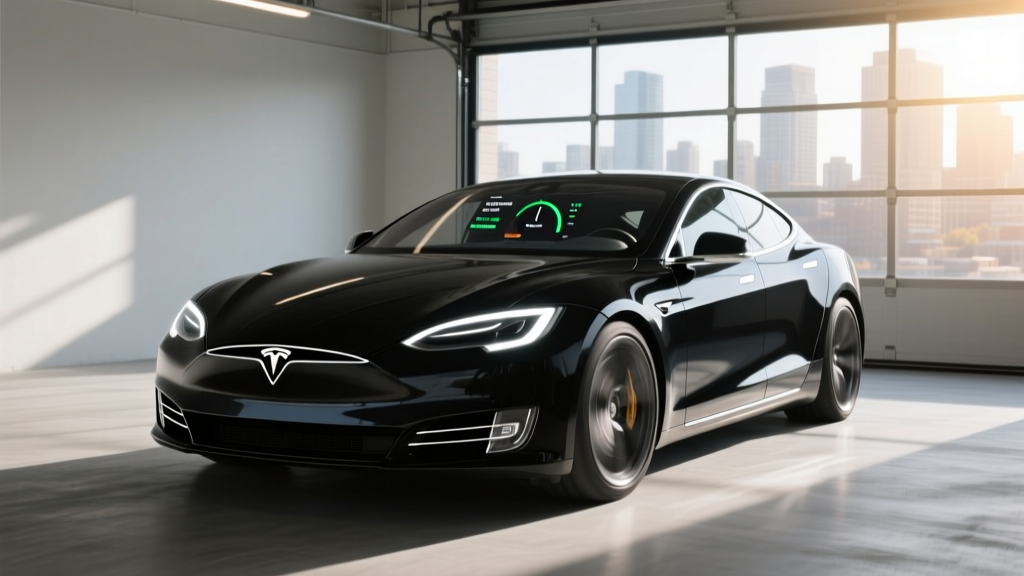
The Tesla Model S P100D occupies a singular place in electric-vehicle history: it was the car that proved a battery-electric sedan could outrun a Lamborghini at stoplights while carrying four adults and their luggage across state lines. Though Tesla discontinued the P100D badge after the 2019 model year — replacing it with the current Plaid and Long Range trims — the P100D remains one of the most searched legacy EVs on the used market. Buyers want to know exactly what Model S P100D horsepower looks like in practice, what real-world range they can expect from a battery that is now several years old, and whether the 2026 used-EV tax credit makes one a smart buy.
This profile covers the final 2019 Model S P100D specifications, real-world ownership data, charging performance, and how it stacks up against today's Model S Long Range and competitors like the Lucid Air and Porsche Taycan. If you are shopping the used market in 2026, this is the spec sheet you need.
Tesla Model S P100D at a Glance: Full Spec Table
| Specification | Value |
|---|---|
| Horsepower (Ludicrous+) | 762 hp (combined dual-motor) |
| Torque | 791 lb-ft |
| 0–60 mph | 2.5 seconds (with rollout) |
| Top Speed | 155 mph |
| Drivetrain | Dual-motor AWD |
| Battery Capacity | 100 kWh (usable ~95 kWh) |
| Battery Chemistry | NMC (Nickel Manganese Cobalt) |
| EPA Range | 315 miles |
| MPGe (combined) | 98 MPGe |
| Efficiency | 34 kWh / 100 mi |
| Max DC Fast Charge | ~120 kW (Supercharger V2 era) |
| 10–80% DC Charge Time | ~45–50 minutes |
| Level 2 Home Charge Rate | 11.5 kW (48A) — ~34 mi/hr |
| Cargo Volume | 26.3 cu ft (rear) + ~5.3 cu ft (frunk) |
| Seating | 5 adults (optional 3rd-row for 7, rarely equipped) |
| Battery Warranty (original) | 8 years / 150,000 miles |
| Original MSRP (2019) | ~$136,200 (before incentives) |
| 2026 Used Market Range | $38,000 – $58,000 (depending on miles & battery SoH) |
Model S P100D Horsepower and Performance Deep Dive
The headline number is 762 horsepower, but that figure requires context. Tesla's P100D uses a dual-motor setup — a rear induction motor rated around 503 hp paired with a front induction motor producing approximately 259 hp. The combined system output of 762 hp is achievable in Ludicrous+ mode with a fully preconditioned battery at high state of charge (above 95%).
In everyday driving without Ludicrous+ engaged, the P100D still delivers roughly 670 hp, which is more than enough to merge onto any freeway with authority. The 2.5-second 0–60 mph time made it the quickest production sedan in the world at launch, a title it held until the Model S Plaid arrived in 2021 with its 1,020 hp tri-motor layout.
What separates the P100D from internal-combustion supercars producing similar power is instant torque delivery. There is no turbo spool-up, no transmission downshift, no power-band sweet spot — you get maximum thrust from 0 rpm. This makes the P100D feel even quicker than its 762 hp suggests in real-world passing and city driving scenarios.
Performance vs. Current Competitors
| Model | Horsepower | 0–60 mph | Drivetrain |
|---|---|---|---|
| Tesla Model S P100D (2019) | 762 hp | 2.5s | Dual-motor AWD |
| Tesla Model S Plaid (2026) | 1,020 hp | 1.99s | Tri-motor AWD |
| Tesla Model S Long Range (2026) | 670 hp | 3.1s | Dual-motor AWD |
| Lucid Air Grand Touring (2026) | 1,050 hp | 3.0s | Dual-motor AWD |
| Porsche Taycan Turbo S (2026) | 750 hp (overboost) | 2.4s | Dual-motor AWD |
Real-World Range: What 315 EPA Miles Actually Means
Real-World Expectation: 250–280 miles in mixed highway driving at 70+ mph; 200–230 miles in freezing temperatures (below 32°F); up to 300+ miles in city/regenerative-heavy driving at moderate temperatures.
The P100D's 315-mile EPA rating was impressive for 2019, but real-world range depends heavily on driving style, speed, and climate. At sustained highway speeds of 75–80 mph, expect to use 36–38 kWh per 100 miles, which brings effective range down to roughly 250–265 miles. Tesla's trip planner tends to be optimistic by 5–10% on long highway runs.
Cold weather is the P100D's biggest range adversary. The NMC battery pack loses efficiency in freezing conditions, and cabin heating draws significant energy (the P100D predates Tesla's heat pump, which arrived with the 2021 refresh). In sub-30°F conditions, plan for 25–35% range reduction, meaning a 315-mile EPA car may deliver only 200–220 miles on a cold winter highway trip.
Battery degradation is another factor for used buyers. According to Tesla's own 2024 Impact Report, Model S/X batteries retain approximately 88% of original capacity at 150,000 miles. A 2019 P100D with 80,000 miles and 92% state of health (SoH) would have an effective usable capacity of roughly 87 kWh, reducing real-world range proportionally. Always request a battery health reading before purchasing.
Charging Speed: DC Fast and Home Level 2
The P100D was designed for Tesla's V2 Supercharger network, which maxes out at 150 kW at the pedestal but sees the car accept roughly 120 kW peak. This is a significant limitation compared to modern EVs that charge at 250–350 kW.
| Charging Level | Power | Speed / Time |
|---|---|---|
| Level 1 (120V outlet) | ~1.4 kW | ~4 miles per hour |
| Level 2 (240V / 48A) | 11.5 kW | ~34 miles per hour |
| DC Fast (V2 Supercharger) | ~120 kW peak | 10–80% in ~45–50 min |
| DC Fast (V3 Supercharger) | ~120 kW peak (car-limited) | 10–80% in ~45–50 min (no V3 benefit) |
The charge curve matters as much as peak rate. The P100D hits its ~120 kW peak between roughly 10–30% SoC, then tapers progressively. By 60% SoC, you are seeing around 70–80 kW; above 80%, charging slows dramatically to protect the battery. A full 10–80% session takes approximately 45–50 minutes at a V2 or V3 Supercharger — the car's onboard charge management, not the station, is the bottleneck.
For home charging, a Level 2 wall connector at 48 amps (11.5 kW) will replenish a depleted 100 kWh pack in roughly 9–10 hours. Most P100D owners charge overnight and wake to a full battery every morning, which is the ideal EV ownership pattern.
Note: The P100D uses Tesla's proprietary connector (now standardized as NACS). CCS adapters are available from Tesla for use on non-Tesla DC fast-charging networks like Electrify America.
Pricing, Tax Credits, and Used-Market Value in 2026
The P100D left production with an MSRP of approximately $136,200 (including destination). On the 2026 used market, examples typically list between $38,000 and $58,000, depending on mileage, condition, battery SoH, and whether the car has Enhanced Autopilot or Full Self-Driving (Supervised) capability.
Here is where the federal used-EV tax credit (IRS §25E) becomes relevant. This credit offers up to $4,000 (or 30% of the sale price, whichever is lower) for qualifying used EVs purchased from a licensed dealer.
| Sale Price Cap | Must be $25,000 or less |
| Buyer Income Cap (AGI) | $75,000 single / $112,500 head of household / $150,000 joint |
| Vehicle Age | Must be at least 2 model years old (2019 P100D qualifies) |
| Dealer Sale Required | Private-party sales do not qualify |
| Maximum Credit | $4,000 or 30% of sale price, whichever is less |
| Transferable at POS | No — claimed on tax return (unlike §30D new-vehicle credit) |
The $25,000 sale price cap is the critical hurdle. Most 2019 P100D examples sell well above $25,000, which means the majority of buyers will not qualify for the used-EV credit. If you can find a high-mileage P100D listed at or below $25,000 from a dealer — rare but not impossible — the credit could bring your effective cost down by up to $4,000. Consult a tax professional to confirm eligibility for your situation.
The new-vehicle §30D credit ($7,500) does not apply to used purchases and is not retroactive. The P100D also exceeded the original MSRP cap for sedans ($55,000) when new, so it never qualified for the new-vehicle credit during its production run.
Interior, Cargo, and Daily Livability
The pre-refresh Model S interior is a study in minimalism — a 17-inch center touchscreen dominates the dash, with virtually no physical buttons. Build quality on 2019 examples improved over earlier years but still falls short of German luxury rivals. Expect some panel-gap variation and occasional rattles on higher-mileage cars.
Cargo capacity is a genuine strength: 26.3 cubic feet behind the rear seats (hatchback-style liftgate) plus approximately 5.3 cubic feet in the front trunk (frunk). That totals over 31 cubic feet with all seats in place — more than most midsize SUVs. Fold the rear seats and you approach 58 cubic feet of flat load space.
Legroom is generous for four adults (42.7 inches front / 35.4 inches rear), though the optional rear-facing third row (for small children only) eats into cargo space and was rarely ordered. The wide, flat floor and absence of a transmission tunnel make the rear middle seat genuinely usable for an adult on shorter trips.
Technology, Autopilot, and Software
The P100D runs Tesla's continuously updated software, which in 2026 includes features not available when the car was new: theater mode for streaming, improved navigation with real-time Supercharger availability, and enhanced battery preconditioning for faster charging.
Autopilot hardware varies by build date. Early 2019 P100Ds shipped with Hardware 2.5; later examples may have Hardware 3.0 (the computer required for Tesla's current FSD Supervised neural networks). Verify the hardware version before purchasing — HW3.0 cars receive more advanced driver-assist features. Tesla has offered HW3.0-to-HW4.0 retrofit upgrades for some vehicles, though availability and cost vary.
Tesla Autopilot and FSD (Supervised) are Level 2 driver-assistance systems per the SAE J3016 scale. The driver must remain fully engaged, keep hands on the wheel, and monitor the road at all times. These systems do not make the car self-driving.
Notable tech features include over-the-air updates, Sentry Mode (360° parking surveillance), Dog Mode (climate control for pets), and the Tesla mobile app for remote preconditioning and charge monitoring. The P100D's air suspension provides adjustable ride height and automatic lowering at highway speeds for improved efficiency.
Pros and Cons: The P100D Verdict
Pros
- 762 hp and 2.5-second 0–60 remain thrilling in 2026
- 315-mile EPA range still adequate for most road trips
- Massive cargo space (31+ cu ft combined) with hatchback utility
- Access to Tesla's Supercharger network (most reliable in the US)
- Continuous OTA software updates add features years after purchase
- Air suspension provides excellent ride comfort and adjustable height
Cons
- Peak DC charge rate of ~120 kW is slow by 2026 standards
- No heat pump — cold-weather range loss is significant
- Pre-refresh interior build quality lags behind Porsche, Lucid, Mercedes
- High-mileage battery replacement costs $15,000–$22,000 if out of warranty
- Insurance premiums remain elevated for high-performance EVs
- Most used examples exceed the $25,000 cap for the §25E used-EV credit
- Regenerative braking is not adjustable (one-pedal or coast — no blend)
Who Should Buy the Model S P100D in 2026?
- You want supercar-rivaling acceleration at a used-EV price point ($40K–$55K)
- You need a five-passenger sedan with genuine cargo-hauling capability
- You road-trip frequently and value the Supercharger network
- You can charge at home and don't mind 45-minute DC fast-charge stops
- Fast charging is a priority (consider a 2024+ Model S Long Range at 250 kW peak)
- You live in a cold climate and need maximum winter range (a heat-pump-equipped EV is better)
- Interior luxury and build quality are non-negotiable (Porsche Taycan, Lucid Air)
- You need the latest hardware and safety architecture (post-2021 refresh Model S)
Frequently Asked Questions
What is the real-world range of the Model S P100D?
The EPA rates it at 315 miles. In real-world mixed highway driving at 70–75 mph, expect 250–280 miles. In freezing weather, plan for 200–230 miles due to the lack of a heat pump and NMC battery cold-weather inefficiency. Battery degradation on used examples will further reduce these numbers proportionally to the pack's state of health.
How fast does the P100D charge at home and on the road?
At home on a Level 2 (240V/48A) charger, the P100D adds approximately 34 miles of range per hour, fully recharging overnight in about 9–10 hours. On DC fast chargers (Supercharger V2 or V3), peak rate is approximately 120 kW, with a 10–80% session taking 45–50 minutes. The car cannot take advantage of V3's 250 kW capability due to its older charge architecture.
Does a used Model S P100D qualify for any federal tax credit?
Possibly, but it is difficult. The IRS §25E used clean vehicle credit offers up to $4,000, but the vehicle must be sold by a dealer for $25,000 or less, and the buyer must meet income caps ($75K single / $150K joint). Most P100Ds sell above $25,000, disqualifying them. Always verify the exact sale price and your AGI with a tax professional before counting on the credit. See IRS §25E guidelines.
Is the Model S P100D worth buying vs. a new Model S Long Range?
It depends on your priorities. A 2026 Model S Long Range starts around $79,990, offers 402 miles of EPA range, charges at up to 250 kW, includes a heat pump, and features the refreshed interior with a rear touchscreen. The P100D costs roughly half as much on the used market and delivers more horsepower (762 vs. 670), but sacrifices charging speed, cold-weather range, and modern interior quality. For budget-conscious performance seekers who charge at home, the P100D is compelling. For road-trippers who want the latest tech, the new Long Range is the better investment.
How long will the P100D battery last?
Tesla's original warranty covers the battery for 8 years or 150,000 miles, whichever comes first, with a minimum 70% capacity retention threshold. A 2019 P100D's warranty expires in 2027 at the latest. Tesla's fleet data shows Model S/X packs retaining roughly 88% capacity at 150,000 miles. Out-of-warranty battery replacements run $15,000–$22,000. Before buying used, request a battery health report and check for any open warranty claims.
What is the Model S P100D's efficiency in MPGe?
The EPA rates the P100D at 98 MPGe combined (92 city / 105 highway). In energy terms, it consumes approximately 34 kWh per 100 miles. This is less efficient than the current Model S Long Range (roughly 28 kWh/100 mi) due to the heavier 100 kWh pack and older powertrain, but still competitive with performance EVs like the Taycan Turbo S.
Sources: EPA Fuel Economy — 2019 Tesla Model S P100D, IRS Used Clean Vehicle Credit (§25E), Tesla Owner's Manual and spec archive.