The Quick Verdict: Does the P100D Still Deliver?
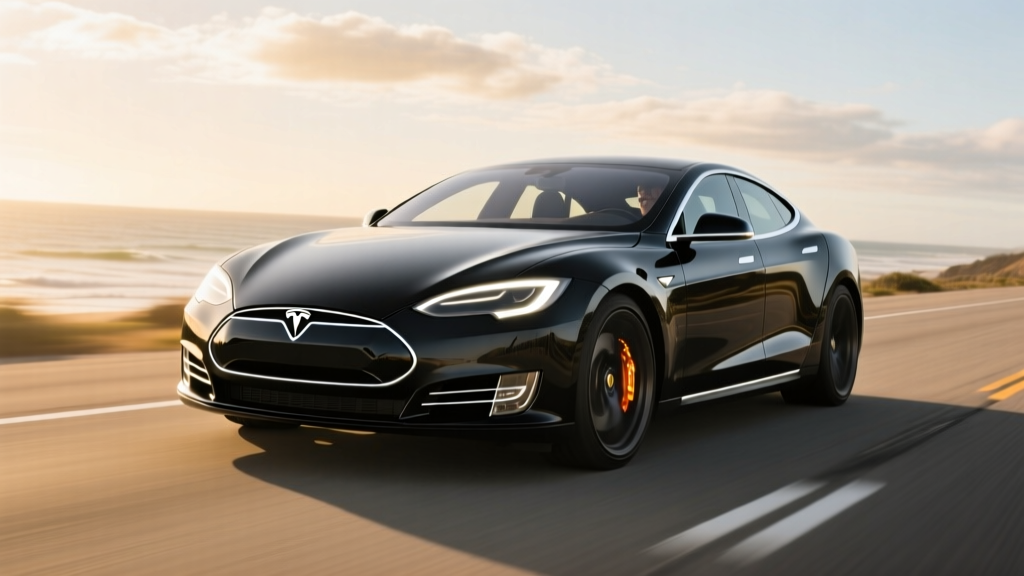
The Tesla Model S P100D occupies a unique space in EV history. When it launched for the 2017 model year, its claimed 0-60 mph time of 2.3 seconds (with rollout) made it the quickest production sedan on the planet — a title that forced every legacy automaker to rethink performance engineering. Nearly a decade later, the P100D remains a benchmark in the used-EV market, and its acceleration still outpaces most new cars you can buy today.
But raw speed is only part of the story. As a daily driver in 2026, the P100D presents a mix of enduring strengths and age-related compromises. The 100 kWh battery pack still delivers strong range, the Supercharger network advantage remains real, and the interior — while showing its years — offers space that newer competitors struggle to match. If you're evaluating a used P100D, this profile gives you the exact numbers you need to decide.
Note: Tesla discontinued the P100D designation after the 2019 model year, replacing it with Performance and later Plaid trims. This review covers the P100D as a used-EV purchase, with current market context and ownership realities.
Tesla Model S P100D 0-60 and Performance Specs
The headline number is the one everyone searches for. Tesla's official claim for the P100D is a 0-60 mph time of 2.3 seconds when using the 1-foot rollout measurement standard common in drag racing. Independent testing by outlets like Motor Trend and Car and Driver recorded times between 2.28 and 2.5 seconds depending on surface conditions, tire temperature, and state of charge.
Without rollout, the 0-60 time sits closer to 2.5–2.7 seconds — still extraordinary for a 4,900-pound luxury sedan. For context, that puts the P100D in supercar territory: faster to 60 mph than a contemporary Lamborghini Huracán or Porsche 911 Turbo S.
| Specification | Value |
|---|---|
| 0-60 mph (with rollout) | 2.3 seconds |
| 0-60 mph (without rollout) | ~2.5–2.7 seconds |
| Quarter-mile | ~10.5 seconds @ 125 mph |
| Horsepower (combined) | ~670 hp (peak) |
| Torque (combined) | ~791 lb-ft (peak) |
| Drivetrain | Dual-motor AWD |
| Top Speed | 155 mph (electronically limited) |
The P100D uses Tesla's dual-motor all-wheel-drive layout: a smaller induction motor up front and a larger rear motor. Both are AC induction (not permanent-magnet), which was Tesla's standard architecture before the Model 3 introduced the permanent-magnet rear motor. The Ludicrous mode — standard on the P100D — unlocks the full power output by allowing the battery to discharge at maximum C-rate, drawing peak current from the 100 kWh pack.
A practical note: achieving peak 0-60 times requires a state of charge above 90%, warm battery temperatures (ideally preconditioned), and dry pavement. At 50% SoC or in cold weather, expect 0-60 times in the 3.0–3.5 second range — still fast, but noticeably off the headline number.
Range and Efficiency: EPA vs. Reality
Real-World Highway (70 mph): ~250–270 miles
Real-World Cold Weather (below 32°F): ~210–240 miles
Combined Efficiency: 98 MPGe / 34 kWh per 100 miles
The P100D's 100 kWh battery pack (approximately 98 kWh usable) earned an EPA combined range rating of 315 miles when new — impressive for 2017 and still competitive today. However, the EPA test cycle includes low-speed city driving that favors EVs, and real-world results diverge significantly at highway speeds and in cold weather.
At sustained 70 mph highway speeds in moderate temperatures, expect 250–270 miles of actual range before reaching a low state of charge. The P100D is a heavy car (4,891 lbs curb weight) with a relatively wide frontal area, and aerodynamic drag dominates energy consumption above 65 mph. In winter conditions below freezing, battery heating demands and increased rolling resistance can reduce range to 210–240 miles.
Efficiency sits at approximately 34 kWh per 100 miles combined (98 MPGe per fueleconomy.gov). This is less efficient than modern EVs like the Lucid Air (which achieves over 4 miles per kWh) but typical for a large, heavy performance sedan of this era.
Battery Pack: Chemistry, Degradation, and Longevity
The P100D uses a 100 kWh NMC (nickel manganese cobalt) lithium-ion battery pack. This is not an LFP (lithium iron phosphate) pack — Tesla did not introduce LFP chemistry into the Model S lineup. The NMC chemistry provides higher energy density (critical for fitting 100 kWh into the sedan platform) but is more sensitive to high-state-of-charge storage and extreme temperatures than LFP.
Based on aggregated owner data and third-party studies (including analysis from TeslaFi fleet data), P100D battery packs typically show 8–12% degradation over the first 100,000 miles. A well-maintained P100D at 80,000 miles might retain 310–330 miles of range at 100% SoC, down from the original 315. Degradation curves tend to flatten after the initial drop, with many packs holding 85–90% capacity at 150,000 miles.
Tesla's battery warranty for the P100D covers 8 years or 150,000 miles (whichever comes first) with a minimum 70% capacity retention threshold. If you're buying a used P100D today, most 2017–2019 models are approaching or past the 8-year mark, meaning the battery warranty may have expired or will expire soon. This is a critical factor in purchase evaluation — a replacement battery pack costs approximately $20,000–$25,000 at a Tesla Service Center.
| Component | Coverage | Retention Threshold |
|---|---|---|
| Battery Pack | 8 years / 150,000 miles | 70% minimum capacity |
| Drive Units (motors) | 8 years / 150,000 miles | N/A |
| Vehicle (basic) | 4 years / 50,000 miles | N/A |
Charging Speed: Supercharger and Home
The P100D supports a maximum DC fast-charge rate of approximately 120 kW at V2 Superchargers (Tesla's earlier generation). This is significantly slower than the current Model S Plaid (250 kW at V3/V4 Superchargers) and behind modern 800V-architecture EVs like the Hyundai Ioniq 5 (240 kW) or Porsche Taycan (270 kW).
| Charging Level | Max Rate | Speed / Time |
|---|---|---|
| Level 1 (120V household) | ~1.4 kW | ~3–4 miles per hour |
| Level 2 (240V, 48A) | 11.5 kW | ~34 miles per hour / ~9.5 hrs (0–100%) |
| DC Fast (V2 Supercharger) | ~120 kW peak | 10–80% in ~45 minutes |
| DC Fast (V3 Supercharger) | ~120 kW (car-limited) | 10–80% in ~45 minutes |
At a V2 Supercharger, a 10–80% charge takes approximately 45 minutes. The charge curve tapers significantly above 80% — from 80–100% can add another 30–40 minutes. This makes the P100D less ideal for frequent long-distance road tripping compared to modern EVs with 200+ kW charge rates, but entirely adequate for drivers who charge at home overnight and Supercharge occasionally.
Home Level 2 charging on a 240V/48A circuit (Tesla Wall Connector or equivalent) delivers 11.5 kW, replenishing the full 100 kWh pack in roughly 9.5 hours. Most owners who plug in nightly at home rarely need public charging except for road trips exceeding 250 miles.
Connector note: All P100D models use Tesla's proprietary connector (now designated NACS). With Tesla opening the Supercharger network to other brands, P100D owners retain full access to the largest and most reliable DC fast-charging network in North America — a meaningful ownership advantage.
Interior, Cargo, and Technology
The P100D's interior is where age shows most clearly. The 2017–2019 Model S dashboard features a 17-inch portrait touchscreen (an older-generation display with noticeable bezels), a small instrument cluster behind the steering wheel, and physical buttons for climate and hazard lights. Material quality is acceptable but not luxury-grade — hard plastics on the lower dash and door panels draw criticism compared to Mercedes, BMW, or even the refreshed 2021+ Model S.
Space, however, is a genuine strength. The P100D offers:
- Front legroom: 42.7 inches
- Rear legroom: 35.4 inches
- Rear cargo (trunk): 26.3 cu ft
- Front trunk (frunk): 5.3 cu ft
- Total cargo with rear seats folded: ~58 cu ft
The hatchback-style rear opening makes loading large items practical, and the flat floor (no transmission tunnel) gives rear-seat passengers excellent footroom. Five adults can ride comfortably, which is more than can be said for many sport sedans.
Tech features include Autopilot basic functionality (traffic-aware cruise control and lane centering — SAE Level 2, requiring full driver attention at all times). Full Self-Driving (Supervised) capability was available as a $10,000–$15,000 add-on, though its value proposition remains debated. The infotainment system supports navigation, streaming media, and Tesla's app ecosystem, though it lacks Apple CarPlay and Android Auto — a notable omission that persists across all Tesla vehicles.
Pricing and Federal Tax Credit Eligibility
As a used vehicle, the P100D is no longer eligible for the new-vehicle federal tax credit under IRS §30D. However, it may qualify for the Used Clean Vehicle Credit (also called the Previously-Owned Clean Vehicle Credit) under IRS §25E, which provides up to $4,000 (or 30% of the sale price, whichever is less).
| Requirement | Detail |
|---|---|
| Maximum sale price | $25,000 |
| Buyer income cap (AGI) | $75,000 single / $112,500 head of household / $150,000 joint |
| Vehicle age | At least 2 model years old (all P100Ds qualify) |
| Battery capacity | At least 7 kWh (P100D's 100 kWh qualifies) |
| Purchase channel | Must buy from a licensed dealer |
| First use | Must be first transfer after original sale (to a qualifying buyer) |
Current used-market pricing for the P100D (2026) ranges from approximately $28,000 to $42,000 depending on mileage, condition, and Autopilot/FSD configuration. Models priced at or below $25,000 are rare but occasionally appear at higher mileages (120,000+ miles). If you find a qualifying P100D at $25,000 or below from a dealer and meet the income requirements, the $4,000 credit effectively brings the net cost to ~$21,000 — exceptional value for the performance.
Insurance costs run higher than average for the segment. Expect annual premiums of $2,400–$3,600 depending on your state, driving record, and coverage level. Tesla's own insurance product (available in select states) sometimes offers competitive rates based on real-time driving behavior.
Pros, Cons, and Who Should Buy
✓ Pros
- Supercar-rivaling 0-60 mph in a practical sedan
- 315-mile EPA range still competitive in 2026
- Full Supercharger network access (NACS)
- Spacious interior with hatchback cargo versatility
- Over-the-air software updates add features over time
- Strong safety ratings (5-star NHTSA overall)
✗ Cons
- 120 kW max DC charge rate is slow by 2026 standards
- Interior materials and design show age vs. modern luxury EVs
- Battery warranty likely expired or expiring on 2017–2019 models
- No Apple CarPlay / Android Auto
- Ride quality firm; adaptive air suspension can develop costly leaks
- Used prices may exceed $25K credit threshold
Who the P100D suits best: Driving enthusiasts who want supercar acceleration with daily-driver practicality, primarily charge at home, and can accept higher maintenance risk on an aging luxury vehicle. It's ideal as a second car or weekend driver rather than a high-mileage commuter. Families needing five-passenger space with occasional 250-mile road trips will find it capable, but frequent road-trippers should consider a newer Model S (with 250 kW charging) or a Lucid Air for faster DC charging.
Who should look elsewhere: Buyers prioritizing the latest interior technology, fastest DC charging, or a full remaining factory warranty. If your budget stretches to $55,000–$70,000, a 2021+ Model S Long Range or a used Lucid Air Grand Touring delivers more modern tech, faster charging, and remaining warranty coverage.
Frequently Asked Questions
What is the real-world range of the Tesla Model S P100D?
The EPA rates the P100D at 315 miles combined. In real-world highway driving at 70 mph, expect 250–270 miles. In cold weather below freezing, range drops to approximately 210–240 miles. Actual range depends on driving style, temperature, terrain, and tire condition.
How fast does the P100D charge at home and on the road?
At home on a 240V/48A Level 2 charger, the P100D adds about 34 miles per hour, filling the battery in ~9.5 hours. At a Tesla V2 or V3 Supercharger, DC fast charging peaks at ~120 kW, taking roughly 45 minutes from 10–80% state of charge.
Does the Tesla Model S P100D qualify for any federal tax credit?
Not the new-vehicle §30D credit (the P100D is discontinued). It may qualify for the Used Clean Vehicle Credit (§25E) of up to $4,000 if the dealer sale price is $25,000 or less and the buyer's AGI is within the income caps ($75K single / $150K joint). Consult a tax professional to confirm eligibility.
Is the P100D still worth buying vs. newer EVs in 2026?
For pure acceleration per dollar, yes — nothing at $30,000–$40,000 matches a 2.3-second 0-60. For overall ownership experience (charging speed, interior quality, warranty), newer EVs like the Hyundai Ioniq 5 N, BMW i4 M50, or a used Model S Long Range (2021+) are more well-rounded. The P100D is a specialist's choice, not a universally optimal one.
What is the biggest risk of buying a used P100D?
Battery replacement cost. With the 8-year/150,000-mile battery warranty expiring on 2017–2019 models, an out-of-warranty battery failure could cost $20,000–$25,000. Before purchasing, review the battery's State of Health (SoH) via the Tesla service menu or a third-party diagnostic tool, and budget for potential replacement in your ownership cost calculation.