Quick Verdict: Tesla Model S or X — Which Flagship Fits Your Garage?
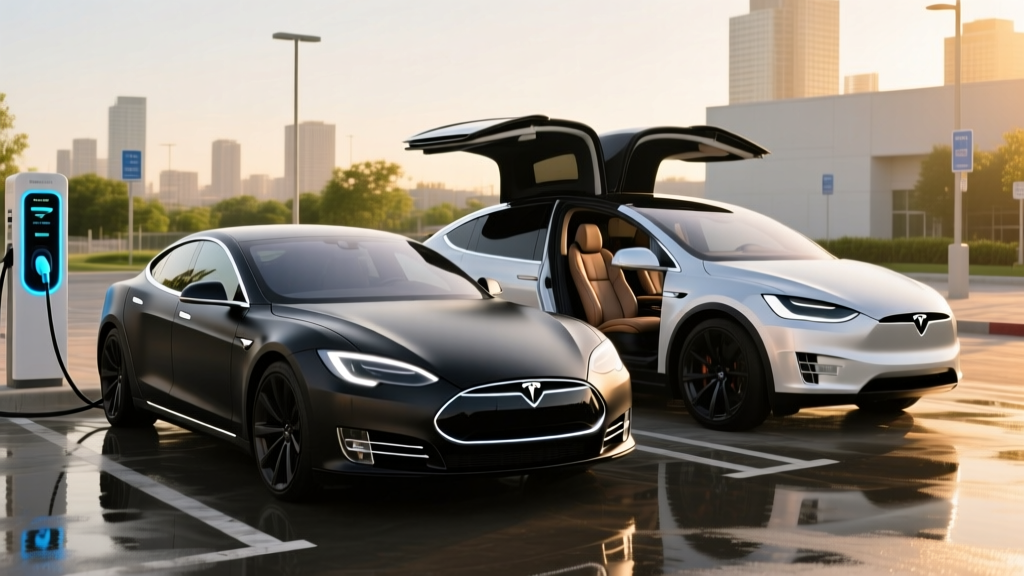
If you're cross-shopping Tesla's two legacy flagships, the decision between a Tesla Model S or X in 2026 comes down to three variables: cargo needs, third-row seating, and whether you value 405+ miles of EPA range over falcon-wing doors. Both ride on the same 100 kWh-class NMC architecture, share Tesla's latest infotainment stack, and tap the Supercharger network — but their use cases diverge sharply once you look past the badge.
Choose Model X if: You need three rows, up to 88 cu ft of cargo space, and easier curbside access for child seats — and can accept a ~30-mile range penalty and ~$10K price premium.
Spec Sheet: Tesla Model S vs Model X (2026 Long Range & Plaid)
| Spec | Model S Long Range | Model S Plaid | Model X Long Range | Model X Plaid |
|---|---|---|---|---|
| EPA Range | 405 mi | 396 mi | 348 mi | 333 mi |
| Battery (usable) | ~95 kWh, NMC | ~95 kWh, NMC | ~95 kWh, NMC | ~95 kWh, NMC |
| Drivetrain | Dual-Motor AWD | Tri-Motor AWD | Dual-Motor AWD | Tri-Motor AWD |
| Horsepower | 670 hp | 1,020 hp | 670 hp | 1,020 hp |
| 0-60 mph | 3.1 sec | 1.99 sec | 3.8 sec | 2.5 sec |
| Max DC Charge | 250 kW | 250 kW | 250 kW | 250 kW |
| 10-80% DC Time | ~28 min | ~28 min | ~30 min | ~30 min |
| Level 2 Rate | 11.5 kW (~44 mi/hr) | 11.5 kW (~44 mi/hr) | 11.5 kW (~34 mi/hr) | 11.5 kW (~34 mi/hr) |
| MPGe (combined) | 120 MPGe | 116 MPGe | 102 MPGe | 98 MPGe |
| Base MSRP | $74,990 | $89,990 | $79,990 | $94,990 |
| Battery Warranty | 8 yr / 150,000 mi | 8 yr / 150,000 mi | 8 yr / 150,000 mi | 8 yr / 150,000 mi |
Source: Tesla.com official specs and fueleconomy.gov. Prices reflect 2026 MSRP before destination; specs subject to mid-year updates.
Real-World Range: What the EPA Sticker Doesn't Tell You
Expect ~340–360 mi on a 70°F mixed drive; ~290–320 mi sustained 80 mph highway; ~260–290 mi in sub-30°F cold with cabin heat.
Model X Long Range — EPA 348 mi
Expect ~290–310 mi mixed; ~250–275 mi sustained highway; ~220–250 mi in deep cold. The X's larger frontal area and 400+ lb weight penalty over the S show up most at speed and in winter.
Tesla's NMC packs retain a top-of-pack buffer (roughly 2–3 kWh) and a bottom buffer (~4 kWh) to protect longevity, so "usable" is ~95 kWh of the ~100 kWh gross. Efficiency in the Model S Long Range works out to about 28–30 kWh/100 mi on the EPA cycle; in real-world 75-mph highway testing, expect 32–35 kWh/100 mi depending on elevation and HVAC load. The Model X, with its higher drag coefficient and weight, pushes 33–37 kWh/100 mi in equivalent highway conditions.
One often-overlooked factor: Tesla's heat pump (standard on both since the 2021 refresh) recovers meaningful efficiency in cold weather versus resistive heating. Owners in the Midwest and Northeast report ~15% winter range loss versus ~25% on older EVs without heat pumps — a significant advantage for four-season commuters.
Charging Speed: DC Fast, Level 2, and the Supercharger Advantage
| Charging Level | Power / Rate | Miles Added per Hour (Model S) | Miles Added per Hour (Model X) |
|---|---|---|---|
| Level 1 (120V / 12A) | ~1.4 kW | ~3–4 mi/hr | ~3 mi/hr |
| Level 2 (240V / 48A) | 11.5 kW | ~44 mi/hr | ~34 mi/hr |
| DC Fast (V3 Supercharger) | Peak 250 kW | ~200 mi in 15 min | ~175 mi in 15 min |
Both the Model S and Model X peak at 250 kW on V3 Superchargers, but — critically — that peak is not sustained. The charge curve tapers sharply above ~50% SoC. You'll see 250 kW only briefly between roughly 15–30% SoC; by 60%, you're closer to 110 kW, and above 80%, speeds drop to under 50 kW to protect the NMC cells. This is why Tesla's navigation preconditions the battery when a Supercharger is your destination — arriving with a warm pack shaves 5–8 minutes off a 10–80% session versus a cold pack.
For home charging, both vehicles accept up to 11.5 kW on a 48A Level 2 circuit, which requires a 60A breaker. If your panel is maxed at 100A or 150A, an electrician may recommend a 32A circuit (7.7 kW), which still replenishes ~250 miles overnight for the S — plenty for daily use. A full Level 2 installation (Tesla Wall Connector + electrician + permit) typically runs $800–$2,000 depending on panel proximity; a panel upgrade to 200A adds $1,500–$3,500 if needed.
The Supercharger network remains the S/X's strongest charging moat: 70,000+ global stalls with near-universal uptime. With NACS now adopted by Ford, GM, Rivian, and others, Tesla's proprietary connector advantage is narrowing — but the S and X still get preferential routing and pricing on the network they were built for.
Performance & Driving Dynamics
The Long Range dual-motor powertrain (670 hp, 3.1 sec 0-60 for the S, 3.8 sec for the X) is already supercar-adjacent by any historical standard. But Plaid's tri-motor layout — one front, two rear — pushes the S to a claimed 1.99-second 0-60 with rollout, and the X to 2.5 seconds, making it the quickest production SUV ever sold.
In practice, the difference you feel daily is the torque-vectoring rear axle on Plaid: it pulls the car through corners with a neutrality the Long Range can't match. For most buyers, the Long Range is the rational pick — you save $15,000, gain ~9 miles of range (S) or ~15 miles (X), and forfeit performance you'll rarely exploit on public roads.
Ride quality on both has improved since the 2021 refresh with adaptive air suspension that now reads road surfaces ahead. The S rides lower and quieter; the X, with its taller roofline and heavier curb weight (~5,100 lb vs ~4,560 lb), transmits more road imperfection but compensates with a commanding sightline.
Pricing, Tax Credit Eligibility, and Total Cost
| Trim | Base MSRP | Dest. | Federal §30D Credit | Effective Price |
|---|---|---|---|---|
| Model S Long Range | $74,990 | $1,390 | $0 (MSRP cap) | $76,380 |
| Model S Plaid | $89,990 | $1,390 | $0 (MSRP cap) | $91,380 |
| Model X Long Range | $79,990 | $1,390 | $0 (MSRP cap) | $81,380 |
| Model X Plaid | $94,990 | $1,390 | $0 (MSRP cap) | $96,380 |
Neither the Model S nor Model X qualifies for the $7,500 federal §30D new-EV tax credit. The IRS caps eligible sedans at $55,000 MSRP and SUVs/pickups at $80,000 MSRP. The Model S, classified as a sedan, exceeds $55K in every trim. The Model X, classified as an SUV, starts just under $80K before destination — but once destination and any options push it over, eligibility vanishes. Even at the barest base Long Range with no add-ons, battery-sourcing and critical-mineral requirements under current IRS §30D rules make qualification uncertain for 2026 builds. Consult a tax professional before banking on the credit.
State incentives may apply: California's CVRP is currently paused for new applications, but states like Colorado, Massachusetts, and New York offer $2,000–$5,000 rebates that don't share the federal MSRP cap. Check your state's energy office for current programs.
On total cost of ownership, electricity at the national average of ~$0.16/kWh costs roughly $4.50 per 100 miles in the Model S — versus ~$14 per 100 miles in a comparable 22-mpg gas sedan at $3.10/gal. Over 5 years and 75,000 miles, that's ~$7,100 in fuel savings. Insurance, however, runs 20–35% higher than equivalent ICE vehicles (average ~$3,200/yr for the S, ~$3,500/yr for the X per industry data), partially offsetting the fuel advantage.
Interior, Cargo, and Tech
Model S offers 28 cu ft of rear cargo (74 cu ft with seats folded) and a 5.3 cu ft frunk. Rear legroom measures 35.4 inches — adequate for adults on trips under three hours, tight for taller passengers beyond that. The 17-inch center touchscreen (tilt-adjustable since 2021) runs Tesla's latest UI with native Spotify, Netflix, and a full Steam-capable gaming suite when parked. A rear 8-inch screen handles climate and media for back-seat passengers.
Model X provides 88 cu ft of total cargo (behind the first row in 5-seat config) or 42 cu ft behind the second row. The optional third row adds two seats but compresses cargo to just 12.6 cu ft behind it. Falcon-wing rear doors open vertically, making child-seat loading dramatically easier than any conventional SUV — but they're slower to operate in tight parking spaces and have historically been a reliability pain point, though Tesla has improved the hinge actuators since 2023.
Both vehicles feature Tesla's Autopilot (SAE Level 2) as standard — adaptive cruise, lane centering, and automatic emergency braking. Full Self-Driving (Supervised), a $8,000 add-on or $99/month subscription, adds city-street navigation and traffic-light recognition but remains Level 2: you are the driver at all times. Tesla's camera-only vision stack has improved substantially, but NHTSA continues to investigate Autopilot-related incidents, and hands-off-wheel reminders trigger every 30–45 seconds.
Pros, Cons, and the Competition
- Class-leading EPA range (405 mi S LR)
- Supercharger network access — most reliable DC network in North America
- Tri-motor Plaid performance (1.99s 0-60 S)
- Over-the-air updates add features post-purchase
- Heat pump standard — superior cold-weather efficiency
- Model X falcon-wing doors ease child-seat access
- No federal tax credit eligibility (MSRP cap)
- 250 kW peak DC charge is now outpaced by Hyundai/Kia's 350 kW E-GMP architecture
- Panel gap and interior material quality lag Lucid, BMW iX, Mercedes EQS
- Falcon-wing doors: slow, expensive to repair, rain gutter issues
- No Apple CarPlay / Android Auto
- Insurance premiums 20-35% above segment average
Key competitors: The Lucid Air Pure ($69,900, 419 mi EPA) undercuts the Model S on price and beats it on range, though its charging network relies on third-party DC. The BMW iX xDrive50 ($87,250, 324 mi EPA) offers a more luxurious interior and faster 195 kW sustained charging but less total range. For three-row EV SUVs, the Rivian R1S ($79,900, 352 mi EPA) is more off-road capable and eligible for the §30D credit at base MSRP, but lacks Supercharger-native access.
Frequently Asked Questions
What is the real-world range of the Tesla Model S and Model X?
The Model S Long Range (EPA 405 mi) delivers ~340–360 mi in mild mixed driving, ~290–320 mi at sustained highway speed, and ~260–290 mi in sub-freezing weather. The Model X Long Range (EPA 348 mi) returns ~290–310 mi mixed, ~250–275 mi highway, and ~220–250 mi in cold conditions.
How fast do the Model S and X charge on DC fast chargers and at home?
Both peak at 250 kW on V3 Superchargers, achieving a 10–80% charge in approximately 28–30 minutes with a preconditioned battery. At home on a 48A Level 2 circuit (11.5 kW), the S adds ~44 miles per hour and the X adds ~34 miles per hour — enough to fully replenish overnight.
Does the Tesla Model S or X qualify for the $7,500 federal EV tax credit?
No, in practice. The §30D credit caps sedans at $55,000 MSRP and SUVs at $80,000 MSRP. The Model S exceeds the sedan cap in all trims. The Model X starts near the SUV cap but destination charges and options typically push it over. Battery-sourcing rules add further uncertainty. Check IRS.gov §30D guidance and consult a tax professional.
Is the Tesla Model S or X worth buying vs. competitors in 2026?
The Model S remains the range-and-charging-network king for sedan buyers who road-trip frequently. The Model X is uniquely practical for families needing three rows and easy child-seat access. However, if interior luxury, tax credit eligibility, or faster DC charging matter more, the Lucid Air, BMW iX, or Rivian R1S deserve serious test drives.
What are the biggest drawbacks of the Model S and X?
Charging speed (250 kW peak now trails 800V competitors), no CarPlay/Android Auto, higher insurance costs, falcon-wing door complexity on the X, and ineligibility for the federal tax credit. Interior fit-and-finish, while improved, still doesn't match German luxury rivals at these price points.
What is the battery warranty on the Model S and X?
Tesla covers the battery and drive unit for 8 years or 150,000 miles (whichever comes first) with a minimum 70% capacity retention guarantee. If degradation drops below 70% within that window, Tesla will repair or replace the pack at no cost. Real-world data from high-mileage owners suggests typical degradation of 8–12% over 100,000 miles with NMC chemistry.