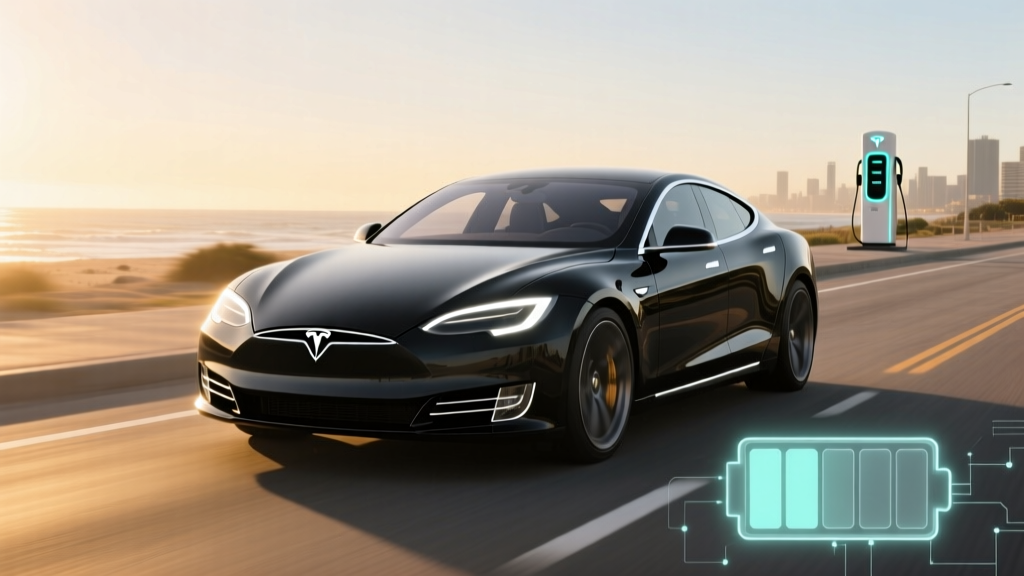
The name Joshua Brown remains inseparable from Tesla's Autopilot narrative. In May 2016, Brown was killed when his Model S, operating in Autopilot mode, collided with a tractor-trailer near Williston, Florida — the first widely publicized fatality involving a semi-autonomous driving system. Nearly a decade later, the incident continues to shape public perception of Tesla's driver-assistance technology, regulatory scrutiny from NHTSA, and the broader conversation about SAE Level 2 automation. This 2026 Tesla Model S review examines the vehicle through that lens: What has changed, what remains limited, and whether the flagship sedan delivers on its $79,990+ promise for today's EV buyers.
2026 Tesla Model S at a Glance: Core Specifications
| Specification | Model S Long Range | Model S Plaid |
|---|---|---|
| Base MSRP | $79,990 | $89,990 |
| EPA Range | 402 miles | 396 miles |
| Battery (usable) | ~100 kWh (NMC) | ~100 kWh (NMC) |
| Drivetrain | Dual-Motor AWD | Tri-Motor AWD |
| Horsepower | 670 hp | 1,020 hp |
| 0–60 mph | 3.1 seconds | 1.99 seconds |
| Top Speed | 155 mph | 200 mph |
| Max DC Fast Charge | 250 kW | 250 kW |
| 10–80% DC Charge Time | ~30 minutes | ~30 minutes |
| Level 2 Charge Rate | 11.5 kW (~34 mi/hr) | 11.5 kW (~34 mi/hr) |
| MPGe (combined) | 120 MPGe | 116 MPGe |
| Efficiency | 28 kWh/100 mi | 29 kWh/100 mi |
| Cargo (rear + frunk) | 28 cu ft + 3.1 cu ft | 28 cu ft + 3.1 cu ft |
| Legroom (front / rear) | 42.7 in / 35.4 in | 42.7 in / 35.4 in |
| Battery Warranty | 8 yr / 150,000 mi | 8 yr / 150,000 mi |
| Basic Warranty | 4 yr / 50,000 mi | 4 yr / 50,000 mi |
Range & Efficiency: EPA vs. the Real World
EPA Estimate: 402 miles (Long Range) / 396 miles (Plaid)
Real-World Expectation: Plan for ~320–340 miles on sustained highway driving at 70–80 mph. In cold weather (below 30°F), expect a 15–25% reduction, dropping usable range to approximately 260–290 miles before needing a charge. City driving with heavy regenerative braking can match or slightly exceed the EPA figure.
The Model S Long Range's 402-mile EPA sticker remains one of the highest of any production EV in 2026. That figure, verified via fueleconomy.gov, is achievable in moderate temperatures with mixed driving. However, efficiency-minded buyers should understand the physics: at highway speeds, aerodynamic drag dominates, and the Model S — despite its 0.208 Cd — consumes energy at a notably higher rate above 70 mph. Cold weather compounds this because the NMC battery requires thermal conditioning (drawing energy from the pack) while cabin heating further reduces net range.
The Plaid's slightly lower range (396 miles) reflects the tri-motor configuration's additional mass and drivetrain losses. In practice, both variants deliver nearly identical real-world highway range; the difference is negligible for trip planning.
Charging Speed: Supercharger Network Advantage
Tesla's Supercharger network remains the gold standard for reliability and coverage, and the Model S leverages it fully. Both trims peak at 250 kW DC fast charging on V3 Superchargers.
| Charging Level | Power | Speed | Notes |
|---|---|---|---|
| Level 1 (120V) | ~1.4 kW | ~4 miles/hour | Emergency/trickle only |
| Level 2 (240V, 48A) | 11.5 kW | ~34 miles/hour | Home Wall Connector; ~11 hrs for full charge |
| DC Fast (V3 Supercharger) | Peak 250 kW | ~200 miles in 15 min | 10–80% in ~30 min; tapers sharply above 80% |
| DC Fast (CCS adapter) | Up to 150 kW | Varies by network | For Electrify America, EVgo, etc. |
A critical detail for road-trippers: the 250 kW peak rate is not sustained. The charge curve is aggressive from 10–40% SoC, then progressively tapers. From 80–100%, charging slows to under 50 kW to protect the NMC cells. Tesla's navigation system automatically preconditions the battery when a Supercharger is set as the destination — warming the pack to optimal temperature for maximum charge acceptance. Skipping preconditioning in cold weather can add 10–15 minutes to your session.
At home, the Tesla Wall Connector at 48 amps delivers 11.5 kW, adding roughly 34 miles per hour of charging. A full 0–100% charge takes approximately 10–11 hours. Most owners charge overnight from 20–80%, which takes about 5–6 hours and is the recommended daily practice for NMC battery longevity.
The Joshua Brown Incident: What It Means for Autopilot & FSD in 2026
SAE Automation Level: Tesla Autopilot and Full Self-Driving (Supervised) are SAE Level 2 systems. The driver must remain fully engaged, hands on or near the wheel, eyes on the road, and ready to intervene at any moment. These are not self-driving systems. Only Level 4 services like Waymo operate without a driver in defined geographic zones.
On May 7, 2016, Joshua Brown was driving his Tesla Model S on US-27A in Florida with Autopilot engaged when the system failed to detect a white tractor-trailer crossing the highway against a bright sky background. Neither Brown nor Autopilot applied the brakes. The NTSB investigation found that Brown's overreliance on the system and Tesla's inadequate safeguards against driver inattention were contributing factors.
The incident triggered lasting changes:
- NHTSA scrutiny: Ongoing investigations into Autopilot and FSD crash patterns, with Standing General Orders requiring Tesla to report all crashes involving Level 2 systems.
- Driver monitoring: Tesla now uses a cabin camera (introduced in 2021 refresh) to detect driver attention, issuing escalating warnings before disengaging Autopilot.
- Software evolution: FSD (Supervised) in 2026 uses a vision-only neural network approach, but the fundamental requirement — constant driver supervision — has not changed.
- Marketing language: Under regulatory pressure, Tesla renamed "Full Self-Driving" to "FSD (Supervised)" to clarify that it is not autonomous.
What Autopilot & FSD (Supervised) Do NOT Do:
- They do not eliminate the need for an attentive driver.
- They cannot reliably detect all stationary objects, emergency vehicles, or construction zones.
- They do not function as Level 3 or Level 4 autonomous systems — you remain legally responsible for the vehicle.
- Performance degrades in heavy rain, fog, snow, or poorly marked roads.
For 2026, Autopilot (standard) includes Traffic-Aware Cruise Control and Autosteer. FSD (Supervised), an $8,000 add-on or $99/month subscription, adds Navigate on Autopilot, Auto Lane Change, Autopark, Summon, and traffic light/stop sign recognition. Despite a decade of iteration, the system still requires the same vigilance Brown was expected to provide — a sobering reminder that marketing names can outpace engineering reality.
Performance & Driving Dynamics
The Model S Plaid's 1.99-second 0–60 mph claim remains one of the fastest production-car times ever recorded. In independent testing, the Plaid consistently hits 60 mph in approximately 2.1–2.3 seconds depending on surface conditions and rollout methodology. The tri-motor setup (one front, two rear) enables precise torque vectoring that makes the Plaid surprisingly composed through corners for a 4,766-pound sedan.
The Long Range variant's 3.1-second 0–60 time is hardly slow — it outpaces most sports cars — while offering the range advantage. Both models use a single-speed reduction gear, so acceleration is linear and immediate with no shift interruptions.
Air suspension is standard, providing adjustable ride height (useful for steep driveways and speed bumps) and a compliant highway ride. The steering is quick and well-weighted, though some enthusiasts note it lacks the tactile feedback of a Porsche Taycan. Regenerative braking is strong enough for one-pedal driving in most conditions, though Tesla removed the adjustable regen setting — it's always at maximum.
Interior, Tech & Practicality
The 2021-refreshed interior carries forward into 2026 with a minimalist 17-inch landscape touchscreen, a 12.3-inch instrument cluster, and a rear-seat 8-inch display. Build quality has improved markedly over pre-2021 models, with more consistent panel gaps and upgraded materials. The yoke steering wheel remains available (a conventional round wheel is now standard with the yoke as a no-cost option).
Cargo and passenger space:
- Rear cargo (seats up): 28 cu ft — best-in-class among luxury EV sedans, aided by the hatchback liftgate
- Frunk: 3.1 cu ft — enough for a charging cable bag and small items
- Rear legroom: 35.4 inches — adequate for adults but tighter than a Mercedes EQS
- Seating: 5-passenger capacity (no third-row option, unlike the Model X)
Notable tech features:
- Over-the-air software updates that add features post-purchase
- Sentry Mode (cameras record when parked, with mobile alerts)
- Dog Mode (maintains cabin temperature for pets)
- Gaming capable — Steam integration allows AAA titles on the center screen while parked
- HEPA air filtration with Bioweapon Defense Mode
Notable drawbacks:
- No Apple CarPlay or Android Auto — Tesla's proprietary infotainment only
- Rear visibility is limited by the sloping roofline (no rear wiper)
- Yoke steering is polarizing and arguably less safe for low-speed maneuvers
- Service center availability remains a pain point in many metro areas
Pricing, Tax Credits & Ownership Cost
| Trim | Base MSRP | As-Tested (typical) | §30D Federal Credit | Effective Price |
|---|---|---|---|---|
| Model S Long Range | $79,990 | $84,490 (w/ FSD) | $0 (exceeds MSRP cap) | $79,990–$84,490 |
| Model S Plaid | $89,990 | $94,490 (w/ FSD) | $0 (exceeds MSRP cap) | $89,990–$94,490 |
Federal tax credit eligibility: The Model S does not qualify for the $7,500 §30D federal EV tax credit. The IRS imposes an MSRP cap of $55,000 for sedans (as outlined on irs.gov), and the Model S starts well above that threshold at $79,990. Additionally, buyer income limits apply ($150,000 single / $300,000 joint filers for the new-vehicle credit), and battery critical-mineral sourcing requirements must be met. Even if the MSRP cap didn't disqualify it, sourcing rules would likely reduce or eliminate the credit.
State incentives may still apply — check your state's EV rebate program. California's CVRP, for example, has income-based rebates, though these typically target vehicles under $60,000.
5-year ownership considerations:
- Insurance: Model S premiums run 30–50% above comparable luxury sedans due to repair costs. Expect $2,800–$4,000/year depending on location and driving record.
- Electricity cost: At $0.15/kWh national average and 28 kWh/100 mi, fueling costs approximately $4.20 per 100 miles — roughly one-third the cost of a comparable BMW 5 Series on premium gas.
- Maintenance: No oil changes, minimal brake wear (regen handles most deceleration). Budget for cabin air filter replacement ($100–$150/yr) and tire rotation. Tires are the significant consumable — expect $1,200–$1,800 for a set of OEM 19–21 inch tires every 25,000–35,000 miles.
- Depreciation: The Model S has historically depreciated 40–50% over 5 years, steeper than the Model 3/Y due to its luxury-segment positioning and rapid Tesla iteration.
Pros, Cons & the Competition
Pros
- Class-leading 402-mile EPA range (Long Range)
- Supercharger network: most reliable DC fast-charging ecosystem in North America
- Brutal acceleration, especially Plaid (1.99s 0–60)
- Hatchback practicality with 28 cu ft cargo
- OTA updates keep the vehicle current
- Low running costs vs. gas luxury sedans
Cons
- No federal tax credit (MSRP cap disqualifies)
- FSD (Supervised) still requires full driver attention — Level 2, not autonomous
- No Apple CarPlay / Android Auto
- Insurance premiums are steep
- Service center wait times in many markets
- Depreciation outpaces Model 3/Y
Key competitors in 2026:
- Lucid Air Pure ($69,900): 419-mile EPA range, more rear-seat space, qualifies for partial tax credit. Less charging infrastructure.
- Porsche Taycan ($92,000+): Superior driving dynamics and build quality, but 246-mile range (base) and slower DC charging on older models.
- BMW i7 ($120,000+): Flagship luxury with Level 2+ Highway Assistant, but far more expensive and lower range.
- Mercedes EQS ($105,000+): More opulent interior, 350-mile range, but significantly pricier.
Who Should Buy the 2026 Tesla Model S?
Choose the Model S Long Range if:
- You need maximum range for frequent road trips and want Supercharger reliability
- You value acceleration and tech-forward features over traditional luxury materials
- You have home Level 2 charging and don't need a tax credit to justify the price
- You prioritize hatchback cargo space in a sedan form factor
Choose the Model S Plaid if:
- You want supercar-level acceleration in a practical daily driver
- Track-capable performance matters (Plaid includes track mode and upgraded cooling)
- Budget is flexible above $90,000
Look elsewhere if:
- You need the federal tax credit — consider the Lucid Air Pure or Tesla Model 3
- Traditional luxury materials and dealer service matter — consider the Porsche Taycan or BMW i7
- You want Apple CarPlay — nearly every competitor offers it
Frequently Asked Questions
What is the real-world range of the 2026 Tesla Model S?
The EPA rates the Long Range at 402 miles and the Plaid at 396 miles. In real-world highway driving at 70–80 mph, expect 320–340 miles. In cold weather (below 30°F), plan for 260–290 miles. The Supercharger network mitigates range concerns on road trips with reliable 250 kW charging every 150–200 miles on most corridors.
How fast does the Model S charge at home and on the road?
On a Tesla V3 Supercharger, the Model S peaks at 250 kW, adding up to 200 miles in 15 minutes, with a 10–80% session taking approximately 30 minutes. At home on a Level 2 Wall Connector (11.5 kW), it adds about 34 miles per hour, taking roughly 10–11 hours for a full charge. Overnight charging from 20–80% takes 5–6 hours.
Does the 2026 Tesla Model S qualify for the federal EV tax credit?
No. The IRS §30D credit caps eligible sedans at $55,000 MSRP, and the Model S starts at $79,990. Even absent the MSRP cap, battery-sourcing and critical-mineral requirements would likely disqualify it. Check irs.gov for current rules, and consult a tax professional for your specific situation.
Is FSD (Supervised) safe after the Joshua Brown incident?
Tesla has added cabin-camera driver monitoring and renamed the system to clarify its limitations, but FSD remains an SAE Level 2 driver-assist system. The driver must remain fully engaged. NHTSA continues to investigate crashes involving Tesla's Autopilot and FSD. The system is capable but not autonomous — treat it as a sophisticated cruise control, not a replacement for an attentive driver.
Is the Model S worth buying vs. the Lucid Air or Porsche Taycan?
If Supercharger access and maximum range are priorities, the Model S Long Range is compelling. If luxury materials, rear-seat comfort, and tax-credit eligibility matter more, the Lucid Air Pure is a strong alternative. If driving dynamics and build quality are paramount, the Porsche Taycan wins despite lower range. The Model S occupies a unique niche: tech-forward performance with the best charging ecosystem, at a premium that excludes federal incentives.
What is the battery warranty on the Model S?
Tesla covers the Model S battery and drive unit for 8 years or 150,000 miles (whichever comes first), with a minimum 70% capacity retention threshold. If the battery degrades below 70% within that window, Tesla will replace or refurbish it at no cost. Out-of-warranty replacement costs are estimated at $15,000–$22,000 depending on pack availability and labor.