The Tesla Model S has been the benchmark luxury electric sedan for over a decade, and its 2026 refresh continues to evolve the formula. While the exterior remains instantly recognizable, it's the interior of the Tesla Model S that defines the ownership experience — a minimalist, screen-dominated cabin that polarizes as much as it impresses. This review goes beyond the marketing gloss to give you exact specs, real-world range data, charging realities, and a clear-eyed assessment of what it's like to live with Tesla's flagship sedan in 2026.
2026 Tesla Model S: At-a-Glance Specifications
| Spec | Model S Long Range | Model S Plaid |
|---|---|---|
| EPA Range | 402 miles | 359 miles |
| Battery (usable) | ~100 kWh (NMC) | ~100 kWh (NMC) |
| Drivetrain | Dual Motor AWD | Tri-Motor AWD |
| Horsepower | 670 hp | 1,020 hp |
| 0-60 mph | 3.1 seconds | 1.99 seconds |
| Top Speed | 155 mph | 200 mph |
| Max DC Fast Charge | 250 kW | 250 kW |
| 10-80% DC Charge | ~27 minutes | ~27 minutes |
| Level 2 Home Charge | 11.5 kW (~34 mi/hr) | 11.5 kW (~34 mi/hr) |
| MPGe (combined) | 120 MPGe | 116 MPGe |
| Efficiency | 28 kWh/100 mi | 29 kWh/100 mi |
| Cargo Volume | 28 cu ft (rear) + 3.1 cu ft (frunk) | 28 cu ft (rear) + 3.1 cu ft (frunk) |
| Rear Legroom | 35.4 inches | 35.4 inches |
| Base MSRP | $74,990 | $89,990 |
| Battery Warranty | 8 yr / 150,000 mi | 8 yr / 150,000 mi |
The Interior of Tesla Model S: Cabin Design and Technology
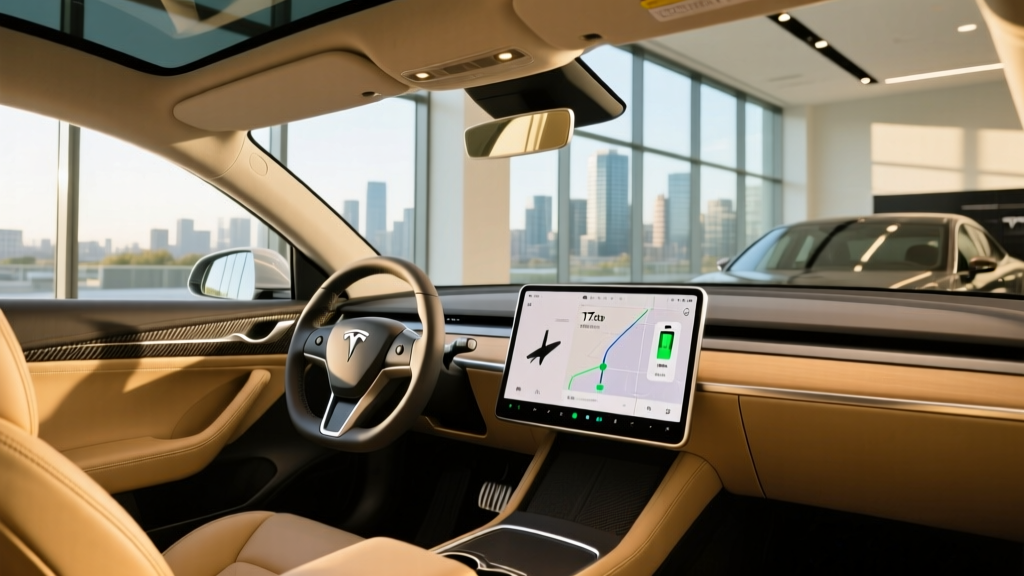
Stepping into the 2026 Model S, the cabin is a study in reduction. Tesla has eliminated nearly every physical button, routing all vehicle controls — climate, mirrors, glovebox, wipers — through the central 17-inch touchscreen. The yoke steering wheel (now standard, with a round wheel available as a no-cost option) frames a compact 12.3-inch instrument display behind it.
Material quality has improved meaningfully over earlier Model S generations. The dashboard and door uppers use soft-touch materials with open-pore wood or carbon-fiber trim. The available cream, black, or black-and-white vegan leather upholstery is durable and easy to maintain, though the seat cushions run firm on longer drives. Heated and ventilated front seats are standard; rear heated seats are included as well.
The rear cabin is where the Model S differentiates itself from the smaller Model 3. Rear legroom measures 35.4 inches — adequate for adults on shorter trips but tighter than a BMW i5 or Mercedes EQS. The rear seatback angle is fixed, which some passengers find too upright for cross-country comfort. A small 8-inch rear touchscreen lets back-seat passengers control climate and media, a welcome addition for families.
Cargo space totals 28 cubic feet behind the rear seats (with a 60/40 split-folding function) plus a 3.1-cubic-foot frunk. The hatchback design gives the Model S a practical advantage over traditional sedans — you can fit bulky items that a trunk-opening competitor simply cannot swallow.
Infotainment and Standout Tech
The infotainment system runs on Tesla's proprietary software, powered by an AMD Ryzen processor that delivers responsive navigation, streaming (Netflix, YouTube, Spotify), and gaming capabilities. A 22-speaker audio system with active noise cancellation is standard and ranks among the best in any luxury vehicle. Wireless phone charging, five USB-C ports, and Bluetooth connectivity round out the tech suite.
Tesla's Autopilot (SAE Level 2 driver-assist) comes standard with adaptive cruise control and lane-keeping. Full Self-Driving (Supervised), a $8,000 add-on, adds automated lane changes, traffic-light recognition, and navigate-on-Autopilot. Despite the "FSD" branding, this remains a Level 2 system requiring constant driver supervision — it does not make the car self-driving.
Real-World Range: What the EPA Number Doesn't Tell You
Model S Long Range: EPA-rated 402 miles. In real-world highway driving at 70-75 mph, expect approximately 320-350 miles. In cold weather (below 30°F), range can drop 20-30%, yielding roughly 280-320 miles. City driving with regenerative braking recovers closer to the EPA figure.
Model S Plaid: EPA-rated 359 miles. Highway real-world: ~285-315 miles. Cold-weather highway: ~250-285 miles.
The Model S Long Range's 402-mile EPA figure remains one of the highest of any production EV sold in the U.S., per fueleconomy.gov. Tesla's NMC battery pack (~100 kWh usable) paired with an efficient heat pump and low drag coefficient (0.208 Cd) delivers this result. However, EPA testing uses a mix of city and highway cycles at moderate speeds. Sustained 75-mph highway driving, headwinds, elevation changes, and climate-control use all pull real-world numbers below the sticker.
Cold weather is the Model S's biggest range adversary. Unlike some competitors, Tesla does not offer an LFP chemistry option on the Model S — the NMC pack provides excellent energy density but is more sensitive to low temperatures. Preconditioning the battery while plugged in (a feature accessible through the Tesla app) mitigates some cold-weather loss and is essential for preserving fast-charge speeds in winter.
Charging Speed: DC Fast Charge and Home Level 2
| Charging Method | Max Power | Speed / Time |
|---|---|---|
| Level 1 (120V outlet) | ~1.4 kW | ~3-4 miles per hour |
| Level 2 (240V home, Wall Connector) | 11.5 kW | ~34 miles per hour |
| DC Fast Charge (Tesla Supercharger V3/V4) | 250 kW peak | 10-80% in ~27 min; ~200 mi in 15 min |
| DC Fast Charge (CCS adapter, non-Tesla) | ~150-250 kW (varies) | Depends on station; may throttle |
The Model S charges at up to 250 kW on Tesla's Supercharger network, which remains the most reliable DC fast-charging infrastructure in the U.S. Peak charge rate is sustained roughly from 10% to 35% SoC, after which the charge curve tapers progressively. From 80% to 100%, charging slows dramatically — a characteristic of NMC chemistry designed to protect battery longevity. For road trips, plan to charge from 10-80% and skip topping off unless you need every last mile to reach your destination.
At home, the Tesla Wall Connector delivers up to 11.5 kW on a 60-amp circuit (48 amps continuous), adding roughly 34 miles of range per hour. An overnight charge from 20% to 80% takes approximately 5-6 hours. Home installation costs typically range from $800 to $2,500 depending on panel capacity and wiring distance — factor in a possible panel upgrade if your home has a 100-amp service.
Tesla includes a CCS adapter with new Model S vehicles, enabling access to Electrify America, EVgo, and other non-Tesla networks. However, charge speeds on third-party networks can be inconsistent, and Tesla's native NACS connector remains the gold standard for reliability.
Pricing, Tax Credits, and Total Cost
| Trim | Base MSRP | Destination | Est. Federal Credit (§30D) | Effective Price* |
|---|---|---|---|---|
| Model S Long Range | $74,990 | $1,390 | Up to $7,500 | ~$68,880 |
| Model S Plaid | $89,990 | $1,390 | Up to $7,500 | ~$83,880 |
*Effective price assumes full §30D eligibility. Actual credit depends on buyer income, battery sourcing, and point-of-sale transfer. See IRS rules below.
The 2026 Model S Long Range starts at $74,990 before destination, placing it in competition with the BMW i5 eDrive40 (~$67,000), Lucid Air Pure (~$69,900), and Mercedes-Benz EQS 450+ (~$104,400). The Plaid trim, at $89,990, enters supercar performance territory at a fraction of the cost of a Porsche Taycan Turbo S.
Federal Tax Credit Eligibility (§30D)
Per IRS guidelines, the §30D New Clean Vehicle Credit offers up to $7,500, but eligibility is not guaranteed. Key requirements for 2026 include:
- MSRP Cap: Sedans must have an MSRP at or below $55,000. The Model S exceeds this cap and does NOT qualify for the new-vehicle §30D credit based on MSRP alone.
- Buyer Income Cap: Modified AGI must not exceed $150,000 (single), $225,000 (head of household), or $300,000 (joint).
- Battery Sourcing: Critical minerals and battery components must meet phased-in domestic-content thresholds.
- Point-of-Sale Transfer: Eligible credits can be transferred to the dealer at purchase, reducing the upfront cost.
Who Should Buy the 2026 Tesla Model S?
Choose the Model S Long Range if: You need maximum range for frequent road trips, want access to the Supercharger network, value over-the-air updates and tech integration, and prefer a hatchback's practicality in a sedan footprint. Ideal for: long-distance commuters, tech-forward buyers, and two-adult households who occasionally carry rear passengers.
Choose the Model S Plaid if: You want supercar acceleration (1.99-second 0-60) with daily-driver practicality and don't mind sacrificing ~43 miles of range for the privilege. Ideal for: performance enthusiasts who need four doors and a back seat.
Look elsewhere if: You regularly carry three adults in the rear seat (consider the Lucid Air or Mercedes EQS), you need a sub-$55,000 EV to qualify for the federal credit, or you prefer physical buttons and traditional luxury materials (BMW i5, Audi e-tron GT).
Pros and Cons: An Honest Assessment
Pros
- Class-leading 402-mile EPA range (Long Range)
- Access to Tesla Supercharger network — the most reliable in the U.S.
- Hatchback cargo versatility with 28 cu ft + frunk
- Over-the-air updates continuously add features
- Exceptional performance across both trims
- Best-in-class 8-year/150,000-mile battery warranty
Cons
- Does not qualify for §30D federal tax credit (MSRP over $55K cap)
- Rear seat legroom (35.4 in) is tight for the price class
- No physical buttons — all controls via touchscreen
- 250 kW peak charge rate trails Hyundai/Kia's 350 kW E-GMP platform
- FSD (Supervised) remains Level 2 despite premium pricing
- Firm ride quality on 21-inch wheels
Frequently Asked Questions
What is the real-world range of the 2026 Tesla Model S?
The Model S Long Range is EPA-rated at 402 miles. In real-world highway driving at 70-75 mph, expect 320-350 miles. In cold weather below 30°F, that drops to roughly 280-320 miles. The Plaid variant delivers approximately 285-315 real-world highway miles.
How fast does the Model S charge at home and on the road?
On a Tesla Supercharger (DC fast charge), the Model S peaks at 250 kW and charges from 10-80% in approximately 27 minutes, adding up to 200 miles in 15 minutes. At home on a Level 2 Wall Connector (11.5 kW), it adds about 34 miles of range per hour, fully replenishing overnight.
Does the 2026 Model S qualify for the federal EV tax credit?
No. The §30D new clean vehicle credit has an MSRP cap of $55,000 for sedans. The Model S starts at $74,990, exceeding this limit. Check your state's incentive programs for potential rebates, and consult a tax professional for the most current guidance.
Is the Model S worth buying vs. the Lucid Air or BMW i5?
The Model S wins on Supercharger network access, range, and software integration. The Lucid Air offers more rear-seat space and comparable range. The BMW i5 provides a more traditional luxury interior with physical controls and a lower starting price. Your priority — tech ecosystem, space, or traditional luxury — determines the best choice.
What battery chemistry does the Model S use?
The Model S uses an NMC (nickel manganese cobalt) lithium-ion battery pack with approximately 100 kWh of usable capacity. NMC provides high energy density for maximum range but is more susceptible to cold-weather range loss compared to LFP chemistry.
Is Tesla's FSD actually self-driving?
No. Full Self-Driving (Supervised) is an SAE Level 2 driver-assist system. The driver must remain fully engaged, monitor the road, and be ready to take over immediately. It does not make the vehicle autonomous. Only Level 4 services like Waymo operate without a human driver in defined areas.