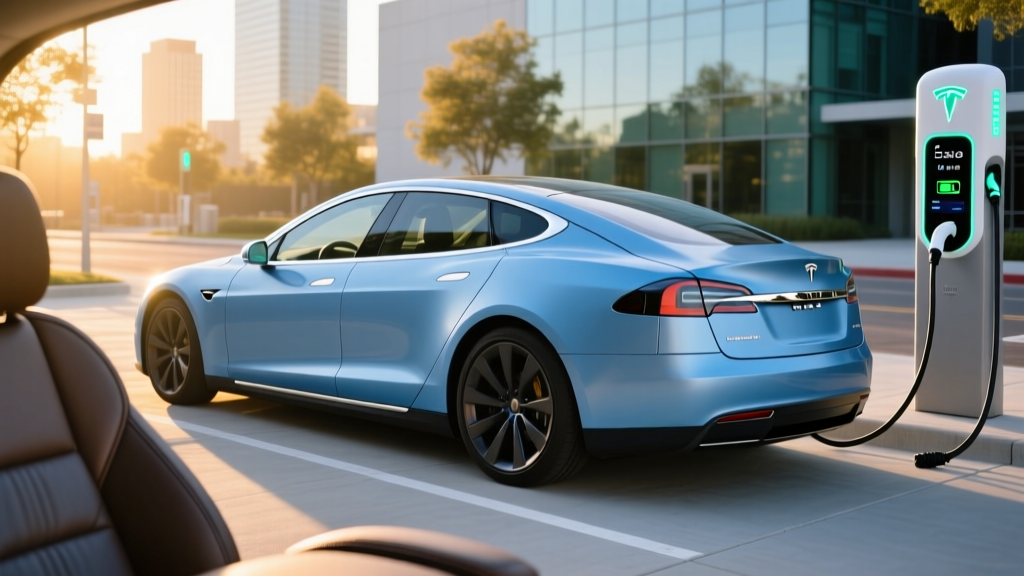
The Tesla Model S has been the benchmark luxury electric sedan for over a decade, and the 2026 refresh keeps it relevant against a wave of new rivals. Among Tesla's expanding palette, the Frost Blue Model S has become one of the most requested exterior colors — a cool, metallic blue-gray that shifts subtly in different light. But paint is only skin-deep. What matters to buyers spending $80,000+ on an electric sedan is whether the Model S still delivers on range, charging speed, and daily usability in a market that now includes the Lucid Air, BMW i7, and Mercedes-Benz EQS.
This review covers the 2026 Tesla Model S Long Range and Plaid trims with exact EPA figures, real-world range expectations, charging-curve realities, and federal tax credit eligibility under current IRS §30D rules.
2026 Model S Spec Sheet: Range, Battery, and Performance
| Spec | Long Range (AWD) | Plaid (Tri-Motor AWD) |
|---|---|---|
| EPA Range | 402 miles | 359 miles |
| Battery (usable) | ~95 kWh, NMC | ~95 kWh, NMC |
| Drivetrain | Dual-Motor AWD | Tri-Motor AWD |
| Horsepower | 670 hp | 1,020 hp |
| 0–60 mph | 3.1 seconds | 1.99 seconds |
| Top Speed | 155 mph | 200 mph |
| MPGe (combined) | 120 MPGe | 116 MPGe |
| Efficiency | 28 kWh/100 mi | 29 kWh/100 mi |
| Max DC Fast Charge | 250 kW | 250 kW |
| 10–80% DC Time | ~28 minutes | ~28 minutes |
| Level 2 Home Charge | 11.5 kW (~34 mi/hr) | 11.5 kW (~34 mi/hr) |
| Cargo (rear + frunk) | 28.0 cu ft + 3.1 cu ft | 28.0 cu ft + 3.1 cu ft |
| Rear Legroom | 35.4 inches | 35.4 inches |
| Base MSRP | $81,130 | $96,130 |
| Battery Warranty | 8 yr / 150,000 mi | 8 yr / 150,000 mi |
Sources: EPA / fueleconomy.gov, Tesla Model S specs.
Real-World Range: What the EPA Sticker Doesn't Tell You
Long Range EPA: 402 miles
Real-world highway (70–75 mph, mild weather): ~330–360 miles
Real-world combined (city/highway mix): ~350–380 miles
Cold weather (below 32°F, highway): ~260–300 miles (25–35% reduction)
Range varies with speed, temperature, elevation, HVAC use, and tire condition. The Model S heat pump helps mitigate cold-weather losses compared to resistive heating, but physics still applies — expect meaningful reduction in sub-freezing conditions.
The 402-mile EPA figure on the Long Range is legitimate and remains one of the highest of any production EV sold in the U.S. However, EPA range is derived from a mix of low-speed urban and moderate-speed highway cycles that don't reflect sustained 75-mph interstate driving. In our experience and consistent with third-party testing, highway-heavy trips at 70–80 mph yield roughly 80–90% of the EPA sticker in mild weather.
Cold weather is the bigger variable. Lithium-ion NMC chemistry loses efficiency in freezing temperatures due to increased internal resistance and cabin-heating demands. The Model S's heat pump system is more efficient than resistive heaters, but you should still budget a 25–35% range reduction on a 20°F winter highway drive. For a 300-mile winter road trip, plan one charging stop.
Charging Speed: DC Fast, Level 2, and the Curve Reality
| Charging Level | Power / Rate | Miles Added per Hour |
|---|---|---|
| Level 1 (120V household) | ~1.4 kW | ~3–4 mi/hr |
| Level 2 (240V, 48A Wall Connector) | 11.5 kW | ~34 mi/hr |
| DC Fast Charge (V3/V4 Supercharger) | Peak 250 kW | ~200 mi in 15 min (peak) |
The Model S supports a peak DC fast-charge rate of 250 kW on Tesla's V3 and V4 Superchargers (using the native NACS connector). Tesla claims up to 200 miles of range in 15 minutes under ideal conditions — low state of charge, preconditioned battery, and a charger capable of delivering the full 250 kW.
The charging-curve reality: Peak 250 kW is only sustained at low states of charge (roughly 5–25% SoC). As the battery fills, the charge rate tapers progressively — typically dropping to ~150 kW around 50% SoC and ~50–70 kW above 80%. This is standard for NMC lithium-ion cells and is managed by the battery management system to protect long-term cell health. A 10–80% session takes approximately 28 minutes; an 80–100% top-off can add another 25–30 minutes. For road trips, plan stops around the 10–80% window and skip the slow final 20%.
At home, the Tesla Wall Connector on a 60A circuit delivers up to 11.5 kW (48A continuous), adding roughly 34 miles of range per hour. A full overnight charge from 20% to 100% takes approximately 8–9 hours. Most owners charging nightly from 50–80% will wake up fully replenished. Installation typically requires a 240V/60A circuit; budget $800–$2,000 for a licensed electrician depending on panel proximity and local permit requirements.
Performance and Driving Impressions
The Long Range's dual-motor AWD powertrain produces 670 horsepower and delivers a 3.1-second 0–60 mph time — quicker than most sports sedans at any price. Power delivery is instantaneous and linear, with no gear shifts to interrupt acceleration. The adaptive air suspension (standard on both trims) adjusts ride height and damping based on speed and road conditions, offering a comfortable boulevard ride that firms up credibly on canyon roads.
The Plaid's tri-motor setup (one front, two rear) generates 1,020 horsepower and a claimed 1.99-second 0–60 time on a prepped surface with rollout subtracted. In real-world conditions on standard asphalt, expect 2.2–2.4 seconds — still brutally quick and firmly in hypercar territory. The Plaid includes track-oriented cooling and a carbon-sleeved rotor design to sustain repeated hard launches without thermal derating.
Both trims feature Tesla's electric power steering, which is precise but light on feedback. The low center of gravity (battery pack under the floor) keeps body roll minimal, and the 4,561-pound curb weight (Long Range) is well-managed by the chassis. This is a grand-touring sedan that happens to be violently quick, not a sports car.
Interior, Tech, and the Frost Blue Exterior
The Frost Blue paint option (a $2,000 premium color on the 2026 Model S) is a metallic blue-gray with a cool undertone that reads differently depending on lighting — more blue in direct sun, more slate-gray in overcast conditions. It pairs well with both the black and white interior options and has become one of Tesla's most popular premium colors alongside Ultra Red and Quicksilver.
Inside, the Model S uses a minimalist layout dominated by a 17-inch center touchscreen (tilting, with 2200x1300 resolution) and a 12.3-inch driver instrument cluster. The yoke steering wheel is standard, with a round wheel available as a no-cost option. Build quality on the 2026 model continues to improve over earlier Fremont production, with tighter panel gaps and more consistent interior material fitment.
Notable tech features:
- Autopilot (standard): Traffic-aware cruise control and lane-centering — SAE Level 2 driver assistance, requires continuous driver supervision
- Full Self-Driving (Supervised) — $8,000 option: Adds automatic lane changes, intersection handling, and parking. Still SAE Level 2; driver must remain engaged at all times
- 17-inch cinematic touchscreen with Netflix, YouTube, and gaming (including Cyberpunk 2077)
- 22-speaker 960W audio system with immersive sound
- HEPA air filtration with Bioweapon Defense Mode
- Wireless phone charging (two pads), ventilated front seats, heated rear seats
- Over-the-air updates continuously adding features and refinements
Tesla Autopilot and FSD (Supervised) are SAE Level 2 systems. They do NOT make the Model S self-driving. The driver must keep hands on the wheel (or demonstrate attention via the cabin camera), monitor the road, and be prepared to take over instantly. Misuse of these systems has resulted in serious crashes. Never use FSD while fatigued, distracted, or in conditions beyond its operational design domain.
Cargo and passenger space: The Model S offers 28.0 cubic feet of rear cargo (with the hatchback-style liftback providing excellent access) plus a 3.1-cubic-foot front trunk (frunk). Rear legroom is 35.4 inches — adequate for adults on shorter trips but tighter than the BMW i7 or Mercedes EQS. The panoramic glass roof creates an airy cabin but does reduce rear headroom slightly for taller passengers.
Pricing, Trims, and Federal Tax Credit Eligibility
| Item | Long Range | Plaid |
|---|---|---|
| Base MSRP (incl. destination) | $81,130 | $96,130 |
| Frost Blue paint add-on | +$2,000 | +$2,000 |
| FSD (Supervised) option | +$8,000 | +$8,000 |
| Typical as-tested (Frost Blue + FSD) | ~$91,130 | ~$106,130 |
| Federal §30D Credit Eligible? | See checklist below — MSRP cap is the primary barrier | |
Federal EV tax credit (§30D) reality check: The IRS §30D New Clean Vehicle Credit offers up to $7,500 for qualifying EVs, but the Model S faces a significant hurdle: the MSRP cap for sedans is $55,000. Since both the Long Range ($81,130) and Plaid ($96,130) exceed this cap, the 2026 Model S does NOT qualify for the federal $7,500 purchase credit, regardless of buyer income or battery sourcing.
- MSRP cap (sedans): $55,000 — Model S exceeds this ❌
- Buyer income cap: $150K single / $300K joint (MAGI) — N/A due to MSRP
- Battery sourcing / critical minerals: N/A due to MSRP
- Point-of-sale transfer: N/A — credit not available for Model S
- State/local incentives: May apply — check your state's EV rebate program (varies by jurisdiction)
Buyers seeking a luxury Tesla sedan with federal credit eligibility will not find it in the Model S. The IRS §30D rules are unambiguous on the sedan MSRP cap. However, some states (California, Colorado, New York, among others) offer separate rebates that may partially offset the cost — consult your state's energy office or a tax professional for specifics.
Model S vs. Key Competitors: Is It Worth Buying?
The 2026 Model S competes in a small but growing segment of luxury electric sedans. Here's how it stacks up on the metrics that matter:
| Metric | Tesla Model S LR | Lucid Air Pure | BMW i7 xDrive50 | Mercedes EQS 450+ |
|---|---|---|---|---|
| EPA Range | 402 mi | 419 mi | 318 mi | 390 mi |
| Base MSRP | $81,130 | $75,000 | $106,695 | $105,550 |
| 0–60 mph | 3.1s | 5.0s | 4.5s | 5.9s |
| Max DC Charge | 250 kW | 200+ kW | 195 kW | 200 kW |
| Supercharger Network | Native NACS | NACS adapter | NACS adapter | NACS adapter |
| Federal §30D Credit | No (MSRP) | No (MSRP) | No (MSRP) | No (MSRP) |
Choose the Model S Long Range if: You want the best combination of range (402 mi), performance (3.1s 0–60), native Supercharger access, and continuous OTA improvements — and you're willing to forgo the federal credit for a proven platform.
Choose the Lucid Air Pure if: Maximum range (419 mi) and interior space are top priorities, and you prefer a more traditional luxury sedan feel at a slightly lower starting price.
Choose the BMW i7 if: Rear-seat luxury, ride comfort, and dealer service infrastructure matter more than range and performance. The i7 is the most "chauffeur-grade" of the group.
Choose the Model S Plaid if: You want hypercar acceleration (1.99s 0–60) in a four-door daily driver and track use is on your radar.
Warranty, Ownership Costs, and Longevity
Tesla covers the Model S battery and drive unit for 8 years or 150,000 miles (whichever comes first), with a minimum 70% capacity retention threshold during the warranty period. The basic vehicle limited warranty is 4 years / 50,000 miles. This battery warranty is competitive with the industry standard (most luxury EVs offer 8 yr / 100,000 mi, making Tesla's 150,000-mile coverage slightly more generous).
Ownership cost considerations:
- Charging cost: At $0.13/kWh (national average residential rate), a full 95 kWh charge costs ~$12.35, yielding a cost of ~$0.036/mile. Supercharger rates average $0.25–$0.35/kWh depending on location.
- Maintenance: No oil changes, no spark plugs, minimal brake wear (regen braking). Expect cabin air filter replacement (~$150 every 2–3 years), tire rotation, and wiper fluid. Tesla recommends no scheduled service intervals.
- Insurance: Model S insurance premiums are above average for the luxury segment. Expect $2,500–$4,000/year depending on location, driving record, and coverage level. Get quotes before purchasing.
- Depreciation: The Model S has historically experienced steeper depreciation than the Model 3/Y due to its higher price point and the rapid pace of Tesla's own product updates. Third-party residual-value forecasts suggest 45–55% retention at 5 years.
- Tires: The 19" or 21" wheels use performance-oriented tires that wear faster than touring tires. Budget $1,200–$2,000 for a set of four replacements every 25,000–35,000 miles.
Pros and Cons
- Best-in-class EPA range (402 mi Long Range)
- Native NACS / Supercharger network access — the most reliable DC fast-charging network in the U.S.
- Brutal performance even on the base Long Range (3.1s 0–60)
- Continuous OTA updates add features and refinements post-purchase
- Strong battery warranty (8 yr / 150,000 mi)
- Hatchback-style liftback for practical cargo loading
- Excellent efficiency (28 kWh/100 mi) for a large luxury sedan
- No federal §30D tax credit (exceeds $55K sedan MSRP cap)
- Rear seat space is tighter than BMW i7 or Lucid Air
- Yoke steering wheel is polarizing (round wheel available but must be requested)
- Insurance premiums are above segment average
- FSD (Supervised) remains a Level 2 system despite the $8,000 price tag and "Full Self-Driving" name
- Service center wait times can be lengthy in some metro areas
- No Apple CarPlay or Android Auto — Tesla's proprietary infotainment only
Who the Frost Blue Model S Is For
The 2026 Model S Long Range in Frost Blue is best suited for:
- Tech-forward commuters who want 400+ miles of range for infrequent road trips and daily driving with minimal charging stops
- Performance sedan buyers who value instant torque and sub-3.5-second 0–60 times without the maintenance of a high-strung ICE sports sedan
- Supercharger-dependent road trippers who prioritize Tesla's mature NACS network over CCS-based alternatives (though the gap is narrowing as other automakers gain NACS adapter access)
- Buyers who don't need the federal credit — at $81K+, the Model S is for those whose income or vehicle budget places them outside §30D eligibility anyway
It is not the best choice for buyers prioritizing rear-seat luxury (look at the BMW i7), maximum interior space (Lucid Air), or federal tax credit eligibility (consider the Tesla Model 3, which falls under the $55K sedan cap).
Frequently Asked Questions
What is the real-world range of the 2026 Tesla Model S?
The EPA rates the Long Range at 402 miles and the Plaid at 359 miles. In real-world highway driving at 70–75 mph in mild weather, expect ~330–360 miles (Long Range) and ~290–320 miles (Plaid). In freezing weather with highway driving, budget a 25–35% reduction from EPA figures.
How fast does the Model S charge at home and on the road?
On a Tesla V3/V4 Supercharger, the Model S peaks at 250 kW DC, adding up to 200 miles in 15 minutes under ideal conditions. A 10–80% session takes approximately 28 minutes. At home on a Level 2 Wall Connector (11.5 kW / 48A), it adds ~34 miles per hour, fully charging overnight in 8–9 hours from low SoC.
Does the 2026 Model S qualify for the $7,500 federal EV tax credit?
No. Under current IRS §30D rules, the federal New Clean Vehicle Credit has a $55,000 MSRP cap for sedans. The Model S Long Range starts at $81,130 and the Plaid at $96,130, both well above the cap. State and local incentives may still apply — check your jurisdiction's programs.
Is the Model S worth buying over the Lucid Air or BMW i7?
The Model S wins on performance-per-dollar (3.1s 0–60 at $81K), native Supercharger access, and proven range. The Lucid Air offers more interior space and slightly more range (419 mi Pure). The BMW i7 offers superior rear-seat luxury and dealer service infrastructure. Your priority (performance vs. comfort vs. space) should drive the decision.
What battery chemistry does the Model S use, and how long will it last?
The Model S uses NMC (nickel manganese cobalt) lithium-ion cells, chosen for their high energy density. Tesla's battery warranty guarantees at least 70% capacity retention over 8 years / 150,000 miles. Real-world data from high-mileage Model S owners suggests 10–15% degradation at 100,000 miles under normal use, though results vary with charging habits and climate.
What is the Frost Blue paint option, and how much does it cost?
Frost Blue is a premium metallic blue-gray exterior color available on the 2026 Model S for an additional $2,000. It's a multi-coat finish that shifts between cool blue and slate gray depending on lighting conditions.
Pricing and specifications reflect 2026 model year data available at time of publication. Federal tax credit rules under IRS §30D are subject to change. Always verify current eligibility on irs.gov and confirm vehicle specs on Tesla's configurator before purchasing. Safety ratings: check NHTSA and IIHS for the latest crash-test results.