Search "tesla model s for kids" and you'll mostly find battery-powered ride-on toys. But if you're a parent researching whether the full-size, real-world Tesla Model S is a practical daily driver for hauling children, car seats, strollers, and groceries — this is the review you actually need. We put the 2026 Model S through the lens that matters to families: rear-seat space, safety data, charging logistics with kids in tow, real-world range on school runs and road trips, and total cost of ownership.
The short verdict: the Model S remains one of the most capable long-range sedans on the market, but its sedan form factor, low roofline, and premium price create real trade-offs versus the more family-oriented Model X or rival SUVs like the BMW i7 and Lucid Air. Here's everything parents need to know before signing the paperwork.
2026 Tesla Model S: Core Specs at a Glance
| Spec | Model S Long Range | Model S Plaid |
|---|---|---|
| Base MSRP | $81,130 | $96,130 |
| EPA Range | 402 miles | 359 miles |
| Battery (usable) | ~100 kWh (NMC) | ~100 kWh (NMC) |
| Drivetrain | Dual-Motor AWD | Tri-Motor AWD |
| Horsepower | 670 hp | 1,020 hp |
| 0–60 mph | 3.1 sec | 1.99 sec |
| Top Speed | 155 mph | 200 mph |
| Max DC Charge Rate | 250 kW | 250 kW |
| 10–80% DCFC Time | ~30 min | ~30 min |
| Level 2 Home Charging | 11.5 kW (~44 mi/hr) | 11.5 kW (~44 mi/hr) |
| EPA Efficiency | 124 MPGe (27 kWh/100mi) | 116 MPGe (29 kWh/100mi) |
| Cargo (rear + frunk) | 26.3 + 2.8 cu ft | 26.3 + 2.8 cu ft |
| Seating Capacity | 5 | 5 |
| Battery Warranty | 8 yr / 150,000 mi | 8 yr / 150,000 mi |
Sources: fueleconomy.gov, Tesla Model S official specs.
Real-World Range: What Parents Will Actually See
EPA Estimate: 402 miles (Long Range)
Expect in mixed driving: ~340–370 miles
Highway-heavy (70+ mph): ~300–330 miles
Cold weather (below 32°F): ~260–300 miles (25–35% loss typical for NMC cells)
School-run + city errands: ~370–400 miles (regen braking recaptures energy in stop-and-go)
The Model S Long Range's 402-mile EPA sticker is genuinely useful for family logistics. On a 250-mile highway trip to visit grandparents with two kids in the back, you'll arrive with roughly 50–80 miles of buffer — enough to skip a charging stop entirely in moderate weather. That's a meaningful quality-of-life advantage when you're managing nap schedules and snack breaks.
However, NMC (nickel-manganese-cobalt) battery chemistry, which Tesla uses in the Model S for its higher energy density, is more sensitive to cold than LFP (lithium iron phosphate). Northern-climate families should budget 25–35% range loss in winter. Tesla's standard heat pump helps mitigate cabin energy draw, but battery chemistry physics still dominate. Preconditioning the battery while plugged in — a feature Tesla includes — is essential for preserving range and enabling fast charging in cold weather.
Charging Speed: How Fast With Kids Waiting?
| Charging Level | Power (kW) | Miles Added per Hour | Typical Use Case |
|---|---|---|---|
| Level 1 (120V household) | ~1.4 kW | ~5 mi/hr | Emergency / overnight trickle |
| Level 2 (240V Wall Connector) | 11.5 kW | ~44 mi/hr | Daily home charging |
| DC Fast (Tesla Supercharger V3) | Up to 250 kW (peak) | ~75 mi in 5 min (peak) | Road trips |
| DC Fast (10–80%) | 250 kW peak, tapering | ~200 mi in 15 min | 30 min total for 10–80% |
The critical nuance: Peak kW is not sustained kW. The Model S hits 250 kW only at a low state of charge (roughly 5–20%) and on a V3 Supercharger with battery preconditioning active. Above 50% SoC, the charge curve tapers significantly — by 80%, you're pulling closer to 60–80 kW. This is why the 10–80% time is ~30 minutes rather than the ~15 minutes that pure peak-rate math would suggest.
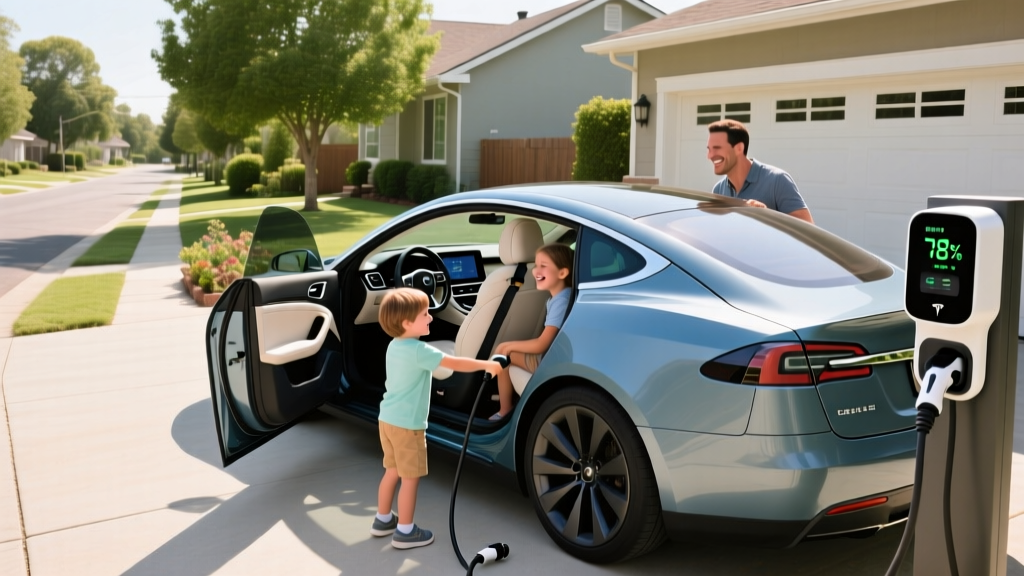
For families, home Level 2 charging is the real story. At 11.5 kW using a Tesla Wall Connector on a 60-amp circuit, a nearly depleted battery fully replenishes in about 9 hours — meaning you plug in after the evening routine and wake up with a full "tank" every morning. A licensed electrician will typically charge $500–$2,000 for a 240V/60A circuit installation, depending on panel proximity and whether your home's electrical panel needs an upgrade to support the additional load.
Safety, Rear-Seat Space, and Kid-Friendly Features
This is where parents need to look past the spec sheet. The Model S earns strong marks but has real compromises versus SUV-style competitors.
Safety ratings: The Model S holds a 5-star overall rating from NHTSA, with 5 stars in frontal and side crash tests. The IIHS has evaluated the Model S with mixed results in updated side-crash protocols — check their latest ratings as Tesla issues running updates.
Rear-seat dimensions: The Model S offers approximately 35.4 inches of rear legroom and 37.8 inches of rear headroom. This is adequate for forward-facing car seats and younger children, but taller teens will find the sloping roofline restrictive compared to a Model X (38.3 inches rear headroom) or a BMW i7 (39.1 inches). The low door sill and sedan roof height mean you'll bend more loading toddlers into rear-facing seats than you would in a crossover.
Cargo reality: 26.3 cu ft behind the rear seats plus a 2.8 cu ft frunk. That's enough for a double stroller, a couple of backpacks, and groceries — but a full family road trip with luggage for four will require strategic packing or a roof box. The 60/40 split-folding rear seats help when you need to haul longer items without passengers in back.
Tech features families will use:
- Cabin Overheat Protection: Keeps interior temperature below 105°F when parked — critical for safety when stepping away briefly
- Dog Mode / Camp Mode: Maintains climate control with a display message for passersby
- Tesla app remote climate: Pre-cool or pre-heat the cabin from your phone before loading kids
- Rear touchscreen: An 8-inch rear display lets back-seat passengers control climate and stream entertainment
- Autopilot (standard): SAE Level 2 driver assistance — adaptive cruise + lane centering. The driver must remain fully engaged; this is not self-driving
- Full Self-Driving (Supervised): Optional $8,000 add-on or $99/month subscription. Still SAE Level 2. Requires active driver supervision at all times
Tesla Autopilot and FSD (Supervised) are SAE Level 2 systems. They do NOT make the vehicle autonomous. The driver is legally and operationally responsible at all times — hands on or near the wheel, eyes on the road. For families, this means these features reduce highway fatigue but do not replace attentive driving, especially with children in the car who may be distracting.
Pricing, Trims, and Federal Tax Credit Eligibility
| Trim | Base MSRP | Destination | Typical As-Tested | §30D Federal Credit |
|---|---|---|---|---|
| Long Range | $81,130 | $1,390 | $82,520+ | Not eligible (exceeds $55K sedan cap) |
| Plaid | $96,130 | $1,390 | $97,520+ | Not eligible (exceeds $55K sedan cap) |
The tax-credit reality for Model S buyers: Under IRS §30D rules, the federal clean vehicle credit is capped at $55,000 MSRP for sedans (SUVs, vans, and trucks have an $80,000 cap). Because the Model S is classified as a sedan by the IRS, neither the Long Range nor Plaid trim qualifies — even before considering buyer income limits ($300K MFJ / $150K single) or the battery-critical-mineral and component-sourcing requirements.
This is a significant ownership-cost disadvantage versus the Tesla Model X (classified as an SUV, eligible up to $80K MSRP — though most trims still exceed that) or more affordable sedans like the Hyundai Ioniq 6 or BMW i5 that may fall under the cap depending on configuration. Always verify current-year eligibility on the IRS Clean Vehicle Credit page before purchase, as classification and sourcing rules can shift.
How the Model S Stacks Up Against Family-Focused Rivals
| Attribute | Tesla Model S LR | Lucid Air Pure | BMW i7 xDrive50 | Tesla Model X LR |
|---|---|---|---|---|
| EPA Range | 402 mi | 419 mi | 318 mi | 335 mi |
| Starting MSRP | $81,130 | $71,090 | $106,895 | $81,630 |
| Rear Headroom | 37.8 in | 37.6 in | 39.1 in | 38.3 in |
| Cargo (rear) | 26.3 cu ft | 32.0 cu ft | 31.2 cu ft | 37.1 cu ft |
| Max DCFC | 250 kW | 200 kW | 195 kW | 250 kW |
| Seating | 5 | 5 | 5–7 | 5–7 |
| §30D Eligible | No | No (sedan cap) | No (over $80K) | Possible (SUV cap) |
Choose the Model S if: You want maximum range per dollar among premium sedans, rely on the Supercharger network for road trips, and your kids are young enough that the low roofline isn't yet a problem.
Choose the Model X if: You need falcon-wing doors for easier car-seat loading, 7-seat capacity, more cargo room, and potential §30D eligibility under the SUV MSRP cap.
Choose the Lucid Air if: You want even more range (419 mi EPA) and a slightly lower entry price, though with a smaller charging network and fewer service centers.
Choose the BMW i7 if: Rear-seat luxury and headroom are priorities and budget is flexible — but expect significantly less range and no tax credit.
Warranty, Longevity, and Battery Degradation
Tesla covers the Model S battery and drive unit for 8 years or 150,000 miles, whichever comes first, with a minimum 70% capacity retention guarantee. This is one of the more generous warranties in the segment.
Real-world degradation data from Tesla's fleet reports and third-party tracking (including data aggregated by sources like Tesla Impact Reports) suggests NMC packs in the Model S lose roughly 10–12% capacity over the first 100,000 miles, then flatten into a slow, linear decline. For a family buying new and planning to keep the car 6–8 years, this means you'll likely retain 88–90% of original range through the typical ownership period.
Battery care tips for families:
- Set daily charge limit to 80–90% for routine use; charge to 100% only before long trips
- Use Scheduled Departure to precondition while plugged in — this warms the battery using grid power rather than pack energy
- Avoid frequent back-to-back Supercharger sessions when home charging is available; Level 2 is gentler on cell chemistry
- Don't let the car sit at 100% SoC for extended periods, especially in heat
The Family Verdict: Pros, Cons, and Who Should Buy
- 402-mi EPA range eliminates most road-trip range anxiety
- Supercharger network reliability (17,000+ U.S. stalls)
- Strong NHTSA 5-star crash rating
- Cabin Overheat Protection and remote climate control
- Fast home charging (44 mi/hr on Level 2)
- Low center of gravity — stable, car-sickness-reducing ride
- OTA updates add features over time
- Sedan roofline makes car-seat loading harder than an SUV
- Only 26.3 cu ft cargo — tight for family road trips
- No §30D federal tax credit (sedan MSRP cap)
- $81K+ starting price; Plaid pushes past $97K
- Insurance premiums run 15–30% above comparable gas sedans
- Touchscreen-only controls can distract while driving with kids
- Model X exists as a more family-practical Tesla option
Who this EV suits best: The Model S is ideal for families with one or two younger children who prioritize range and driving dynamics over cargo volume and easy car-seat access. It excels as a commuter-plus-road-tripper for households with reliable home Level 2 charging. If you regularly haul three kids, bulky sports gear, or need 7 seats, the Model X or a three-row electric SUV is the more practical Tesla.
Frequently Asked Questions
What is the real-world range of the Tesla Model S?
The EPA rates the 2026 Model S Long Range at 402 miles. In real-world mixed driving, expect 340–370 miles. Highway driving at 75+ mph drops this to roughly 300–330 miles, and cold winter weather (below freezing) can reduce range to 260–300 miles due to NMC battery chemistry sensitivity and cabin heating demands.
How fast does the Model S charge at home and on road trips?
At home on a Level 2 Tesla Wall Connector (11.5 kW), the Model S adds about 44 miles of range per hour — a full overnight charge from near-empty. On a V3 Supercharger, it peaks at 250 kW, adding up to 75 miles in 5 minutes at low SoC. A 10–80% DC fast charge takes approximately 30 minutes, though the charge curve tapers significantly above 50%.
Does the Tesla Model S qualify for the $7,500 federal EV tax credit?
No. Under current IRS §30D rules, sedans must have an MSRP at or below $55,000 to qualify. The Model S starts at $81,130, well above that cap. Buyers should also be aware of income limits ($300,000 for married filing jointly, $150,000 for single filers) and battery-sourcing requirements. Always verify eligibility at irs.gov before purchasing.
Is the Model S safe for children?
Yes — the Model S holds a 5-star overall NHTSA safety rating. Standard features include automatic emergency braking, side-collision warning, and a rigid battery pack that contributes to structural integrity. The rear seat accommodates forward-facing car seats comfortably; rear-facing seats fit but the low roofline requires more bending during loading compared to an SUV.
Should I buy the Model S or the Model X for my family?
Choose the Model S if you value maximum range (402 vs 335 miles), a lower price point, and sportier driving dynamics — and your family fits within a sedan's cargo and roofline constraints. Choose the Model X if you need falcon-wing doors for easier car-seat access, available 7-seat configuration, 37.1 cu ft of cargo space, and potential §30D tax-credit eligibility under the SUV MSRP cap.
How much does it cost to charge the Model S vs. filling a gas car?
At the U.S. average residential electricity rate of ~$0.17/kWh, fully charging the Model S's 100 kWh battery at home costs roughly $17 for 402 miles — about $0.042 per mile. A comparable gas sedan getting 28 MPG at $3.40/gallon costs ~$0.121 per mile. Over 15,000 annual miles, that's roughly $630 in electricity vs. $1,815 in gasoline — a savings of ~$1,185 per year on fuel alone.