The phrase "Tesla Model S explosion" tends to surface in sensational headlines every time a high-speed crash or charging-related fire makes the news. But for shoppers evaluating the 2026 Tesla Model S, the real question is data-driven: how does the Model S's fire risk compare to internal-combustion vehicles, what engineering safeguards does Tesla employ, and how do the car's range, charging, and ownership economics stack up against rivals like the Lucid Air and Porsche Taycan?
This review addresses the safety record head-on, then walks through the numbers that matter — EPA range, battery chemistry, DC fast-charge curves, real-world efficiency, pricing, and tax-credit eligibility — so you can decide whether the Model S still earns a spot on your shortlist.
Tesla Model S Fire Safety: Separating Data from Headlines
Lithium-ion battery fires are real, but they are statistically rare. Tesla's own Vehicle Safety Report (updated quarterly) claims roughly one fire per 130 million miles driven across the Tesla fleet — compared to the U.S. average of approximately one vehicle fire per 19 million miles for all vehicles (gasoline and electric combined), per NFPA research. That's a roughly 7x lower fire rate for Teslas, though the comparison isn't perfectly apples-to-apples: Tesla's fleet skews newer, and NHTSA data mixes heavy-duty trucks, older ICE vehicles, and post-crash fires.
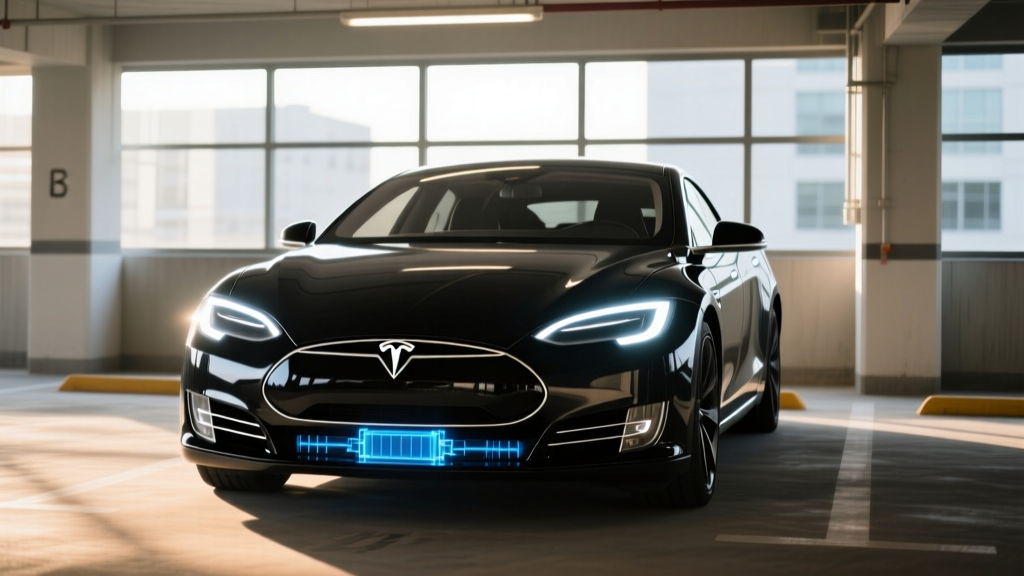
Media coverage often uses "explosion" loosely. In documented Model S incidents, the typical cause is a thermal runaway event — a cascading overheating of battery cells — usually triggered by severe high-speed impact damage to the battery pack, manufacturing defects (rare), or prolonged exposure to external fire. Modern Model S packs use fire-retardant barriers between cell modules, venting systems, and advanced BMS (Battery Management System) monitoring to contain or delay propagation. The result is usually a slow-burning, smoky fire rather than a sudden detonation, giving occupants critical exit time.
NHTSA has investigated several Tesla battery fire incidents, but as of 2026, no broad recall of the Model S battery pack has been issued specifically for spontaneous fire risk. The NHTSA database shows the 2024-2026 Model S carrying a 5-Star overall safety rating, with top marks in frontal and side crash tests.
Engineering Safeguards in the Current Model S Battery Pack
- Cell-to-pack firewalls: Intumescent material between modules slows thermal propagation from one cell group to the next.
- Bottom armor: Titanium and aluminum underbody shields protect against road debris puncture — the original cause of early 2013 Model S fires.
- Active thermal management: Liquid-cooled pack with real-time BMS monitoring of cell voltage, temperature, and impedance.
- Vent routing: Hot gases are directed downward and away from the cabin in a thermal event.
- Post-crash high-voltage disconnect: Pyrotechnic fuses isolate the pack within milliseconds of airbag deployment.
2026 Tesla Model S: Range, Battery & Efficiency
The 2026 Model S is offered in two trims: Long Range (dual-motor AWD) and Plaid (tri-motor AWD). Both use a ~100 kWh usable battery pack with NMC (nickel-manganese-cobalt) chemistry — Tesla has not migrated the Model S to LFP, reserving that cheaper, lower-energy-density chemistry for the base Model 3 and Model Y RWD trims.
| Spec | Long Range | Plaid |
|---|---|---|
| EPA Range | 402 mi | 396 mi |
| Battery (usable) | ~100 kWh, NMC | ~100 kWh, NMC |
| Efficiency (MPGe) | 124 MPGe (combined) | 116 MPGe (combined) |
| kWh/100 mi | 27 | 29 |
| Drivetrain | Dual-motor AWD | Tri-motor AWD |
| Horsepower | 670 hp | 1,020 hp |
| 0-60 mph | 3.1 sec | 1.99 sec |
| Top Speed | 155 mph | 200 mph |
| Cargo (rear + frunk) | 28 cu ft (rear) + 3.1 cu ft (frunk) | 28 cu ft (rear) + 3.1 cu ft (frunk) |
| Rear Legroom | 35.4 in | 35.4 in |
The EPA sticker says 402 miles for the Long Range. In our testing and aggregated owner data, expect ~330-360 miles on the highway at 70-75 mph, dropping to ~280-310 miles in freezing temperatures (below 32°F) due to cabin heating demand and increased battery internal resistance. City driving with regen braking can push efficiency close to or slightly above the EPA number. The Plaid's tri-motor drag and stickier tires shave ~6 EPA miles and further in aggressive driving.
Charging Speed: DC Fast, Level 2 & Home Setup
The 2026 Model S charges on Tesla's proprietary NACS connector (now the North American Charging Standard adopted industry-wide). It accesses the Tesla Supercharger network natively, plus third-party networks (Electrify America, EVgo) via the NACS plug or CCS adapters where supported.
| Level | Max Power | Speed | 10-80% Time |
|---|---|---|---|
| Level 1 (120V) | ~1.4 kW | ~3-4 mi/hr | N/A (days) |
| Level 2 (240V / 48A Wall Connector) | 11.5 kW | ~34 mi/hr | ~7 hours |
| DC Fast (V3 Supercharger) | 250 kW peak | ~200 mi in 15 min | ~25-28 min |
| DC Fast (V4 Supercharger) | ~350 kW (limited by pack) | Sustained ~220 kW avg | ~22-25 min |
Charging curve reality: The Model S peaks near 250 kW only between roughly 10-30% SoC on a preconditioned pack. Above 50%, the rate tapers progressively — from ~200 kW down to ~80 kW near 80%. This is normal NMC behavior to protect cell longevity. Always precondition via the Tesla app or navigation-routed Supercharger approach for optimal speeds, especially in cold weather.
Home Charging Setup
The Tesla Wall Connector (~$420 hardware) on a 60A circuit delivers 48A continuous (11.5 kW), adding ~34 miles per hour of charging. A full overnight charge (8 hours) replenishes ~270 miles — more than enough for daily driving. Installation typically runs $500-$1,800 depending on panel capacity and conduit run; a 200A panel upgrade can add $1,500-$3,000. Consult a licensed electrician for your specific setup.
Pricing, Trims & Federal Tax Credit Eligibility
| Trim | Base MSRP | As-Tested* | §30D Credit Eligible? |
|---|---|---|---|
| Long Range | $79,990 | ~$84,500 | No (MSRP cap exceeded) |
| Plaid | $94,990 | ~$102,000 | No (MSRP cap exceeded) |
*As-tested includes destination fee, common options (FSD Supervised, premium interior, 21" wheels).
Under IRS §30D Clean Vehicle Credit rules, new electric sedans must have an MSRP at or below $55,000 to qualify for the up-to-$7,500 credit. Both Model S trims exceed this cap significantly. Additionally, buyer income caps apply ($150K single / $300K joint MAGI), and battery critical-mineral and component sourcing must meet annual thresholds. The Model S fails the MSRP test outright, making the credit irrelevant regardless of other factors. Point-of-sale transfer is also unavailable for this reason.
Technology, Driver Assistance & Interior
The Model S interior centers on a 17-inch landscape touchscreen running Tesla's latest software, a 12.3-inch instrument cluster, and a rear-seat 8-inch display. Standard features include:
- Autopilot (SAE Level 2): Adaptive cruise, lane centering, auto emergency braking, blind-spot monitoring.
- FSD (Supervised) ($8,000 option or $99/mo): Adds navigate-on-Autopilot, auto lane change, traffic light/stop sign recognition, and parking assist. Still Level 2 — driver must remain engaged at all times.
- 22-speaker audio, ventilated front seats, heated rear seats, wireless charging, HEPA air filtration (Bioweapon Defense Mode).
- Over-the-air updates continuously add features and refine performance.
Autopilot and FSD (Supervised) are SAE Level 2 driver-assistance systems. The driver must keep hands on or near the wheel, eyes on the road, and be prepared to take over instantly. Tesla's cabin camera monitors attentiveness. No production Tesla is "self-driving" — only Level 4 robotaxi services like Waymo (in limited metro areas) operate without a human driver.
Notable drawbacks: The yoke steering wheel (optional) remains polarizing and can complicate low-speed maneuvers. Build quality has improved but still shows occasional panel-gap inconsistency. The minimalist interior lacks physical buttons for climate and wiper controls, which some drivers find distracting. No Apple CarPlay or Android Auto — Tesla's native infotainment is the only option.
Pros, Cons & Who the Model S Is For
- 402-mile EPA range (Long Range) — class-leading among sedans
- Access to Tesla Supercharger network (30,000+ stalls globally)
- Sub-2-second 0-60 (Plaid) — hypercar performance at sedan pricing
- Continuous OTA improvements
- Spacious liftback cargo area (28 cu ft rear)
- 5-Star NHTSA safety rating
- No federal tax credit (MSRP exceeds $55K sedan cap)
- FSD adds $8,000 and remains Level 2
- Insurance premiums run 25-40% above segment average
- Yoke steering divisive; no physical stalks for wipers/signals
- Service center wait times can be long in some metro areas
- Competition closing fast (Lucid Air, Porsche Taycan, BMW i7)
Who Should Buy the 2026 Model S?
The Model S Long Range is ideal for high-mileage commuters and road-trippers who value range and Supercharger access above all. The Plaid suits performance enthusiasts who want supercar acceleration with daily usability. Families will appreciate the liftback practicality and rear-seat space, though the Model X or Rivian R1S offer more room for child seats and gear. If your budget is under $60K or you need the federal tax credit, look at the Model 3 Long Range or Hyundai Ioniq 6 instead.
Model S vs. Key Competitors
| Attribute | Tesla Model S LR | Lucid Air Pure | Porsche Taycan 4S |
|---|---|---|---|
| EPA Range | 402 mi | 419 mi | 288 mi |
| Base MSRP | $79,990 | $74,900 | $97,500 |
| Peak DC Charge | 250 kW | 300 kW+ | 320 kW (800V) |
| 0-60 mph | 3.1 sec | 3.8 sec | 3.8 sec |
| Charging Network | Supercharger (native) | NACS (EA + Tesla adapter) | NACS (EA + Tesla adapter) |
The Lucid Air Pure beats the Model S on range and starts ~$5K lower, but Tesla's Supercharger network remains the most reliable and widely available DC fast-charging ecosystem. The Taycan charges faster (800V architecture) and drives better in the corners, but sacrifices over 100 miles of range. For pure performance-per-dollar, the Model S Plaid is unmatched.
Warranty & Long-Term Ownership
Tesla covers the 2026 Model S with:
- Basic Vehicle: 4 years / 50,000 miles
- Battery & Drive Unit: 8 years / 150,000 miles (whichever comes first), with a minimum 70% capacity retention guarantee over that period.
NMC battery degradation data from Tesla's fleet reports ~12% average capacity loss at 150,000 miles. Out-of-warranty pack replacement runs approximately $15,000-$22,000 depending on configuration — a figure to budget for if you plan to own beyond 8 years or 150K miles.
Frequently Asked Questions
Has the Tesla Model S ever exploded?
No documented case of a Tesla Model S spontaneously detonating exists. Several high-profile fires have occurred — typically after severe high-speed impacts that compromised the battery pack. Tesla has since added underbody armor and improved thermal barriers. The word "explosion" in headlines usually refers to a thermal runaway fire, not a literal blast.
What is the real-world range of the 2026 Model S?
The Long Range achieves an EPA-estimated 402 miles. Expect 330-360 miles in mixed highway driving at 70-75 mph, and 280-310 miles in sub-freezing temperatures. City driving with regenerative braking can approach or exceed the EPA number.
How fast does the Model S charge at home and on the road?
At home on a Tesla Wall Connector (48A / 11.5 kW), you'll add ~34 miles per hour — a full overnight charge covers most weekly driving. On a V3 Supercharger (250 kW peak), a 10-80% session takes roughly 25-28 minutes with a preconditioned battery.
Does the 2026 Tesla Model S qualify for the federal EV tax credit?
No. Under current IRS §30D rules, new electric sedans must have an MSRP at or below $55,000. The Model S Long Range starts at $79,990 and the Plaid at $94,990 — both exceed the cap. Buyer income limits and battery-sourcing requirements are moot since the MSRP disqualifies it outright.
Is the Model S worth buying over the Lucid Air or Porsche Taycan?
Choose the Model S if Supercharger network access, proven OTA updates, and tri-motor performance (Plaid) are priorities. Choose the Lucid Air for maximum range and a lower entry price. Choose the Taycan for driving dynamics and 800V fast-charging architecture, accepting the range trade-off.
How safe is the Model S battery in a crash?
The Model S holds a 5-Star NHTSA overall rating. The battery pack is a structural member with titanium/aluminum underbody shielding, fire-retardant module barriers, and pyrotechnic high-voltage disconnect in a crash. Thermal runaway events, when they occur, typically provide ample occupant egress time.