The Tesla Model S has been the benchmark luxury electric sedan for over a decade, but one of its most debated design elements remains its doors. From flush-mounted electronic handles to the optional auto-presenting feature, the Tesla Model S doors encapsulate the car's blend of futuristic minimalism and real-world practicality. In this comprehensive 2026 review, we examine the door design, entry system, and every critical specification — range, charging, performance, pricing, and tax credit eligibility — to help you decide if this flagship sedan still earns its place in your garage.
Tesla Model S Doors: Design, Handles & Entry Technology
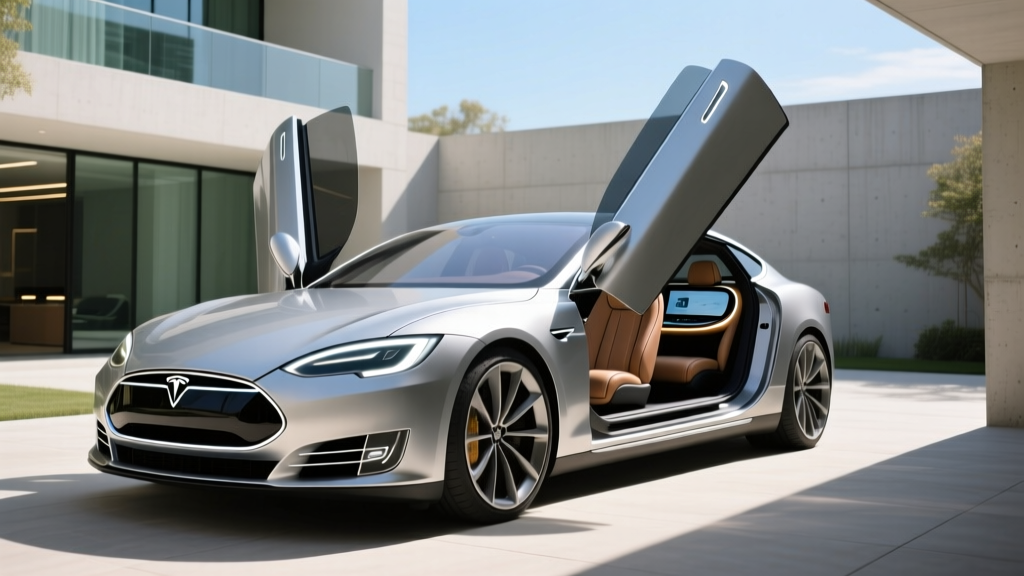
The Model S uses a fully flush door-handle design that sits recessed into the bodywork until activated. Unlike conventional pull handles, these electronic handles present themselves when the car detects the key fob or phone-as-key approaching. Once you grasp the handle, a microswitch releases the latch and the door swings open with light assistance.
On higher trims and with the Premium Interior package, Tesla offers auto-presenting doors on the driver's side. This feature uses ultrasonic sensors to detect obstacles and automatically swings the driver's door open upon approach, then closes it when you press the brake pedal. It's a theatrical touch that works well in garages but can be overly cautious in tight parking spaces where the sensor false-triggers.
| Feature | Specification |
|---|---|
| Handle Type | Flush electronic, auto-presenting |
| Keyless Entry | Phone-as-key + key fob |
| Auto-Present Driver Door | Available (Premium Interior) |
| Soft-Close | Standard (power latch) |
| Child Safety Locks | Electronic, app-controllable |
| Frameless Windows | Yes, all four doors |
Owners should know that the electronic handles rely on the 12V auxiliary system. If the 12V battery dies, Tesla includes a manual release cable inside the door panel (accessible from the interior), but there is no external mechanical override — a consideration for those in extreme climates where 12V systems can be stressed.
2026 Tesla Model S Full Spec Sheet
| Spec | Model S Long Range | Model S Plaid |
|---|---|---|
| EPA Range | 402 miles | 396 miles |
| Battery (usable) | ~100 kWh, NMC | ~100 kWh, NMC |
| Drivetrain | Dual-Motor AWD | Tri-Motor AWD |
| Horsepower | 670 hp | 1,020 hp |
| 0-60 mph | 3.1 seconds | 1.99 seconds |
| Top Speed | 155 mph | 200 mph |
| Max DC Charge Rate | 250 kW | 250 kW |
| 10-80% DC Time | ~30 minutes | ~30 minutes |
| Level 2 Home Rate | 11.5 kW (~44 mi/hr) | 11.5 kW (~44 mi/hr) |
| MPGe (combined) | 120 MPGe | 116 MPGe |
| kWh/100 mi | 28 kWh | 29 kWh |
| Base MSRP | $79,990 | $94,990 |
Real-World Range: What the EPA Sticker Doesn't Tell You
EPA Estimated: 402 miles (Long Range) / 396 miles (Plaid)
Real-World Highway (70 mph): ~310–340 miles
Cold Weather (below 32°F): ~260–300 miles
Mixed Commuting: ~360–380 miles
The Model S Long Range carries a 402-mile EPA rating — still one of the highest of any production EV sold in the US. According to fueleconomy.gov, the combined efficiency sits at 120 MPGe (28 kWh/100 mi).
However, real-world testing consistently shows highway driving at 70+ mph drops range by 15–22%. The Plaid's tri-motor setup and stickier tires add rolling resistance, shaving real-world highway range to roughly 300–320 miles. Cold weather compounds this: NMC chemistry loses efficiency below freezing, and while Tesla's heat pump and battery preconditioning mitigate some loss, expect 25–35% range reduction in sustained sub-30°F driving.
The Model S uses an NMC (nickel manganese cobalt) battery pack, chosen for its high energy density. This gives the sedan its class-leading range but means Tesla recommends daily charging to 80–90% for longevity, reserving 100% for road trips. Unlike LFP-equipped vehicles, you should not routinely charge NMC to full.
Charging Speed: DC Fast, Home Level 2 & Connector Details
The Model S charges via the NACS (North American Charging Standard) connector natively — no adapter needed for Tesla Superchargers. With the opening of the Supercharger network to other brands, the Model S now shares stalls with Ford, Rivian, and GM vehicles, though Tesla owners still benefit from seamless plug-and-charge integration.
| Charging Level | Power | Miles Added per Hour | Notes |
|---|---|---|---|
| Level 1 (120V) | 1.4 kW | ~5 mi/hr | Emergency/trickle only |
| Level 2 (240V, 48A) | 11.5 kW | ~44 mi/hr | Home Wall Connector |
| Level 2 (240V, 32A) | 7.7 kW | ~30 mi/hr | Mobile Connector, NEMA 14-50 |
| DC Fast (Supercharger V3) | 250 kW peak | ~200 mi in 15 min | 10-80% in ~30 min |
| DC Fast (CCS adapter) | Up to 150 kW | Varies by station | Requires Tesla CCS adapter |
The charge curve matters: the Model S peaks near 250 kW only between roughly 10–30% state of charge, then tapers progressively. From 50–80%, you'll see 80–120 kW, which is why 10-80% takes about 30 minutes rather than a linear extrapolation of peak speed. Preconditioning the battery (automatic when a Supercharger is set in navigation) is essential for hitting peak rates — arrive cold and you may peak at only 100–120 kW.
At home, the Tesla Wall Connector delivers up to 11.5 kW on a 60A circuit (48A continuous), adding roughly 44 miles of range per hour. A full overnight charge from 20% to 80% takes about 5–6 hours, making it effortless for daily driving.
Performance: 0-60, Horsepower & Drivetrain Breakdown
The Model S Long Range pairs front and rear permanent-magnet motors for 670 combined horsepower and a 3.1-second 0-60 mph time. That's supercar territory from just a few years ago, delivered silently and with all-weather AWD traction.
The Plaid steps to a tri-motor layout — one front, two rear — producing 1,020 hp and a claimed 1.99-second 0-60 on a prepped surface. In real-world testing on typical asphalt, expect 2.2–2.4 seconds. The Plaid's torque-vectoring rear axle gives it cornering agility that belies its 4,766-pound curb weight.
Both trims feature adaptive air suspension with automatic ride-height adjustment. The system lowers the car at highway speeds for aerodynamic efficiency (improving range by roughly 2–3%) and raises it for driveway clearance. The steering is quick but numb — a common Tesla trait — and the regenerative braking is aggressive enough for near one-pedal driving, though Tesla removed the adjustable regen toggle in favor of a fixed high-regen calibration.
Pricing, Trim Levels & Federal Tax Credit Eligibility
| Trim | Base MSRP | Destination | Est. Federal Credit | Effective Price |
|---|---|---|---|---|
| Model S Long Range | $79,990 | $1,390 | $0* | $81,380 |
| Model S Plaid | $94,990 | $1,390 | $0* | $96,380 |
*The Model S does NOT qualify for the §30D new EV tax credit because its MSRP exceeds the IRS sedan cap of $55,000. See IRS §30D rules for full details.
This is a critical point many buyers miss. Under current IRS §30D rules, sedans must have an MSRP at or below $55,000 to qualify for the up-to-$7,500 federal tax credit. The Model S starts at $79,990 — well above that cap — making it ineligible regardless of battery sourcing or buyer income. If federal incentives are a priority in your purchase decision, the Model S will not help.
However, some states offer their own EV rebates or luxury-EV incentives that may apply. Check your state energy office or DMV for current programs. Tesla also periodically offers lease deals or referral credits that can offset the price, though these change frequently.
Options to budget for: FSD (Supervised) adds $8,000 or $99/month, premium paint colors range $1,500–$2,500, and 21-inch Arachnid wheels cost $4,500 but reduce range by roughly 5–8%.
Interior, Cargo Space & Standout Technology
The Model S cabin centers on a 17-inch landscape touchscreen running Tesla's latest software, a 12.3-inch digital instrument cluster, and a rear-seat 8-inch display for climate and entertainment controls. Build quality on 2025–2026 models has improved substantially over earlier years, with tighter panel gaps, ventilated front seats, and a yoke-or-round steering wheel choice.
Cargo capacity is generous for a sedan:
- Trunk: 28.0 cu ft (with rear seats up)
- Rear seats folded: 54.0 cu ft
- Frunk (front trunk): 5.3 cu ft
- Rear legroom: 35.4 inches
- Front headroom: 38.8 inches
The hatchback-style trunk lid (the entire rear glass lifts) makes loading far easier than a traditional sedan's parcel shelf, and the frunk accommodates a carry-on bag or charging cables.
Tech highlights include native Spotify/Apple Music/Tidal streaming, a 22-speaker audio system, HEPA air filtration with Bioweapon Defense Mode, and over-the-air updates that continuously add features. The gaming capability (Steam integration on the main display while parked) remains a class-exclusive party trick.
Autopilot comes standard with traffic-aware cruise control and lane-keeping. FSD (Supervised) adds automated lane changes, city-street navigation, and traffic-light recognition — but this is a SAE Level 2 system. You must keep hands on the wheel and eyes on the road at all times. It is not self-driving.
Warranty Coverage & Long-Term Ownership Costs
Tesla's warranty for the Model S includes:
- Basic Vehicle: 4 years / 50,000 miles
- Battery & Drive Units: 8 years / 150,000 miles (Long Range)
- Battery & Drive Units: 8 years / 150,000 miles (Plaid)
- Battery Capacity Guarantee: Retains at least 70% over warranty period
The 70% retention threshold is standard for the industry. Real-world data from Tesla's own fleet reports suggest average degradation of roughly 10–12% over 150,000 miles for NMC packs, meaning most owners will stay well within the guarantee. A full battery replacement out of warranty currently runs approximately $13,000–$18,000 depending on pack configuration.
Insurance costs are above average for the segment — expect $2,400–$3,800 annually depending on your location and driving record, according to industry aggregators. Tesla's own insurance product is available in many states and uses real-time driving data to set premiums.
Tesla Model S vs. Key Competitors
The Model S competes with the Lucid Air, Porsche Taycan, BMW i7, and Mercedes EQS. Each trade-off is distinct:
- Lucid Air Grand Touring: 516-mile EPA range (class leader), $125,650 MSRP, slower charging at ~200 kW peak. Better range, higher price.
- Porsche Taycan Turbo S: Superior handling and build, but only ~280-mile EPA range and ~$190,000. A driver's car, not a range champion.
- BMW i7 xDrive60: 318-mile range, $120,300, more traditional luxury execution with superior rear-seat comfort.
- Mercedes EQS 580: 371-mile range, $105,550, excellent ride quality, controversial styling.
The Model S occupies a unique middle ground: it undercuts all of these on price while delivering the second-best range (behind Lucid), the fastest acceleration (Plaid), and the most mature charging network access.
Pros
- Class-leading 402-mile EPA range (Long Range)
- Tri-motor Plaid delivers sub-2-second 0-60
- Access to 30,000+ Tesla Superchargers natively
- Hatchback trunk + frunk for real cargo utility
- Continual OTA updates add value over time
- Low maintenance (no oil, minimal brake wear with regen)
Cons
- Does not qualify for $7,500 federal tax credit (MSRP cap)
- FSD remains Level 2 — not autonomous despite the name
- Panel gaps and interior materials trail Porsche/Mercedes
- High insurance premiums relative to peers
- No physical buttons — all climate/media via touchscreen
- Auto-present doors can be slow in cold weather
Who Should Buy the 2026 Tesla Model S?
The Model S fits buyers who want maximum range without stepping into SUV territory, value Supercharger network access for frequent road trips, and appreciate tech-forward minimalism. It's an excellent long-distance commuter and a surprisingly practical family sedan thanks to the hatchback design.
It's less ideal if you prioritize traditional luxury materials (look at the EQS or i7), need the absolute lowest purchase price (the Model 3 or a used EV may serve better), or require the federal tax credit to make the math work. Towing is rated at just 2,000 pounds — adequate for a small trailer, not a boat.
Frequently Asked Questions
What is the real-world range of the Tesla Model S?
The EPA rates the Long Range at 402 miles and the Plaid at 396 miles. In real-world highway driving at 70 mph, expect 310–340 miles. In cold weather below 32°F, range drops to roughly 260–300 miles depending on cabin heating use and terrain.
How fast does the Model S charge at home and on the road?
At home on a Level 2 Wall Connector (11.5 kW), you'll add about 44 miles per hour, fully replenishing overnight. On a V3 Supercharger (250 kW peak), 10–80% takes approximately 30 minutes with a preconditioned battery. Charging via CCS adapter at third-party stations peaks around 150 kW.
Does the Tesla Model S qualify for the federal EV tax credit?
No. Under IRS §30D rules, sedans must have an MSRP of $55,000 or less to qualify. The Model S starts at $79,990, exceeding this cap. State-level incentives may still apply — check your local energy office. Consult a tax professional for personal eligibility guidance.
How reliable are the auto-presenting doors?
The auto-presenting driver door works reliably in moderate temperatures but can be slower to actuate below freezing due to thicker lubricants and sensor caution. The ultrasonic obstacle detection occasionally false-triggers near curbs or tall parking blocks. Manual operation is always available.
Is the Model S worth buying over the Lucid Air or Porsche Taycan?
Choose the Model S if you want the best combination of range, performance, Supercharger access, and price under $100K. Choose the Lucid Air if maximum range (516 mi) is paramount and budget is flexible. Choose the Taycan if driving dynamics and build quality matter more than range and charging speed.
What is the battery warranty on the Model S?
Tesla covers the battery and drive units for 8 years or 150,000 miles, whichever comes first, with a guaranteed minimum 70% capacity retention over that period. Out-of-warranty replacement costs approximately $13,000–$18,000.