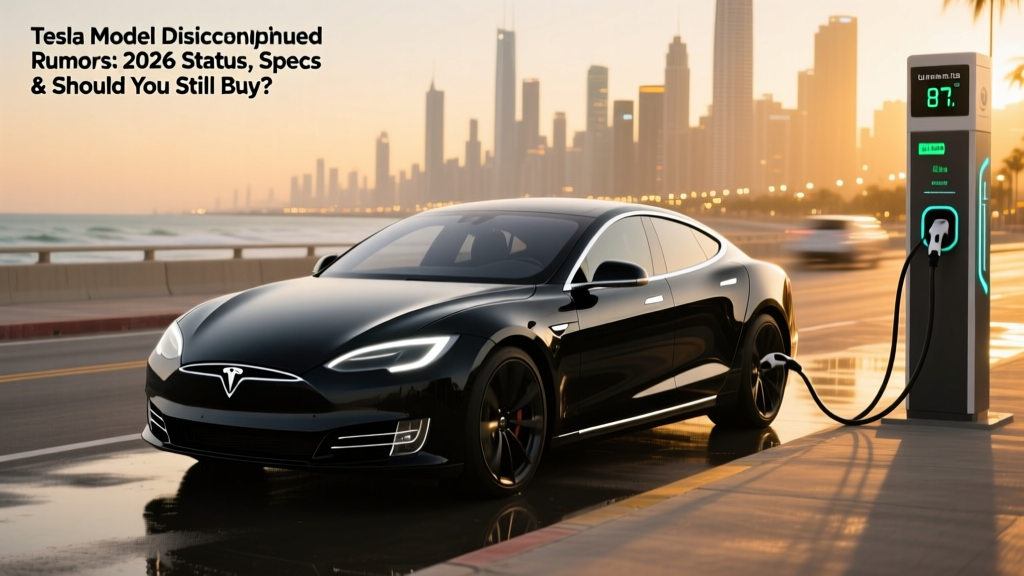
Rumors about the Tesla Model S being discontinued surface almost every year, and 2026 is no exception. With Tesla's lineup increasingly focused on higher-volume vehicles and new form factors, buyers are understandably asking: is the Model S still in production, and does it still make sense to purchase one? This profile cuts through the speculation with hard specs, real-world ownership data, and a clear-eyed look at where the Model S stands in today's luxury EV market.
Is the Tesla Model S Actually Discontinued in 2026?
As of the current 2026 model year, the Tesla Model S remains listed on Tesla's official website and is available for order in the United States. Tesla has not issued a formal discontinuation announcement. However, the company has progressively reduced the Model S's prominence in its marketing and showroom presence, and production volumes have fallen dramatically from peak years.
The discontinuation speculation stems from several observable trends: Tesla's Fremont factory has progressively reallocated lines toward Model Y and Cybertruck production; global Model S sales have dwindled to low four-digit figures annually; and Tesla's public roadmap emphasizes next-generation platforms and robotaxi development over legacy sedan refreshes. That said, the Model S continues to serve as Tesla's flagship sedan and halo technology platform — it's where features like the yoke steering and Plaid powertrain debuted.
2026 Tesla Model S: Full Spec Breakdown
| Specification | Long Range | Plaid |
|---|---|---|
| EPA Range | 402 miles | 396 miles |
| Battery Capacity (usable) | ~95 kWh (NMC) | ~95 kWh (NMC) |
| Drivetrain | Dual-Motor AWD | Tri-Motor AWD |
| Horsepower | 670 hp | 1,020 hp |
| 0-60 mph | 3.1 seconds | 1.99 seconds |
| Top Speed | 155 mph | 200 mph |
| Efficiency (EPA) | 124 MPGe (27 kWh/100mi) | 116 MPGe (29 kWh/100mi) |
| Peak DC Fast Charge | 250 kW | 250 kW |
| 10-80% DC Charge Time | ~27 minutes | ~27 minutes |
| Level 2 Home Charging | 11.5 kW (~44 mi/hr) | 11.5 kW (~44 mi/hr) |
| Base MSRP | $79,990 | $94,990 |
| Battery Warranty | 8 yr / 150,000 mi | 8 yr / 150,000 mi |
The Model S uses an NMC (nickel manganese cobalt) battery chemistry, which offers higher energy density than LFP but requires more careful state-of-charge management. Tesla recommends daily charging to 80-90% for NMC packs and reserving 100% charges for road trips. The 8-year/150,000-mile battery warranty guarantees a minimum 70% capacity retention — a threshold consistent with industry norms for this chemistry class.
Charging Speed: DC Fast, Level 2, and the Supercharger Advantage
| Charging Method | Power | Miles Added per Hour | Notes |
|---|---|---|---|
| Level 1 (120V) | ~1.4 kW | ~3-5 mi/hr | Emergency/trickle only |
| Level 2 (240V, 48A) | 11.5 kW | ~44 mi/hr | Full overnight charge in ~10 hrs |
| DC Fast (Supercharger V3) | 250 kW peak | ~200 mi in 15 min | Tapers above 50% SoC |
| DC Fast (Supercharger V4) | Up to 325 kW (station dependent) | Similar — vehicle limited to ~250 kW intake | Future headroom; current Model S caps at 250 kW |
The Model S's 250 kW peak DC fast-charging rate is no longer class-leading. Competitors on 800-volt architectures — such as the Hyundai Ioniq 6 (up to 350 kW) and Porsche Taycan (up to 320 kW) — can charge faster under optimal conditions. However, the Model S benefits from seamless access to the Tesla Supercharger network, which remains the most reliable and widely deployed DC fast-charging infrastructure in North America, with over 6,000 stations and 65,000+ individual chargers.
One critical nuance: the 250 kW peak rate is only sustained for a narrow window between roughly 10-30% state of charge. Above 50%, the charge curve tapers significantly, dropping below 100 kW by 70% SoC. This means a 10-80% session takes approximately 27 minutes, but a 50-80% top-up alone still takes around 18 minutes. Always precondition the battery (via in-car navigation to a Supercharger) before arriving to maximize charge speed.
Pricing, Trim Levels, and Federal Tax Credit Eligibility
| Trim | Base MSRP | As-Tested (typical options) | §30D Federal Credit |
|---|---|---|---|
| Long Range | $79,990 | $83,000-$87,000 | Not eligible (exceeds MSRP cap) |
| Plaid | $94,990 | $98,000-$105,000 | Not eligible (exceeds MSRP cap) |
Here's a critical point many buyers miss: the Tesla Model S does not qualify for the IRS §30D federal EV tax credit. The law caps eligible sedans at an MSRP of $55,000 (vans, SUVs, and trucks have a higher $80,000 cap). Since the Model S is classified as a sedan and starts at $79,990, it is ineligible regardless of buyer income or battery sourcing.
Additionally, §30D imposes income caps ($150,000 single / $300,000 joint filers) and critical-mineral/battery-component sourcing requirements that shift annually. Even if the Model S were under the MSRP cap, battery sourcing compliance for 2026 would require verification. Always confirm current-year eligibility with a tax professional and consult the IRS's official clean vehicle credit page before purchase.
State-level incentives may still apply. California, for example, has offered rebates through various clean-fuel programs, though amounts and eligibility vary by jurisdiction and funding availability. Check your state's energy office or DMV for current programs.
Interior, Cargo, and Daily Livability
The Model S interior remains a study in minimalism — some call it elegant, others find it sparse for the price point. The 17-inch center touchscreen dominates the dash and controls virtually every vehicle function, from climate to glovebox release. A secondary 8-inch screen serves rear passengers, and a 12.3-inch instrument cluster sits behind the available yoke or conventional steering wheel.
Practical dimensions matter for sedan shoppers comparing the Model S to luxury alternatives:
- Cargo volume: 28.0 cu ft trunk + 3.1 cu ft frunk (31.1 cu ft total) — significantly more than the BMW i7 (17.7 cu ft) and competitive with the Mercedes EQS (22.0 cu ft)
- Rear legroom: 35.4 inches — adequate for adults but less generous than the BMW i7 (42.8 in) or Mercedes EQS (42.2 in)
- Front headroom: 40.5 inches
- Seating: Standard 5-passenger; ventilated front seats, heated rear seats included
The liftback design is a practical advantage over traditional sedan trunks, making it easier to load bulky items. The frunk, while small, accommodates a charging cable bag or laptop bag.
Tech, Driver Assistance, and the FSD Question
The Model S includes Tesla's Basic Autopilot as standard, providing adaptive cruise control and lane-centering on marked roads. The optional Full Self-Driving (Supervised) package — currently priced around $8,000 or available as a monthly subscription — adds automatic lane changes, traffic-light recognition, and navigation-guided driving on highways and some city streets.
Beyond driver assists, the Model S features a 22-speaker audio system, wireless phone charging, HEPA air filtration with Bioweapon Defense Mode, and over-the-air software updates that periodically add features. The gaming-capable infotainment system can run titles at a quality level approaching a PlayStation 5, though this is a niche use case.
Real-World Ownership: Who Should Buy the Model S?
Pros
- Class-leading EPA range at 402 miles (Long Range)
- Unmatched Supercharger network access with NACS connector
- Plaid's 1.99-second 0-60 remains among the fastest production cars ever built
- Liftback cargo practicality exceeds typical luxury sedans
- 8-year/150,000-mile battery warranty
- OTA updates keep software current without dealer visits
Cons
- No federal tax credit eligibility (MSRP exceeds $55,000 sedan cap)
- 250 kW peak charge rate trails 800V competitors (Taycan, Ioniq 6)
- Rear legroom falls short of BMW i7 and Mercedes EQS
- Panel gaps and interior material quality have drawn criticism at this price
- Discontinuation risk could affect long-term resale value and parts availability
- Yoke steering is polarizing and not universally preferred
Best suited for: Tech-forward buyers who prioritize range, acceleration, and Supercharger convenience over traditional luxury materials. The Model S excels as a long-distance commuter and road-trip vehicle where its 400-mile range and fast-charging network access shine. Families who need maximum rear-seat space may prefer the BMW i7 or Mercedes EQS.
Consider alternatives if: You want the latest 800V charging architecture, maximum rear-seat luxury, or federal tax-credit eligibility. The EPA's EV comparison tool can help benchmark efficiency and range against competitors.
Is the Model S Still Worth Buying vs. Competitors?
The luxury EV sedan segment has grown substantially, and the Model S faces credible rivals it didn't have five years ago:
- BMW i7 xDrive50: $105,700, 318 mi EPA, far more rear-seat luxury, but less range and no Supercharger access
- Mercedes-Benz EQS 450+: ~$104,400, 390 mi EPA, opulent interior, but slower charging and depreciates steeply
- Lucid Air Pure: $69,900, 419 mi EPA, superior efficiency (4.5 mi/kWh), but newer brand with fewer service centers
- Porsche Taycan: $90,900+, 246-318 mi EPA, best driving dynamics, 800V fast-charging, but less range
The Model S holds its ground on range and charging-infrastructure access. The Lucid Air Pure is arguably the strongest range-and-value competitor, offering more EPA miles at a lower price — but Tesla's service network and Supercharger ecosystem remain a significant practical advantage for buyers outside major metro areas.
Frequently Asked Questions
Is Tesla discontinuing the Model S in 2026?
Tesla has not made an official discontinuation announcement. The Model S remains available for order as of the current model year. However, declining sales volumes and Tesla's strategic pivot toward newer platforms mean the model's long-term future is uncertain. Buyers concerned about long-term parts and service support should weigh this risk.
What is the real-world range of the Tesla Model S?
The Long Range model's EPA estimate is 402 miles. Real-world highway driving at 70-75 mph typically yields 330-355 miles. In cold weather below freezing, expect 280-310 miles. Preconditioning the battery and using seat heaters instead of cabin heat can recover 15-30 miles in winter conditions.
How fast does the Model S charge at home and on the road?
On a 240V Level 2 home charger at 48 amps (11.5 kW), the Model S adds approximately 44 miles of range per hour, fully charging overnight in about 10 hours. On a V3 Supercharger, it peaks at 250 kW, adding up to 200 miles in 15 minutes. A full 10-80% DC fast charge takes approximately 27 minutes.
Does the Tesla Model S qualify for the federal EV tax credit?
No. Under IRS §30D rules, sedans must have an MSRP of $55,000 or less to qualify. The Model S starts at $79,990, making it ineligible regardless of buyer income or battery sourcing. State-level incentives may still apply — check your local energy office.
Should I buy a Model S now or wait for a replacement?
If you need a long-range electric sedan today and value Supercharger access, the Model S is a proven, capable vehicle. However, if you can wait and are concerned about discontinuation risk, competitors like the Lucid Air and BMW i7 represent newer platforms with more certain production futures. There is no confirmed Model S successor on Tesla's announced roadmap.
How does the Model S battery hold up over time?
Tesla's NMC battery packs in the Model S have demonstrated strong longevity in owner-reported data, with typical degradation of 8-12% over the first 100,000 miles. The 8-year/150,000-mile warranty covers defects and capacity loss below 70%. Avoiding frequent 100% charges and DC fast-charging in extreme heat will help maximize battery life.