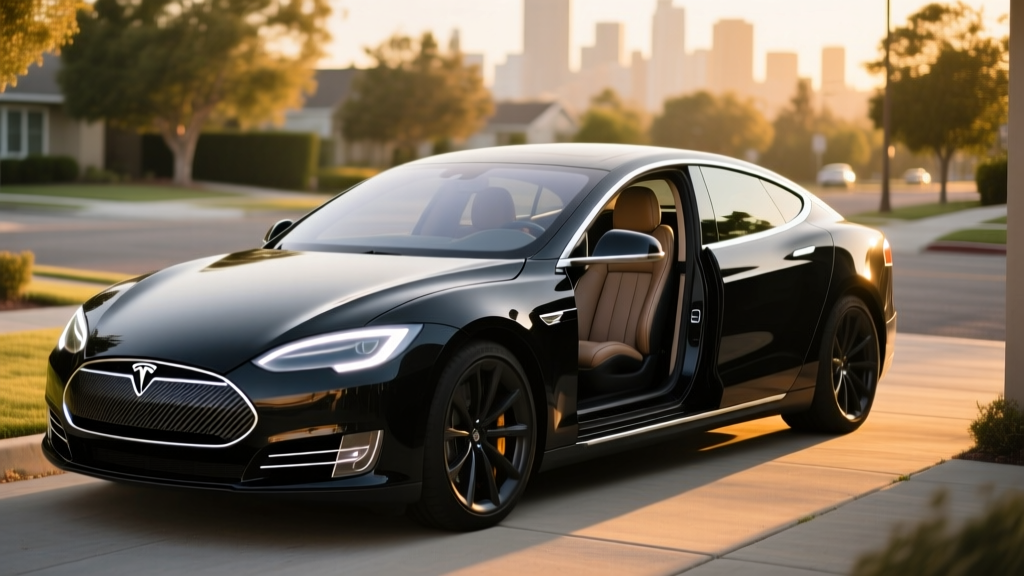
The Tesla Model S has been the benchmark luxury electric sedan for over a decade, but its depreciation trajectory is one of the most debated topics among EV buyers. If you're researching Tesla Model S depreciation before committing $80,000+ to a flagship sedan, you're asking the right question. Luxury EVs historically lose value faster than their gas counterparts, and the Model S sits at the intersection of rapid tech iteration, aggressive Tesla price cuts, and a shifting competitive landscape.
This profile pairs a full 2026 Model S spec breakdown with a hard look at what drives its resale value — and what you can expect to recover when it's time to sell.
2026 Tesla Model S at a Glance: Core Specs
| Spec | Model S Long Range | Model S Plaid |
|---|---|---|
| Base MSRP | $79,990 | $94,990 |
| EPA Range | 402 mi | 396 mi |
| Battery (usable) | ~95 kWh, NMC | ~95 kWh, NMC |
| Drivetrain | Dual-Motor AWD | Tri-Motor AWD |
| Horsepower | 670 hp | 1,020 hp |
| 0–60 mph | 3.1 sec | 1.99 sec |
| Top Speed | 155 mph | 200 mph |
| Peak DC Charge Rate | 250 kW | 250 kW |
| 10–80% DC Fast Charge | ~30 min | ~30 min |
| Level 2 Home Charge | 11.5 kW (~34 mi/hr) | 11.5 kW (~34 mi/hr) |
| MPGe (combined) | 120 MPGe | 116 MPGe |
| Efficiency | 28 kWh/100 mi | 29 kWh/100 mi |
| Cargo Volume | 28 cu ft (rear) + frunk | 28 cu ft (rear) + frunk |
| Rear Legroom | 35.4 in | 35.4 in |
| Battery Warranty | 8 yr / 150,000 mi | 8 yr / 150,000 mi |
| Basic Warranty | 4 yr / 50,000 mi | 4 yr / 50,000 mi |
Real-World Range: What the EPA Number Doesn't Tell You
EPA Estimate: 402 miles (Long Range) / 396 miles (Plaid)
Real-World Expectation: Plan for ~320–340 miles on mixed highway driving at 70–80 mph. In cold weather (below 32°F), expect a 20–30% reduction, dropping effective range to roughly 260–290 miles. City driving with regen braking can match or slightly exceed the EPA figure.
The Model S's 402-mile EPA rating remains one of the highest of any production EV sold in the U.S. According to fueleconomy.gov, the Long Range achieves this with a 28 kWh/100 mi consumption figure — impressive for a 4,500+ lb luxury sedan. But the physics of aerodynamic drag at highway speeds and NMC battery behavior in cold temperatures mean the sticker number is a ceiling, not a guarantee.
On a 75°F day at 65 mph with climate control in auto, you'll see roughly 340–360 miles from a full charge. Push to 80 mph and that drops to around 310–320. In sub-freezing Midwestern winters, preconditioning the battery (which the Model S does automatically when a Supercharger is navigated to) helps, but cabin heating and battery chemistry limitations still eat into range meaningfully.
Charging Speed: 250 kW Peak, but Watch the Curve
| Charging Level | Power / Rate | Miles Added per Hour | Notes |
|---|---|---|---|
| Level 1 (120V) | ~1.4 kW | ~3–4 mi/hr | Emergency/trickle only |
| Level 2 (240V, 48A) | 11.5 kW | ~34 mi/hr | Full charge overnight (~9–10 hrs) |
| DC Fast (Supercharger V3) | Up to 250 kW | ~200 mi in 15 min (peak) | 10–80% in ~30 min; tapers sharply above 80% |
| DC Fast (Supercharger V4) | Up to 250 kW (Model S limited) | Same as V3 for current Model S | V4 stalls can deliver higher kW, but Model S architecture caps at 250 kW |
The Model S charges at a peak of 250 kW on Tesla's V3 and V4 Superchargers. That's competitive but no longer class-leading — the Hyundai Ioniq 5 and Porsche Taycan can accept 350 kW on compatible chargers. The real-world implication: a 10–80% session takes roughly 30 minutes, and the charge curve tapers significantly past 80% State of Charge. Charging from 80–100% can add another 20+ minutes, which matters on road trips if you habitually top off.
At home on a Wall Connector (240V, 48A), the onboard 11.5 kW charger replenishes about 34 miles of range per hour — a full 0–100% takes roughly 9–10 hours. This is adequate for daily use but slower than some competitors with larger onboard chargers (the Lucid Air offers up to 19.2 kW AC).
Understanding Tesla Model S Depreciation: What the Data Shows
Luxury sedans have always depreciated steeply, and EVs add the variable of rapid technology obsolescence. The Tesla Model S faces several depreciation headwinds:
- Aggressive price cuts: Tesla has historically adjusted MSRP mid-cycle, instantly reducing the resale value of existing owners' vehicles. A Model S bought at $105,000 in 2022 saw its replacement priced under $80,000 by 2024.
- Tech iteration: Each hardware refresh (HW3 → HW4, new battery packs, updated interior) makes older versions feel dated faster than traditional luxury cars.
- Battery degradation uncertainty: While Tesla's NMC packs have proven durable (typically retaining 85–90% capacity at 100,000 miles based on fleet data), secondhand buyers discount for unknown battery health.
- Warranty transferability: The 8-year/150,000-mile battery warranty does transfer to subsequent owners, which partially mitigates depreciation.
- Competition surge: The Lucid Air, Porsche Taycan, BMW i7, and Mercedes EQS all compete in this space now, diluting the Model S's monopoly on luxury EV sedan demand.
Based on industry resale data, a 3-year-old Model S typically retains roughly 45–55% of its original MSRP, compared to 50–60% for a comparable BMW 5 Series or Mercedes E-Class. A 5-year-old Model S retains approximately 30–40%. The Plaid trim depreciates slightly faster in percentage terms due to its higher starting price and narrower buyer pool.
Key depreciation mitigators: low mileage, documented Supercharger-only charging avoidance (home Level 2 charging is gentler on NMC cells), clean title, and remaining battery warranty years.
Pricing, Tax Credits, and the True Cost to Buy
| Item | Model S Long Range | Model S Plaid |
|---|---|---|
| Base MSRP | $79,990 | $94,990 |
| Destination Fee | $1,995 | $1,995 |
| Federal §30D Tax Credit | Not eligible (MSRP cap exceeded; sedan cap is $55,000) | Not eligible (MSRP cap exceeded) |
| Estimated Out-the-Door | ~$84,000–$88,000 (varies by state tax/fees) | ~$100,000–$105,000 |
This is a critical point for buyers: the Tesla Model S does not qualify for the $7,500 federal EV tax credit under IRS §30D. The credit has an MSRP cap of $55,000 for sedans (and $80,000 for SUVs/trucks/vans), per IRS guidelines. Since the Model S starts at $79,990, it exceeds the sedan cap regardless of trim. Additionally, buyer income limits ($150,000 single / $300,000 joint AGI) and battery critical-mineral sourcing rules apply to vehicles that do qualify.
Some states offer their own EV incentives that may apply — check your state's energy office or DMV for current programs. But at the federal level, the Model S is a full-price purchase.
Performance and Driving: Where the Model S Still Delivers
The Long Range's 670 hp and 3.1-second 0–60 time are genuinely quick for any sedan, let alone one with 402 miles of range. The Plaid's 1,020 hp and sub-2-second 0–60 remain headline-grabbing, though real-world rollout figures on street surfaces typically land in the 2.1–2.3 second range.
What matters more for daily driving: the dual-motor AWD system provides confident all-weather traction, the adaptive air suspension absorbs highway imperfections well, and the cabin is significantly quieter post-2021 refresh. The yoke steering remains polarizing — it's standard, with a round wheel available as a no-cost option.
Autopilot (basic) is included and provides competent adaptive cruise and lane-keeping. Full Self-Driving (Supervised) is a $8,000 add-on. It's critical to understand that FSD is an SAE Level 2 driver-assistance system — you must remain fully engaged, hands near the wheel, eyes on the road. It is not autonomous driving.
ADAS Limitation Notice: Tesla Autopilot and FSD (Supervised) are SAE Level 2 systems. The driver must continuously monitor the road and be prepared to take over immediately. These systems do not make the vehicle self-driving. Misuse or inattention can result in serious accidents.
Interior, Cargo, and Tech
The 2026 Model S interior is minimalist in the way only Tesla can execute — a 17-inch landscape touchscreen handles virtually all controls, with a 12.3-inch instrument cluster and an 8-inch rear passenger screen. Build quality has improved substantially since the 2021 refresh, with ventilated front seats, a HEPA air filtration system, and a 22-speaker audio system.
Cargo space is generous: 28 cubic feet behind the rear seats (hatchback-style liftback) plus a front trunk (frunk). Rear legroom at 35.4 inches is adequate for adults but trails the Lucid Air (37.3 in) and BMW i7 (42.0 in). If rear-seat comfort is a priority, the Model S is a compromise compared to its peers.
The infotainment system remains best-in-class for responsiveness and features (gaming, streaming, navigation with real-time Supercharger routing), but Apple CarPlay and Android Auto are still not supported — a notable omission at this price point.
Pros and Cons
Pros
- 402-mile EPA range — among the highest of any EV on sale
- Access to the Tesla Supercharger network (17,000+ stalls in North America)
- Tri-motor Plaid offers supercar acceleration in a 4-door sedan
- Over-the-air updates continuously add features
- Strong 8-year/150,000-mile battery warranty
- Excellent efficiency (28 kWh/100 mi) for its size and power
Cons
- Steep depreciation — 45–55% retention at 3 years
- No federal tax credit eligibility (MSRP exceeds §30D sedan cap)
- 250 kW peak DC charge rate trails 350 kW competitors
- No Apple CarPlay / Android Auto
- Rear legroom trails Lucid Air and German luxury rivals
- Yoke steering is standard (round wheel is a no-cost option)
- Insurance costs run 20–40% higher than comparable gas sedans
Who Should Buy the Model S — and Who Shouldn't?
Best for: Tech-forward commuters and road-trippers who prioritize maximum range, Supercharger network access, and straight-line performance. If you drive 300+ miles regularly and want to minimize charge stops, the Model S Long Range is still hard to beat.
Consider alternatives if: Rear-seat comfort is a priority (look at the Lucid Air or BMW i7), you want the fastest possible DC charging (Porsche Taycan at 350 kW), or you're depreciation-sensitive and plan to sell within 3 years (a leased luxury EV or a less expensive model may protect your wallet).
Is the Model S Worth It vs. Key Competitors?
At $80,000–$95,000, the Model S competes with the Lucid Air Pure ($72,000, 419 mi EPA), Porsche Taycan ($92,000, 283 mi EPA), and BMW i7 ($120,000, 318 mi EPA). The Model S wins on range-per-dollar and Supercharger access. The Lucid Air wins on interior space and efficiency. The Taycan wins on driving dynamics and 350 kW charging. The i7 wins on rear-seat luxury. Depreciation-wise, the Porsche and BMW historically retain value slightly better due to brand prestige and less volatile pricing strategies.
Frequently Asked Questions
What is the real-world range of the 2026 Tesla Model S?
The EPA rates the Long Range at 402 miles and the Plaid at 396 miles. In real-world highway driving at 70–80 mph, expect 320–340 miles. In cold weather below freezing, plan for 260–290 miles. City driving with regenerative braking can approach or exceed the EPA number.
How fast does the Model S charge at home and on the road?
On a Level 2 home charger (240V, 48A), the Model S charges at 11.5 kW, adding roughly 34 miles of range per hour for a full overnight charge. On a Tesla V3 Supercharger, it peaks at 250 kW and charges from 10–80% in approximately 30 minutes. Charging above 80% slows significantly — add 20+ minutes for 80–100%.
Does the Tesla Model S qualify for the federal EV tax credit?
No. Under current IRS §30D rules, the federal clean vehicle credit has an MSRP cap of $55,000 for sedans. The Model S starts at $79,990, making it ineligible regardless of buyer income or battery sourcing. Check IRS.gov for the latest rules, and consult a tax professional for your specific situation.
How much does the Tesla Model S depreciate over 3 and 5 years?
Based on market data, a 3-year-old Model S retains approximately 45–55% of its original MSRP, and a 5-year-old retains roughly 30–40%. Key factors driving depreciation include Tesla's mid-cycle price adjustments, rapid technology updates, and increased competition. Low mileage, home-charging history, and remaining battery warranty help preserve resale value.
What is the battery warranty on the Model S?
Tesla covers the Model S battery and drive unit for 8 years or 150,000 miles, whichever comes first, with a minimum 70% capacity retention guarantee. This warranty is transferable to subsequent owners, which provides some depreciation protection for used-market buyers.
Is the Model S Plaid worth the premium over Long Range?
The Plaid adds 350 hp, a tri-motor setup, and a 1.99-second 0–60 time for a $15,000 premium. If track performance and bragging rights matter, yes. For daily driving and road trips, the Long Range is marginally more efficient (120 vs 116 MPGe), has 6 more miles of EPA range, and depreciates slightly less in absolute dollars due to its lower starting price.