The Tesla Model S has been the benchmark luxury electric sedan for over a decade, but as competitors like the Lucid Air, BMW i5, and Mercedes EQS have closed the gap, one question keeps surfacing in forums and owner groups: how comfortable is the Tesla Model S back seat? It's a fair question for a vehicle starting near $80,000 that frequently serves as a family hauler, executive shuttle, and road-trip machine. In this 2026 profile, we put the Model S under the microscope — rear-cabin comfort, real-world range, charging behavior, and total cost — to help you decide if it still earns its flagship status.
2026 Tesla Model S: Quick Verdict
The current-generation Model S (post-2021 Palladium refresh, updated through 2026) remains one of the fastest, longest-range sedans you can buy. Its 402-mile EPA range and 250 kW DC fast-charging capability are genuinely class-leading. However, the Tesla Model S back seat is where the story gets complicated. Rear legroom is adequate but not generous by luxury-sedan standards, the seat cushion is relatively flat, and the rear-facing third-row option (once available) has been discontinued. For couples or small families with younger children, the cabin works well. For tall adults on long trips or executives expecting S-Class levels of rear-seat luxury, the Model S falls short of newer rivals.
| Spec | Value |
|---|---|
| EPA Range | 402 miles |
| Battery (usable) | ~95 kWh, NMC chemistry |
| Drivetrain | Dual-Motor AWD |
| Horsepower | 670 hp |
| 0–60 mph | 3.1 seconds |
| Peak DC Fast Charge | 250 kW (Supercharger V3/V4) |
| 10–80% DC Charge Time | ~27 minutes |
| Level 2 Charge Rate | 11.5 kW (~41 mi/hr) |
| EPA Efficiency | 124 MPGe / 28 kWh/100 mi |
| Base MSRP | $79,990 |
| Plaid Trim MSRP | $94,990 |
| Federal Tax Credit (§30D) | Not eligible (exceeds MSRP cap) |
| Battery Warranty | 8 years / 150,000 miles |
Real-World Range: What the EPA Number Doesn't Tell You
The EPA rates the 2026 Model S Long Range at 402 miles — a number few EVs at any price can match. But real-world results depend heavily on driving conditions, and buyers should calibrate expectations accordingly.
- City / moderate climate: 370–395 miles (regen braking recovers energy in stop-and-go)
- Highway (70–75 mph, mild weather): 310–340 miles (aerodynamic drag dominates at speed)
- Cold weather (below 30°F, highway): 250–290 miles (battery heating + cabin HVAC draw)
- Worst-case (cold + highway + elevation gain): ~220–250 miles
The Model S uses a heat pump (standard since 2021), which mitigates cold-weather losses compared to older resistance-heated EVs. Still, expect a 20–30% range reduction in sustained winter highway driving. The battery's NMC chemistry is energy-dense but slightly more temperature-sensitive than LFP.
On a 300-mile road trip in mild conditions, the Model S will arrive with roughly 80–100 miles of buffer — comfortable for most drivers. In January, on I-80 through Wyoming at 75 mph, that buffer shrinks dramatically. Preconditioning the battery via the Tesla app before departure and while navigating to a Supercharger is essential for both range preservation and charging speed.
Tesla Model S Back Seat: Comfort, Space, and Practicality
This is the section buyers researching the Tesla Model S back seat came for, so let's be precise about what the rear cabin delivers — and where it doesn't.
Dimensions and Space
| Measurement | Model S (2026) | Lucid Air | BMW i5 |
|---|---|---|---|
| Rear Legroom | 35.4 in | 37.6 in | 36.2 in |
| Rear Headroom | 38.1 in | 37.8 in | 37.5 in |
| Rear Shoulder Room | 55.4 in | 55.0 in | 55.9 in |
| Cargo Volume (rear seats up) | 25.0 cu ft | 32.0 cu ft | 17.3 cu ft |
| Frunk | 3.1 cu ft | — | — |
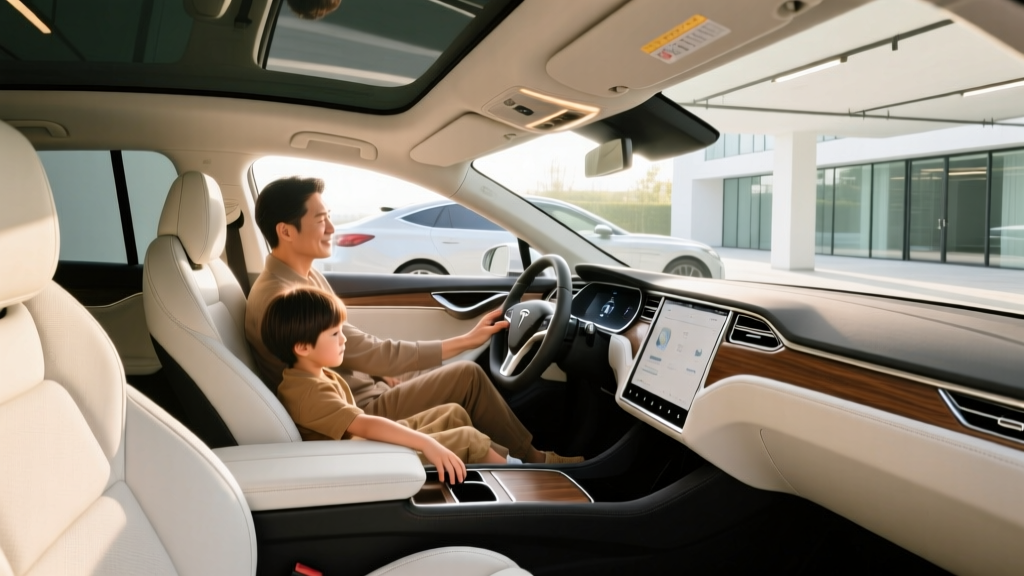
At 35.4 inches of rear legroom, the Model S is tighter than the Lucid Air by over two inches and noticeably snugger than a Mercedes EQS. A 6-foot adult seated behind a 6-foot driver will find knees close to the front seatback. The seat cushion is relatively flat and thin compared to the heavily bolstered, reclining rear seats in German luxury sedans. There's no available rear-seat massage, ventilation, or executive recline package — features competitors offer at this price point.
What the Rear Seat Does Well
- Headroom is excellent thanks to the panoramic glass roof and skateboard architecture — even tall passengers won't feel cramped vertically.
- Three-across seating is feasible for short trips; the flat floor (no transmission tunnel) helps the middle passenger.
- Two USB-C ports and a small rear touchscreen (added in the 2021 refresh) give rear passengers climate and entertainment control.
- Child-seat installation via LATCH anchors is straightforward, and the wide-opening rear doors ease car-seat loading.
Where the Rear Seat Falls Short
- Seat cushion angle and padding are the most common owner complaints — the cushion is flat, offering limited thigh support on long trips.
- No rear-seat HVAC vents in the traditional sense; climate flows from the front and the small rear screen controls temperature but not directional airflow.
- Road noise at highway speeds is more noticeable in the rear than in the Lucid Air or EQS, despite acoustic glass improvements in recent model years.
- The discontinued third row (removed after 2023) means families needing more than five seats must look elsewhere.
Charging Speed: DC Fast, Level 2, and the Curve Reality
The Model S charges on Tesla's Supercharger network natively (NACS connector) and can also access CCS-equipped public chargers via the included adapter. Here's what the numbers look like across charging levels:
| Charging Level | Power / Rate | Miles Added per Hour | Notes |
|---|---|---|---|
| Level 1 (120V household) | ~1.4 kW | ~5 mi/hr | Emergency/trickle only |
| Level 2 (240V home, 48A) | 11.5 kW | ~41 mi/hr | Full charge in ~9 hours |
| DC Fast (Tesla V3 Supercharger) | Peak 250 kW | ~200 mi in 15 min | 10–80% in ~27 min |
| DC Fast (V4 Supercharger) | Up to 250 kW | Similar to V3 | Newer stall design, CCS-native |
A critical note on the charging curve: the Model S peaks at 250 kW only at a low state of charge (roughly 10–20% SoC). By 50% SoC, the rate tapers to approximately 150 kW, and above 80%, it drops further to under 60 kW. This is normal lithium-ion behavior, but it means the advertised "15-minute" charging claim applies only to a partial session. A realistic 10–80% session on a V3 Supercharger takes 25–30 minutes, and 10–90% can stretch past 40 minutes.
For home charging, a Tesla Wall Connector on a 60-amp circuit delivers the full 11.5 kW (48 amps continuous). Expect a full overnight charge from 20% to 100% in roughly 8–9 hours. Most owners charging nightly from 40–80% will see a full replenishment in under 4 hours. A Tesla Wall Connector costs around $475, with professional installation typically running $500–$1,500 depending on panel proximity and local permit requirements.
Performance, Efficiency, and Driving Dynamics
The Long Range Model S produces 670 horsepower from its dual-motor all-wheel-drive powertrain, delivering a 3.1-second 0–60 mph time. That's supercar territory in a five-passenger sedan. The Plaid trim (1,020 hp, 1.99-second 0–60) exists for buyers who prioritize acceleration above all else, but the Long Range is the volume seller and the more practical daily driver.
Efficiency is a genuine Model S strength. At 124 MPGe combined (28 kWh per 100 miles), it extracts more miles per kilowatt-hour than nearly every large luxury EV. The Lucid Air Grand Touring edges it out slightly at 131 MPGe, but the Tesla's combination of range and efficiency remains exceptional. This efficiency translates directly to lower charging costs: at the national average electricity rate of ~$0.17/kWh, a full charge costs roughly $16.15 — or about $0.04 per mile.
Pricing, Tax Credits, and Ownership Cost
The 2026 Model S Long Range starts at $79,990 (including destination). The Plaid begins at $94,990. Common options like FSD (Supervised) capability ($8,000 one-time or $99/month), premium interior colors, and 21-inch wheels can push an as-tested Long Range to $88,000–$92,000.
| Item | Cost |
|---|---|
| Long Range Base MSRP | $79,990 |
| Plaid Base MSRP | $94,990 |
| FSD (Supervised) | $8,000 or $99/mo |
| Premium Paint (e.g., Ultra Red) | $2,500 |
| 21" Arachnid Wheels | $4,500 |
| Estimated As-Tested (Long Range w/ options) | $88,000–$92,000 |
Federal Tax Credit Eligibility
Does the Model S qualify for the §30D federal EV tax credit? No. Under current IRS rules, the new-vehicle credit has an MSRP cap of $55,000 for sedans. The Model S, at $79,990+, exceeds this cap and is therefore ineligible for the $7,500 credit regardless of buyer income or battery sourcing.
Buyers should also be aware that the §30D credit has modified adjusted gross income (MAGI) caps: $150,000 (single), $225,000 (head of household), and $300,000 (joint). Even if a cheaper Tesla (e.g., Model 3 RWD) met the MSRP cap, income limits could still disqualify some buyers. Consult a tax professional for your specific situation.
Warranty, Tech, and Driver Assistance
Tesla covers the Model S battery and drive unit for 8 years or 150,000 miles, whichever comes first, with a minimum 70% capacity retention threshold. The basic vehicle limited warranty is 4 years / 50,000 miles. These terms are competitive with Lucid and slightly better than some German rivals, though Hyundai's 10-year/100,000-mile battery warranty remains the industry benchmark.
Standout Technology
- 17-inch center touchscreen with exceptional responsiveness and an expanding app/gaming ecosystem
- Over-the-air updates that regularly add features — a Tesla hallmark
- Autopilot (standard) includes adaptive cruise, lane-keeping, and automatic emergency braking
- FSD (Supervised) — an optional $8,000 package enabling city-street and highway automated steering with driver supervision. This is SAE Level 2, not autonomous driving; the driver must remain fully engaged at all times.
- Sentry Mode, Dog Mode, Camp Mode — utility features competitors still haven't matched
Notable Drawbacks
- No Apple CarPlay or Android Auto — Tesla's proprietary system is the only option
- Minimalist interior lacks physical buttons for climate, mirrors, and glovebox (all screen-controlled)
- Panel gap consistency has improved but still draws scrutiny compared to BMW/Mercedes build quality
- Insurance costs run 20–40% higher than comparable ICE sedans due to repair complexity and parts pricing
- 402-mile EPA range — among the longest of any EV sold
- 250 kW Supercharger network access (most reliable DC network in the US)
- 670 hp / 3.1-sec 0–60 in a spacious sedan
- Class-leading efficiency (124 MPGe)
- Excellent cargo space (25 cu ft + frunk)
- Continuous OTA improvements
- Rear seat comfort lags Lucid Air, EQS, and BMW i5
- 35.4" rear legroom is tight for the class
- No federal tax credit (MSRP exceeds $55K sedan cap)
- No CarPlay/Android Auto
- FSD remains Level 2 despite the "Full Self-Driving" name
- Higher insurance premiums than non-EV competitors
Who Should Buy the 2026 Tesla Model S?
The Model S is best suited for:
- Tech-forward professionals who value range, Supercharger access, and performance over traditional luxury rear-seat pampering
- Commuters with long one-way drives (50+ miles) where the 402-mile range and efficiency pay daily dividends
- Families with younger children where rear-seat passengers are small enough that the 35.4" legroom is a non-issue
- Road-trip enthusiasts who rely on Tesla's Supercharger network for cross-country travel
The Model S is not the best choice for:
- Executive chauffeur duty — the Lucid Air or Mercedes EQS offers a far superior rear-seat experience
- Tall families where all passengers exceed 6 feet — consider the Lucid Air or a three-row EV SUV
- Budget-conscious buyers — no tax credit and $80K+ pricing put this out of reach for most incentive-dependent shoppers
Choose the Lucid Air if: Rear-seat comfort, interior luxury, and slightly better efficiency (131 MPGe) matter more than Supercharger exclusivity.
Choose the BMW i5 if: You want a more traditional luxury experience, physical controls, CarPlay, and are willing to sacrifice ~100 miles of range.
Frequently Asked Questions
What is the real-world range of the Tesla Model S?
The EPA rates it at 402 miles. Expect 310–340 miles on the highway in mild weather, 370–395 in city driving, and as low as 250–290 miles in cold-weather highway conditions. Preconditioning the battery helps in all scenarios.
How fast does the Model S charge at home and on DC fast chargers?
On a Tesla V3 Supercharger (250 kW peak), the Model S charges from 10–80% in approximately 27 minutes. At home on a Level 2 Wall Connector (11.5 kW), it adds roughly 41 miles of range per hour, with a full charge taking about 9 hours.
Does the Tesla Model S qualify for the federal EV tax credit?
No. The §30D credit has a $55,000 MSRP cap for sedans. The Model S starts at $79,990, making it ineligible regardless of buyer income or battery sourcing. Always verify current rules at IRS.gov.
Is the Tesla Model S back seat comfortable for adults?
It's adequate but not class-leading. Rear legroom is 35.4 inches — tighter than the Lucid Air (37.6") and BMW i5 (36.2"). The seat cushion is relatively flat, lacking the thigh support and recline options found in German luxury sedans. Adults under 5'10" will be fine; taller passengers may find long trips uncomfortable.
Is the Model S worth buying over the Lucid Air?
If Supercharger access, proven software, and Tesla's service network are priorities, yes. If rear-seat luxury, slightly better efficiency, and a more traditional luxury interior matter more, the Lucid Air Grand Touring is the stronger pick. Both are excellent vehicles — the right choice depends on which trade-offs you accept.
What is the Model S battery warranty?
Tesla covers the battery and drive unit for 8 years or 150,000 miles, with a guaranteed minimum 70% capacity retention. The basic vehicle warranty is 4 years / 50,000 miles.