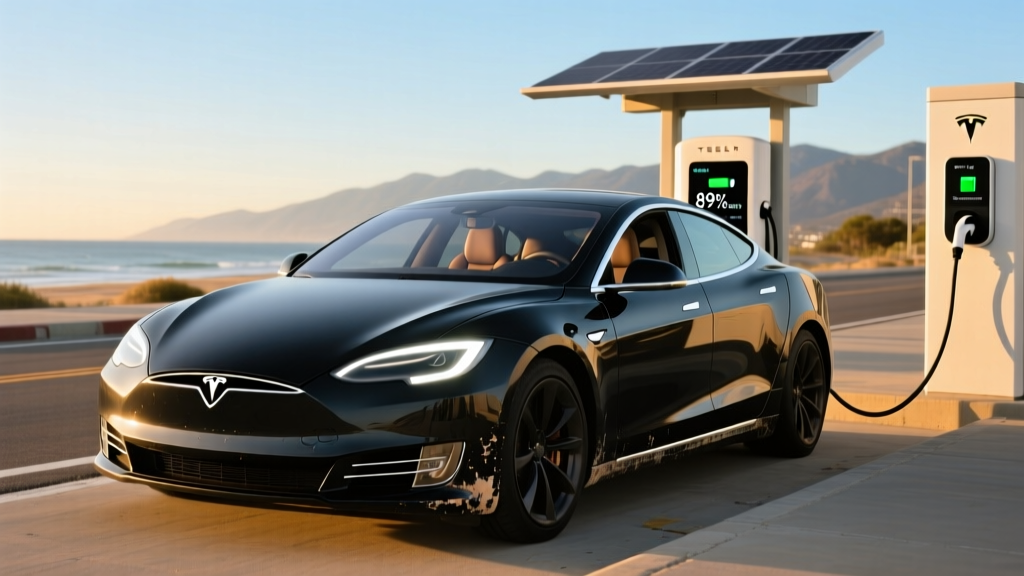
The Tesla Model S 85D hasn't rolled off the Fremont assembly line since 2016, but it remains one of the most-searched used EVs on the market. The reason is simple: dual-motor all-wheel drive, Supercharger access, and a luxury sedan badge at a depreciated price that now sits between $12,000 and $22,000 depending on mileage and condition. But buying a decade-old EV is fundamentally different from buying a decade-old gas car. The battery is the powertrain, and its state of health (SoH) dictates everything from daily usability to resale value.
This review breaks down what you need to know about the Model S 85D in 2026 — real-world range after years of degradation, charging capabilities on both legacy and modern networks, ownership costs, and how it stacks up against newer budget EVs and certified pre-owned alternatives.
Model S 85D: Core Specifications at a Glance
| Specification | 2015–2016 Model S 85D |
|---|---|
| EPA Range (original) | 237 miles |
| Battery Capacity (usable) | ~81 kWh (85 kWh nominal) |
| Battery Chemistry | NMC (Nickel Manganese Cobalt) |
| Drivetrain | Dual-Motor AWD |
| Horsepower | 383 hp (combined) |
| 0–60 mph | 5.2 seconds |
| Max DC Fast Charge | ~120 kW (Supercharger V1/V2) |
| 10–80% DC Charge Time | ~45–55 minutes (real-world) |
| Level 2 Home Charging | 10 kW onboard charger (dual charger option: 20 kW) |
| Efficiency | 101 MPGe combined / 33 kWh/100mi |
| Cargo Volume | 26.3 cu ft (rear trunk) + front trunk (frunk) |
| Seating | 5 passengers (optional rear-facing 3rd row for +2) |
| Battery Warranty (original) | 8 years / unlimited miles |
| Original MSRP | ~$82,200 (base, before incentives) |
| Used Price Range (2026) | $12,000–$22,000 |
Sources: EPA fueleconomy.gov, Tesla historical specifications.
Real-World Range: What to Expect From a 10-Year-Old Battery
Expected Real-World Range in 2026 (with degradation): 170–210 miles depending on battery SoH, driving style, and climate.
Cold Weather (below 32°F): Expect an additional 15–25% reduction, bringing effective range to 130–175 miles on a full charge.
The Model S 85D's NMC battery pack was rated for 237 miles when new. A decade later, degradation is the single most important variable. NMC chemistry in Tesla's early packs typically shows 10–18% capacity loss over 8–10 years and 100,000–150,000 miles. That means a typical 85D in 2026 delivers roughly 190–210 miles on a full charge under moderate conditions.
Highway driving at 75+ mph reduces efficiency significantly — the Model S is a large, heavy sedan (4,960 lbs), and aerodynamic drag at speed pushes consumption to 38–42 kWh/100mi, cutting highway range to roughly 160–185 miles even on a healthy pack. In freezing temperatures, the battery's internal resistance increases and cabin heating draws substantial power (the 85D uses resistive PTC heating rather than the more efficient heat pumps found in newer EVs like the Model Y or Hyundai Ioniq 5). Plan for 130–175 miles of usable range in winter conditions.
Pro tip for buyers: Before purchasing, check the car's energy screen or use third-party OBD-II tools like Scan My Tesla to pull actual battery capacity data. Compare current usable kWh against the original ~81 kWh to calculate degradation percentage. Anything above 20% loss should trigger a price negotiation or walk-away.
Charging: Supercharger Access and Home Setup
The 85D was built during Tesla's Supercharger V2 era. Its peak DC charge rate tops out around 120 kW, but the charge curve tapers aggressively above 60% state of charge (SoC). Here's the realistic breakdown:
| Charging Level | Power / Rate | What You Get |
|---|---|---|
| Level 1 (120V standard outlet) | ~1.2 kW | 3–4 miles per hour — overnight trickle only |
| Level 2 (240V, single charger) | 10 kW | ~29 miles per hour — full charge in ~8.5 hours |
| Level 2 (240V, dual charger option) | 20 kW | ~58 miles per hour — full charge in ~4.5 hours |
| DC Fast Charge (Tesla Supercharger V2) | Peak ~120 kW, avg ~70 kW | 10–80% in ~45–55 minutes |
| DC Fast Charge (Supercharger V3/V4) | Limited to ~120 kW by vehicle | No benefit over V2 — car is the bottleneck |
| CCS / Non-Tesla DCFC (with adapter) | Peak ~100–120 kW | Requires Tesla CCS adapter; same taper curve |
The 85D uses Tesla's proprietary connector (pre-NACS standardization). Tesla has opened the Supercharger network to non-Tesla EVs via NACS, but the 85D's connector is compatible with all existing Supercharger stalls. If you want to use Electrify America, EVgo, or other CCS networks, you'll need a Tesla-to-CCS adapter (roughly $200–$300 from authorized suppliers).
For home charging, a 240V Level 2 wall connector on a 60-amp circuit delivers the full 10 kW (or 20 kW if the car has the optional dual onboard chargers). Installation typically costs $800–$2,000 depending on panel capacity and run length — budget for a potential panel upgrade if you're in an older home with 100-amp service. A licensed electrician should evaluate your setup before purchase.
Charging curve reality: The 85D hits its peak ~120 kW only between roughly 10–30% SoC. From 30–60%, it sustains 80–100 kW. Above 60%, it drops to 40–60 kW, and above 80%, it falls below 20 kW. This means the advertised 10–80% time of 45–55 minutes is realistic, but don't expect to "top off" quickly at high SoC — plan your road-trip stops to leave at 60–70% rather than waiting for 90%+.
Performance and Driving Dynamics
The 85D's dual-motor AWD powertrain produces 383 horsepower and delivers a 5.2-second 0–60 mph time — still genuinely quick for a 4,960-pound luxury sedan. The all-wheel-drive system provides excellent traction in rain and light snow, and the low center of gravity (battery pack under the floor) gives it composed handling for its size.
However, this is not a performance EV by 2026 standards. The current Model S Plaid does 0–60 in 1.99 seconds, and even the base Model 3 Highland hits 5.8 seconds at a fraction of the weight. The 85D's air suspension (standard on most trims) provides a comfortable ride, but be aware that air strut replacement costs $1,500–$2,500 per corner if they fail — a common issue on 8+ year-old examples.
Regenerative braking on the 85D is aggressive and enables near one-pedal driving in most conditions, though it lacks the adjustable regen settings found in newer EVs. The steering is precise but heavy, and the overall driving feel is more grand-tourer than sport-sedan.
Tech, Interior, and Driver Assistance
The 85D's interior reflects 2015-era Tesla minimalism: a 17-inch center touchscreen dominates the dashboard, with most vehicle controls routed through it. The infotainment system received over-the-air updates for years, but hardware limitations mean it runs slower than modern Tesla systems. Key observations:
- Navigation and Supercharger routing: Still functional, with automatic battery preconditioning when navigating to a Supercharger — a critical feature for optimizing charge speed.
- Autopilot (Basic): Lane centering and adaptive cruise control. This is SAE Level 2 driver-assist — you must keep hands on the wheel and eyes on the road at all times. It is not self-driving.
- Enhanced Autopilot / FSD: Some 85D examples were optioned with Enhanced Autopilot or early Full Self-Driving capability. However, Tesla's FSD hardware from this era (HW1 and early HW2) is significantly behind current HW4/AI5 systems and will likely never receive the latest FSD (Supervised) features. Do not pay a premium for FSD on an 85D.
- No Apple CarPlay or Android Auto: Tesla's closed ecosystem means no smartphone mirroring. Bluetooth audio and USB media are available.
- Build quality: Early Model S vehicles are known for panel gap inconsistencies, door handle failures (a notorious issue), and touchscreen delamination. Inspect carefully.
Pricing, Tax Credits, and Ownership Costs
Since the Model S 85D is only available on the used market, pricing depends heavily on mileage, battery health, and condition. As of early 2026, here's what to expect:
| Category | Details |
|---|---|
| Used Price Range | $12,000–$22,000 (private party & dealer) |
| Original MSRP (2015–2016) | ~$82,200 (base) to $95,000+ (loaded) |
| Federal Used EV Tax Credit (§25E) | Up to $4,000 or 30% of sale price (whichever is less) |
| §25E Income Caps | $75,000 single / $112,500 HOH / $150,000 joint (MAGI) |
| §25E Vehicle Price Cap | $25,000 or less (sale price) |
| New EV Credit (§30D) | NOT eligible — vehicle is used / discontinued |
| Estimated Annual Insurance | $1,800–$2,800 (varies by state, driver, coverage) |
| Estimated Annual Electricity Cost | $600–$900 (12,000 mi/yr, $0.14/kWh avg) |
The key incentive for the 85D in 2026 is the §25E Used Clean Vehicle Credit, not the §30D new-vehicle credit. Under IRS rules, you can claim up to $4,000 or 30% of the purchase price — whichever is lower — if the car is purchased from a dealer for $25,000 or less and your modified adjusted gross income falls within the caps above. The credit is available once per vehicle (identified by VIN) and cannot have been claimed previously under §25E. Always verify eligibility with a tax professional before purchase.
Ownership cost reality: While electricity is far cheaper than gasoline (~$0.04–$0.07 per mile vs $0.12–$0.16 for a comparable gas sedan), maintenance surprises on a 10-year-old Model S can be significant. Budget $2,000–$4,000 annually for potential repairs: air suspension, door handles, MCU (Media Control Unit) replacement, drive unit swaps, and 12V battery replacements are all known cost centers. Tesla's out-of-warranty service pricing is premium-tier.
Pros and Cons: The Honest Verdict
✓ Pros
- Full Tesla Supercharger network access — still the most reliable DC fast-charging network in the US
- Dual-motor AWD provides confident all-weather traction
- Spacious interior with 26.3 cu ft cargo + frunk — more practical than most sedans
- Over-the-air updates kept the software relevant for years
- Strong depreciation means significant value at $12K–$22K
- Eligible for up to $4,000 used EV tax credit (§25E)
- 5.2-second 0–60 remains genuinely quick
✗ Cons
- Battery degradation reduces range to 170–210 miles — marginal for road trips
- Out-of-warranty repair costs can be severe ($3K–$7K for battery/drive unit replacement)
- Slow DC fast charging by 2026 standards (~120 kW peak vs 250–350 kW on modern EVs)
- No heat pump — cold-weather range loss is significant
- Outdated Autopilot hardware — will not receive latest FSD features
- Known issues: door handles, MCU1 screen delamination, air suspension failure
- Insurance costs higher than comparable gas sedans
- No Apple CarPlay / Android Auto
Who Should Buy the Model S 85D in 2026?
Best fit: Budget-conscious commuters who have home Level 2 charging, drive under 80 miles round-trip daily, and want a spacious, quick luxury sedan with Supercharger access for occasional road trips. The 85D makes sense if you can accept 180–200 miles of real-world range and budget $2,000–$3,000/year for potential repairs.
Not ideal for: High-mileage drivers, those without home charging access (public-only charging with a 120 kW peak is frustrating), buyers who want modern driver-assist features, or anyone who needs reliable cold-weather range above 150 miles.
Consider instead: A used 2021–2023 Model 3 Long Range (~$25,000–$32,000) offers 330+ miles EPA, 250 kW charging, HW4 Autopilot, and a heat pump — substantially more capable and with fewer age-related failure points. Alternatively, a used Chevrolet Bolt EV ($12,000–$16,000) offers 259 miles EPA with far lower repair-cost risk, though no DC fast charging to speak of.
Frequently Asked Questions
Does the Tesla Model S 85D qualify for the $7,500 federal EV tax credit?
No. The §30D New Clean Vehicle Credit applies only to new vehicles purchased from a dealer that meet current MSRP caps, buyer income limits, and battery-sourcing requirements. The 85D is discontinued and only available used. However, it may qualify for the §25E Used Clean Vehicle Credit (up to $4,000) if purchased from a dealer for $25,000 or less and your income is within limits.
How much range does a used 85D actually have in 2026?
Expect 170–210 miles on a full charge under moderate conditions, depending on battery degradation (typically 10–18% loss after 8–10 years). Highway driving at 75+ mph and cold weather will reduce this further. Always verify actual battery capacity via OBD-II diagnostics before purchasing.
Can the 85D use Tesla Supercharger V3/V4 stalls?
Yes, it can physically connect and charge at any Supercharger stall. However, the 85D's onboard charging hardware limits it to roughly 120 kW peak — meaning V3 (250 kW) and V4 stalls offer no speed advantage over older V2 (150 kW) stalls. The car is the bottleneck, not the charger.
What happens if the battery fails out of warranty?
The original 8-year/unlimited-mile battery warranty has expired for all 85D examples. A replacement battery pack from Tesla costs approximately $12,000–$20,000 depending on availability and labor. Third-party EV battery shops may offer refurbished packs for $8,000–$14,000. This is the single biggest financial risk of owning an out-of-warranty Model S.
Is the 85D's Autopilot system capable of self-driving?
No. The 85D's Autopilot is an SAE Level 2 driver-assistance system. It provides lane centering and adaptive cruise control on marked highways, but requires full driver attention at all times. The hardware (HW1/HW2) is outdated and will not support Tesla's current FSD (Supervised) capabilities. Do not purchase an 85D expecting autonomous driving features.
How does the 85D compare to a used Model 3?
The Model 3 Long Range (2021+) offers more EPA range (330+ mi), faster charging (250 kW peak), a heat pump for cold weather, HW4 Autopilot hardware, and lower maintenance risk — but at a higher used price ($25,000–$32,000). The 85D wins on cargo space, ride comfort, and entry price, but loses on nearly every technical metric.