Tesla Model S 75D: The Used EV Bargain That Still Holds Up
The Tesla Model S 75D is no longer in production — Tesla discontinued the 75 kWh battery option after the 2019 model year — but it remains one of the most searched legacy Tesla configurations on the used market. If you're evaluating a 2017–2019 Model S 75D as a pre-owned purchase in 2026, this profile gives you the exact numbers you need: real-world range, charging behavior, battery health expectations, and whether it qualifies for the federal used-EV tax credit under IRS §25E.
The 75D designation tells you two things: 75 refers to the approximate battery capacity in kWh, and D means dual-motor all-wheel drive. This was the volume-selling Model S configuration during its run, offering a practical balance of range, performance, and price that the higher-capacity 100D and P100D couldn't match on value.
Spec Sheet: Tesla Model S 75D at a Glance
| Specification | Value |
|---|---|
| EPA Range | 259 miles (2018–2019 model years) |
| Battery Capacity | 75 kWh (usable ~72.5 kWh) |
| Battery Chemistry | NMC (Nickel Manganese Cobalt) |
| Drivetrain | Dual-motor AWD |
| Horsepower | ~328 hp (combined) |
| 0–60 mph | 4.2 seconds |
| EPA Efficiency | 103 MPGe combined / 33 kWh/100mi |
| Max DC Fast Charge | ~120 kW peak (V2 Supercharger) |
| 10–80% DC Charge Time | ~40–45 minutes |
| Level 2 Home Charge Rate | 11.5 kW (48A) — ~29 mi/hr |
| Cargo Volume | 26.3 cu ft (rear) + 5.3 cu ft (frunk) |
| Passenger Capacity | 5 adults (optional rear-facing 3rd row for +2 children on older trims) |
| Battery Warranty (Original) | 8 years / 150,000 miles |
Real-World Range: What 259 EPA Miles Actually Means
Real-World Highway (70 mph, moderate temps): ~220–235 miles
Real-World City/Mixed: ~240–255 miles
Cold Weather (below 32°F, highway): ~175–200 miles (25–35% reduction)
The EPA's 259-mile figure for the 2018–2019 Model S 75D was competitive when new, but real-world results depend heavily on driving style, speed, and temperature. The Model S is a large, heavy sedan (~4,800 lbs), and at sustained highway speeds above 70 mph, aerodynamic drag pushes consumption to roughly 36–38 kWh/100mi, cutting effective range to the low 220s.
Cold weather is the bigger concern for used 75D buyers. The 75 kWh pack lacks the thermal headroom of the 100D, and Tesla's battery heating system draws from the same pack. In sub-freezing conditions, expect a 25–35% range reduction. If your commute is 80 miles round-trip in a northern climate, the 75D will handle it — but you'll be charging daily rather than every other day.
Battery degradation factor: By 2026, a 2017–2019 Model S 75D will be 7–9 years old. NMC batteries in Teslas from this era typically show 8–15% degradation depending on charging habits and mileage. A 75D with 80,000+ miles and frequent Supercharging history may deliver only ~210–225 miles of real-world range in mild conditions. Always check the vehicle's State of Health (SoH) via the Tesla service menu or a third-party diagnostic before purchase.
Charging: DC Fast Charge, Home Level 2, and the V2 Limitation
| Charging Method | Power (kW) | Speed | Notes |
|---|---|---|---|
| Level 1 (120V household) | ~1.4 kW | ~3–4 mi/hr | Emergency/trickle only |
| Level 2 (240V, 48A) | 11.5 kW | ~29 mi/hr | Full charge in ~7–8 hours |
| DC Fast (V2 Supercharger) | ~120 kW peak | 10–80% in ~40–45 min | Tapers significantly above 60% |
| DC Fast (V3 Supercharger) | ~120 kW (capped) | Same as V2 for this model | 75D cannot utilize V3's 250 kW peak |
The 75D's charging architecture is its most visible age marker. The pack maxes out at roughly 120 kW on DC fast charging, even when plugged into a V3 Supercharger capable of 250 kW. The charge curve peaks near 50–60% State of Charge and tapers aggressively above 80%, meaning a 10–80% session takes approximately 40–45 minutes. That was acceptable in 2018; in 2026, newer EVs like the Hyundai Ioniq 5 or Tesla Model 3 Highland achieve 10–80% in 18–25 minutes.
For home charging, the onboard charger supports 11.5 kW (48 amps) on a 240V/60A circuit. A full Level 2 home install typically costs $800–$2,000 depending on panel proximity and local permitting, according to data from the U.S. Department of Energy. With overnight Level 2 charging, the 75D refills from 20% to full in roughly 6 hours — more than adequate for daily use.
Key ownership note: Tesla removed free unlimited Supercharging for most Model S vehicles ordered after January 2017. Some used 75Ds still carry transferable free Supercharging — this is a significant value-add worth verifying in the vehicle's Tesla account before purchase.
Performance and Driving Experience
The dual-motor AWD powertrain delivers approximately 328 horsepower and propels the 75D from 0–60 mph in 4.2 seconds. That's brisk by any sedan standard and remains competitive with newer mid-range EVs. The instant torque delivery and low center of gravity make the Model S feel quicker than the numbers suggest in real-world merging and passing situations.
Ride quality is a highlight: the air suspension (standard on most 75D trims) provides a compliant, adjustable ride with automatic height adjustment at speed. However, air suspension repairs on out-of-warranty Model S vehicles are a known cost concern — replacement struts run $1,500–$2,500 per corner at independent shops.
Regenerative braking on the 75D is strong but not true one-pedal driving. Unlike newer Teslas and many competitor EVs, the Model S from this era does not come to a complete stop via regen alone; you'll still use the friction brake for final stopping. Tesla removed the user-adjustable regen setting via software update in 2020 (later partially restored), so behavior depends on the current software version.
Tech, Interior, and Driver Assistance
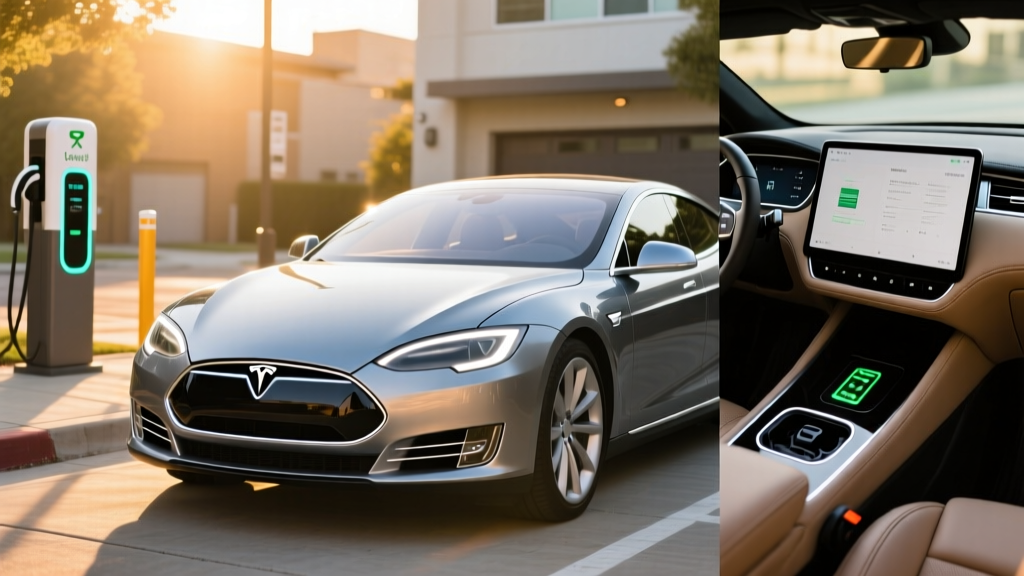
The 2017–2019 Model S interior centers on a 17-inch portrait touchscreen running Tesla's proprietary infotainment OS. The system received continuous over-the-air updates through 2025, though Tesla has begun prioritizing newer vehicle architectures. The 75D's MCU1 (Media Control Unit) in 2017 models was upgraded to MCU2 starting in March 2018 — the MCU2 is meaningfully faster and supports newer software features including the updated navigation, Sentry Mode dashcam integration, and Theater mode.
Autopilot and FSD: The Model S 75D was available with Enhanced Autopilot or the Full Self-Driving (FSD) capability package. Per NHTSA's SAE automation framework, all Tesla consumer driver-assist systems — including FSD (Supervised) — are SAE Level 2. The driver must remain fully engaged, hands on or near the wheel, eyes on the road. These are not self-driving systems. A used 75D with FSD purchased on the secondary market does not always transfer the FSD license; verify with Tesla directly whether FSD is tied to the vehicle or the original owner's account.
Notable interior drawbacks by 2026 standards: the 75D-era Model S lacks a rear-seat entertainment screen, USB-C ports (USB-A only), and the minimalist design language of the 2021+ refresh. Panel gaps, creaking trim, and seat bolster wear are common complaints on higher-mileage examples.
Pricing, Used Market Value, and Federal Tax Credit Eligibility
The Model S 75D originally started at approximately $74,500 MSRP (before incentives) during its 2017–2019 production run. In the 2026 used market, expect pricing in these ranges depending on mileage, condition, and battery health:
| Condition / Mileage | Typical Used Price (2026) | After §25E Credit |
|---|---|---|
| Low miles (<40K), excellent SoH | $28,000–$34,000 | $24,000–$30,000 |
| Mid miles (40K–80K), good SoH | $22,000–$28,000 | $18,000–$24,000 |
| High miles (80K+), fair SoH | $16,000–$22,000 | $12,000–$18,000 |
Federal used-EV tax credit (§25E): Unlike the new-vehicle §30D credit, the used-EV credit offers up to $4,000 (or 30% of the sale price, whichever is less) for qualifying pre-owned electric vehicles. Key eligibility requirements per the IRS:
- Sale price must be $25,000 or less
- Buyer income caps: $75,000 single / $112,500 head of household / $150,000 joint (MAGI)
- Vehicle must be at least 2 model years old
- Must be purchased from a licensed dealer (private-party sales do not qualify)
- Buyer cannot have claimed the used-EV credit in the prior 3 years
- Credit is non-refundable — it can only offset tax liability
This means only Model S 75D examples priced at or below $25,000 from a dealer qualify, and only if the buyer's income falls under the caps. Higher-mileage, older 75Ds are the most likely candidates. Always consult a tax professional to confirm your specific eligibility — rules are subject to legislative change.
Pros and Cons: The Honest Assessment
Pros
- Still-fast 4.2-second 0–60 and smooth dual-motor AWD
- Air suspension ride quality remains excellent when functional
- Access to the Tesla Supercharger network (reliability leader among public networks)
- Spacious cargo area (26.3 cu ft rear + 5.3 cu ft frunk)
- OTA software updates kept the 75D current longer than most legacy EVs
- Low used pricing relative to original MSRP — strong depreciation = buyer opportunity
Cons
- 120 kW DC fast-charge ceiling feels slow vs. 2026 standards (250–350 kW)
- NMC battery degradation (8–15% typical at 7–9 years) reduces usable range
- Air suspension and MCU failures are expensive out-of-warranty repairs
- No longer receives major Tesla software feature updates
- Interior quality and materials lag behind 2021+ refresh and competitors
- FSD license may not transfer on used purchase
Who Should Buy the Tesla Model S 75D in 2026?
- You want a premium large sedan with Supercharger network access under $25,000
- Your daily commute is under 100 miles round-trip with home Level 2 charging
- You value acceleration and AWD capability in a used EV
- You can verify strong battery SoH (>88%) before purchase
- You regularly road-trip 300+ miles and need fast DC charging (consider a used Model 3 Long Range or Ioniq 5)
- You want current-generation ADAS, interior tech, or warranty coverage
- You live in an extreme cold climate where the 75 kWh pack's reduced buffer becomes a daily constraint
The Model S 75D occupies a specific niche in 2026: it's the most affordable entry point into a full-size Tesla sedan with Supercharger access, dual-motor AWD, and air suspension. For a disciplined buyer who can inspect battery health, budget for potential air suspension or MCU repairs, and primarily drives within the real-world range envelope, the 75D offers remarkable value — often $18,000–$24,000 after the used-EV credit.
For comparison, a used 2020–2021 Tesla Model 3 Long Range AWD in a similar price range offers a more modern platform, ~310-mile EPA range, 250 kW DC charging capability, and likely lower maintenance risk. The trade-off is interior space and ride sophistication — the Model S is simply a larger, more comfortable car.
Frequently Asked Questions
What is the real-world range of the Tesla Model S 75D?
The EPA rated the 2018–2019 Model S 75D at 259 miles. In real-world mixed driving at moderate temperatures, expect 220–255 miles depending on speed and conditions. Cold weather (below freezing) can reduce range to 175–200 miles. Battery degradation on a 7–9-year-old NMC pack will further reduce these figures by 8–15%.
How fast does the Model S 75D charge?
On DC fast charging (Tesla V2 or V3 Supercharger), the 75D peaks at approximately 120 kW, achieving a 10–80% charge in roughly 40–45 minutes. It cannot take advantage of V3 Superchargers' 250 kW capability. At home on a 240V/48A Level 2 charger, it adds about 29 miles of range per hour, with a full charge taking 7–8 hours.
Does the Model S 75D qualify for any federal EV tax credit?
It does not qualify for the new-vehicle §30D credit (the car is no longer sold new). However, it may qualify for the §25E used clean vehicle credit of up to $4,000 if the sale price is $25,000 or less, purchased from a licensed dealer, and the buyer meets income caps ($75K single / $150K joint). Consult a tax professional and verify current IRS guidelines.
Is the Model S 75D worth buying vs. a used Model 3?
It depends on priorities. The 75D offers a larger cabin, air suspension, more cargo space, and a more premium driving experience. The Model 3 Long Range offers newer architecture, faster DC charging (~250 kW), longer EPA range (~310–358 mi depending on year), and generally lower out-of-warranty repair risk. If space and comfort matter most, the 75D wins. If charging speed and modern tech matter most, the Model 3 is the stronger pick.
What should I check before buying a used Model S 75D?
Prioritize: (1) Battery State of Health — request a Tesla service diagnostic or use the car's energy app to estimate degradation; (2) Air suspension functionality — test all ride heights and listen for compressor strain; (3) MCU version — MCU2 (March 2018+) is significantly better; (4) Supercharger history — frequent DC fast charging accelerates NMC degradation; (5) Title status and accident history via Carfax or AutoCheck.
What is the battery warranty situation on a used 75D?
Tesla's original battery warranty for the Model S 75D was 8 years or 150,000 miles, whichever comes first, with a minimum 70% capacity retention threshold. For a 2017 model, this warranty expired in 2025. For a 2019 model, coverage extends through 2027 or 150,000 miles. If the battery falls below 70% SoH while under warranty, Tesla will repair or replace it. Out-of-warranty battery replacement for a 75 kWh pack typically costs $12,000–$16,000 at a Tesla service center.