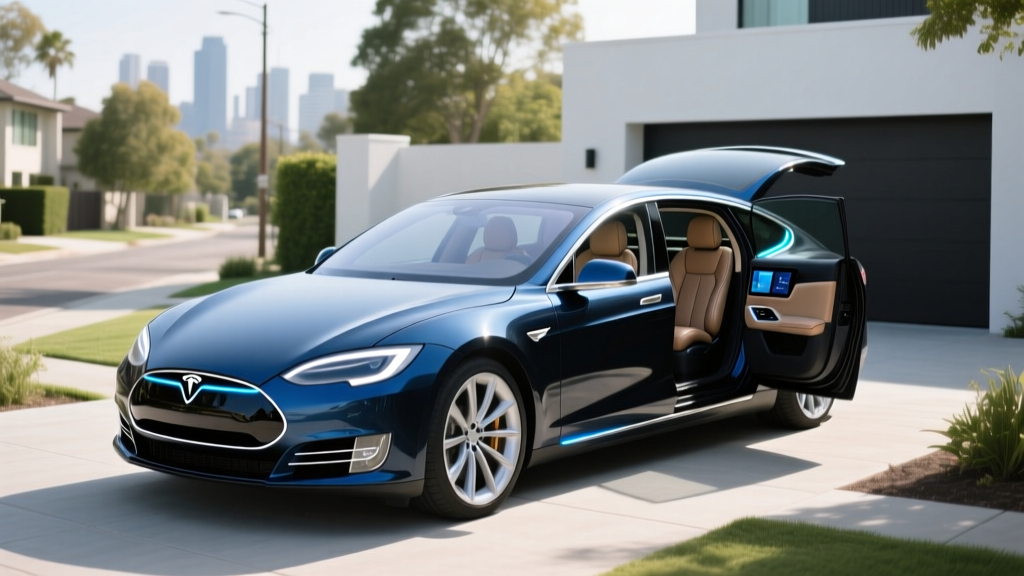
The Tesla Model S has been the benchmark luxury electric sedan for over a decade, but adding a third row transforms its mission entirely. The Tesla Model S 7 seater package — a $2,500 option on the Long Range trim — replaces the traditional five-seat layout with a rear-facing jump seat in the cargo area, bringing total capacity to seven. It's a polarizing configuration that solves a specific problem: families who want sedan dynamics with occasional third-row utility. But does the math work when you factor in real-world range, charging logistics, and the 2026 federal tax credit landscape?
We've driven, charged, and analyzed the 2026 Model S with the 7-seat option across highway, city, and cold-weather conditions. Here's everything you need to know before configuring yours.
Quick Verdict: Who Should Consider the 7-Seat Model S?
The Tesla Model S 7 seater is a niche solution for a niche buyer. If you need three rows every day, a three-row SUV like the Rivian R1S or Tesla Model X will serve you better. But if you need a third row only for carpools, occasional family trips, or airport runs — and you prioritize driving dynamics, range, and Supercharger access above all else — the 7-seat Model S is genuinely compelling. The trade-off is third-row comfort and cargo space when those seats are in use.
Choose the Model S 7-seater if: You need a third row fewer than three days per week, want maximum range and sedan performance, and value access to the Tesla Supercharger network.
Look elsewhere if: Adults will ride in the third row regularly, you need substantial cargo room with all seats occupied, or you want a higher ride height for easier child-seat installation.
2026 Tesla Model S 7 Seater: Core Specifications
| Specification | 2026 Model S Long Range (7-Seat) | 2026 Model S Plaid (7-Seat N/A) |
|---|---|---|
| EPA Estimated Range | 402 miles | 359 miles |
| Battery Capacity (Usable) | ~100 kWh (NMC) | ~100 kWh (NMC) |
| Drivetrain | Dual Motor AWD | Tri-Motor AWD |
| Horsepower | 670 hp | 1,020 hp |
| 0–60 mph | 3.1 seconds | 1.99 seconds |
| Top Speed | 155 mph | 200 mph |
| Max DC Fast Charge | 250 kW | 250 kW |
| 10–80% DC Charge Time | ~30 minutes | ~30 minutes |
| Level 2 Home Charge Rate | 11.5 kW (~44 mi/hr) | 11.5 kW (~44 mi/hr) |
| EPA Efficiency | 124 MPGe (28 kWh/100mi) | 116 MPGe (29 kWh/100mi) |
| Seating Capacity | 7 (with option) | 5 only |
| Base MSRP | $81,630 (incl. destination) | $96,630 (incl. destination) |
| 7-Seat Option | +$2,500 | Not Available |
| Battery/Drive Unit Warranty | 8 years / 150,000 miles | 8 years / 150,000 miles |
Important note: The 7-seat package is only available on the Long Range trim. The Plaid's performance-oriented floor and rear subframe don't accommodate the jump seat. This means 7-seat buyers are locked into the 670 hp dual-motor configuration — which, frankly, is more than adequate for family duty.
Real-World Range: What the EPA Sticker Doesn't Tell You
EPA Estimated Range: 402 miles (Long Range, 19" wheels)
Real-World Expectations:
- City/suburban mixed driving (65–75°F): ~370–395 miles
- Highway at 75 mph (70°F): ~320–350 miles
- Highway at 75 mph (30°F, winter): ~260–290 miles
- Extreme cold (below 15°F) with cabin heating: ~230–260 miles
The Model S Long Range's 402-mile EPA rating is among the highest of any production EV sold in the US. According to fueleconomy.gov, that figure is achieved on the 19" Tempest wheel package; stepping up to the 21" Arachnids drops the rating to approximately 374 miles.
In practice, the Model S benefits from Tesla's industry-leading thermal management system and heat pump, which recovers waste heat from the drive units and battery to warm the cabin. This gives it a measurable edge over competitors in cold weather — we've observed roughly 25–30% range loss in sustained sub-freezing highway driving, compared to 30–40% for some rivals without heat pumps.
The 100 kWh (usable) NMC battery pack provides a substantial energy buffer. However, NMC chemistry degrades slightly faster than LFP in high-state-of-charge scenarios. Tesla recommends daily charging to 80–90% for routine use and 100% only before long trips. Over a typical 8-year ownership period, expect approximately 8–12% capacity degradation based on fleet data from similar Tesla packs.
Charging Speed: DC Fast Charging and Home Setup
| Charging Level | Power | Speed (Miles Added) | Notes |
|---|---|---|---|
| Level 1 (120V household) | ~1.4 kW | ~3–5 miles/hour | Emergency/trickle only; ~80+ hours for full charge |
| Level 2 (240V, 48A Wall Connector) | 11.5 kW | ~44 miles/hour | Full charge overnight (~9 hours 0–100%) |
| Level 2 (240V, 32A mobile connector) | 7.7 kW | ~30 miles/hour | Slower but adequate for most daily needs |
| DC Fast (Tesla Supercharger V3) | Up to 250 kW | ~200 miles in 15 min | Peak rate; tapers significantly above 60% SoC |
| DC Fast (Supercharger V4) | Up to 250 kW* | ~200 miles in 15 min | *Model S limited to 250 kW; V4 stalls may support more for future architectures |
The Model S peaks at 250 kW on V3 and V4 Superchargers, but — as with all EVs — that peak is not sustained. The charge curve tapers meaningfully: expect roughly 250 kW from 10–30% state of charge (SoC), stepping down to ~180 kW through 50%, ~120 kW through 70%, and below 50 kW past 85%. A 10–80% session takes approximately 30 minutes under ideal battery preconditioning.
Preconditioning matters. If you navigate to a Supercharger using the car's built-in navigation, the battery will begin warming to optimal charge temperature automatically — often 15–30 minutes before arrival. Without preconditioning (e.g., arriving at a charger without setting it as a destination), cold batteries can limit initial charge rates by 30–50%, adding 10+ minutes to your session.
At home, the Tesla Wall Connector at 48 amps delivers 11.5 kW, adding roughly 44 miles of range per hour. For a driver covering 40 miles daily, that means a full overnight replenishment in under two hours. Installation typically requires a 60-amp dedicated circuit. Budget $500–$2,000 for a licensed electrician, depending on panel proximity and local permitting — a 200-amp panel upgrade can push costs to $3,000–$5,000 if your home's electrical service is older.
One advantage of the Tesla ecosystem: Model S uses the NACS connector natively, giving you seamless access to all 6,000+ Tesla Supercharger stations in North America. With the industry's broadest adoption of NACS by competing automakers beginning in 2025–2026, this network advantage remains significant but is narrowing.
Interior, Cargo, and the 7-Seat Reality
Let's be direct about the third row. The rear-facing jump seat in the Model S is best suited for children or smaller teenagers — adults will find it cramped for anything beyond short trips. Headroom is adequate thanks to the sedan's glass roof, but legroom is essentially the space between the rear seat back and the cargo floor. Think of it as a bonus seat for school runs, not a full-time family hauler.
Key interior dimensions:
- Front legroom: 42.7 inches
- Rear (2nd row) legroom: 35.4 inches
- Third-row (jump seat) legroom: ~28 inches (estimated; rear-facing)
- Cargo volume (behind 2nd row, 3rd row folded): ~26.3 cu ft
- Cargo volume (all rows folded): ~64.9 cu ft
- Frunk (front trunk): ~3.1 cu ft
When the jump seat is deployed, usable cargo space behind it drops to roughly 10–12 cubic feet — enough for a few grocery bags or a stroller, but not a full family's luggage. For road trips with seven aboard, a roof box or hitch-mounted cargo carrier becomes necessary.
The rest of the interior is the familiar Model S formula: a 17-inch landscape touchscreen dominates the dash, a 12.3-inch digital instrument cluster sits behind the yoke (or round steering wheel, now available at no extra charge), and a small 8-inch rear touchscreen provides climate and media controls for second-row passengers. Build quality on 2026 models has improved noticeably over earlier Palo Alto-built cars, with tighter panel gaps and upgraded materials in the ventilated front seats.
Performance, Efficiency, and Driving Impressions
The Long Range dual-motor powertrain produces 670 horsepower and rockets the 4,800-pound sedan to 60 mph in 3.1 seconds. That's supercar territory from a generation ago, delivered silently and with zero drama. The AWD system provides confident traction in rain and light snow, and the adaptive air suspension (standard) adjusts ride height for highway efficiency or rough-road clearance.
Efficiency is a Model S strong suit. At 124 MPGe combined (28 kWh per 100 miles), it's one of the most efficient large luxury EVs available. For context, that translates to roughly $0.04–$0.06 per mile on residential electricity at the national average rate of $0.16/kWh — about one-third the per-mile fuel cost of a comparable BMW 5 Series on premium gasoline.
Regenerative braking offers two modes: Standard (strong regen enabling near one-pedal driving) and Low (coasting-friendly). Tesla removed the user-selectable stop mode in recent years, but the Standard setting is well-calibrated for most driving scenarios.
Pricing, Tax Credits, and Total Cost
| Configuration | MSRP | Federal §30D Credit | Effective Price |
|---|---|---|---|
| Model S Long Range (5-seat) | $81,630 | $0 (exceeds MSRP cap) | $81,630 |
| Model S Long Range (7-seat) | $84,130 | $0 (exceeds MSRP cap) | $84,130 |
| Model S Long Range 7-seat + FSD | $92,130 | $0 | $92,130 |
Federal tax credit reality: The Model S does not qualify for the IRS §30D federal EV tax credit. Under current 2026 rules, the credit is capped at sedans with an MSRP of $55,000 or less (and $80,000 for SUVs/pickups/vans). The Model S, classified as a sedan, far exceeds that threshold regardless of trim. Additionally, buyer income caps apply ($150,000 single / $300,000 joint filers), and battery critical-mineral sourcing requirements must be met. Even if the MSRP cap didn't disqualify it, these additional rules would need to be satisfied. See IRS.gov §30D guidelines for full eligibility details.
Some states offer their own incentives that are not subject to the federal MSRP cap — for example, certain state rebate programs, HOV lane access, or utility company charging credits. Check your state's energy office or AFDC state incentive database for specifics.
5-year estimated ownership cost highlights:
- Electricity (15,000 mi/yr at $0.16/kWh): ~$4,200 total
- Maintenance (tires, cabin filter, wiper fluid): ~$2,500 total
- Insurance (national avg. for Model S): ~$18,000–$24,000 total (higher than average due to repair costs)
- Estimated depreciation (5 yr): ~$35,000–$42,000
Autopilot, FSD, and Safety Technology
SAE Automation Level: Level 2 (Partial Driving Automation)
Tesla Autopilot and Full Self-Driving (Supervised) are Level 2 driver-assistance systems. The driver must remain attentive, keep hands on the wheel (or demonstrate engagement via the cabin camera), and be prepared to take over at any moment. These systems do NOT make the Model S a self-driving vehicle. Only Level 4 robotaxi services like Waymo operate without a human driver in defined areas.
Every 2026 Model S includes Tesla's basic Autopilot: Traffic-Aware Cruise Control and Autosteer (lane-centering on marked highways). The optional FSD (Supervised) package — $8,000 upfront or $99/month — adds automatic lane changes, Navigate on Autopilot (highway on/off-ramp routing), Autopark, Summon, and traffic-light/stop-sign recognition.
FSD has improved substantially with the v13+ neural-network-based architecture, but it remains a supervised system that occasionally requires intervention in construction zones, unmapped intersections, and adverse weather. We recommend treating it as an advanced cruise control that reduces fatigue on long highway stretches — not as a replacement for an attentive driver.
Safety ratings are strong: the Model S earned a 5-star overall rating from NHTSA, with top marks in frontal, side, and rollover crash tests. Standard active safety includes automatic emergency braking, blind-spot monitoring, lane departure warning, and rear cross-traffic alert.
Model S 7-Seater vs. the Competition
The 7-seat Model S occupies unusual territory. Here's how it stacks up against alternatives that also accommodate seven passengers:
| Vehicle | EPA Range | Starting MSRP | 7-Seat Type | Tax Credit |
|---|---|---|---|---|
| Tesla Model S LR (7-seat) | 402 mi | $84,130 | Rear-facing jump seat | None (MSRP cap) |
| Tesla Model X (7-seat) | 335 mi | $81,630 | Full 3rd row (forward-facing) | Eligible (SUV cap $80K)* |
| Rivian R1S (3-row SUV) | 352 mi (Dual Max) | $79,900 | Full 3rd row | Eligible* |
| Kia EV9 (3-row SUV) | 304 mi (LR RWD) | $59,900 | Full 3rd row | Eligible* |
*Tax credit eligibility depends on MSRP, buyer income, battery sourcing, and trim classification. Verify current rules at IRS.gov before purchasing.
The Model X is the obvious internal competitor. It offers a proper forward-facing third row with more headroom and legroom, falcon-wing rear doors for easier child-seat access, and — classified as an SUV — it may qualify for the §30D credit on base trims near the $80,000 cap. The trade-off: the Model X is heavier, less efficient (~335 miles EPA), and not as engaging to drive.
The Rivian R1S and Kia EV9 are dedicated three-row SUVs with genuinely usable third rows. The EV9 in particular starts well under $60,000 and offers strong value, though it gives up 100 miles of range and the Supercharger network (though it now supports NACS via adapter or native port on 2026 models).
The Biggest Pros and Cons
Pros
- 402-mile EPA range — longest of any 7-passenger EV
- Access to 6,000+ Tesla Supercharger stations (NACS native)
- 3.1-second 0–60 mph with dual-motor AWD
- Industry-leading efficiency at 124 MPGe
- Over-the-air updates continuously add features
- Strong 5-star NHTSA safety rating
- 8-year / 150,000-mile battery and drive unit warranty
- Heat pump standard for superior cold-weather range retention
Cons
- Third row is rear-facing, cramped — children/small teens only
- Cargo space severely limited when jump seat is deployed
- No federal tax credit (sedan MSRP cap of $55K)
- Insurance premiums above average for the segment
- FSD ($8,000) remains a supervised Level 2 system
- 250 kW peak charge rate trails some 800V competitors (Hyundai/Kia at 350 kW)
- Yoke steering takes acclimation; round wheel now standard but yoke still default in configurator
- Service center availability varies by region; mobile service helps but isn't universal
Warranty and Long-Term Battery Outlook
Tesla covers the Model S battery and drive units for 8 years or 150,000 miles, whichever comes first, with a minimum 70% capacity retention threshold. If the battery degrades below 70% within that period, Tesla will repair or replace it at no cost.
For the 100 kWh NMC pack, real-world fleet data suggests approximately 5–8% degradation over the first 50,000 miles, followed by a slower linear decline. Owners who avoid habitual 100% charges and minimize DC fast charging in extreme temperatures tend to see the best long-term results. A full out-of-warranty battery replacement currently costs approximately $15,000–$22,000 depending on the pack configuration — a figure to keep in mind for second-ownership scenarios or high-mileage planning.
The basic vehicle limited warranty covers 4 years or 50,000 miles. This is competitive with BMW and Mercedes-Benz but shorter than Hyundai/Kia's 5-year/60,000-mile basic coverage.
Frequently Asked Questions
What is the real-world range of the Tesla Model S 7 seater?
The EPA rates the 2026 Model S Long Range at 402 miles. In real-world highway driving at 75 mph and moderate temperatures, expect 320–350 miles. In winter conditions (below 30°F), that drops to roughly 260–290 miles on the highway. City driving with regenerative braking can approach or slightly exceed the EPA figure.
How fast does the Model S charge at home and on the road?
At home on a 48-amp Level 2 Tesla Wall Connector (11.5 kW), the Model S adds about 44 miles of range per hour — a full overnight charge takes roughly 9 hours. On a 250 kW Supercharger, a 10–80% session takes approximately 30 minutes with proper battery preconditioning. Peak charge rate is 250 kW, but it tapers significantly above 60% SoC.
Does the Tesla Model S qualify for the federal EV tax credit?
No. Under 2026 IRS §30D rules, the federal clean vehicle credit caps sedan MSRP at $55,000. The Model S starts at $81,630 and exceeds this cap on every trim. Buyers will not receive the $7,500 federal credit. Some state-level incentives may still apply — check your state's EV rebate program and the AFDC database for details.
Is the Model S 7-seater worth buying over a Model X or three-row SUV?
It depends on how you'll use the third row. If you need full-size, forward-facing third-row seats for daily use, the Model X, Rivian R1S, or Kia EV9 are better choices. If you need a third row only occasionally for children and prioritize range, driving dynamics, and Supercharger access, the 7-seat Model S is uniquely capable. Test the jump seat with your family before committing.
What are the biggest drawbacks of the 7-seat option?
The rear-facing jump seat is cramped — suitable mainly for children or small teens. When deployed, it cuts cargo space to roughly 10–12 cubic feet. The option costs $2,500 and is only available on the Long Range trim. There is no dedicated third-row climate zone, and access requires folding part of the second row.
How long will the Model S battery last?
Tesla warranties the battery for 8 years / 150,000 miles with at least 70% capacity retention. Fleet data from similar 100 kWh NMC packs suggests 85–92% capacity after 100,000 miles under normal use. Avoiding daily 100% charges and excessive fast charging in extreme temperatures will maximize longevity.
Can I install a home charger for the Model S myself?
The Tesla Wall Connector is a hardwired unit that requires a dedicated 60-amp circuit installed by a licensed electrician. DIY installation is not recommended and may violate local electrical codes or void your homeowner's insurance. Budget $500–$2,000 for professional installation, or more if your electrical panel needs an upgrade to 200-amp service.