The Model S 100D: Tesla's Long-Range Dual-Motor Benchmark
The Tesla Model S 100D occupies a unique space in the EV landscape. Introduced as a 2017 model-year variant and produced through 2020 (before Tesla simplified its naming to Long Range and Plaid), the 100D paired a 100 kWh battery pack with dual-motor all-wheel drive to deliver what was, at the time, the longest EPA-rated range of any production electric vehicle. If you're evaluating a used Model S 100D in 2026 — or comparing its specs against the current Long Range and Plaid lineup — understanding its real-world performance, charging behavior, and ownership economics is essential.
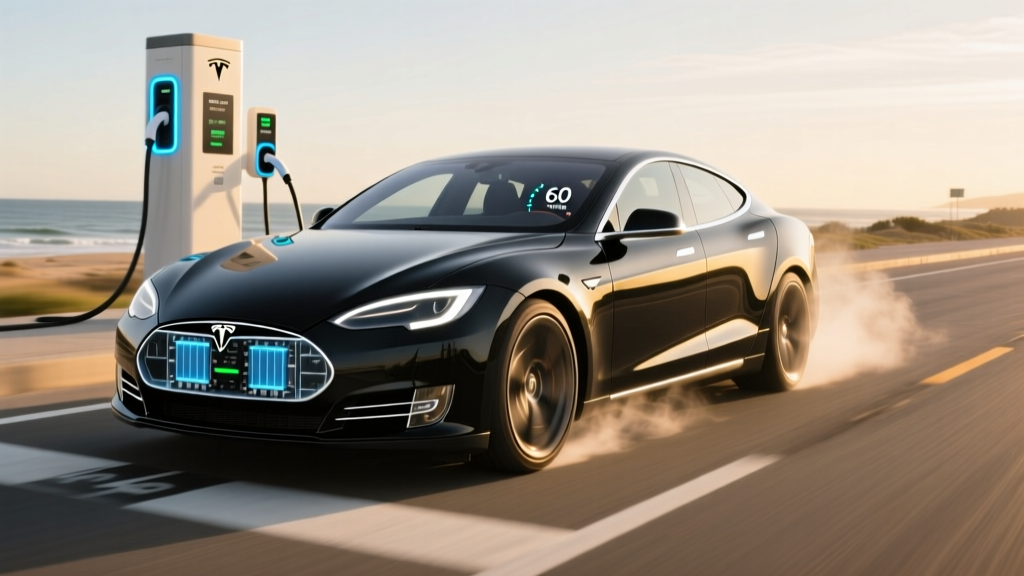
The headline number most enthusiasts search for is the Model S 100D 0-60 mph time of 4.1 seconds (with rollout subtracted, Tesla claimed 3.8 seconds). That's quick by any measure, but the 100D was never Tesla's performance flagship — that role belonged to the P100D with Ludicrous Mode. The 100D's engineering priority was range and efficiency, with performance as a bonus. Let's break down every spec that matters for ownership in 2026.
Full Spec Sheet: Model S 100D at a Glance
| Specification | Model S 100D (2017–2019) | Current Model S Long Range (2025) |
|---|---|---|
| EPA Range | 335 miles | 402 miles |
| Battery Capacity (usable) | ~98 kWh (100 kWh nominal) | ~95 kWh (Panasonic 4680-variant) |
| Battery Chemistry | NMC (Nickel Manganese Cobalt) | NMC / 4680 cells |
| Drivetrain | Dual-motor AWD | Dual-motor AWD |
| Horsepower | ~518 hp (combined) | 670 hp |
| 0-60 mph | 4.1 sec (3.8 w/ rollout) | 3.1 sec |
| Top Speed | 155 mph | 155 mph |
| Max DC Fast Charge | ~120 kW (V2 Supercharger) | 250 kW (V3 Supercharger) |
| 10-80% DC Charge Time | ~40 minutes | ~27 minutes |
| Level 2 Charge Rate | 11.5 kW (48A) | 11.5 kW (48A) |
| EPA Efficiency | 101 MPGe (33 kWh/100mi) | 124 MPGe (27 kWh/100mi) |
| Cargo Volume | 26.3 cu ft (rear) + 5.3 cu ft (frunk) | 28.0 cu ft (rear) + 5.3 cu ft (frunk) |
| Seating | 5 (optional 7-seat) | 5 |
| Battery Warranty | 8 yr / 150,000 mi | 8 yr / 150,000 mi |
Real-World Range: What 335 EPA Miles Actually Means
Real-World Highway (70 mph, mild weather): ~280–300 miles
Real-World City/Mixed: ~300–320 miles
Cold Weather (below 32°F, highway): ~230–260 miles
Hot Weather w/ AC (95°F+, highway): ~270–290 miles
The Model S 100D's 335-mile EPA rating was groundbreaking when it launched, but real-world range depends heavily on driving conditions. The 100D's large NMC pack gives it a substantial energy buffer, yet its older drivetrain and heavier curb weight (~4,900 lbs) mean it doesn't match the efficiency of Tesla's current 2025 Long Range model.
In highway testing at sustained 70-75 mph speeds in moderate temperatures (60-75°F), expect roughly 280 to 300 miles before reaching a low state of charge. The Model S's aerodynamic sedan profile helps on the highway compared to SUV-shaped competitors, but the 100D's older motor technology — it predates Tesla's permanent-magnet reluctance rear motor introduced in 2019 — draws more energy at cruise.
Cold weather is the equalizer for all EVs, and the 100D is no exception. Below freezing, battery chemistry slows ion movement, cabin heating demands significant energy (the 100D uses resistive PTC heating, not the more efficient heat pump Tesla introduced in the 2021 refresh), and range drops 20-30%. On a 20°F winter highway drive, plan for 230-260 miles of usable range. Preconditioning the battery while plugged in helps mitigate this loss.
Charging Speed: DC Fast Charge and Home Level 2
The Model S 100D was designed around Tesla's V2 Supercharger network, which peaked at 120 kW. This is the single biggest practical difference between the 100D and any post-2021 Model S.
| Charging Method | Power (kW) | Miles Added per Hour | 10-80% Time |
|---|---|---|---|
| Level 1 (120V, 12A) | 1.4 kW | ~4 mi/hr | N/A (days) |
| Level 2 (240V, 48A) | 11.5 kW | ~34 mi/hr | ~7 hours |
| Tesla V2 Supercharger | 120 kW peak | ~200 mi/hr (peak) | ~40 minutes |
| Tesla V3 Supercharger | ~100-120 kW (limited*) | ~180 mi/hr (peak) | ~40-45 minutes |
| CCS Adapter + 350 kW station | ~100-120 kW | ~180 mi/hr | ~40-45 minutes |
*The 100D's battery management system and older cell architecture cannot accept V3 Supercharger's full 250 kW. Expect peak rates around 100-120 kW regardless of charger capability.
The charging curve matters more than peak numbers. The 100D's NMC pack charges aggressively from 10% to roughly 50% state of charge, then tapers significantly. From 50-80%, you'll see rates drop to 60-80 kW, and above 80%, charging slows to protect battery longevity. For road trips, the practical strategy is to charge from 10-60% (about 20-25 minutes), then move on — the last 20% takes disproportionately longer.
At home on a Level 2 wall connector at 48 amps (11.5 kW), the 100D gains roughly 34 miles of range per hour. A full overnight charge from 20% to 80% takes about 5-6 hours, which suits most daily driving needs. If your home electrical panel supports a 60-amp circuit, you'll get the full 48-amp continuous charge rate; older panels may require a Tesla Wall Connector installation with a licensed electrician, potentially including a panel upgrade.
Performance: The Model S 100D 0-60 Story
The Model S 100D 0-60 mph time of 4.1 seconds (manufacturer-claimed, with a 1-foot rollout subtracted per drag-racing convention) made it one of the fastest sedans on the road in 2017-2019, even though it wasn't positioned as a performance model. The real-world 0-60 from a standing start without rollout is closer to 4.4-4.6 seconds — still devastatingly quick for a 4,900-pound luxury sedan.
The dual-motor setup pairs an induction motor on each axle. Tesla's pre-2019 dual-motor configuration used identical induction front and rear motors, whereas the 2019+ Raven update introduced a permanent-magnet reluctance motor on the front axle for improved efficiency. The 100D's all-induction setup delivers instant torque from both axles but at a slight efficiency penalty versus newer powertrains.
Combined output sits at approximately 518 horsepower. The AWD system provides excellent traction in rain and light snow, and the low center of gravity (battery pack mounted under the floor) gives the 100D surprisingly flat cornering for its weight. It's not a sports sedan in the BMW M5 sense, but it dispatches highway merges and passing maneuvers with effortless authority.
Pricing, Tax Credits, and 2026 Ownership Costs
The Model S 100D is no longer sold new. Tesla discontinued the 100D badge after the 2019 model year, replacing it with the Long Range and Performance (later Plaid) variants. In 2026, the 100D is available exclusively on the used market.
| Item | Details |
|---|---|
| Original MSRP (2017-2019) | $94,000 – $105,000 (before options/incentives) |
| Used Market Price (2026 est.) | $32,000 – $48,000 (depending on mileage, condition, battery SoH) |
| Federal Used EV Credit (§25E) | Up to $4,000 (30% of sale price, max $4,000) |
| Credit Income Cap | $75K single / $112.5K HOH / $150K joint (AGI) |
| Vehicle Eligibility Requirements | Must be sold by a dealer, model year at least 2 years old, sale price ≤ $25,000 |
| Federal New EV Credit (§30D) | Not applicable (used vehicle; new Model S exceeds MSRP cap) |
A critical detail for used EV buyers: the IRS §25E Used Clean Vehicle Credit offers up to $4,000 (30% of the sale price) but has strict requirements. The vehicle must be purchased from a licensed dealer (not a private party), the sale price must not exceed $25,000, and the buyer's adjusted gross income must fall below the caps listed above. Given that well-maintained Model S 100D examples typically sell for $32,000-$48,000 in 2026, most will not qualify for the used-EV credit due to the $25,000 price cap.
For buyers considering a new Model S instead: the current Long Range starts around $79,990, which exceeds the §30D new-vehicle MSRP cap of $55,000 for sedans. The new Model S does not qualify for the federal tax credit regardless of buyer income.
Interior, Cargo, and Technology
The pre-refresh Model S 100D (2017-2020) features Tesla's earlier interior design: a portrait-oriented 17-inch touchscreen, traditional instrument cluster behind the steering wheel, and physical steering-wheel stalks. The cabin seats five adults comfortably (a rear-facing third-row child seat was an early option, bringing seating to seven, though it was rarely specified and has since been discontinued).
Cargo capacity: 26.3 cubic feet behind the rear seats, plus 5.3 cubic feet in the front trunk (frunk). With the rear seats folded, total cargo space expands to approximately 58 cubic feet. The liftback hatch design makes loading bulky items easier than a traditional sedan trunk.
Passenger space: Front legroom measures 42.7 inches; rear legroom is 35.4 inches. The flat floor (no transmission tunnel) gives the rear middle seat usable foot space, though the center position remains narrow for adults on long trips.
Tech highlights:
- 17-inch touchscreen with navigation, media, and vehicle controls
- Over-the-air (OTA) software updates — the 100D continues to receive feature additions years after purchase
- Autopilot (Level 2 driver assist) — adaptive cruise control and lane-keeping; Full Self-Driving (Supervised) was available as a paid option but requires active driver supervision at all times
- HEPA air filtration with Bioweapon Defense Mode
- Panoramic glass roof (fixed, no shade — can increase cabin heat in summer)
Notable drawbacks of the pre-refresh interior: Build quality on 2017-2019 Model S vehicles was inconsistent — panel gaps, rattles, and premature wear on seat bolsters are common complaints. The MCU1 (first-generation media control unit) in early 2017 models was sluggish and prone to failure; Tesla issued a recall and many were upgraded to MCU2. Confirm the MCU version before purchasing.
Battery Health, Warranty, and Longevity
The 100D's NMC battery pack is warrantied for 8 years or 150,000 miles (whichever comes first), with Tesla guaranteeing a minimum of 70% capacity retention during the warranty period. For a 2017-2018 model, the original battery warranty may be expiring or already expired in 2026, which is a critical factor for used buyers.
Real-world degradation data from Tesla owner communities and fleet analyses suggest the 100 kWh pack loses approximately 8-12% capacity in the first 50,000 miles, then degrades more slowly. A 2018 Model S 100D with 80,000 miles might show 85-90% state of health (SoH), translating to roughly 285-300 miles of usable range at full charge — still highly practical.
Battery replacement out of warranty is expensive. Tesla's current replacement pricing for a 100 kWh pack runs approximately $13,000-$16,000 including labor, though refurbished packs may be available at lower cost. Before purchasing a used 100D, request a battery health reading from the vehicle's service menu or have a Tesla Service Center perform a pre-purchase inspection.
NMC chemistry offers higher energy density than LFP (lithium iron phosphate), which is why Tesla used it for long-range applications. The trade-off: NMC degrades slightly faster than LFP and is more sensitive to sustained high state-of-charge storage. Best practice is to charge to 80-90% for daily use and reserve 100% charges for road trips.
Pros and Cons: Model S 100D in 2026
Pros
- 335-mile EPA range still competitive in 2026; real-world 280-300 mi highway
- 4.1-second 0-60 with effortless dual-motor AWD acceleration
- Access to Tesla Supercharger network (largest in the U.S.)
- Continued OTA updates add features years after purchase
- Spacious liftback cargo area (26.3 cu ft) plus frunk
- HEPA cabin filtration — among the best in any vehicle
- Used pricing ($32K-$48K) offers luxury EV value
Cons
- DC fast charging capped at ~120 kW — slower than modern EVs at 250-350 kW chargers
- No heat pump (resistive heating) — greater cold-weather range loss
- Pre-refresh build quality concerns (panel gaps, MCU1 failures)
- Battery warranty likely expired or expiring on 2017-2018 examples
- Does not qualify for most federal tax credits in typical used transactions
- Older Autopilot hardware (HW2.5) — limited FSD capability vs. HW4
- Resistive cabin heating draws 4-6 kW in winter, accelerating range loss
Model S 100D vs. Key Competitors
In the used luxury EV sedan market at $32,000-$48,000, the 100D competes with:
- Tesla Model 3 Long Range (2021-2023, used): Faster charging (250 kW), heat pump, newer interior, but smaller cargo and less rear legroom. Used pricing overlaps. Better choice for charging speed and efficiency.
- Porsche Taycan 4S (2020-2021, used): Superior driving dynamics and 270 kW charging, but EPA range of only 200-227 miles and tighter rear seating. For driving enthusiasts who charge frequently.
- Lucid Air Pure/Touring (2023+, used): Far superior range (419+ EPA) and efficiency, but used examples still command $55,000+ and are harder to find.
- BMW i5 eDrive40 (2024, used): Newer platform, excellent build, but 295-mile EPA range and less Supercharger access (though BMW has gained NACS adapter compatibility).
The 100D wins on range-per-dollar and Supercharger network access. It loses on charging speed and interior freshness. For buyers prioritizing road-trip range and Tesla's charging ecosystem at a sub-$45K budget, the 100D remains compelling.
Who Should Buy the Model S 100D?
Choose the Model S 100D if:
- You want 280+ real-world highway miles at a used price under $45,000
- You rely on Tesla's Supercharger network for road trips
- You need a spacious sedan with substantial cargo room (liftback + frunk)
- You value OTA updates and Tesla's software ecosystem
- You can charge at home and use DC fast charging primarily for trips
Look elsewhere if:
- Fast DC charging (200+ kW) is critical to your routine
- You live in a cold climate and need a heat pump for winter efficiency
- Build quality and a modern interior refresh are priorities
- You want current Autopilot hardware (HW4) and the latest FSD features
- You need the federal used EV credit (most 100D transactions exceed the $25K cap)
Frequently Asked Questions
What is the real-world range of the Tesla Model S 100D?
The EPA rates the 100D at 335 miles, but real-world highway driving at 70 mph in mild weather yields approximately 280-300 miles. City and mixed driving can approach 300-320 miles thanks to regenerative braking. In cold weather (below freezing), expect 230-260 miles due to battery chemistry limitations and resistive cabin heating.
How fast does the Model S 100D charge?
On DC fast charging, the 100D peaks at approximately 120 kW on Tesla V2 Superchargers and is similarly limited on V3 stations due to its older battery architecture. A 10-80% charge takes roughly 40 minutes. At home on a Level 2 (240V, 48A) connection, it charges at 11.5 kW, adding about 34 miles of range per hour, with a full overnight charge taking 5-6 hours for a typical daily replenishment.
Does the Model S 100D qualify for the federal EV tax credit?
As a used vehicle, the 100D may qualify for the IRS §25E Used Clean Vehicle Credit of up to $4,000 — but only if purchased from a dealer for $25,000 or less and the buyer meets income caps ($75K single / $150K joint). Since most Model S 100D examples sell for $32,000-$48,000, the majority will not qualify. The §30D new-vehicle credit does not apply. Consult a tax professional for your specific situation.
Is the Model S 100D worth buying in 2026 vs. competitors?
It depends on priorities. The 100D offers exceptional range-per-dollar and Supercharger access at $32K-$48K used. However, its 120 kW charging cap, lack of a heat pump, and aging interior put it behind the used Model 3 Long Range (faster charging, heat pump) and Porsche Taycan (driving dynamics). For range-focused buyers who road-trip on the Supercharger network, the 100D is still a strong value. For charging-speed priority or cold-climate buyers, the Model 3 Long Range is the better pick.
What are the biggest pros and cons of the Model S 100D?
Top pros: 335-mile EPA range (280-300 real-world highway), 4.1-second 0-60, Supercharger access, spacious liftback cargo, continued OTA updates, and sub-$45K used pricing. Top cons: 120 kW DC charging cap (slower than modern EVs), no heat pump (greater winter range loss), pre-refresh build quality variability, likely expired battery warranty on 2017-2018 models, and limited federal tax credit eligibility.
How long will the 100D battery last?
Tesla's NMC 100 kWh packs typically retain 85-90% capacity at 80,000 miles based on fleet data. The original 8-year/150,000-mile battery warranty is expiring on 2017-2018 models. Out-of-warranty battery replacement costs approximately $13,000-$16,000. Best practices for longevity: charge to 80-90% daily, avoid frequent 100% charges, and precondition the battery before fast charging in cold weather.
Does the 100D have Autopilot or Full Self-Driving?
The 100D shipped with Autopilot (adaptive cruise control and lane-keeping) as standard. Some examples have Full Self-Driving (Supervised) capability as a purchased add-on. However, both are SAE Level 2 driver-assistance systems — the driver must remain fully engaged and responsible at all times. The 100D's HW2.5 computer is less capable than current HW4 hardware, and some newer FSD features may not be available. This is not autonomous or self-driving technology.
Sources: EPA Fuel Economy – Tesla Model S 100D, IRS Used Clean Vehicle Credit (§25E), Tesla Charging