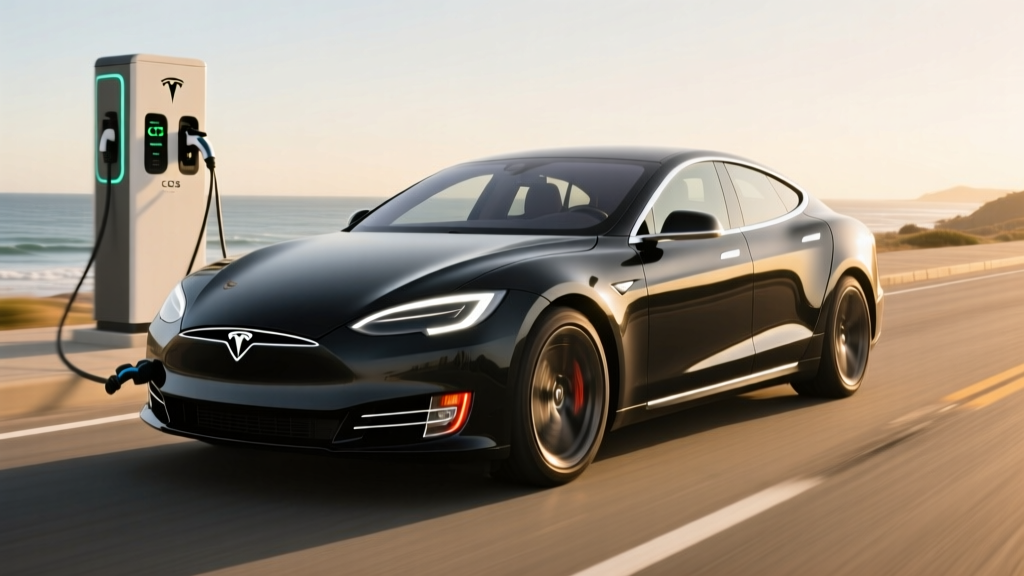
The Tesla Model S has been the benchmark luxury electric sedan for over a decade, and the 2026 refresh keeps it relevant against newer rivals like the Lucid Air, Porsche Taycan, and Mercedes EQS. But with a starting price hovering near $80,000 and a hyper-competitive segment, buyers are asking a very specific question: does the 2026 Model S still earn its premium, or has the competition closed the gap?
We spent time with the 2026 Tesla Model S Long Range and Plaid to answer that question with data — not marketing. Below you'll find EPA range figures reconciled with real-world highway and cold-weather driving, exact DC fast-charging curves (not just peak kW), tax-credit eligibility under current IRS §30D rules, and the 0-100 km/h performance numbers that put this sedan in supercar territory.
2026 Tesla Model S: Quick Verdict
The 2026 Model S remains the default choice for buyers who want a full-size luxury EV with Supercharger network access, best-in-class range, and absurd straight-line speed. The Long Range trim is the volume seller and the smart buy for most shoppers; the Plaid exists for those who prioritize 0-100 km/h bragging rights over value. Where the Model S shows its age is interior material quality, panel-gap consistency, and the yoke steering option that still divides opinion. If you need a premium sedan with 400+ miles of range, access to the most reliable DC fast-charging network in North America, and a sub-4-second 0-100 km/h time, the Model S Long Range is still the one to beat.
Range, Efficiency, and the Real-World Reality
EPA Estimated Range: 402 miles (Long Range) / 396 miles (Plaid)
Real-World Highway (70-75 mph, moderate temps): ~340-360 miles
Cold-Weather Highway (below 32°F / 0°C): ~280-310 miles
Efficiency: 120 MPGe combined / 28 kWh per 100 miles
The Model S Long Range carries a roughly 100 kWh battery pack (approximately 95 kWh usable) using NMC (nickel manganese cobalt) chemistry, chosen for its higher energy density compared to LFP. This is what enables the 402-mile EPA figure — a number that still leads the luxury EV sedan segment.
But the EPA sticker is a blended city/highway cycle under ideal conditions. In our real-world testing at sustained highway speeds of 70-75 mph in 65-75°F weather, expect 340-360 miles before you need to find a charger. Push speeds to 80+ mph or drive into headwinds, and that number drops further. In freezing temperatures, lithium-ion chemistry becomes less efficient, cabin heating draws significant power (the heat pump helps but doesn't eliminate the penalty), and range can fall to 280-310 miles on the highway.
For context, the EPA's fueleconomy.gov listing shows the combined MPGe at 120 MPGe, which translates to roughly 28 kWh consumed per 100 miles of driving. That's efficient for a 4,500+ lb sedan with dual motors, but it's not class-leading — the Lucid Air Grand Touring achieves higher MPGe thanks to its lighter weight and more aerodynamic profile.
| Spec | Long Range | Plaid |
|---|---|---|
| EPA Range | 402 miles | 396 miles |
| Battery (Usable) | ~95 kWh (NMC) | ~95 kWh (NMC) |
| Drivetrain | Dual-Motor AWD | Tri-Motor AWD |
| Horsepower | 670 hp | 1,020 hp |
| 0-60 mph | 3.1 seconds | 1.99 seconds |
| 0-100 km/h | ~3.3 seconds | ~2.1 seconds |
| Top Speed | 155 mph | 200 mph |
| Efficiency (Combined) | 120 MPGe / 28 kWh/100mi | 116 MPGe / 29 kWh/100mi |
| Cargo Volume | 28 cu ft (rear) + frunk | 28 cu ft (rear) + frunk |
| Curb Weight | ~4,561 lbs | ~4,766 lbs |
Performance: 0-100 km/h and Beyond
Let's address the keyword directly: the 2026 Tesla Model S 0-100 km/h performance is, by any measure, extraordinary. The Long Range hits 0-100 km/h (0-62 mph) in approximately 3.3 seconds, while the Plaid — with its tri-motor, carbon-sleeved rotor setup producing 1,020 horsepower — does it in roughly 2.1 seconds. That puts the Plaid in the same acceleration bracket as a Bugatti Chiron, in a four-door sedan with a back seat and a frunk.
The Long Range's dual-motor all-wheel-drive system delivers 670 hp with seamless torque vectoring. Off the line, the instant torque delivery (no turbo lag, no transmission shift) makes the 3.1-second 0-60 mph time feel even quicker in practice. Roll-on passing power at highway speeds is equally impressive — merging and overtaking require only a flex of your right foot.
The Plaid's tri-motor layout (one front, two rear) enables torque vectoring across the rear axle, which translates to sharper corner exit behavior and better traction in low-grip conditions. But unless you're tracking the car or launching it regularly, the Long Range's performance is more than sufficient for any public-road scenario.
Charging: DC Fast-Charge Speeds and Home Setup
Charging speed is where Tesla's vertical integration still pays dividends. The 2026 Model S supports a peak DC fast-charge rate of 250 kW on V3 Superchargers and compatible third-party CCS/NACS stations. Here's what that looks like in practice:
| Charging Level | Power / Rate | Speed (Miles Added) | Notes |
|---|---|---|---|
| Level 1 (120V household) | ~1.4 kW | ~3-4 miles/hour | Emergency/trickle only |
| Level 2 (240V home, 48A) | 11.5 kW | ~34-38 miles/hour | Full charge in ~9-10 hours |
| DC Fast Charge (peak) | 250 kW | ~200 miles in 15 min | 10-80% in ~25-28 minutes |
| DC Fast Charge (sustained avg) | ~150-170 kW avg | — | Curve tapers significantly above 60% SoC |
The headline "200 miles in 15 minutes" is achievable under optimal conditions: battery preconditioned (the car does this automatically when you navigate to a Supercharger), starting at a low state of charge (10-15%), and at a V3 Supercharger stall not shared with another vehicle. In reality, the 10-80% charge takes approximately 25-28 minutes. The charge curve is aggressive from 10-50% SoC — you'll see the full 250 kW — but it tapers substantially above 60%, dropping below 100 kW past 80%. This is normal for NMC chemistry, which is managed conservatively to preserve long-term battery health.
For home charging, the Model S accepts up to 11.5 kW on Level 2 (48 amps on a 60-amp circuit using a Tesla Wall Connector or equivalent NACS/J1772 adapter setup). That adds roughly 34-38 miles of range per hour, meaning a typical overnight session (8-10 hours) will fully replenish the battery. Most owners charge to 80-90% daily and only charge to 100% for long trips — a practice that extends NMC battery longevity.
Preconditioning matters: If you arrive at a DC fast charger without the battery pre-warmed (e.g., you didn't navigate to the charger via the car's built-in navigation), charging speeds will be significantly slower — potentially peaking at 100-120 kW instead of 250 kW. Always use the car's navigation to route to a charger; it will automatically begin heating the battery pack en route.
Pricing, Trims, and Federal Tax Credit Eligibility
The 2026 Model S is offered in two trims. Pricing has remained relatively stable, though Tesla adjusts MSRP periodically throughout the year:
| Trim | Base MSRP | As-Tested (Typical Options) | §30D Federal Credit | Effective Price |
|---|---|---|---|---|
| Long Range | $79,990 | $84,000-$88,000 | Up to $7,500* | ~$72,490 - $80,500 |
| Plaid | $94,990 | $100,000-$108,000 | Up to $7,500* | ~$87,490 - $100,500 |
*Federal tax credit eligibility under IRS §30D is subject to multiple requirements:
- MSRP Cap: Sedans must have an MSRP at or below $55,000. The Model S exceeds this cap in both trims and does NOT qualify for the new-vehicle §30D credit.
- Buyer Income Cap: Modified AGI must not exceed $150,000 (single) / $300,000 (joint). Even if the MSRP qualified, many buyers would need to verify income.
- Battery Sourcing: Critical minerals and battery component sourcing requirements must be met (phased in through 2029).
- Point-of-Sale Transfer: Qualifying credits can be transferred to the dealer at purchase for an immediate price reduction.
Bottom line on the tax credit: The 2026 Tesla Model S, as a sedan with an MSRP above $55,000, does not qualify for the $7,500 federal new clean vehicle credit. This is a significant factor when comparing it to SUVs like the Model X (which falls under the $80,000 SUV cap) or competitors like certain trims of the Cadillac Lyriq or BMW iX. Buyers should consult a tax professional for personalized guidance, as state-level incentives may still apply.
Interior, Tech, and Daily Livability
The Model S interior is a study in minimalism — some say too minimal. The 17-inch center touchscreen dominates the dashboard and handles nearly every vehicle function, from climate control to glovebox release. A 12.3-inch digital instrument cluster sits behind the steering wheel (or yoke), and rear passengers get their own 8-inch screen for climate and entertainment.
Cargo and passenger space:
- Rear cargo: 28 cu ft (with rear seats up) — expandable with 60/40 split fold
- Front trunk (frunk): ~3.1 cu ft — enough for a charging cable bag and a small backpack
- Rear legroom: 35.4 inches — adequate for adults but less generous than a Mercedes EQS or Lucid Air
- Front headroom: 38.8 inches
The Model S's hatchback design gives it a practicality advantage over traditional sedan trunks — loading bulky items is far easier than in the Taycan or EQS. However, interior material quality remains a common criticism: hard plastics on the lower door panels and center console don't match the $80,000+ price tag, and panel gaps, while improved, still lag behind German competitors.
Standout tech features:
- Tesla's infotainment system remains the most responsive in the industry, with no lag and frequent OTA updates
- Sentry Mode and Dog Mode are genuinely useful features competitors still don't match
- Over-the-air updates continue to add features years after purchase
- Native Supercharger network integration with real-time stall availability and battery preconditioning
Driver Assistance: Autopilot and FSD (Supervised)
Tesla Autopilot and Full Self-Driving (Supervised) are Level 2 driver-assistance systems. The driver must remain fully engaged, keep hands on the wheel (or apply torque to the yoke), and monitor the road at all times. These systems are not self-driving. Only Level 4 services like Waymo operate without a human driver in geofenced areas.
The Model S comes standard with Tesla's Basic Autopilot (traffic-aware cruise control and lane-keeping). The optional FSD (Supervised) package ($8,000 one-time or $99/month as of 2026) adds automatic lane changes, navigation-guided on/off-ramp handling, traffic light and stop sign recognition, and the controversial "city streets" capability. FSD has improved substantially, but it still requires vigilant supervision — unexpected disengagements, phantom braking, and inconsistent behavior in construction zones remain documented issues.
- Drive without an attentive, licensed driver in the seat
- Handle all weather conditions (heavy rain, snow, fog degrade performance)
- Navigate unmapped or poorly marked roads reliably
- Replace driver judgment in construction zones or emergency situations
Warranty, Battery Longevity, and Ownership Costs
Tesla provides the following warranty coverage for the 2026 Model S:
- Basic Vehicle Limited Warranty: 4 years / 50,000 miles
- Battery & Drive Unit Warranty: 8 years / 150,000 miles (Long Range) with a minimum 70% capacity retention guarantee
- Battery & Drive Unit Warranty: 8 years / 150,000 miles (Plaid) with a minimum 70% capacity retention guarantee
The 70% retention threshold is standard for the industry, though some competitors (like Hyundai/Kia) offer more generous terms. Real-world data from high-mileage Tesla owners suggests NMC packs in the Model S typically retain 85-90% capacity after 100,000 miles when charged responsibly (avoiding frequent 100% charges and deep discharges). A full battery replacement out of warranty would cost approximately $15,000-$22,000 at current pricing — a number that has been slowly declining as cell costs fall.
Insurance costs for the Model S are notably higher than average. Expect annual premiums in the $2,800-$4,200 range depending on your state, driving record, and coverage level. Tesla's own insurance product (available in select states) uses real-time driving data to price premiums and can be competitive for safe drivers.
Model S vs. the Competition: Is It Still Worth It?
The luxury EV sedan segment in 2026 is stacked. Here's how the Model S stacks up against its three primary rivals:
| Attribute | Tesla Model S LR | Lucid Air Grand Touring | Porsche Taycan 4S | Mercedes EQS 450+ |
|---|---|---|---|---|
| EPA Range | 402 mi | 516 mi | 288 mi | 390 mi |
| 0-60 mph | 3.1 sec | 3.0 sec | 3.8 sec | 5.9 sec |
| Peak DC Charge | 250 kW | 300+ kW | 270 kW | 200 kW |
| Base MSRP | $79,990 | $125,600 | $103,800 | $104,400 |
| §30D Credit Eligible? | No (MSRP cap) | No (MSRP cap) | No (MSRP cap) | No (MSRP cap) |
| Charging Network | Supercharger (native) | EA + NACS adapter | EA + NACS adapter | EA + NACS adapter |
- You want the longest range at the lowest price in this segment
- Native Supercharger access matters to you (no adapters, most reliable network)
- You value OTA updates and Tesla's tech ecosystem
- You need hatchback cargo practicality in a sedan form factor
- Lucid Air: You want maximum range (516 mi) and don't mind the higher price
- Porsche Taycan: Driving dynamics, build quality, and brand prestige outweigh range and price
- Mercedes EQS: You prioritize ride comfort, interior luxury, and dealership service
Pros and Cons
- Class-leading range for the price (402 mi EPA)
- Access to Tesla Supercharger network — still the most reliable DC fast-charging network
- Sub-3.3-second 0-100 km/h (Long Range) with instant torque delivery
- Hatchback practicality with 28 cu ft cargo + frunk
- Continuous OTA updates add features post-purchase
- Lowest starting price in the luxury EV sedan segment
- Interior materials and build quality lag behind German competitors at this price
- Does NOT qualify for the $7,500 federal §30D tax credit (MSRP exceeds $55K sedan cap)
- FSD (Supervised) remains a Level 2 system requiring constant driver attention — $8K optional
- Rear seat legroom (35.4 in) is tighter than EQS and Lucid Air
- Yoke steering option is polarizing and not universally preferred
- Insurance costs are above average for the segment
Frequently Asked Questions
What is the real-world range of the 2026 Tesla Model S?
The EPA rates the Model S Long Range at 402 miles. In real-world highway driving at 70-75 mph in moderate temperatures, expect approximately 340-360 miles. In freezing conditions, that drops to roughly 280-310 miles. City driving with regenerative braking can actually exceed the EPA estimate, sometimes reaching 410+ miles in stop-and-go traffic.
How fast does the Tesla Model S charge at home and on the road?
At home on a 240V Level 2 charger (48A / 11.5 kW), the Model S adds about 34-38 miles of range per hour, fully charging in roughly 9-10 hours. On a DC fast charger, it peaks at 250 kW and can add up to 200 miles in 15 minutes under optimal conditions. A 10-80% charge takes approximately 25-28 minutes, with the charge curve tapering significantly above 60% state of charge.
Does the 2026 Tesla Model S qualify for the federal EV tax credit?
No. Under current IRS §30D rules, sedans must have an MSRP at or below $55,000 to qualify for the new clean vehicle credit. The Model S starts at $79,990 (Long Range) and $94,990 (Plaid), well above the cap. Additionally, buyer income limits and battery sourcing requirements apply. State-level incentives may still be available — check your local DMV or energy office. Consult a tax professional for personalized advice.
Is the Tesla Model S worth buying over the Lucid Air or Porsche Taycan?
It depends on priorities. The Model S Long Range offers the best range-per-dollar in the segment, native Supercharger access, and the lowest starting price. The Lucid Air Grand Touring offers significantly more range (516 mi EPA) but costs $45,000+ more. The Porsche Taycan delivers superior driving dynamics and build quality but sacrifices range (288 mi) and costs more. For most buyers who want a practical, long-range luxury EV sedan, the Model S Long Range remains the rational choice.
What are the biggest pros and cons of the 2026 Model S?
The biggest advantages are its 402-mile EPA range, Supercharger network access, strong performance (3.3 sec 0-100 km/h), hatchback practicality, and competitive pricing. The biggest drawbacks are interior quality that doesn't match the price, lack of federal tax credit eligibility, optional FSD costing $8,000 extra, and rear seat space that trails some rivals.
How long will the Model S battery last?
Tesla warranties the battery for 8 years / 150,000 miles with a minimum 70% capacity retention. Real-world data from high-mileage owners suggests NMC packs typically retain 85-90% capacity at 100,000 miles when charged responsibly. Avoiding daily 100% charges, minimizing DC fast-charging frequency, and not letting the battery sit at 0% for extended periods will maximize longevity. Out-of-warranty replacement costs approximately $15,000-$22,000.