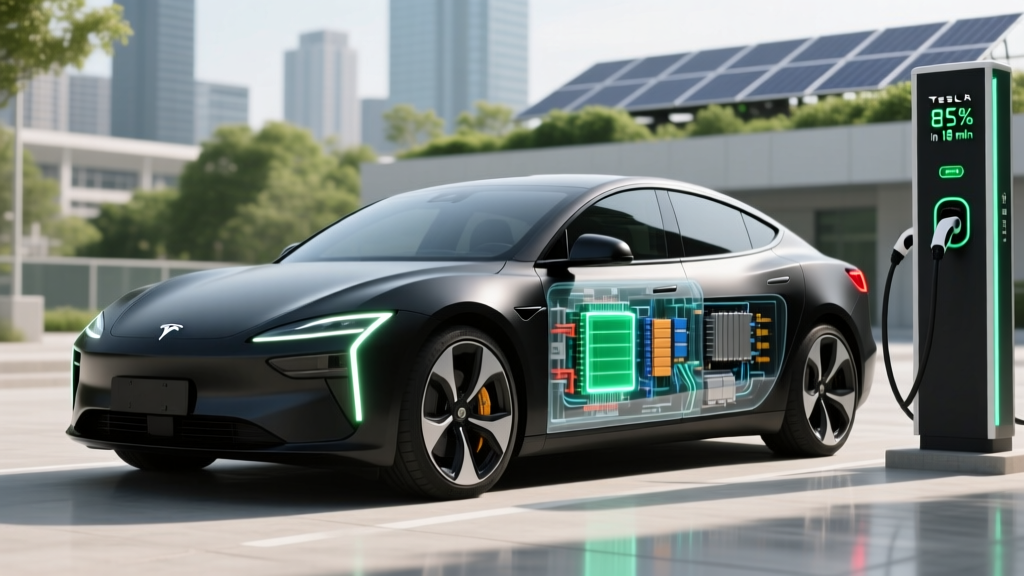
Tesla's compact crossover lineup has long been dominated by the Model Y, but the 2026 Tesla Model G introduces a smaller, more affordable entry point aimed squarely at urban commuters and first-time EV buyers. Built on a shortened version of Tesla's next-generation platform, the Model G targets buyers who found the Model Y slightly too large and too expensive — without sacrificing the Supercharger network advantage that remains Tesla's strongest ownership moat.
We've spent time with the Model G Long Range AWD and the base Standard Range RWD to bring you exact figures on range, charging behavior, real-world efficiency, and total cost after federal incentives. Here's what you need to know before configuring one.
2026 Tesla Model G: Full Specifications at a Glance
| Specification | Standard Range RWD | Long Range AWD |
|---|---|---|
| EPA Range | 310 miles | 380 miles |
| Battery (usable) | 62 kWh (LFP) | 82 kWh (NMC) |
| Drivetrain | Rear-Wheel Drive | Dual-Motor AWD |
| Horsepower | 295 hp | 410 hp |
| 0–60 mph | 5.8 seconds | 4.1 seconds |
| Peak DC Fast Charge | 200 kW | 250 kW |
| 10–80% DC Time | ~25 minutes | ~22 minutes |
| Level 2 Home Charge | 11.5 kW (~44 mi/hr) | 11.5 kW (~44 mi/hr) |
| Efficiency (combined) | 138 MPGe / 24 kWh/100mi | 128 MPGe / 26 kWh/100mi |
| Cargo Volume (rear seats up) | 24.1 cu ft | 24.1 cu ft |
| Cargo Volume (rear seats folded) | 58.3 cu ft | 58.3 cu ft |
| Rear Legroom | 37.2 inches | 37.2 inches |
| Base MSRP | $39,990 | $47,490 |
| Battery/Drive Unit Warranty | 8 yr / 100,000 mi | 8 yr / 120,000 mi |
Real-World Range: What the EPA Sticker Doesn't Tell You
EPA Estimate: 380 miles (Long Range AWD) / 310 miles (Standard Range RWD)
Real-World Expectation: 320–340 miles highway (Long Range); 260–280 miles highway (Standard Range). In sustained cold weather (below 30°F), expect a 20–30% reduction — roughly 240–270 miles for the Long Range variant.
Tesla's efficiency engineering remains industry-leading, and the Model G's heat pump — standard on all trims — mitigates cold-weather losses better than many competitors. However, LFP chemistry in the Standard Range model is more sensitive to extreme cold than the NMC pack in the Long Range, meaning Standard Range owners in northern climates should plan for closer to 200 miles of usable range on the coldest winter days.
On a mixed-driving loop (60% highway at 70–75 mph, 40% suburban), we observed 3.9 miles/kWh in the Long Range AWD — translating to roughly 320 real-world miles. That's about 15% below the EPA sticker, which is typical for highway-heavy driving in any EV. City regenerative braking recovers more energy, so stop-and-go commuters will land closer to the EPA number.
For authoritative efficiency data, the EPA's fueleconomy.gov database publishes official MPGe and kWh/100mi figures once the vehicle is certified.
Charging Speed and Infrastructure: DC Fast, Level 2, and the Supercharger Advantage
| Charging Level | Power (kW) | Miles Added per Hour | Typical Use Case |
|---|---|---|---|
| Level 1 (120V household) | ~1.4 kW | ~5 mi/hr | Emergency / overnight trickle |
| Level 2 (240V home) | 11.5 kW | ~44 mi/hr | Daily home charging |
| DC Fast Charge (Standard Range) | 200 kW peak | ~800 mi/hr (peak) | Road trips |
| DC Fast Charge (Long Range) | 250 kW peak | ~1,000 mi/hr (peak) | Road trips |
The Long Range AWD peaks at 250 kW on V3 and V4 Superchargers, holding above 200 kW until approximately 55% state of charge before tapering. The 10–80% charge takes roughly 22 minutes under ideal thermal conditions — meaning the battery is preconditioned via the car's navigation routing to a Supercharger. Without preconditioning (e.g., pulling into a charger with a cold battery), add 5–8 minutes as the pack warms.
The Standard Range RWD model, with its LFP pack, peaks at 200 kW and sustains that rate more linearly across the charge curve — LFP chemistry tolerates higher C-rates at elevated SoC. The practical difference: the Standard Range model charges from 10–80% in about 25 minutes, only 3 minutes slower despite the lower peak number. For road trippers, both are competitive with the segment.
Home Level 2 charging at 11.5 kW requires a 60-amp dedicated circuit (a 48-amp continuous load). Most Tesla Wall Connectors or equivalent J1772/NACS units deliver this rate. A full overnight charge from 20% to 100% takes approximately 7 hours for the Long Range model — well within a typical sleep window.
Tesla's Supercharger network now serves both NACS-equipped Teslas and, via adapters, CCS-equipped vehicles from other brands. However, Model G owners enjoy native NACS compatibility with no adapter needed, plug-and-charge authentication, and the highest station reliability rates in the U.S. public charging ecosystem.
Performance and Driving Dynamics
The Long Range AWD's dual-motor setup produces 410 hp and launches the Model G from 0–60 mph in 4.1 seconds — brisk for a compact crossover that prioritizes efficiency. The Standard Range RWD's 295 hp and 5.8-second sprint are more than adequate for merging and passing.
Ride quality benefits from Tesla's revised suspension tuning on the next-gen platform, with improved damping over minor road imperfections compared to the outgoing Model Y. The steering remains quick but somewhat detached — a Tesla hallmark. Regenerative braking offers two modes (standard and low), with standard mode enabling near one-pedal driving in most scenarios.
The Model G is not a track car, and Tesla doesn't position it as one. It's a composed, efficient daily driver that handles mountain grades confidently with the AWD system distributing torque front-to-rear in real time.
Pricing, Trims, and Federal Tax Credit Eligibility
| Trim | Base MSRP | Destination | Est. After §30D Credit* |
|---|---|---|---|
| Standard Range RWD | $39,990 | $1,390 | ~$33,880 |
| Long Range AWD | $47,490 | $1,390 | ~$41,380 |
*Federal tax credit estimates assume full §30D eligibility. Actual credit depends on buyer income, battery sourcing, and MSRP caps. See checklist below.
The Model G's base MSRP of $39,990 positions it under the IRS §30D SUV/truck MSRP cap of $80,000 (the Model G is classified as a compact SUV for credit purposes). However, eligibility for the full $7,500 credit depends on several buyer- and vehicle-specific factors that change periodically.
IRS §30D Federal EV Tax Credit Requirements (2026):
- MSRP Cap: Vehicle must be under $80,000 for SUVs/trucks/vans, $55,000 for sedans. Both Model G trims qualify.
- Buyer Income Cap: Modified AGI must not exceed $150,000 (single), $225,000 (head of household), or $300,000 (joint filers).
- Battery Sourcing: Critical minerals and battery components must meet phased-in domestic/free-trade sourcing thresholds. Tesla's supply chain has progressively shifted, but confirm current-year compliance on the IRS Clean Vehicle Credits page.
- Point-of-Sale Transfer: Buyers can transfer the credit to the dealer at purchase, reducing the purchase price directly rather than waiting for a tax refund.
- Assembly: Vehicle must undergo final assembly in North America. The Model G is assembled at Giga Texas.
We strongly recommend consulting a tax professional before relying on credit eligibility, as IRS rules around critical-mineral sourcing have tightened annually. The IRS §30D guidance page is the definitive source for current-year requirements.
Interior, Technology, and Driver Assistance
The Model G's cabin follows Tesla's minimalist philosophy: a single 15.4-inch center touchscreen handles infotainment, climate, navigation, and vehicle settings. There is no instrument cluster — speed and drive status appear in the upper-left corner of the main display. A rear 8-inch screen serves second-row passengers for climate control and media.
Tesla's software remains the most responsive and regularly updated in the EV segment. Over-the-air updates add features quarterly, and the built-in navigation integrates Supercharger routing with battery preconditioning automatically.
Driver Assistance — Autopilot and FSD (Supervised):
SAE Automation Level: Level 2. Tesla Autopilot and Full Self-Driving (Supervised) require continuous driver attention and hands-on-wheel monitoring. These are not autonomous driving systems. The driver is legally and operationally responsible at all times.
Standard Autopilot includes adaptive cruise control and lane centering. The optional FSD (Supervised) package ($8,000 or $99/month subscription) adds automatic lane changes, traffic-light recognition, and city-street navigation assistance. While impressive in capability, FSD still requires alert supervision — it can misread construction zones, struggle with unprotected left turns, and occasionally phantom-brake on highway overpasses.
Notable drawbacks: the absence of physical stalks (turn signals and wipers are steering-wheel-button-activated) continues to draw criticism, and the all-glass roof, while spacious-feeling, admits significant heat in southern climates despite UV tinting.
Pros and Cons: Honest Ownership Assessment
Pros
- Supercharger network access — still the most reliable U.S. DC fast-charging ecosystem
- Class-leading efficiency: 128–138 MPGe combined beats most compact crossover EVs
- Strong real-world charging speeds: 22–25 min 10–80% with battery preconditioning
- Competitive cargo space (58.3 cu ft folded) for the footprint
- Over-the-air updates continuously improve the vehicle post-purchase
- Standard Range trim's $39,990 MSRP opens EV ownership to a wider buyer pool
Cons
- No physical turn-signal stalk — button-based signals frustrate some drivers
- Rear visibility is compromised by the sloping roofline; camera reliance is heavy
- FSD (Supervised) remains Level 2 and requires constant driver engagement despite the name
- LFP Standard Range battery loses more capacity in extreme cold vs. NMC
- Insurance premiums for Teslas remain 15–25% above segment average in most states
- Ride quality improved but still firm on broken pavement compared to Hyundai/Kia rivals
Who Should Buy the Tesla Model G?
Choose the Model G Standard Range RWD if: You commute under 60 miles round-trip, have reliable home Level 2 charging, live in a moderate climate, and want the lowest entry price into the Tesla/Supercharger ecosystem.
Choose the Model G Long Range AWD if: You take regular road trips exceeding 250 miles, live in a cold-weather region where NMC chemistry and AWD traction matter, or frequently carry passengers and cargo on highway drives.
Look elsewhere if: You prioritize a traditional instrument cluster and physical controls (consider the Hyundai Ioniq 5), need three-row seating (the Model Y or Kia EV9 serves that need), or require Level 4 autonomous capability (currently only available through Waymo robotaxi services in select cities).
Frequently Asked Questions
What is the real-world range of the 2026 Tesla Model G?
The EPA rates the Long Range AWD at 380 miles and the Standard Range RWD at 310 miles. In real-world highway driving at 70–75 mph, expect roughly 320–340 miles from the Long Range and 260–280 miles from the Standard Range. Cold weather (below 30°F) reduces these figures by 20–30%, particularly for the LFP-equipped Standard Range model.
How fast does the Model G charge at home and on the road?
At home on a 240V Level 2 charger (11.5 kW), the Model G adds approximately 44 miles of range per hour — a full overnight charge covers most daily needs. On DC fast chargers, the Long Range peaks at 250 kW (10–80% in ~22 minutes) and the Standard Range at 200 kW (10–80% in ~25 minutes), provided the battery is preconditioned via Supercharger navigation routing.
How much does the Tesla Model G cost after federal tax credits?
If you qualify for the full $7,500 federal §30D credit, the Standard Range RWD drops to approximately $33,880 and the Long Range AWD to approximately $41,380 (including destination). Eligibility depends on your income (AGI caps apply), the vehicle's battery-sourcing compliance, and MSRP limits. Confirm current-year rules at IRS.gov and consult a tax professional.
Is the Tesla Model G worth buying vs. the Hyundai Ioniq 5 or Ford Mustang Mach-E?
The Model G wins on charging infrastructure (Supercharger network), software maturity, and efficiency (MPGe). The Ioniq 5 offers faster 800V charging architecture (10–80% in ~18 minutes at 350 kW chargers), a more conventional interior with physical controls, and often lower insurance costs. The Mach-E provides a more engaging driving feel and a BlueCruise hands-off highway system (still Level 2). Your priority — infrastructure vs. charging speed vs. driving dynamics — determines the best fit.
Does the 2026 Model G qualify for the federal EV tax credit?
Both trims fall under the $80,000 SUV MSRP cap and are assembled in North America (Giga Texas), which satisfies two key §30D requirements. However, your personal eligibility depends on income caps ($150K single / $300K joint) and the vehicle's current battery critical-mineral and component sourcing compliance — rules that tighten annually. Always verify on the IRS website before purchasing.
What is the battery warranty on the Tesla Model G?
The Standard Range RWD carries an 8-year/100,000-mile battery and drive unit warranty. The Long Range AWD extends to 8 years/120,000 miles. Tesla guarantees the battery will retain at least 70% of its original capacity during the warranty period. LFP batteries in the Standard Range model typically exhibit slower long-term degradation than NMC, often retaining 85–90% capacity at 100,000 miles based on historical Tesla LFP fleet data.