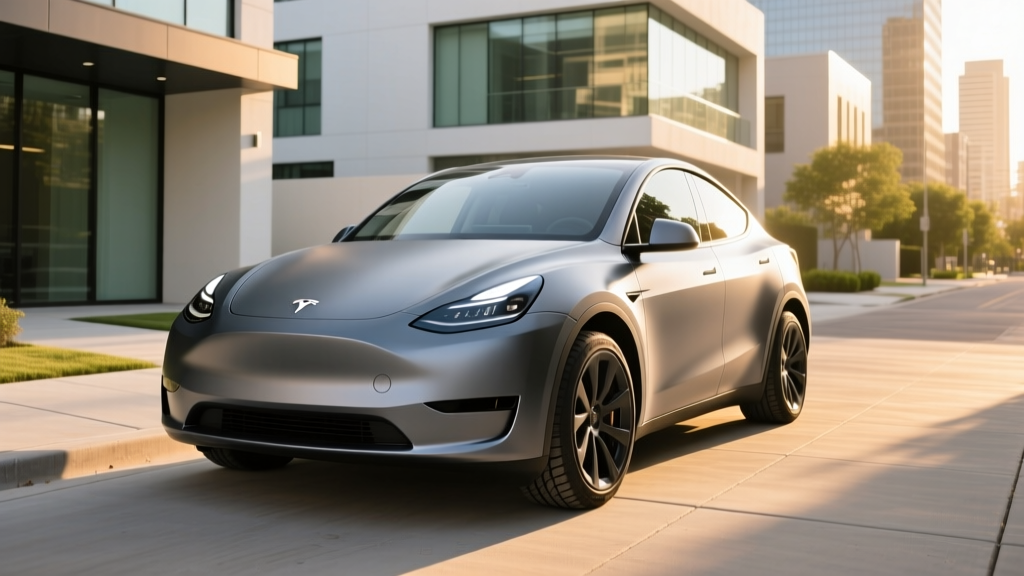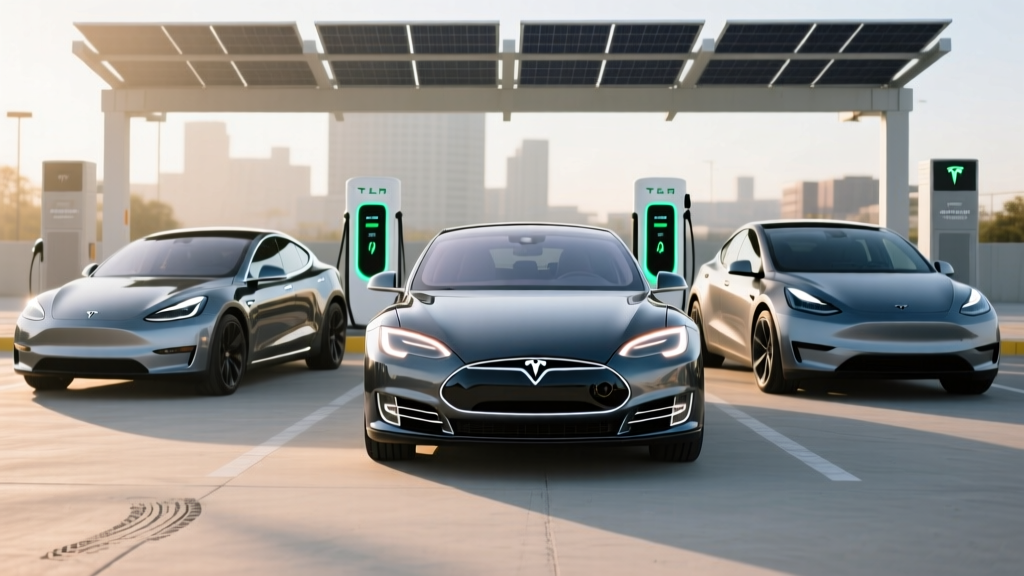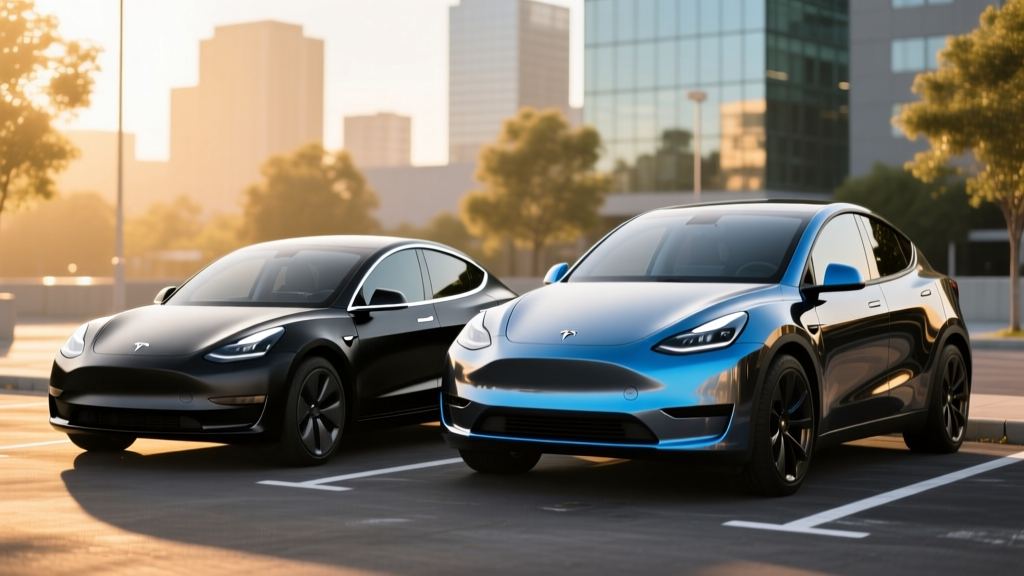
Tesla's naming convention has tripped up shoppers since the Model Y launched. The letters don't map to size the way BMW or Mercedes nomenclature does, and the Model 3 sedan and Model Y crossover share more DNA than their names suggest. Both ride on the same platform, use the same battery chemistries, and overlap heavily in price. Yet their differences in cargo volume, seating position, and efficiency matter once you plug in real-world ownership numbers.
This guide decodes the Tesla Model 3 Y naming logic, then pits the 2026 versions of each against each other across range, charging, performance, pricing, and tax-credit eligibility so you can buy with confidence.
Why Tesla Named Them Model 3 and Model Y (And Why It Confuses Buyers)
Elon Musk originally wanted Tesla's lineup to spell "S-3-X-Y" — a playful nod to "S-E-X-Y." Ford held the trademark on "Model E," so Tesla swapped in the numeral 3. The Model Y followed as the compact crossover variant, sharing the Model 3's architecture but wearing a taller hatchback body. The result: two vehicles that share roughly 75% of their parts but serve different use cases.
The naming causes three common buyer mistakes:
- Assuming Model 3 is smaller in every dimension — it's shorter and lower, but rear legroom is surprisingly competitive.
- Assuming Model Y is a three-row family hauler — the optional third row fits only small children and deletes nearly all cargo space when deployed.
- Assuming identical powertrains mean identical efficiency — the Y's taller frontal area costs it 20–40 miles of EPA range depending on the trim.
2026 Spec Snapshot: Model 3 vs Model Y Side by Side
| Attribute | Model 3 RWD | Model 3 Long Range AWD | Model Y RWD | Model Y Long Range AWD |
|---|---|---|---|---|
| EPA range | 272 mi | 363 mi | 259 mi | 320 mi |
| Battery (usable) | ~60 kWh (LFP) | ~75 kWh (NMC) | ~60 kWh (LFP) | ~75 kWh (NMC) |
| MPGe (combined) | 132 MPGe | 134 MPGe | 124 MPGe | 122 MPGe |
| Efficiency | 25 kWh/100mi | 25 kWh/100mi | 27 kWh/100mi | 28 kWh/100mi |
| 0–60 mph | 5.8 s | 4.2 s | 6.6 s | 4.8 s |
| Horsepower | 271 hp | 346 hp | 295 hp | 384 hp |
| Drivetrain | RWD | Dual-motor AWD | RWD | Dual-motor AWD |
| Cargo (rear seats up) | 23 cu ft | 23 cu ft | 30 cu ft | 30 cu ft |
| Cargo (seats folded) | 65 cu ft | 65 cu ft | 72 cu ft | 72 cu ft |
| Rear legroom | 35.3 in | 35.3 in | 41.6 in | 41.6 in |
| Base MSRP | $38,990 | $45,990 | $44,990 | $48,990 |
Real-World Range Reality Check
EPA sticker: 363 miles (Model 3 LR AWD) / 320 miles (Model Y LR AWD)
Expect in the real world: ~290–310 miles on a 70°F highway run at 70 mph; ~240–260 miles in sub-freezing winter conditions. LFP-equipped RWD trims lose a slightly higher percentage in cold weather because the chemistry is less tolerant of low-temperature charging — preconditioning is non-negotiable if you want full regen and fast-charge speeds below 40°F.
Charging Speed: DC Fast, Level 2, and the NACS Advantage
Both the Model 3 and Model Y use Tesla's North American Charging Standard (NACS) connector natively, which in 2026 grants access to the largest reliable DC fast-charging network in the U.S. — the Supercharger network, now exceeding 30,000 stalls. Non-Tesla networks with NACS adapters (Ford, Rivian, GM) have increased congestion at some popular corridors, but Tesla's own vehicles still handshake fastest with V3 and V4 stalls.
| Level | Connector / Source | Peak Power | Miles Added per Hour | 10–80% Time |
|---|---|---|---|---|
| Level 1 | 120V household (J1772 adapter) | 1.4 kW | ~3–5 mi/hr | N/A (overnight top-up only) |
| Level 2 | 240V home Wall Connector | 11.5 kW (48A) | ~35–44 mi/hr | ~7–8 hours (0–100%) |
| DC Fast (V3) | NACS Supercharger | 250 kW | Up to ~1,000 mi/hr peak | ~25 min (LR NMC) / ~30 min (RWD LFP) |
| DC Fast (V4) | NACS Supercharger V4 | 325 kW (future cabinet) | Higher peak, same curve taper | ~20 min where available |
Charge-curve caveat: Peak 250 kW is sustained only between roughly 10–30% State of Charge on NMC Long Range trims. Above 50%, the curve tapers to ~100 kW, and above 80% it drops below 40 kW. LFP RWD packs can accept high charge rates deeper into the SoC window because the chemistry tolerates higher C-rates near full — but they start from a lower peak (~170 kW on most V3 stalls). For road trips, plan 20–25 minute stops from 10–80%, not the "15 minutes" marketing sometimes implies.
Battery Chemistry: LFP vs NMC in the 2026 Lineup
Tesla continues to split battery chemistry by trim, and this choice affects ownership more than most buyers realize:
| Factor | LFP (RWD trims) | NMC (Long Range / Performance) |
|---|---|---|
| Energy density | Lower (~60 kWh pack) | Higher (~75 kWh pack) |
| Range | 272 mi (M3) / 259 mi (MY) | 363 mi (M3) / 320 mi (MY) |
| Cold-weather performance | More range loss, slower regen below freezing | Better low-temp tolerance |
| Charging to 100% daily | Recommended (BMS calibration needs it) | 80% daily, 100% for trips only |
| Cycle life / longevity | 3,000+ cycles typical | 1,500–2,000 cycles typical |
| Cobalt / ethical sourcing | Cobalt-free | Contains cobalt and nickel |
| Cost | Lower (reflected in RWD MSRP) | Higher |
If you commute under 60 miles daily and have home charging, LFP is arguably the superior long-term chemistry — you can charge to 100% every night without degradation anxiety. Long Range NMC is the pick for road-trippers and cold-climate owners who need every EPA mile.
Performance and Drivetrain: What the Numbers Mean on the Road
The Model 3's lower curb weight (by roughly 250–350 lbs depending on trim) gives it a consistent 0.5–0.8 second advantage to 60 mph over the equivalent Model Y powertrain. The 3 also handles with less body roll, thanks to its lower center of gravity and shorter overhangs.
The Model Y counters with a more commanding seating position, 6+ inches of additional rear legroom, and a hatchback that swallows a full-size dog crate or two large suitcases vertically — something the Model 3's trunk cannot match despite its surprising depth.
Both vehicles come standard with Tesla's Autopilot (SAE Level 2 driver assistance). Full Self-Driving (Supervised) remains a $8,000 add-on or $99/month subscription and, despite the name, still requires active driver supervision at all times. Do not confuse it with Level 4 robotaxi services like Waymo.
Pricing, Trims, and Federal Tax Credit Eligibility
Under IRS §30D rules in effect for 2026, the new clean vehicle credit offers up to $7,500, split into two halves: $3,750 for meeting critical-mineral sourcing requirements and $3,750 for battery-component sourcing. Both halves phase in stricter foreign-entity-of-concern (FEOC) rules each year, and China-sourced battery components can disqualify a vehicle entirely.
As of early 2026, Tesla's U.S.-built Model 3 and Model Y have consistently qualified for the full or partial credit, but eligibility shifts with supply-chain changes. Always verify on the official fueleconomy.gov tax credit page before purchasing.
| Trim | Base MSRP | Est. §30D Credit* | Effective Price | MSRP Cap Check |
|---|---|---|---|---|
| Model 3 RWD | $38,990 | $7,500 | ~$31,490 | Under $55k sedan cap ✓ |
| Model 3 LR AWD | $45,990 | $7,500 | ~$38,490 | Under $55k sedan cap ✓ |
| Model Y RWD | $44,990 | $7,500 | ~$37,490 | Under $80k SUV cap ✓ |
| Model Y LR AWD | $48,990 | $7,500 | ~$41,490 | Under $80k SUV cap ✓ |
*Credit eligibility requires buyer AGI under $150k single / $300k joint, vehicle MSRP under cap, and compliant battery sourcing. Point-of-sale transfer is available — the dealer applies the credit at purchase, reducing your out-of-pocket. Always confirm with your tax professional and the IRS §30D guidance.
Who Should Buy Which — The Decision Framework
Choose the Model 3 if:
- You commute solo or with one passenger and rarely haul bulky cargo
- You prioritize maximum range per dollar (363 mi LR vs 320 mi Y LR at lower MSRP)
- You want sharper handling and a sportier driving feel
- You can live with a traditional trunk instead of a hatch
Choose the Model Y if:
- You regularly carry rear-seat passengers (the extra 6.3 inches of legroom matters)
- You need hatchback versatility for strollers, bikes, or dog crates
- You prefer a higher, crossover-style seating position
- You want the optional (if cramped) third-row seat for small children
Warranty, Ownership Costs, and Long-Term Outlook
Both vehicles carry Tesla's standard warranty package:
- Basic vehicle: 4 years / 50,000 miles
- Battery & drive unit: 8 years / 100,000 miles (RWD) or 8 years / 120,000 miles (Long Range AWD), with a minimum 70% capacity retention guarantee
Tesla's insurance premiums tend to run higher than competitors — expect $1,800–$2,800/year depending on state and driving record, per industry averages. Maintenance costs are low (no oil changes, minimal brake wear thanks to regen), but tire replacement comes sooner than on ICE vehicles due to the instant torque and heavier curb weight. Budget for a set of four every 25,000–35,000 miles.
For a deeper look at long-term battery health, Tesla's own Impact Report shows median degradation of ~12% at 200,000 miles across the fleet — well within the 70% warranty floor for most owners.
Pros, Cons, and the Competition
Pros (Both Models)
- Class-leading Supercharger network access via native NACS
- Over-the-air updates continually add features
- Strong resale value relative to non-Tesla EVs
- Minimalist interior = low distraction, high build-quality improvement post-2024 refresh
- Excellent efficiency (kWh/100mi) in their segments
Cons (Both Models)
- No Apple CarPlay or Android Auto
- Touchscreen-only controls for climate, mirrors, and glovebox frustrate some drivers
- Higher insurance premiums than Hyundai Ioniq 5 or Chevrolet Equinox EV
- FSD (Supervised) remains SAE Level 2 — not a hands-off system
- Model 3 trunk opening is narrow; Model Y third row is impractical for adults
Key competitors to cross-shop: the Hyundai Ioniq 5 (faster 800V charging, CarPlay, more buttons), the Ford Mustang Mach-E (more engaging steering, BlueCruise hands-off on mapped highways), and the Chevrolet Equinox EV (lower starting price, but slower DC charging and smaller Supercharger-equivalent network).
Frequently Asked Questions
What is the real-world range of the Tesla Model 3 and Model Y?
Expect ~290–310 highway miles from a Long Range AWD Model 3 in mild weather, and ~260–280 from the Model Y LR AWD. In sub-freezing temperatures, subtract 15–25%. The RWD LFP trims deliver ~220–250 real-world highway miles depending on temperature.
How fast do the Model 3 and Model Y charge at home and on the road?
At home on a 240V/48A Wall Connector, both add ~35–44 miles of range per hour, fully charging overnight. On a V3 Supercharger, the Long Range NMC trims 10–80% in ~25 minutes; the RWD LFP trims take ~30 minutes due to a lower peak kW.
How much does a 2026 Tesla Model 3 or Model Y cost after tax credits?
With the full $7,500 §30D credit applied at point of sale, the Model 3 RWD drops to roughly $31,490 and the Model Y LR AWD to roughly $41,490. Eligibility depends on your income, the vehicle's battery sourcing, and MSRP caps — verify before purchase.
Do the 2026 Model 3 and Model Y qualify for the federal EV tax credit?
As of early 2026, both models have qualified for up to the full $7,500, but battery-sourcing rules tighten annually. The buyer must also meet AGI limits ($150k single / $300k joint). Check fueleconomy.gov and consult a tax professional for your specific situation.
Is it worth buying a Tesla Model 3 or Y vs. competitors?
If Supercharger access, OTA updates, and efficiency top your list, yes — neither vehicle has a clear overall rival at the price. If you want CarPlay, 800V ultra-fast charging on non-Tesla networks, or physical buttons, the Ioniq 5 or Mach-E are strong alternatives.
Which is better for families, the Model 3 or Model Y?
The Model Y wins for families. Its hatchback cargo area, taller roof, optional (child-only) third row, and 41.6 inches of rear legroom make it far more practical for car seats, strollers, and gear than the Model 3's sedan trunk.