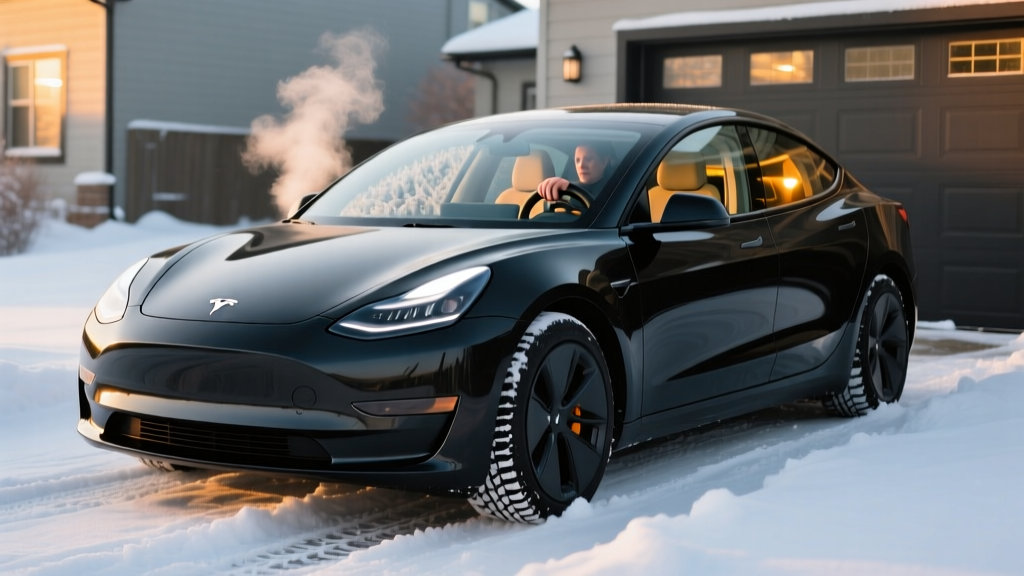
The Tesla Model 3 in Winter: What Changes When Temperatures Drop
The refreshed Tesla Model 3 (internally dubbed "Highland" and updated for the 2025–2026 model years) remains one of the most efficient electric sedans on the market. But efficiency on a sticker and efficiency on a frozen January morning in Minnesota are two different numbers. If you're researching Tesla Model 3 winter tires and cold-weather ownership, you're asking the right questions: range loss, charging speed degradation, regenerative braking limitations, and tire compound choices all shift dramatically below 40°F.
This guide covers the 2026 Tesla Model 3 lineup — Long Range AWD, Performance AWD, and the base RWD — through the specific lens of winter ownership. We'll pair EPA numbers with real-world cold-weather expectations, break down charging behavior in freezing conditions, and explain why your tire choice matters more on an EV than on a gas car.
| Spec | RWD (Base) | Long Range AWD | Performance AWD |
|---|---|---|---|
| EPA Range | 272 mi | 363 mi | 315 mi |
| Battery (usable, est.) | ~57.5 kWh (LFP) | ~75 kWh (NMC) | ~75 kWh (NMC) |
| Drivetrain | Rear-Wheel Drive | Dual-Motor AWD | Dual-Motor AWD |
| Horsepower | 271 hp | 346 hp | 510 hp |
| 0–60 mph | 5.8 sec | 4.2 sec | 2.9 sec |
| Peak DC Fast Charge | 170 kW | 250 kW | 250 kW |
| 10–80% DCFC Time | ~25 min | ~18 min | ~18 min |
| Level 2 Home Charge (11.5 kW) | ~30 mi/hr | ~44 mi/hr | ~44 mi/hr |
| MPGe (combined) | 132 MPGe | 130 MPGe | 119 MPGe |
| Efficiency (kWh/100 mi) | 25 | 26 | 28 |
| Cargo (trunk + frunk) | 23 cu ft | 23 cu ft | 23 cu ft |
| Rear Legroom | 35.2 in | 35.2 in | 35.2 in |
| Battery Warranty | 8 yr / 100,000 mi | 8 yr / 120,000 mi | 8 yr / 120,000 mi |
| Base MSRP (2026) | $38,990 | $47,740 | $52,990 |
Real-World Range: Winter vs. EPA Sticker Numbers
The EPA tests vehicles under controlled conditions that don't replicate a 15°F morning with the cabin heater blasting and winter tires adding rolling resistance. For the Model 3 Long Range AWD — the most popular trim for cold-climate buyers — the gap is meaningful.
Real-World Highway (70°F, no wind): ~300–320 miles at 75 mph
Real-World Winter Highway (20°F, cabin heat on): ~220–260 miles
Real-World Winter City (30°F, moderate heat): ~270–300 miles
Cold weather reduces range through three mechanisms: battery internal resistance increases (slowing charge acceptance and reducing usable capacity), cabin and seat heating consume 2–5 kW continuously, and winter tires add 5–8% rolling resistance compared to the factory all-season rubber. According to fueleconomy.gov, lithium-ion batteries lose roughly 10–15% of effective capacity at 20°F even before HVAC loads are factored in.
The LFP (lithium iron phosphate) battery in the RWD trim is more susceptible to cold-weather range loss than the NMC (nickel manganese cobalt) packs in the Long Range and Performance models. LFP chemistry has higher internal resistance at low temperatures, meaning you'll see a steeper range drop and slower initial charging in the base car during deep freezes. If winter commuting is your primary use case, the Long Range AWD with its NMC pack and standard heat pump is the stronger choice.
Winter Tires for the Tesla Model 3: What You Need to Know
Tesla equips the Model 3 with either all-season or summer performance tires from the factory, depending on trim and wheel option. None of these are rated for severe snow service (the Three-Peak Mountain Snowflake symbol). For anyone driving in sustained temperatures below 45°F, dedicated winter tires are not optional — they're a safety requirement.
Why Winter Tires Matter More on an EV
EVs are heavier than comparable gas cars (the Model 3 Long Range AWD weighs ~4,034 lbs), and electric motors deliver instant torque with zero ramp-up. That combination means you're asking more of your tires in every braking and acceleration event. All-season tire compounds harden significantly below 40°F, losing grip on cold dry pavement — let alone ice or packed snow.
Recommended Winter Tire Options (2026)
- Nokian Hakkapeliitta R5 EV: Purpose-built for EVs with foam-lined noise reduction, low rolling resistance, and severe snow rating. Available in 18" and 19" for Model 3. ~$260–$290/tire.
- Michelin X-Ice Snow: Strong ice braking, good wet performance, and moderate EV-friendly rolling resistance. A long-standing favorite for Model 3 owners. ~$200–$230/tire.
- Bridgestone Blizzak WS90: Excellent snow traction, slightly higher rolling resistance (expect 3–5% more range loss). Budget-friendlier at ~$170–$200/tire.
- Pirelli Cinturato Winter 2: European-market favorite now available in North America, good balance of snow grip and low noise.
Buy a dedicated set of 18" wheels (the Model 3's smallest factory-compatible size) and mount winter tires on them. Swapping complete wheel-and-tire sets is faster, avoids biannual mounting/dismounting damage, and lets you downsize from 19" or 20" wheels for a taller sidewall that handles potholes and plow ridges better. Expect to spend $1,100–$1,600 for a full winter wheel/tire setup including TPMS sensors.
Range Impact of Winter Tires
Winter tires increase rolling resistance by 5–12% depending on compound and tread depth. On the Model 3 Long Range, this translates to roughly 15–35 fewer miles of range on a full charge in mild conditions. In deep cold, combined with battery and HVAC losses, the total winter range reduction with dedicated snow tires can reach 35–40% versus the EPA sticker. Plan your trips accordingly.
Cold-Weather Charging: Speeds, Preconditioning, and Curve Behavior
A lithium-ion battery that's cold will not accept a fast charge at its peak rate. Tesla's thermal management system actively warms the pack when you navigate to a Supercharger, but preconditioning takes time and isn't always sufficient in extreme cold.
| Charging Method | Normal (60–80°F) | Cold (below 32°F, preconditioned) | Cold (no preconditioning) |
|---|---|---|---|
| Level 1 (120V / 12A) | ~3 mi/hr (1.4 kW) | ~3 mi/hr (most energy goes to battery heating) | ~1–2 mi/hr |
| Level 2 (240V / 48A) | ~44 mi/hr (11.5 kW) | ~35–40 mi/hr | ~15–25 mi/hr initially |
| DC Fast Charge (Supercharger) | Peak 250 kW, 10–80% in ~18 min | Peak ~180–220 kW, 10–80% in ~25 min | Peak ~50–90 kW initially, tapering slowly |
Always navigate to a Supercharger using the car's built-in routing — this triggers battery preconditioning, which warms the pack to approximately 95–105°F for optimal charge acceptance. Without preconditioning in sub-freezing temperatures, you may arrive at a 250 kW Supercharger and see only 50–90 kW initially, with the rate climbing slowly as the pack warms. A session that should take 18 minutes can stretch to 40+ minutes.
The charge curve also shifts in winter. At normal temperatures, the Model 3 Long Range sustains close to 250 kW from roughly 10–35% State of Charge before tapering. In deep cold, that peak window narrows and the taper begins earlier. Plan to charge to 85–90% at DC fast chargers in winter to compensate for range loss — the extra 10 minutes of charging time buys you 30–40 additional real-world miles.
Pricing, Tax Credits, and the Winter Ownership Budget
The 2026 Model 3 starts at $38,990 for the RWD and climbs to $52,990 for the Performance AWD before destination fees and options. But the out-of-pocket price depends heavily on federal tax credit eligibility under IRS §30D clean vehicle rules.
| Trim | Base MSRP | As-Tested (typical options) | Est. §30D Credit | Effective Price |
|---|---|---|---|---|
| RWD | $38,990 | $40,490 (w/ FSD transfer) | Up to $7,500* | ~$32,990 |
| Long Range AWD | $47,740 | $50,240 (w/ premium wheels) | Up to $7,500* | ~$42,740 |
| Performance AWD | $52,990 | $54,490 | Up to $7,500* | ~$46,990 |
*The §30D federal EV tax credit has strict eligibility requirements that change annually. For 2026, qualifying buyers must meet adjusted gross income caps ($150,000 single / $300,000 joint), the vehicle MSRP must not exceed $55,000 for sedans, and the battery must meet critical-mineral and battery-component sourcing thresholds set by the IRS. The credit can now be transferred to the dealer at point of sale as an instant discount. Always verify current-year rules on irs.gov and consult a tax professional before relying on credit eligibility.
Beyond the purchase price, winter ownership adds costs: a set of quality winter tires on dedicated wheels runs $1,100–$1,600, and you'll rotate between two tire sets every six months. However, the Model 3's lack of engine oil, coolant flushes, and transmission fluid offsets some of that expense over time. Tesla's battery and drive unit warranty covers 8 years/120,000 miles (Long Range and Performance) or 8 years/100,000 miles (RWD) with a 70% minimum capacity retention guarantee.
Winter Tech: Heat Pump, Regenerative Braking, and Driver Assists
The refreshed Model 3 includes a standard heat pump across all trims — a critical cold-weather feature. Unlike resistive cabin heaters that draw 4–6 kW, Tesla's heat pump moves ambient heat into the cabin at roughly 1–2 kW in moderate cold (above 10°F), cutting HVAC energy consumption by 30–50%. Below roughly 0°F, the heat pump supplements with resistive heating, and efficiency gains narrow.
Regenerative Braking in Winter
Cold batteries cannot accept the high charge rates that regenerative braking demands. In sub-freezing temperatures, the Model 3 reduces regen strength automatically to protect the battery. You'll notice this as a lighter deceleration feel when you lift off the accelerator — the car won't slow as aggressively as it does in warm weather. Tesla's software displays a dotted line on the energy bar indicating limited regen. As the battery warms through driving and preconditioning, regen gradually restores. Drivers accustomed to one-pedal driving should plan for longer braking distances during the first 10–15 minutes of a cold-weather trip.
Autopilot and FSD (Supervised) in Snow
Tesla's Autopilot and Full Self-Driving (Supervised) are SAE Level 2 driver-assistance systems — not self-driving. The driver must remain fully engaged at all times. In winter conditions, these systems face additional limitations:
- Snow, slush, and road salt can obscure cameras and degrade lane-keeping accuracy.
- Faded or snow-covered lane markings reduce Autopilot's ability to center the vehicle.
- Reduced traction means longer stopping distances — Autopilot's following distance may be insufficient on ice.
- FSD (Supervised) may disengage more frequently in winter weather and require immediate driver takeover.
- Always clear all cameras and sensors before driving. Never rely on Level 2 systems in low-visibility or icy conditions.
Standout Cold-Weather Features
- Scheduled preconditioning: Set departure times to warm the battery and cabin while plugged in — preserves range and ensures a warm car.
- Heated seats (all four) and heated steering wheel: Far more energy-efficient than cabin air heating (under 200W total vs. 2–5 kW for forced air).
- Defrost via app: Melt windshield ice and warm the cabin remotely before you walk outside.
- Traction control tuning: Tesla's dual-motor AWD system adjusts torque distribution between front and rear motors in milliseconds, providing strong traction in snow without a traditional limited-slip differential.
Who Should Buy the Model 3 for Winter Driving?
- You commute 40+ miles daily in cold climates and need buffer beyond your round-trip distance.
- You want AWD traction with NMC battery chemistry that handles cold charging better than LFP.
- You road-trip in winter and need the Supercharger network for long-distance reliability.
- Your daily winter driving is under 30 miles and you charge at home every night.
- You prioritize the lowest purchase price and can accept steeper cold-weather range loss with LFP.
- You live in a mild-winter climate (Pacific Northwest, mid-Atlantic) where deep freezes are rare.
- You want a physical instrument cluster, traditional controls, or dealer-service infrastructure in rural areas.
- You prefer a more comfortable ride over the Model 3's firm, sport-tuned suspension.
Pros and Cons: Tesla Model 3 as a Winter EV
- Class-leading efficiency (130 MPGe combined LR AWD) stretches winter range further than most competitors.
- Standard heat pump cuts cabin heating energy use by 30–50%.
- Dual-motor AWD provides excellent snow traction with instant torque vectoring.
- Extensive Supercharger network reduces winter road-trip anxiety.
- App-based preconditioning and defrost are best-in-class for daily winter use.
- Over-the-air updates continuously improve thermal management algorithms.
- Real-world winter range drops 30–40% from EPA sticker — plan trips conservatively.
- DC fast charging slows significantly in deep cold without proper preconditioning.
- Regen braking reduction in cold requires driver adaptation and longer stopping distances.
- Firm ride quality is more noticeable on frost-heaved and salt-damaged roads.
- Camera-only ADAS (no lidar/radar) is more prone to weather-related disengagements.
- Winter tire cost ($1,100–$1,600) is an ownership expense not reflected in the MSRP.
Frequently Asked Questions
What is the real-world winter range of the Tesla Model 3?
The Model 3 Long Range AWD has an EPA range of 363 miles, but in real-world winter driving at 20°F with cabin heat on, expect 220–260 miles at highway speeds and 270–300 miles in city driving. The RWD with its LFP battery loses a larger percentage of range in cold weather.
How fast does the Model 3 charge in winter?
At a 250 kW Supercharger with proper preconditioning, the Long Range AWD charges from 10–80% in approximately 25 minutes in cold weather (vs. ~18 minutes in warm weather). Without preconditioning, peak charge rates may be limited to 50–90 kW initially, stretching a session to 40+ minutes. Home Level 2 charging at 11.5 kW adds about 35–40 miles per hour in winter vs. 44 in warm conditions.
Does the Tesla Model 3 qualify for the federal EV tax credit?
The Model 3 may qualify for up to $7,500 under IRS §30D, but eligibility depends on your income (under $150K single / $300K joint for 2026), the vehicle's MSRP (sedan cap is $55,000), and battery critical-mineral and component sourcing requirements that change annually. The credit can be applied at point of sale. Verify current rules on irs.gov before purchasing.
Are winter tires necessary on a Tesla Model 3?
Yes, if you regularly drive in temperatures below 45°F or encounter snow and ice. The factory all-season tires lose significant grip in cold conditions, and the Model 3's weight (~4,000 lbs) and instant electric torque demand more from tires than a lighter gas car. Dedicated winter tires like the Nokian Hakkapeliitta R5 EV or Michelin X-Ice Snow are strongly recommended.
Is the Tesla Model 3 worth buying vs. competitors for winter driving?
The Model 3 Long Range AWD offers the best combination of efficiency, charging infrastructure access, and cold-weather software features in its price class. Competitors like the BMW i4 xDrive40 and Hyundai Ioniq 6 AWD offer more traditional controls and in some cases a smoother ride, but neither matches Tesla's Supercharger network or over-the-air thermal management improvements. If winter road trips are a priority, the Model 3's charging ecosystem remains the strongest advantage.
Does cold weather damage the Tesla Model 3 battery?
No. Tesla's battery management system actively protects the pack by limiting charge and discharge rates when the battery is cold. However, consistently charging to 100% and leaving the car unplugged in extreme cold accelerates long-term degradation. Best practice: keep the car plugged in during winter, set charge limits to 80% for daily use (or 100% for LFP trims as Tesla recommends), and use scheduled preconditioning before driving.