Tesla Model 3 Dimensions: Width, Length, and Garage Fitment
The Tesla Model 3 remains one of the best-selling electric sedans in the U.S., but buyers shopping tight urban garages or narrow parking spaces need exact dimensional data before committing. Let's address the headline question first, then move into the full performance, charging, and ownership picture that matters just as much as whether it fits between your garage walls.
| Measurement | Specification |
|---|---|
| Overall width (mirrors folded) | 72.8 in (1,849 mm) |
| Overall width (mirrors extended) | 82.2 in (2,088 mm) |
| Overall length | 184.8 in (4,694 mm) |
| Overall height | 56.8 in (1,443 mm) |
| Wheelbase | 113.2 in (2,875 mm) |
| Ground clearance | 5.5 in (140 mm) |
| Curb weight (RWD) | 3,862 lbs |
| Curb weight (Long Range AWD) | 4,034 lbs |
| Front headroom | 40.3 in |
| Rear headroom | 37.8 in |
| Front legroom | 42.7 in |
| Rear legroom | 35.2 in |
| Cargo volume (trunk) | 21.0 cu ft |
| Frunk volume | 3.1 cu ft |
Garage fitment note: At 72.8 inches wide with mirrors folded (roughly 6 feet 1 inch), the Model 3 fits standard single-car garages designed for compact-to-midsize sedans. However, the 82.2-inch span with mirrors deployed means you'll want at least 9 feet of clear interior width to open doors comfortably. For comparison, the Toyota Camry measures 72.4 inches wide — the Model 3 is barely half an inch broader despite housing a full-size battery pack.
The refreshed "Highland" body (introduced for the 2024 model year and continuing into 2025) shed the chrome trim, added a front lip spoiler, and introduced slimmer LED headlights that marginally tighten the visual profile. Dimensional changes from the pre-2024 Model 3 are negligible — length grew by roughly 1 inch, width stayed constant.
Range, Battery Chemistry, and Real-World Efficiency
The 2025 Model 3 lineup splits into three trims with distinct battery chemistries and range profiles. Understanding the LFP vs. NMC trade-off is critical to choosing the right one.
| Trim | Drivetrain | Battery Chemistry | Usable Capacity | EPA Range | MPGe (Combined) | kWh/100 mi |
|---|---|---|---|---|---|---|
| RWD (Standard Range) | Rear-Wheel Drive | LFP (CATL) | ~57.5 kWh | 272 mi | 132 MPGe | 25 |
| Long Range AWD | Dual-Motor AWD | NMC (Panasonic) | ~75 kWh | 342 mi | 131 MPGe | 26 |
| Performance AWD | Dual-Motor AWD | NMC (Panasonic) | ~75 kWh | 315 mi | 121 MPGe | 28 |
Real-World Range Reality Check
EPA sticker: 342 miles (Long Range AWD)
Expect in practice: 280–310 miles on mixed highway driving at 70–75 mph. In freezing temperatures (below 30°F), plan for 20–30% range reduction — roughly 240–270 miles from a full charge. City driving with regenerative braking can match or slightly exceed the EPA figure thanks to the Model 3's excellent efficiency and heat pump (standard on all 2025 trims).
Why the gap? EPA testing uses moderate speeds and includes city regen cycles. Sustained 75-mph highway driving, headwinds, cold-soaked batteries, and cabin heating all consume extra energy. The Model 3's ~25–26 kWh/100 mi combined rating is among the best in its class, but physics still applies.
LFP vs. NMC: Which Battery Is Right for You?
The base RWD trim uses a lithium iron phosphate (LFP) battery supplied by CATL. LFP cells are heavier and less energy-dense than NMC, which is why the RWD trim gets 70 fewer miles of range. But LFP offers two major ownership advantages:
- Cycle life: LFP cells tolerate thousands more charge cycles before meaningful degradation, making them ideal for high-mileage commuters.
- 100% daily charging: Tesla recommends charging LFP batteries to 100% regularly (even daily) to maintain cell-balancing accuracy. NMC batteries, by contrast, benefit from an 80% daily charge limit to prolong longevity.
The Long Range and Performance trims use nickel manganese cobalt (NMC) cells from Panasonic's Nevada Gigafactory lines. NMC delivers higher energy density (more range in the same physical pack) and better cold-weather performance, at the cost of a slightly shorter overall cycle life.
Charging Speed: DC Fast Charging and Home Level 2
Charging speed is often the deciding factor for road-trip-capable EVs. The refreshed Model 3 improved its DC fast-charge architecture, though it still trails the 800-volt platforms in the Hyundai Ioniq 5 and Kia EV6.
| Charging Level | Power / Rate | Speed | Notes |
|---|---|---|---|
| Level 1 (120V household) | ~1.4 kW | ~3–5 mi/hr | Emergency/trickle only |
| Level 2 (240V home, 48A) | 11.5 kW | ~37 mi/hr | Full charge overnight (~8–9 hrs for LR) |
| DC Fast Charge (peak) | 250 kW (LR/Perf), 170 kW (RWD) | 10–80% in ~25 min (LR) | Peak rate sustained to ~50% SoC, then tapers |
| Tesla Supercharger V4 | Up to 250 kW | ~170 mi in 15 min (LR) | Widest proprietary network in the U.S. |
Charging curve reality: The Long Range AWD peaks at 250 kW only at low state-of-charge (roughly 5–25% SoC). From 25–50%, expect ~175–200 kW. Above 60%, the rate drops to ~100 kW and tapers further to ~40 kW past 80%. A 10–80% session takes about 25 minutes at a V3 or V4 Supercharger. Charging from 80–100% adds another 20+ minutes — plan your stops accordingly.
NACS connector: The Model 3 uses Tesla's North American Charging Standard (NACS) port natively. As of 2025, Ford, GM, Rivian, and Volvo/Polestar have adopted NACS access to Tesla Superchargers, making the network busier at popular corridors. However, the Model 3's native integration — including automatic plug-and-charge handshake and battery preconditioning when you navigate to a Supercharger — still provides the most seamless charging experience available.
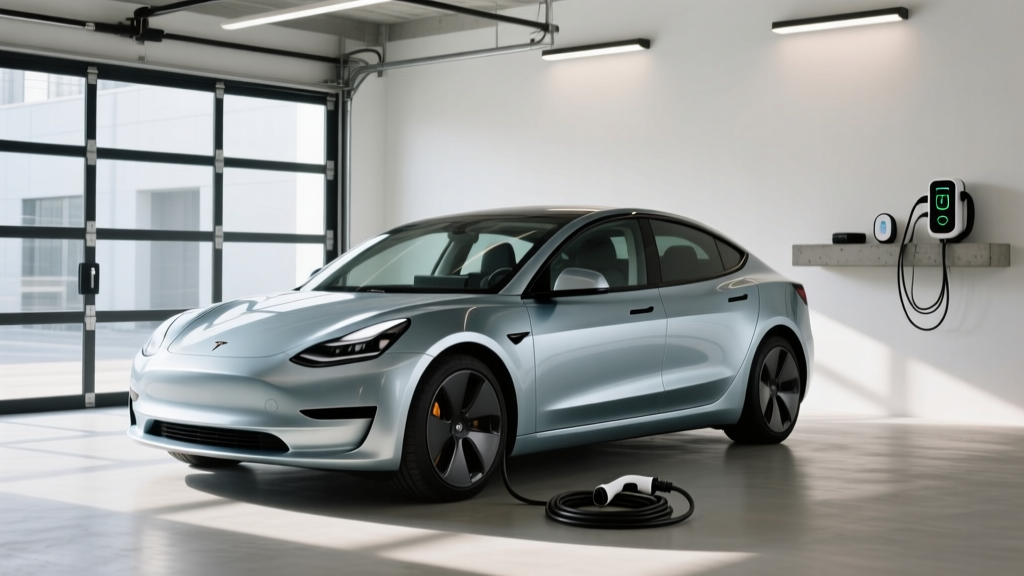
Home charging: The onboard charger accepts up to 11.5 kW (48 amps) on Level 2. Tesla's Wall Connector ($420) or any J1772-to-NACS adapter-equipped Level 2 station will deliver a full overnight charge. For a 60-amp circuit with a 48-amp continuous draw, most homes need a panel with 200-amp service. Expect a licensed electrician to quote $800–$2,000 for a standard install, or $3,000–$5,000+ if a panel upgrade is required.
Performance: 0–60, Horsepower, and Drivetrain
| Trim | Horsepower | Torque (lb-ft) | 0–60 mph | Top Speed | Drivetrain |
|---|---|---|---|---|---|
| RWD | 271 hp | 317 | 5.8 sec | 125 mph | Rear-Wheel Drive |
| Long Range AWD | 346 hp | 389 | 4.2 sec | 125 mph | Dual-Motor AWD |
| Performance AWD | 510 hp | 546 | 2.9 sec | 163 mph | Dual-Motor AWD |
The base RWD's 5.8-second 0–60 time is quicker than most gas-powered compact sedans and more than adequate for highway merging. The Long Range adds dual-motor all-wheel drive for $5,000 more — worth it for anyone dealing with snow, rain, or steep driveways. The Performance trim's 2.9-second sprint puts it in supercar territory, with track-tuned adaptive dampers, larger brakes, and a subtle rear spoiler.
The Highland refresh brought measurable ride-quality improvements: new frequency-selective dampers, added acoustic glass, and revised suspension bushings reduce road noise and harshness noticeably compared to the pre-2024 Model 3. It's still a firm-riding sedan, but no longer punishing on broken pavement.
Pricing, Tax Credits, and Total Cost of Ownership
| Trim | Base MSRP | Destination | Federal Credit (§30D) | Effective Price (if eligible) |
|---|---|---|---|---|
| RWD | $38,990 | $1,390 | Up to $7,500 | ~$32,880 |
| Long Range AWD | $44,990 | $1,390 | Up to $7,500 | ~$38,880 |
| Performance AWD | $52,990 | $$1,390 | Up to $7,500 | ~$46,880 |
Federal Tax Credit Eligibility (§30D) — Key Rules for 2025
- MSRP cap: Sedans must have an MSRP at or below $55,000. The RWD and Long Range qualify; the Performance trim at $52,990 + $1,390 destination = $54,380 also clears the cap, but adding certain premium packages could push it over.
- Income cap: Adjusted gross income must not exceed $150,000 (single), $225,000 (head of household), or $300,000 (married filing jointly).
- Battery sourcing: The full $7,500 requires both critical-mineral and battery-component sourcing thresholds. As of 2025, the Model 3 Long Range (Panasonic cells built in Nevada) has historically qualified for the full credit, while the RWD's CATL-sourced LFP cells face tighter foreign-entity-of-concern (FEOC) restrictions that may reduce or eliminate the credit. Verify current eligibility on IRS.gov or via Tesla's checkout page before ordering.
- Point-of-sale transfer: As of 2024, buyers can transfer the credit to the dealer at purchase, reducing the upfront price rather than waiting for a tax refund. Tesla supports this at checkout.
5-year ownership economics: The Model 3 Long Range, driven 12,000 miles/year at $0.14/kWh (national average for home charging), costs roughly $500/year in electricity. A comparable BMW 330i at 28 MPG combined and $3.50/gallon costs ~$1,500/year in fuel. Over five years, that's a ~$5,000 fuel savings. Factor in zero oil changes, reduced brake wear from regen, and the total-cost advantage widens — though insurance premiums for the Model 3 tend to run 15–25% higher than gas equivalents.
Tech, Driver Assistance, and Interior
The Model 3 interior is famously minimalist — a single 15.4-inch center touchscreen handles everything from climate control to glovebox release. The Highland refresh added an 8-inch rear touchscreen for passengers, ventilated front seats, ambient lighting, and power-folding mirrors.
Autopilot and FSD (Supervised)
SAE Level 2 — Driver Assistance, NOT Self-Driving
Tesla's Autopilot (standard) and Full Self-Driving Supervised ($8,000 option or $99/month) are SAE Level 2 systems. The driver must remain fully attentive, keep hands on the wheel, and be prepared to take over at any moment. FSD Supervised can navigate highway interchanges, handle traffic lights, and manage city streets, but it requires constant supervision and makes errors. It is not autonomous driving. Only Level 4 services like Waymo operate without a human driver.
The Model 3 uses Tesla's vision-only approach (no LiDAR or radar) with eight cameras and the HW4.0 processor. Safety ratings remain strong: the Model 3 earned a 5-star overall rating from NHTSA and Top Safety Pick+ from IIHS when equipped with acceptable headlights.
Notable Drawbacks
- No physical stalks: The Highland refresh moved turn signals to steering-wheel buttons and gear selection to the touchscreen. This is the most polarizing change and takes genuine adaptation.
- Minimalist controls: Adjusting mirrors, opening the glovebox, and changing vent direction all require screen taps — frustrating while driving.
- Low ground clearance: At 5.5 inches, steep driveways and speed bumps demand caution. No air suspension option is available.
- Rear-seat space: 35.2 inches of rear legroom is tight for taller passengers. The Hyundai Ioniq 6 offers 37.4 inches by comparison.
How the Model 3 Compares to Key Competitors
Pros
- Best-in-class efficiency (25–26 kWh/100 mi)
- Access to the Tesla Supercharger network (17,000+ U.S. stalls)
- Strong resale value relative to EV segment average
- Over-the-air updates continuously add features
- Excellent safety ratings (NHTSA 5-star, IIHS TSP+)
- Heat pump standard — better cold-weather range retention
Cons
- Stalkless steering wheel requires adaptation
- FSD is expensive and still requires full driver attention
- Rear seat is tighter than some competitors
- Insurance costs above segment average
- RWD LFP battery may face reduced federal tax credit
- Firm ride compared to luxury-oriented rivals
Model 3 vs. Hyundai Ioniq 6 vs. BMW i4
The Hyundai Ioniq 6 (800V architecture, 360-mile range, ~$42,000) charges faster — 10–80% in 18 minutes at a 350 kW charger — and offers a more conventional interior with physical buttons. Its trade-off is access to a less reliable public charging ecosystem (CCS via Electrify America) unless you use a NACS adapter.
The BMW i4 eDrive40 (~$57,000) delivers a more premium cabin, superior ride comfort, and 307 miles of range. It costs significantly more and charges at a lower 205 kW peak, but appeals to buyers who prioritize build quality and dealership service.
The Model 3 wins on efficiency, Supercharger network access, and value after tax credits. It loses on interior material quality (vs. BMW) and peak charging speed (vs. Hyundai).
Who the Tesla Model 3 Suits Best
Choose the Model 3 RWD if: You commute under 40 miles daily, can charge at home, live in a mild climate, and want the lowest entry price. LFP's tolerance for daily 100% charging makes it ideal for predictable routines.
Choose the Model 3 Long Range AWD if: You take regular road trips, live in a cold-weather state, need all-wheel drive, or simply want the maximum range buffer. This is the sweet-spot trim for most buyers.
Choose the Model 3 Performance if: You want sports-car acceleration, track capability, and don't mind sacrificing ~27 miles of range and paying above the tax-credit MSRP cap threshold (depending on options).
Look elsewhere if: You need a spacious rear seat for car seats or tall adults (consider the Model Y or Ioniq 5), you refuse to adapt to a stalkless steering wheel, or you require the fastest possible DC charging (Ioniq 6 or EV6).
Warranty Coverage
| Component | Coverage |
|---|---|
| Basic vehicle | 4 years / 50,000 miles |
| Battery & drive unit (RWD) | 8 years / 100,000 miles |
| Battery & drive unit (Long Range / Performance) | 8 years / 120,000 miles |
| Battery capacity retention | Minimum 70% over warranty period |
Tesla's battery warranty guarantees the pack will retain at least 70% of its original capacity over the coverage period. Real-world data from high-mileage owners suggests NMC packs degrade roughly 10–12% over the first 100,000 miles, with degradation slowing significantly afterward. LFP packs show similar or slightly better longevity but less long-term public data.
Frequently Asked Questions
What is the real-world range of the Tesla Model 3?
The EPA rates the Long Range AWD at 342 miles. In real-world highway driving at 70–75 mph, expect 280–310 miles. In freezing temperatures, plan for 240–270 miles. The RWD trim delivers roughly 220–250 real-world highway miles from its 272-mile EPA rating.
How fast does the Model 3 charge at home and on the road?
At home on a 240V Level 2 charger (48A), the Model 3 adds about 37 miles of range per hour, fully charging overnight in 8–9 hours. On a Tesla Supercharger, the Long Range peaks at 250 kW and charges from 10–80% in approximately 25 minutes. The RWD peaks at 170 kW.
How much does the Model 3 cost after the federal tax credit?
If you qualify for the full $7,500 §30D credit and choose the Long Range AWD ($44,990 MSRP + $1,390 destination), your effective price drops to roughly $38,880. Eligibility depends on income caps, battery sourcing rules, and MSRP limits — always verify on IRS.gov before ordering.
Does the Tesla Model 3 qualify for the federal EV tax credit?
The Long Range AWD has historically qualified for the full $7,500 credit due to its U.S.-assembled Panasonic battery. The RWD's CATL LFP battery faces FEOC sourcing restrictions that may reduce or eliminate the credit as of 2025. Check Tesla's checkout page and the IRS qualified vehicle list for the most current status.
Is the Tesla Model 3 worth buying over the competition?
The Model 3 remains the efficiency and charging-network leader in the electric sedan segment. If Supercharger access, software integration, and low running costs are your priorities, it's difficult to beat. If you prefer a more conventional interior, faster peak charging, or a roomier back seat, the Hyundai Ioniq 6 or BMW i4 are strong alternatives.
How wide is the Tesla Model 3 — will it fit in a standard garage?
The Tesla Model 3 is 72.8 inches wide with mirrors folded and 82.2 inches with mirrors extended. It fits standard single-car garages, but you'll want at least 9 feet of interior width for comfortable door opening. It's comparable in width to a Toyota Camry (72.4 in).