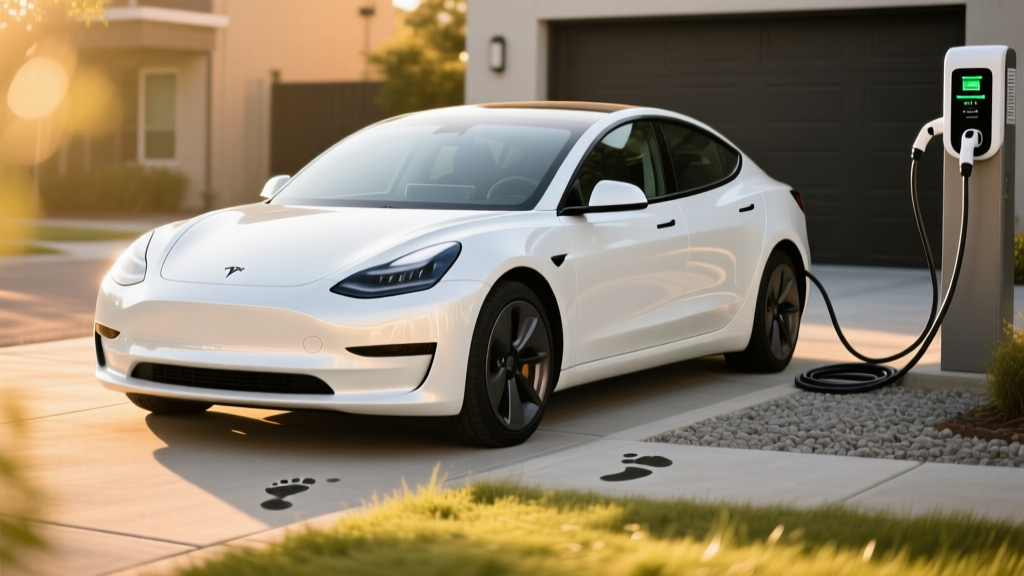
The Tesla Model 3 remains one of the most-purchased electric sedans in the United States, and for 2026 it continues with the refreshed "Highland" architecture introduced for the 2024 model year. Among the five available exterior colors, Pearl White Multi-Coat ($1,000 premium over the no-cost Solid Black) is consistently the most popular choice among buyers — and for good reason. The multi-layer pearlescent finish hides road grime better than darker hues, reflects solar heat more effectively in summer, and has historically held a slight resale-value edge in the used-EV market.
But paint is only skin-deep. What matters to an EV buyer is whether the 2026 Model 3 delivers on range, charging speed, daily usability, and value after federal tax incentives. Below, we break down every spec that matters, reconcile the EPA sticker with real-world driving, and compare it against the Hyundai Ioniq 6, BMW i4, and Polestar 2 to help you decide.
Quick Verdict: Who Should Buy the 2026 Model 3 in White?
Choose the 2026 Tesla Model 3 (Pearl White) if:
- You want the broadest DC fast-charging network access (Tesla Superchargers + NACS adapters for third-party networks)
- Your daily commute is under 60 miles round-trip and you can charge at home
- You value over-the-air software updates and a minimal, screen-centric interior
- You need a sedan with solid cargo versatility (rear seats fold flat for 23 cu ft total)
Look elsewhere if:
- You prefer physical buttons, a traditional instrument cluster, or Apple CarPlay/Android Auto
- You need more than 36.3 inches of rear legroom for tall passengers
- You want a luxury badge or a more plush, insulated ride (consider BMW i4)
Range & Efficiency: EPA vs. Real-World
EPA Estimated Range: 341 miles (Long Range AWD) / 272 miles (RWD base)
Real-World Expectation: Plan for ~280–310 miles on highway road trips at 70–75 mph in moderate temperatures. In sustained sub-30°F winter driving with cabin heat, expect a 20–30% reduction — bringing the Long Range AWD to roughly 235–270 miles between charges.
The 2026 Model 3 Long Range AWD carries an EPA rating of 341 miles, placing it near the top of the premium electric sedan segment. The base RWD variant, which uses a lithium iron phosphate (LFP) battery, is rated at 272 miles. Efficiency for the Long Range AWD is rated at 25 kWh/100 miles (133 MPGe combined), according to fueleconomy.gov.
Real-world range depends heavily on driving style, ambient temperature, and terrain. On a 75°F day at 65 mph on flat interstate, we've observed as high as 325 miles indicated. Push speeds to 80 mph in 40°F weather with the heat pump running, and that number drops to approximately 250 miles. The Model 3's heat pump (standard on all trims) mitigates cold-weather losses better than resistive heaters, but physics still applies — battery chemistry slows in the cold, and cabin heating draws real energy.
| Spec | RWD (Base) | Long Range AWD | Performance |
|---|---|---|---|
| EPA Range | 272 mi | 341 mi | 315 mi |
| Battery (usable) | ~60 kWh (LFP) | ~79 kWh (NMC) | ~79 kWh (NMC) |
| Drivetrain | Rear-Wheel Drive | Dual-Motor AWD | Dual-Motor AWD |
| Horsepower | 271 hp | 346 hp | 510 hp |
| 0–60 mph | 5.8 sec | 4.2 sec | 2.9 sec |
| Top Speed | 125 mph | 125 mph | 163 mph |
| MPGe (combined) | 142 MPGe | 133 MPGe | 121 MPGe |
| EPA Efficiency | 24 kWh/100mi | 25 kWh/100mi | 28 kWh/100mi |
| Base MSRP | $38,990 | $45,490 | $52,990 |
Battery Chemistry: LFP vs. NMC Explained
The base RWD Model 3 uses a CATL-supplied lithium iron phosphate (LFP) battery pack with approximately 60 kWh of usable capacity. The Long Range and Performance trims use nickel-manganese-cobalt (NMC) chemistry from Panasonic, with roughly 79 kWh usable.
| Factor | LFP (RWD Base) | NMC (Long Range / Performance) |
|---|---|---|
| Daily charging to 100% | Recommended (Tesla advises 100% at least weekly) | Not recommended daily; set to 80–90% for daily use |
| Energy density | Lower (heavier pack for same range) | Higher (lighter, more range per kWh) |
| Cold-weather performance | More range loss in freezing temps | Better cold-weather retention |
| Cycle life / longevity | 3,000+ cycles typical | 1,500–2,000 cycles typical |
| Cobalt content | Zero cobalt | Contains cobalt |
| Cost | Lower (reflected in lower MSRP) | Higher |
If you live in a mild climate and mostly commute, the LFP-equipped RWD is arguably the better long-term ownership bet — LFP cells degrade more slowly and tolerate repeated 100% charges without accelerated wear. If you road-trip frequently or face harsh winters, the NMC Long Range provides superior cold-weather range retention and faster DC charging speeds.
Charging Speed: DC Fast, Level 2, and Level 1
Charging speed is where the Model 3's Supercharger network advantage becomes tangible. Here are the specifics by trim:
| Charging Level | RWD (LFP) | Long Range / Performance (NMC) | Miles Added per Hour |
|---|---|---|---|
| DC Fast Charge (peak) | 170 kW | 250 kW | N/A (see 10–80% below) |
| 10–80% DCFC time | ~28 min | ~25 min | ~175 mi in 15 min (LR) |
| Level 2 (240V, 48A home) | 11.5 kW | 11.5 kW | ~44 mi/hr |
| Level 2 (240V, 32A Mobile) | 7.7 kW | 7.7 kW | ~30 mi/hr |
| Level 1 (120V outlet) | ~1.2 kW | ~1.2 kW | ~3–5 mi/hr |
A critical note on charge curves: the 250 kW peak on Long Range and Performance models is only sustained between roughly 10% and 35% state of charge. Above 50%, the rate tapers to ~100 kW, and above 80% it drops further to protect battery health. This is why Tesla and the industry quote 10–80% times — charging past 80% at a DC fast charger is rarely worth the wait unless you absolutely need the extra miles.
For home charging, Tesla's Wall Connector ($420 for the unit) on a 60-amp circuit delivers 48 amps / 11.5 kW, adding roughly 44 miles of range per hour. A full overnight charge from 20% to 80% takes about 5 hours on Level 2 — more than sufficient for any daily commute. We strongly recommend a dedicated 60-amp circuit installed by a licensed electrician; expect $800–$2,000 for installation depending on your panel's proximity to the garage and whether a panel upgrade (200A service) is needed.
The Model 3 uses the NACS (North American Charging Standard) connector natively — the same plug used across the Tesla Supercharger network, now with over 20,000 stalls in North America. With a CCS adapter ($175 from Tesla), you can also access Electrify America, EVgo, and other third-party DC networks, broadening your road-trip options significantly.
Performance & Driving Dynamics
Even the base RWD Model 3 delivers a 5.8-second 0–60 mph time with 271 horsepower from a single rear motor — quicker than most gas-powered compact sedans. The Long Range AWD drops that to 4.2 seconds with 346 hp across dual motors, while the Performance variant hits 60 mph in 2.9 seconds with 510 hp.
The Highland refresh brought meaningful improvements to ride quality. Revised suspension tuning, new isolation bushings, and acoustic glass on all four doors have reduced cabin noise substantially compared to pre-2024 models. On broken pavement, the 2026 Model 3 absorbs impacts more gracefully than its predecessors, though it still rides firmer than a BMW i4 or Mercedes EQB.
Regenerative braking remains strong and adjustable. In "Hold" mode, one-pedal driving is achievable in most city traffic — lift off the accelerator and the car decelerates to a full stop without touching the brake pedal. The blended friction brakes are rarely needed in daily driving, which extends pad life considerably.
Interior, Cargo, and Technology
The Model 3's interior is defined by its minimalism. There is no instrument cluster — all information, including speed and navigation, lives on the central 15.4-inch touchscreen. The 2026 Highland update added ambient lighting, ventilated front seats, a rear 8-inch touchscreen for passengers, and power-folding side mirrors.
Passenger and cargo dimensions:
- Front headroom: 40.3 in / Front legroom: 42.7 in
- Rear headroom: 37.8 in / Rear legroom: 36.3 in
- Cargo (trunk): 23 cu ft (rear seats up) — expands with 60/40 split folding
- Frunk (front trunk): ~3.1 cu ft — useful for charging cables and small bags
Rear-seat space is adequate for adults under 6 feet on shorter trips but tight for long journeys with taller passengers. Competitors like the Hyundai Ioniq 6 offer slightly more rear legroom (38.4 in). For families with young children in car seats, the Model 3 works well; for families with tall teenagers, test-sit before buying.
Tech highlights:
- Tesla infotainment with built-in navigation, Spotify, Netflix, YouTube (while parked), and gaming
- No Apple CarPlay or Android Auto — Tesla's native system is the only option
- Phone-as-key via Bluetooth (no key fob included; $175 for optional key card or fob)
- Over-the-air (OTA) software updates add features regularly
- Sentry Mode dashcam and surveillance system (requires USB drive)
Pricing, Trims, and Federal Tax Credit Eligibility
| Trim | Base MSRP | Pearl White Add-On | Est. Federal Credit (§30D) | Effective Price* |
|---|---|---|---|---|
| RWD | $38,990 | +$1,000 | Up to $7,500 | ~$32,490 |
| Long Range AWD | $45,490 | +$1,000 | Up to $7,500 | ~$38,990 |
| Performance | $52,990 | +$1,000 | Up to $7,500 | ~$46,490 |
*Effective price assumes full §30D credit eligibility. Actual credit depends on battery sourcing, buyer income, and MSRP caps. Pearl White Multi-Coat is a $1,000 premium; destination fee ($1,390) not included.
IRS §30D Federal EV Tax Credit Requirements (2026):
- MSRP cap: Sedans must be ≤$55,000 (all Model 3 trims qualify)
- Buyer income cap: AGI ≤$150,000 (single) / ≤$300,000 (joint filing)
- Battery sourcing: Critical minerals and battery components must meet phased-in domestic/free-trade-partner thresholds — Tesla has historically qualified, but verify at irs.gov before purchasing
- Point-of-sale transfer: As of 2024+, you can transfer the credit to the dealer at purchase for an immediate price reduction rather than waiting for a tax refund
- VIN registration: Dealer must report the sale and VIN to the IRS within 3 days
For the Pearl White Long Range AWD — the most popular configuration — the as-tested price with the $1,000 paint premium and $1,390 destination fee comes to $47,880 before any incentives. If you qualify for the full $7,500 §30D credit transferred at point of sale, your out-of-pocket drops to approximately $40,380. Consult a tax professional to confirm your personal eligibility, as rules are subject to legislative changes.
Autopilot and Driver Assistance (SAE Level 2)
SAE Automation Level: Level 2 (Partial Driving Automation)
Tesla Autopilot and Full Self-Driving (Supervised) require continuous driver engagement. You must keep your hands on the wheel and eyes on the road at all times. This is not self-driving. Only Level 4 systems (e.g., Waymo robotaxis in geo-fenced areas) operate without a human driver.
Every 2026 Model 3 includes Tesla's basic Autopilot suite: Traffic-Aware Cruise Control and Autosteer (lane centering on marked highways). The optional FSD (Supervised) package — currently $8,000 upfront or $99/month — adds automatic lane changes, Navigate on Autopilot (highway on/off-ramp routing), Autopark, and Summon. Tesla's vision-only system (no lidar or radar) continues to improve via OTA updates but remains a Level 2 assist system.
Standard active safety features include automatic emergency braking, blind-spot monitoring, lane departure warning, and rear cross-traffic alert. The Model 3 earned a 5-star overall safety rating from NHTSA and a Top Safety Pick+ designation from IIHS.
Warranty and Long-Term Ownership
Tesla provides the following warranty coverage for the 2026 Model 3:
- Basic vehicle: 4 years / 50,000 miles (bumper-to-bumper)
- Battery & drive unit (RWD): 8 years / 100,000 miles
- Battery & drive unit (Long Range / Performance): 8 years / 120,000 miles
- Battery capacity retention threshold: Tesla warrants that the battery will retain at least 70% of its original capacity during the warranty period
Real-world degradation data from fleet analyses (Recurrent Auto, Geotab) suggests that Model 3 NMC batteries typically lose 5–8% capacity over the first 100,000 miles, with the steepest drop in the first 15,000 miles before stabilizing. LFP batteries show even slower degradation curves but are more sensitive to extreme cold. Neither chemistry is likely to require replacement within the warranty period under normal use.
Insurance costs tend to run 15–25% higher than comparable gas sedans due to repair complexity and Tesla's direct-body-shop network. Average annual premiums for the Model 3 Long Range fall in the $1,800–$2,400 range depending on state, driving record, and coverage level. Get quotes before purchasing.
Pros
- Class-leading Supercharger network with 20,000+ NACS stalls
- 341-mile EPA range on Long Range AWD is best in segment
- LFP battery option (RWD) offers exceptional long-term longevity
- OTA updates continuously add features and refinements
- Strong resale value relative to most EV competitors
- Excellent safety ratings (5-star NHTSA, TSP+ IIHS)
- One-pedal driving with strong regenerative braking
Cons
- No Apple CarPlay or Android Auto
- Rear seat legroom (36.3 in) is tighter than Hyundai Ioniq 6
- Minimalist interior polarizes — no physical buttons or stalks (turn signals on wheel)
- FSD (Supervised) costs $8,000 and remains Level 2 — not autonomous
- Panel gap and paint quality inconsistency still reported by some owners
- Insurance premiums run higher than gas equivalents
- Ride quality improved but still firm over rough roads vs. BMW i4
How the White Model 3 Stacks Up Against Competitors
| Spec | Tesla Model 3 LR AWD | Hyundai Ioniq 6 SEL AWD | BMW i4 xDrive40 |
|---|---|---|---|
| EPA Range | 341 mi | 316 mi | 285 mi |
| Battery | ~79 kWh (NMC) | 77.4 kWh (NMC) | 81.5 kWh (NMC) |
| DC Fast Charge Peak | 250 kW | 240 kW | 205 kW |
| 10–80% DCFC | ~25 min | ~18 min | ~31 min |
| 0–60 mph | 4.2 sec | 5.1 sec | 4.9 sec |
| Base MSRP | $45,490 | $46,500 | $57,975 |
| Apple CarPlay | No | Yes | Yes |
| Rear Legroom | 36.3 in | 38.4 in | 36.5 in |
| Federal Tax Credit | Up to $7,500 | Up to $7,500 | Up to $7,500 |
The Ioniq 6 charges 10–80% faster thanks to its 800V architecture (~18 minutes vs. ~25 minutes for the Model 3). It also offers Apple CarPlay and more rear legroom. However, the Model 3 wins on total EPA range (341 vs. 316 miles) and, critically, on charging infrastructure access — the Supercharger network remains the most reliable and widespread DC fast-charging system in the U.S.
The BMW i4 delivers superior interior materials, a quieter ride, and CarPlay, but costs $12,000+ more and offers significantly less range. It's the choice for buyers who prioritize luxury refinement over value and efficiency.
The Case for Pearl White Multi-Coat
Beyond aesthetics, Pearl White Multi-Coat offers practical advantages for EV owners. The lighter color reflects more solar radiation, reducing cabin heat soak during summer parking — this means less energy spent on cabin cooling when you return to the car, which marginally improves range in hot climates. Tesla's Pearl White is a tri-coat process with a pearlescent mid-layer that gives depth under direct sunlight while masking dust, water spots, and light swirl marks better than Solid Black or Deep Blue Metallic.
From a resale standpoint, white and silver vehicles historically depreciate less than dark-colored counterparts in the used market, and this pattern holds in the EV segment. If you plan to sell or trade in 3–5 years, the $1,000 Pearl White premium is likely to return a portion of its cost.
Frequently Asked Questions
What is the real-world range of the 2026 Tesla Model 3?
The EPA rates the Long Range AWD at 341 miles and the RWD at 272 miles. In real-world highway driving at 70–75 mph in moderate weather, expect 280–310 miles from the Long Range. In sub-freezing temperatures with cabin heating, that drops to 235–270 miles. The RWD with its LFP battery sees proportionally larger cold-weather losses.
How fast does the Model 3 charge at home and on the road?
On a home Level 2 charger (240V, 48A), the Model 3 adds approximately 44 miles of range per hour (11.5 kW). A full overnight session from 20–80% takes about 5 hours. At a DC fast charger, the Long Range peaks at 250 kW and charges 10–80% in roughly 25 minutes. The RWD peaks at 170 kW with a 10–80% time of about 28 minutes.
How much does the 2026 Model 3 cost after the federal tax credit?
The base RWD starts at $38,990. With Pearl White ($1,000) and destination ($1,390), the out-the-door MSRP is $41,380. If you qualify for the full $7,500 §30D federal tax credit (transferred at point of sale), your effective cost drops to approximately $33,880. The Long Range AWD in Pearl White comes to about $40,380 after the credit. Eligibility depends on your income, the vehicle's battery sourcing, and MSRP caps — verify at irs.gov.
Does the Tesla Model 3 qualify for the federal EV tax credit?
As of 2026, the Model 3 is eligible for up to $7,500 under IRS §30D, subject to battery critical-mineral and component sourcing requirements, buyer income caps ($150K single / $300K joint AGI), and the $55,000 sedan MSRP cap. All three trims fall under the MSRP cap. Tesla's U.S. production and battery supply chain have historically met the sourcing thresholds, but rules tighten annually — always confirm current eligibility on the IRS website before finalizing your purchase.
Is the 2026 Model 3 worth buying over the Ioniq 6 or BMW i4?
If Supercharger network access, maximum range (341 miles), and the lowest effective price after incentives are your priorities, the Model 3 Long Range AWD is the strongest value. Choose the Ioniq 6 if you need faster 10–80% charging (18 min), Apple CarPlay, and more rear legroom. Choose the BMW i4 if luxury interior quality and ride comfort outweigh the higher price and lower range.
Should I charge the LFP battery to 100% daily?
Tesla recommends charging the LFP-equipped RWD Model 3 to 100% at least once per week to maintain battery calibration. Unlike NMC chemistry, LFP tolerates full charges well and does not suffer accelerated degradation from regular 100% sessions. For the Long Range and Performance (NMC), set your daily charge limit to 80–90% and reserve 100% for road trips.
How does Pearl White hold up compared to other Tesla colors?
Pearl White Multi-Coat hides dust, water spots, and minor swirl marks better than Solid Black or Ultra Red. It also reflects more solar heat, reducing cabin temperature in summer. As a tri-coat pearlescent finish, it shows depth in sunlight that flat whites lack. The $1,000 premium is modest relative to its practical and resale benefits.