The Tesla Model 3 remains one of the most popular electric sedans on the road, but buyers shopping for daily practicality often ask one specific question: how much can the Tesla Model 3 trunk size actually hold? The answer matters more than you'd think for a compact EV sedan, especially when competing against hatchback rivals with more versatile cargo layouts. This review covers the Model 3's cargo dimensions in detail, along with every spec you need — range, charging, pricing, and tax credit eligibility — to decide if it's the right EV for your garage.
Tesla Model 3 Trunk Size and Cargo Capacity Breakdown
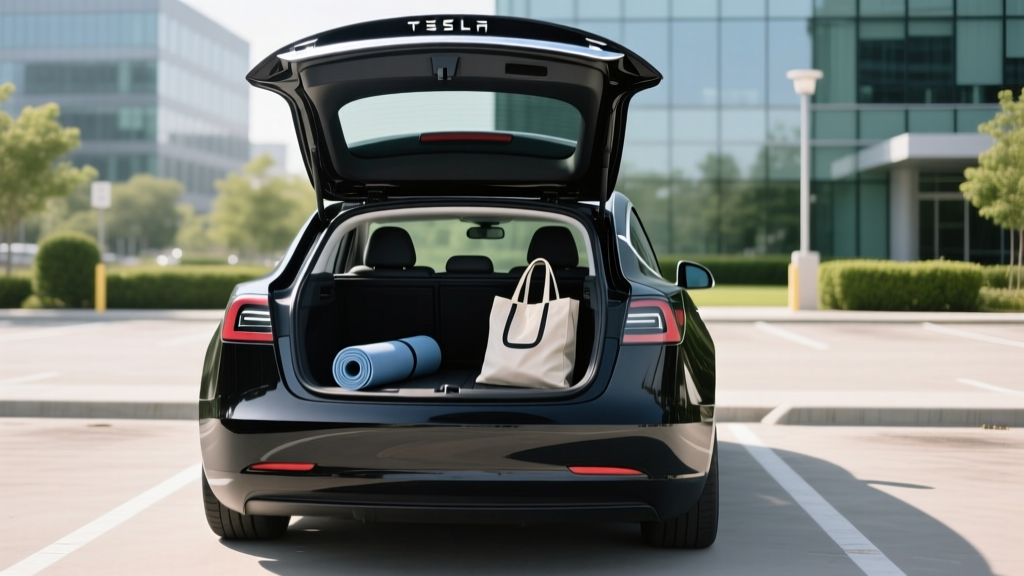
The 2026 Tesla Model 3 provides 23 cubic feet of total cargo volume when you combine the rear trunk and the front trunk (frunk). Here's how that space breaks down:
- Rear trunk: ~19.5 cu ft — a deep, wide well with a powered liftgate on all trims
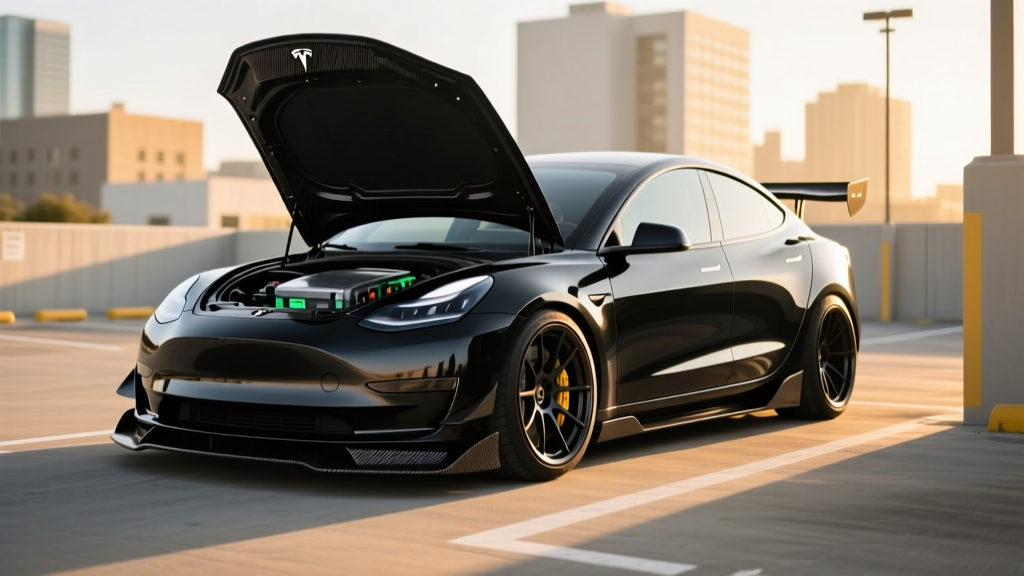
- Front trunk (frunk): ~3.1 cu ft — useful for charging cables, a laptop bag, or groceries
- Max cargo with rear seats folded: The rear seats split 60/40 and fold nearly flat, extending usable length for items like skis, flat-pack furniture, or bicycle wheels (with the front wheel removed)
Compared to the Hyundai Ioniq 6 (12.3 cu ft trunk) or the BMW i4 (16.6 cu ft), the Model 3's trunk is genuinely generous for a sedan. The deep under-floor storage bin in the rear adds another layer of organization for smaller items. However, because this is a sedan and not a hatchback or liftback, the trunk opening is narrower than what you'd find on the Model Y or a Polestar 2. Large boxes or dog crates require careful maneuvering through the opening.
Interior passenger space measures 40.3 inches of front legroom and 34.9 inches of rear legroom. The rear seat is best suited for two adults; a third middle passenger will find the narrow floor and firm cushion less comfortable on longer trips.
Range, Battery, and Real-World Efficiency
The 2026 Model 3 is offered with two primary battery and drivetrain configurations. The base Rear-Wheel Drive uses a lithium iron phosphate (LFP) battery, while the Long Range AWD and Performance trims use nickel-manganese-cobalt (NMC) chemistry for higher energy density.
| Trim | Battery (usable kWh) | Chemistry | EPA Range | MPGe (combined) | kWh/100 mi |
|---|---|---|---|---|---|
| RWD | 60 kWh | LFP | 272 mi | 132 MPGe | 25 |
| Long Range AWD | 79 kWh | NMC | 363 mi | 132 MPGe | 25 |
| Performance AWD | 79 kWh | NMC | 315 mi | 119 MPGe | 28 |
The LFP battery in the RWD trim is a deliberate trade-off: lower energy density means less range, but LFP chemistry tolerates frequent 100% charging without accelerating degradation. Tesla recommends charging LFP packs to 100% at least once weekly for accurate state-of-charge calibration. NMC packs in the Long Range and Performance trims are best kept between 20–80% for daily use, reserving 100% for road trips.
Charging Speed: DC Fast Charging and Home Level 2
Charging speed is where the refreshed Model 3 continues to leverage Tesla's Supercharger network advantage, though the peak kW numbers require some context about real-world charge curves.
| Charging Level | Max Rate | Speed / Time |
|---|---|---|
| Level 1 (120V household) | ~1.4 kW | ~3–4 miles per hour |
| Level 2 (240V home / destination) | 11.5 kW (48A onboard) | ~37–44 miles per hour; full charge in ~8–9 hours |
| DC Fast Charge (Supercharger V3/V4) | Peak 250 kW (RWD) / 250 kW (LR) | 10–80% in ~25 min (RWD) / ~30 min (LR AWD) |
A critical nuance: the peak 250 kW rate is not sustained throughout the session. The Model 3's charge curve tapers significantly above 50–60% state of charge. On a V3 Supercharger, you'll see 250 kW only in the low SoC window (roughly 5–30%), then the rate steps down to ~150 kW, then ~100 kW, and finally ~40–50 kW as you approach 80%. This is why Tesla quotes 10–80% times rather than 0–100% — the final 20% can take as long as the first 70%.
For home charging, the 11.5 kW onboard charger is competitive. A full overnight charge from 20% to 80% takes roughly 5 hours on a properly installed 60-amp circuit (Wall Connector or equivalent). If your home electrical panel only supports a 40-amp circuit, you'll see ~9.6 kW and roughly 30 miles of range per hour — still adequate for most daily commuting needs. Always consult a licensed electrician to assess your panel capacity before installation.
The Model 3 now ships with the NACS (North American Charging Standard) connector natively. This gives direct access to the entire Supercharger network without adapters. For Electrify America or other CCS-based networks, you'll need Tesla's CCS adapter (sold separately, ~$175), though most Tesla owners rarely leave the Supercharger ecosystem.
Performance and Drivetrain
Even the base Model 3 RWD delivers brisk acceleration that outpaces most gas-powered compact sedans. The dual-motor AWD variants push into sports-car territory.
- RWD: 283 hp, 0–60 mph in 5.8 seconds, single rear motor
- Long Range AWD: 384 hp combined, 0–60 mph in 4.2 seconds, dual motor
- Performance AWD: 510 hp combined, 0–60 mph in 2.9 seconds, dual motor with track-tuned suspension
All trims feature regenerative braking with adjustable intensity. The "High" regen setting enables near one-pedal driving in city traffic, reducing brake wear significantly. The Performance trim adds adaptive dampers, larger brakes, and a track mode that adjusts torque distribution and cooling for sustained high-speed driving.
Pricing, Trims, and Federal Tax Credit Eligibility
| Trim | Base MSRP | Est. After §30D Credit* |
|---|---|---|
| RWD | $38,990 | ~$31,490 |
| Long Range AWD | $45,740 | ~$38,240 |
| Performance AWD | $52,990 | ~$45,490 |
*Federal tax credit estimates assume full eligibility. Actual credit depends on IRS §30D requirements.
The IRS §30D clean vehicle credit offers up to $7,500 for qualifying new EVs, but eligibility is not automatic. Here's what determines whether you qualify:
- MSRP cap: Sedans must be priced at or below $55,000. The RWD and Long Range trims qualify; the Performance trim at $52,990 also clears the cap, but adding options like FSD or premium wheels can push it over.
- Buyer income limits: Modified adjusted gross income must not exceed $150,000 (single), $225,000 (head of household), or $300,000 (joint filers).
- Battery sourcing: The credit splits into two halves — $3,750 for critical-mineral sourcing and $3,750 for battery-component manufacturing. Tesla's supply chain has progressively met these thresholds, but the exact credit amount can vary by production batch and model year. Always verify current eligibility on the IRS source page or with a tax professional.
- Point-of-sale transfer: As of 2024, you can transfer the credit to the dealer at purchase, reducing your out-of-pocket cost immediately rather than waiting for a tax refund. Tesla supports this at checkout.
Technology, Driver Assistance, and Interior
The Model 3's interior is minimalist by design — a 15.4-inch center touchscreen handles virtually all vehicle controls, navigation, media, and climate. There is no traditional instrument cluster; speed and range info appear in the upper-left corner of the main display. The 2026 refresh added ventilated front seats, ambient lighting, rear-seat ventilation controls on a small secondary screen, and improved sound insulation that noticeably reduces road noise compared to pre-2024 models.
Autopilot comes standard on all trims and includes adaptive cruise control, lane-centering, automatic emergency braking, and blind-spot monitoring. This is an SAE Level 2 driver-assistance system — you must keep your hands on the wheel and eyes on the road at all times. It does not drive itself.
Notable drawbacks include the lack of physical buttons for common functions (glove box, mirror adjustment, and wiper settings are all buried in touchscreen menus), limited rear-seat headroom for taller passengers, and no Apple CarPlay or Android Auto integration — Tesla relies entirely on its proprietary software ecosystem.
Warranty and Long-Term Ownership
Tesla's warranty coverage is structured around the high-voltage battery and drive unit:
- Battery warranty: 8 years / 100,000 miles (RWD) or 8 years / 120,000 miles (Long Range / Performance), whichever comes first, with a minimum 70% capacity retention threshold
- Drive unit warranty: Matches battery warranty terms
- Vehicle limited warranty: 4 years / 50,000 miles (bumper to bumper)
Real-world battery degradation data from fleet studies suggests Model 3 NMC packs lose approximately 5–8% capacity over the first 100,000 miles, with degradation slowing significantly after the initial break-in period. LFP packs tend to degrade even more slowly but can show state-of-charge calibration drift if never charged to 100%.
Insurance costs tend to run 15–25% higher than comparable gas sedans due to repair complexity and Tesla's proprietary parts ecosystem. Get a quote before purchasing — premiums vary significantly by state, driving record, and trim level.
Who the Tesla Model 3 Suits Best
Look elsewhere if: You regularly carry more than two rear passengers, need hatchback-style cargo access for bulky items (consider the Model Y or Hyundai Ioniq 5), prefer physical controls, or live in an area with limited Supercharger coverage and rely on third-party DC fast-charging networks.
Frequently Asked Questions
What is the real-world range of the Tesla Model 3?
The EPA rates the Long Range AWD at 363 miles, but expect 290–310 miles on highway road trips at 75+ mph, and roughly 250–275 miles in freezing weather. The RWD model's 272-mile EPA rating translates to approximately 220–240 miles in real-world highway driving.
How fast does the Model 3 charge at home and on the road?
On a Level 2 home charger (11.5 kW), you'll add roughly 37–44 miles of range per hour, fully recharging overnight. On a V3 Supercharger, 10–80% takes about 25–30 minutes depending on trim, though the charge curve tapers significantly above 60% state of charge.
How much does the Model 3 cost after the federal tax credit?
If you qualify for the full $7,500 §30D credit, the RWD drops to approximately $31,490 and the Long Range AWD to ~$38,240. Eligibility depends on your income, the vehicle's MSRP staying under $55,000, and battery-sourcing requirements. Verify details at IRS.gov or with a tax professional.
Does the Tesla Model 3 qualify for the federal EV tax credit?
As of 2026, the RWD and Long Range trims generally qualify for up to $7,500 under §30D, provided the buyer meets income caps and the vehicle's battery sourcing meets critical-mineral and component-manufacturing thresholds. The Performance trim's eligibility depends on final optioned MSRP remaining under $55,000. Rules change periodically — always check current IRS guidance.
Is the Tesla Model 3 worth buying over competitors?
The Model 3's strongest advantages are its Supercharger network access, efficiency (25 kWh/100 mi is among the best in class), and over-the-air software updates. Competitors like the Hyundai Ioniq 6 offer comparable range but lack NACS access without adapters. The BMW i4 provides a more traditional luxury interior but at a significantly higher price. If charging infrastructure access and proven efficiency are your priorities, the Model 3 remains hard to beat in its segment.
What are the biggest pros and cons of the Model 3?
Pros: Class-leading Supercharger network, excellent efficiency, strong acceleration across all trims, competitive trunk space for a sedan, LFP battery option for daily 100% charging, and continuous OTA improvements.
Cons: Touchscreen-only controls require menu diving, no Apple CarPlay/Android Auto, rear seat is tight for three adults, sedan trunk opening limits bulky-item loading, higher insurance costs, and FSD remains a Level 2 system despite its name and price.