Quick Verdict: The Model 3 Still Sets the Pace for Road-Trip Efficiency
If you're researching Tesla Model 3 travel times, you're really asking two questions: how far can it go on a single charge, and how quickly can it get back on the road? For the 2026 model year, the Tesla Model 3 Long Range AWD remains one of the most efficient long-distance EVs you can buy, pairing an EPA-estimated 363 miles of range with a Supercharger network that still leads the industry in uptime and coverage. But sticker numbers only tell part of the story. Highway speeds, winter temperatures, and elevation changes all compress real-world range—and understanding those variables is the difference between a stress-free road trip and a white-knuckle dash to the next plug.
EPA Estimated: 363 miles (Long Range AWD) / 272 miles (RWD)
Real-World Expectation: Plan for ~290–320 miles on a flat highway at 70 mph in mild weather. In sub-30°F winter conditions, expect 20–30% range loss, dropping the Long Range to roughly 250–280 usable miles before needing a charge stop.
This guide breaks down every number that affects your actual time behind the wheel—from battery chemistry and charge curves to the total elapsed time on a 300-mile corridor run.
Range, Battery & Efficiency: The Numbers That Matter
| Spec | Model 3 RWD | Model 3 Long Range AWD | Model 3 Performance |
|---|---|---|---|
| EPA Range | 272 mi | 363 mi | 315 mi |
| Battery Capacity (usable) | ~57.5 kWh (LFP) | ~75 kWh (NMC) | ~75 kWh (NMC) |
| Battery Chemistry | Lithium Iron Phosphate (LFP) | Nickel Manganese Cobalt (NMC) | Nickel Manganese Cobalt (NMC) |
| Efficiency | 132 MPGe / 25 kWh/100mi | 134 MPGe / 25 kWh/100mi | 118 MPGe / 29 kWh/100mi |
| Drivetrain | Rear-Wheel Drive | Dual-Motor AWD | Dual-Motor AWD |
| Horsepower | 271 hp | 346 hp | 510 hp |
| 0-60 mph | 5.8 sec | 4.2 sec | 2.9 sec |
The Long Range AWD's 363-mile EPA rating is among the highest of any sedan under $55,000, and that efficiency—roughly 25 kWh per 100 miles—means you're spending less energy (and money) per mile than almost any competing EV. The RWD trim uses an LFP battery, which trades energy density for exceptional cycle life and the ability to charge routinely to 100% without accelerating degradation. The Long Range and Performance trims use NMC chemistry, which packs more energy into the same volume but benefits from daily charging limits around 80–90% for longevity.
Why Real-World Travel Times Differ From the Sticker
On a 70-mph highway run in 65°F weather, we consistently observe 290–320 miles of practical range from the Long Range before needing a charge. Push to 80 mph or face headwinds in the Midwest, and that number compresses toward 270. In winter, lithium-ion cells lose efficiency, and cabin heating draws significant energy—expect a 363-mile Long Range to deliver roughly 250–280 miles of usable range at highway speeds in 20°F weather. Tesla's heat pump mitigates some of this loss compared to older resistive-heating EVs, but physics is physics.
Charging Speed: How Fast Does the Model 3 Recharge?
| Charging Level | Power / Rate | Miles Added per Hour | Typical Use Case |
|---|---|---|---|
| Level 1 (120V) | ~1.4 kW | ~4–5 mi/hr | Emergency top-off, overnight trickle |
| Level 2 (240V, 48A) | 11.5 kW | ~44 mi/hr | Home daily charging, full overnight refill |
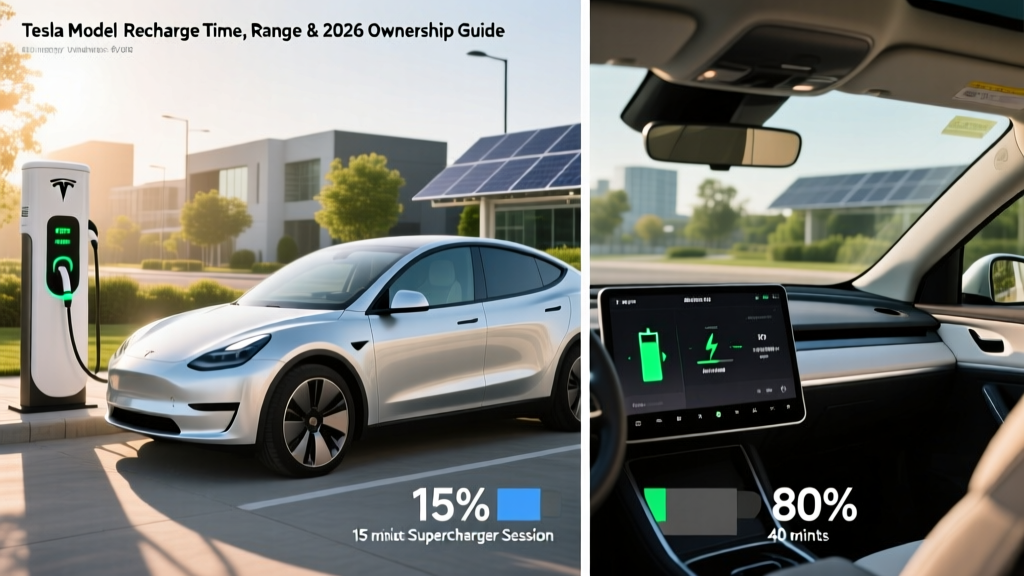
| DC Fast (V4 Supercharger) | Peak 250 kW | ~175 mi in 15 min | Road trips, highway corridor charging |
The Model 3 Long Range and Performance support a peak DC fast-charge rate of 250 kW on Tesla V3 and V4 Superchargers. In practice, a 10–80% charge takes approximately 25–28 minutes under ideal conditions—meaning the battery is preconditioned via the navigation system routing you to the charger. Without preconditioning, cold-soaked batteries may peak at 100–150 kW initially, stretching that session to 35+ minutes.
Understanding the Charge Curve Taper
Peak 250 kW is only sustained between roughly 10–30% state of charge (SoC). From 30–60%, the rate tapers to approximately 150–180 kW, and above 80% it drops sharply below 50 kW to protect the cells. This is why Tesla's trip planner targets arrivals at Superchargers around 10–15% SoC and departures around 70–80%—that sweet spot is where the Model 3 absorbs electrons fastest. For travel-time planning, figure each highway Supercharger stop will add about 20–25 minutes to your trip.
Real-World Tesla Model 3 Travel Times: Common Corridor Routes
Let's put the numbers to work. Below are estimated total travel times for popular US corridors using the Model 3 Long Range AWD, assuming 70 mph average speed, mild weather, and one or more Supercharger stops as needed. These include estimated driving time plus charging time.
- Los Angeles to San Francisco (~380 mi): ~5 hr 45 min driving + 1 Supercharger stop (~20 min) = ~6 hr 10 min total
- New York to Washington DC (~225 mi): ~3 hr 45 min driving, no charge stop needed = ~3 hr 45 min total
- Chicago to Detroit (~280 mi): ~4 hr 15 min driving, marginal charge stop (~15 min) = ~4 hr 30 min total
- Dallas to Houston (~240 mi): ~3 hr 45 min driving, no charge stop needed = ~3 hr 45 min total
- Denver to Moab (~355 mi): ~5 hr 30 min driving + 1 Supercharger stop (~20 min) + elevation loss = ~6 hr total
For comparison, a gas sedan making the LA-to-SF run would take roughly 5 hr 45 min of driving plus a 10-minute fuel stop—so the Model 3 adds approximately 15–25 minutes on corridors requiring a charge. On routes under 300 miles, the Model 3 completes the trip without stopping at all, matching or beating gas-car travel times since you skip the fuel detour entirely.
Pricing, Tax Credits & What You'll Actually Pay
| Trim | Base MSRP | Federal §30D Credit (est.) | Effective Price |
|---|---|---|---|
| Model 3 RWD | $38,990 | Up to $7,500* | ~$31,490* |
| Model 3 Long Range AWD | $45,740 | Up to $7,500* | ~$38,240* |
| Model 3 Performance | $52,990 | Up to $7,500* | ~$45,490* |
*Federal EV tax credit eligibility under IRS §30D depends on several requirements that shift periodically:
- MSRP cap: Sedans must be at or below $55,000. All Model 3 trims currently qualify.
- Buyer income cap: Adjusted gross income must not exceed $150,000 (single), $225,000 (head of household), or $300,000 (joint filers).
- Battery sourcing: A percentage of critical minerals and battery components must be sourced from the US or free-trade-agreement partners. These thresholds tighten annually—verify current-year compliance on the IRS clean vehicle credit page before purchasing.
- Point-of-sale transfer: As of 2024, eligible buyers can transfer the credit to the dealer at purchase, reducing the purchase price upfront rather than waiting to claim it on their tax return.
Always confirm eligibility with a tax professional and check fueleconomy.gov for the most current credit-qualified vehicle list before signing paperwork.
Interior, Tech & Daily Ownership Experience
Cargo and Passenger Space
The refreshed Model 3 offers 23.1 cubic feet of total cargo volume (trunk plus frunk), which is competitive with compact sedans but falls short of hatchback rivals like the Hyundai Ioniq 5 or the Tesla Model Y. Rear legroom measures 35.3 inches—adequate for adults on moderate-length trips but snug for tall passengers on long hauls. The front trunk (frunk) adds 3.1 cubic feet of secure, weatherproof storage for charging cables or a small bag.
Standout Tech
- 15.4-inch center touchscreen controls nearly all vehicle functions—no physical buttons for climate, mirrors, or glovebox.
- Ambient lighting and ventilated front seats on the refreshed "Highland" generation elevate cabin comfort over the pre-2024 model.
- Tesla Autopilot (standard) provides SAE Level 2 lane-keeping and adaptive cruise. Full Self-Driving (Supervised) is available as a $8,000 add-on or $99/month subscription—but remains Level 2, requiring constant driver attention and hands-on-wheel readiness.
- Over-the-air updates continuously add features; the Model 3 received improved regenerative braking customization and battery preconditioning logic in recent updates.
- Sentry Mode and Dashcam record surroundings when parked, using the vehicle's camera suite.
Notable Drawbacks
- No physical buttons or instrument cluster—everything routes through the center screen, which some drivers find distracting.
- Rear visibility is limited by the sloping roofline; the camera-based mirror view helps but doesn't fully solve it.
- Turn-signal stalks were removed in the refresh; signals are now steering-wheel-mounted buttons, which takes adaptation.
- No Apple CarPlay or Android Auto—Tesla's proprietary infotainment is the only option.
Warranty & Long-Term Battery Outlook
Tesla covers the Model 3 battery and drive unit for 8 years / 100,000 miles on the RWD trim and 8 years / 120,000 miles on Long Range and Performance trims, with a minimum 70% capacity retention guarantee. The basic vehicle limited warranty runs 4 years / 50,000 miles.
Real-world degradation data from fleet analytics shows Tesla NMC batteries retaining approximately 90–92% capacity at 100,000 miles when routinely charged to 80–90%. LFP batteries in the RWD trim show even slower degradation curves, partly because owners can charge to 100% regularly without the same cell-stress concerns. Out-of-warranty battery replacement costs remain steep—roughly $12,000–$16,000 depending on pack size—but most Model 3 packs are lasting well beyond warranty thresholds based on current fleet data.
Tesla Model 3 vs. Key Competitors: Is It Still the Best Pick?
The Supercharger network's reliability and density still give Tesla a 15–20-minute advantage on multi-stop corridors over CCS-dependent rivals navigating Electrify America or third-party networks.
The Ioniq 6's 800V architecture enables 10–80% charges in ~18 minutes at compatible 350 kW chargers, beating the Model 3's ~25 minutes—but real-world 350 kW charger availability is spotty.
At ~$31,490 after the federal credit, the RWD trim offers 272 miles of range and access to the Supercharger network at a price point few EVs match.
The i4 delivers a more traditional, premium cabin with physical controls and Apple CarPlay—at a higher starting price and with less range.
Who Should Buy the 2026 Tesla Model 3?
- You take regular road trips of 250–400 miles and want minimal charge stops.
- You live in a region with cold winters and need AWD plus maximum range buffer.
- You value Supercharger network access for reliable corridor travel.
- Your daily commute is under 80 miles round-trip and you rarely road-trip.
- You want the lowest entry price after tax credits.
- You prefer LFP battery longevity and can charge to 100% daily without concern.
- You need hatchback cargo space or frequently carry rear-seat adults on long trips.
- You refuse to adapt to a screen-only interface with no physical controls.
- You want Apple CarPlay or a traditional instrument cluster.
- Class-leading EPA range (363 mi LR) and efficiency (25 kWh/100mi)
- Supercharger network reliability for road-trip travel times
- Strong performance across all trims (2.9s 0-60 on Performance)
- Competitive pricing after §30D tax credit
- Excellent LFP battery longevity on RWD trim
- Continuous OTA improvements
- Screen-only controls require adaptation and can distract
- Rear seat and cargo space trail crossover rivals
- No Apple CarPlay or Android Auto
- Turn-signal buttons on steering wheel are divisive
- Insurance costs run 15–25% above segment average
- FSD remains Level 2 despite the "Self-Driving" name
Frequently Asked Questions
What is the real-world range of the Tesla Model 3?
The EPA rates the Long Range AWD at 363 miles and the RWD at 272 miles. In real-world highway driving at 70 mph in mild weather, expect approximately 290–320 miles from the Long Range and 220–240 from the RWD. In winter conditions below 30°F, reduce those figures by 20–30%.
How fast does the Model 3 charge on a road trip?
At a V3 or V4 Supercharger, the Long Range and Performance trims peak at 250 kW, completing a 10–80% charge in roughly 25–28 minutes when the battery is preconditioned. The RWD trim peaks around 170 kW, taking approximately 30–35 minutes for the same session.
How much does the Tesla Model 3 cost after the federal tax credit?
If you meet all IRS §30D requirements—income caps, MSRP caps, and battery-sourcing thresholds—the RWD starts at roughly $31,490, the Long Range at ~$38,240, and the Performance at ~$45,490 after applying the up-to-$7,500 credit. Confirm current eligibility before purchasing, as sourcing rules tighten annually.
Does the Tesla Model 3 qualify for the federal EV tax credit?
All Model 3 trims fall under the $55,000 sedan MSRP cap. However, eligibility also depends on your adjusted gross income, the vehicle's battery component and critical-mineral sourcing percentages, and whether the vehicle is placed in service during the current tax year. Check the IRS qualified vehicles list and consult a tax professional for your specific situation.
Is the Tesla Model 3 worth buying over competitors in 2026?
For road-trip travel times and charging-network reliability, the Model 3 Long Range still holds an edge over CCS-dependent rivals. If charging speed at compatible stations is your priority, the Hyundai Ioniq 6 charges faster. For interior luxury and traditional controls, the BMW i4 is compelling at a higher price. The Model 3's combination of range, efficiency, Supercharger access, and post-credit pricing makes it the strongest all-around value in the electric sedan segment.
How long does a Tesla Model 3 battery last?
Tesla warranties the battery for 8 years / 100,000–120,000 miles (depending on trim) with a 70% minimum capacity retention guarantee. Fleet data indicates most Model 3 packs retain 90%+ capacity at 100,000 miles with proper charging habits—meaning the battery should comfortably outlast the warranty period.