Tesla Model 3 Towing Capacity: The Quick Answer
If you've searched for the Tesla Model 3 towing capacity, you've likely hit a wall of conflicting information. Here's the definitive breakdown for the 2026 model year:
- US market: The Tesla Model 3 is not officially rated for towing by Tesla in the United States. The owner's manual does not provide a tow rating, and Tesla does not sell a factory tow hitch for the US-spec Model 3.
- European and Australian markets: The Model 3 is rated to tow up to 1,000 kg (2,204 lbs) with a braked trailer, and Tesla sells an OEM tow hitch accessory in those regions.
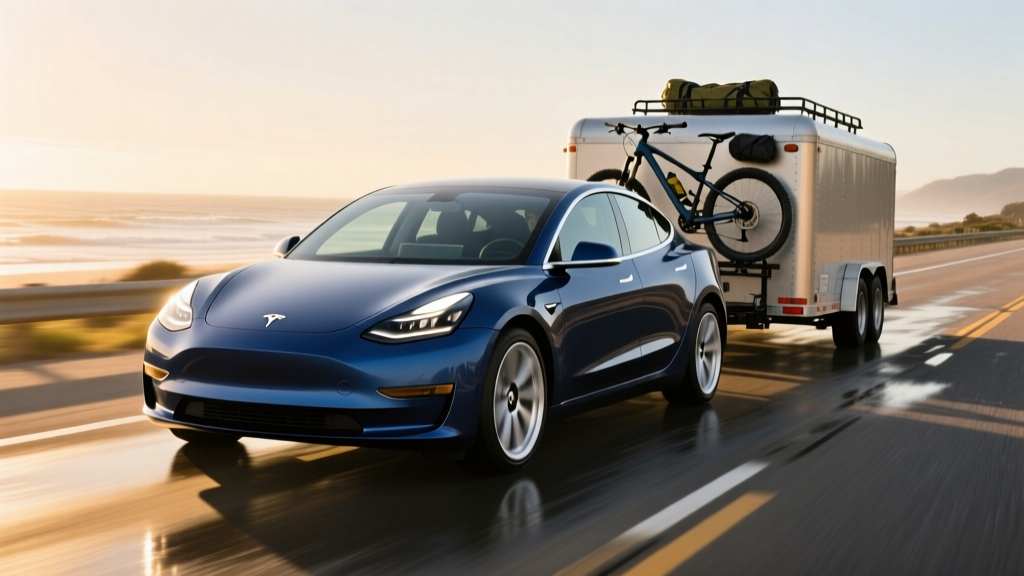
- Aftermarket (US): Several third-party hitches (e.g., Curt, EcoHitch) are rated for up to 2,000 lbs gross trailer weight on the Model 3, but using one is at the owner's risk — Tesla does not endorse or warrant towing in the US.
2026 Tesla Model 3 Full Spec Table
Before we dig into the towing implications, here are the complete 2026 Model 3 specs across all three trims currently available:
| Spec | Standard Range (RWD) | Long Range AWD | Performance AWD |
|---|---|---|---|
| EPA Range | 272 mi | 341 mi | 315 mi |
| Battery Capacity (usable) | ~57.5 kWh | ~75 kWh | ~75 kWh |
| Battery Chemistry | LFP (Lithium Iron Phosphate) | NMC (Nickel Manganese Cobalt) | NMC |
| Horsepower | 271 hp | 346 hp | 510 hp |
| 0-60 mph | 5.8 sec | 4.2 sec | 2.9 sec |
| Drivetrain | RWD (single motor) | AWD (dual motor) | AWD (dual motor) |
| Max DC Fast Charge | 170 kW | 250 kW | 250 kW |
| 10-80% DCFC Time | ~25 min | ~22 min | ~22 min |
| Level 2 Home Charge (11.5 kW) | ~44 mi/hr | ~44 mi/hr | ~44 mi/hr |
| MPGe (combined) | 142 MPGe | 132 MPGe | 122 MPGe |
| kWh/100 mi | 24 kWh/100mi | 25 kWh/100mi | 28 kWh/100mi |
| Cargo (trunk + frunk) | 23 cu ft + 3.1 cu ft | 23 cu ft + 3.1 cu ft | 23 cu ft + 3.1 cu ft |
| Rear Legroom | 35.2 inches | ||
| Base MSRP (2026) | $38,990 | $44,990 | $52,990 |
| Battery Warranty | 8 years / 120,000 miles (70% min retention) | ||
Source: fueleconomy.gov and Tesla Model 3 specs. Prices before destination fees.
Real-World Range: What the EPA Sticker Doesn't Tell You
The Standard Range RWD's LFP battery has a different discharge curve — it holds voltage more steadily but drops off sharply near the bottom. Tesla recommends charging LFP batteries to 100% regularly (unlike NMC, which prefers an 80% daily limit). This effectively gives you the full 272 miles as a usable daily range, which partially offsets the smaller battery.
If you're towing — even informally with an aftermarket hitch — expect range to plummet. Real-world towing tests by European owners (where the Model 3 is rated for towing) show 40-50% range reduction when pulling a braked trailer near the 1,000 kg limit. That turns the Long Range's 341-mile sticker into roughly 170-200 miles between charges with a trailer in tow. For a lightweight bike rack or small utility trailer under 800 lbs, the penalty is closer to 20-30%.
Charging Speed: DC Fast, Level 2, and the Curve Reality
| Charging Level | Power (kW) | Speed (miles of range added/hr) | Notes |
|---|---|---|---|
| Level 1 (120V household) | ~1.4 kW | ~3-5 mi/hr | Emergency/trickle only |
| Level 2 (240V, 48A) | 11.5 kW | ~44 mi/hr | Full charge in ~7-8 hrs (Long Range) |
| DC Fast Charge (Long Range/Performance) | Peak 250 kW | Up to ~1,000 mi/hr at peak | 10-80% in ~22 min; tapers hard above 80% |
| DC Fast Charge (Standard Range RWD) | Peak 170 kW | Up to ~700 mi/hr at peak | 10-80% in ~25 min; LFC chemistry charges more linearly |
A critical nuance: the 250 kW peak on Long Range and Performance trims is not sustained. The charge curve peaks near 15-20% State of Charge (SoC) and begins tapering around 50-55%. From 80-100%, you're looking at another 25-30 minutes — which is why Tesla's Supercharger navigation typically routes you to arrive at 10% and leave at 80%.
The Standard Range's LFP battery charges more slowly at peak (170 kW) but maintains a flatter curve through a wider SoC window. In practice, the 10-80% time difference between trims is smaller than the peak kW numbers suggest.
For home charging, a 240V / 48A Level 2 wall connector on a 60A circuit is the practical sweet spot. Expect to pay $800-$1,800 for professional installation depending on your panel capacity and run distance. If your home has a 100A main panel, you may need a $1,500-$3,000 panel upgrade to support a 60A dedicated circuit — get a quote from a licensed electrician before committing.
Why the Model 3 Is a Poor Towing Choice (and What to Buy Instead)
Even setting aside the lack of a US tow rating, the Model 3's physics work against towing:
- Sedan ground clearance: At 5.5 inches, the Model 3 sits low. Hitching a trailer risks scraping the rear diffuser on inclines and driveways.
- Weight distribution: Towing shifts load rearward. The Model 3's rear axle on the RWD trim carries less static weight than a crossover, reducing stability margin.
- Range penalty: As noted, even a modest 1,000-lb trailer can cut range by 30-40%. On a 272-mile Standard Range car, that means ~160-190 miles — problematic for any road trip.
- Regen braking with a trailer: Aggressive regenerative braking can destabilize a trailer. You'd need to reduce regen settings, further eroding efficiency.
- Warranty risk: Tesla can deny powertrain or battery warranty claims if damage is traced to towing in an unsupported market.
Better alternatives if towing matters:
| Vehicle | US Tow Rating | EPA Range | Base MSRP (2026) |
|---|---|---|---|
| Tesla Model Y Long Range AWD | 3,500 lbs | 320 mi | $44,990 |
| Ford Mustang Mach-E (w/ tow pkg) | 1,500 lbs | 312 mi (Ext Range) | $42,995 |
| Hyundai Ioniq 5 AWD | 2,300 lbs | 290 mi | $46,700 |
| Kia EV6 AWD | 2,700 lbs | 282 mi | $45,900 |
| Rivian R1S Dual-Motor | 7,700 lbs | 352 mi (Max Pack) | $79,900 |
The Model Y is the clear step-up within the Tesla ecosystem — it shares much of the Model 3's platform and efficiency but adds the ride height, structural reinforcement, and factory tow hitch needed for legitimate towing duty.
2026 Pricing, Trims, and Federal Tax Credit Eligibility
| Trim | Base MSRP | Est. As-Tested (common options) | §30D Credit Eligible? | Effective Price After Credit |
|---|---|---|---|---|
| Standard Range RWD | $38,990 | $39,990 (w/ paint + wheels) | Yes — if income & sourcing qualify | ~$31,490 |
| Long Range AWD | $44,990 | $46,990 | Yes — under $55K sedan cap | ~$37,490 |
| Performance AWD | $52,990 | $54,490 | Yes — under $55K sedan cap | ~$45,490 |
- MSRP cap: Sedans must be ≤ $55,000 (all Model 3 trims qualify).
- Buyer income cap: AGI ≤ $150,000 (single), $225,000 (head of household), $300,000 (joint).
- Battery sourcing: Critical minerals and battery components must meet escalating domestic/free-trade-agreement percentages. Tesla's US-built batteries generally satisfy current thresholds, but verify at purchase — rules tighten annually.
- Manufacturer: Tesla has cleared the old 200,000-unit cap phase-out; all current models are eligible if other criteria are met.
Who Should Buy the 2026 Tesla Model 3 (and Who Shouldn't)
The Model 3 is ideal for:
- Efficiency-focused commuters: The Standard Range RWD at 142 MPGe and ~$31,500 after the tax credit is one of the cheapest ways into a new EV in 2026.
- Tech-forward drivers: Tesla's infotainment, Supercharger network access, and Autopilot (Level 2 driver assist — not self-driving) remain class-leading in usability.
- Solo or two-person households: Rear seat space is adequate but not generous (35.2" legroom). The 23 cu ft trunk plus 3.1 cu ft frunk handles groceries and carry-ons, not furniture.
Skip the Model 3 if:
- You need to tow anything beyond a bike rack. Look at the Model Y or a crossover-class EV.
- You regularly carry adults in the rear seat — headroom and legroom are tight for passengers over 6 feet.
- You live in a charging desert without home charging access. The Model 3's efficiency helps, but public charging dependency is stressful with a smaller battery.
Pros, Cons, and the Verdict
Pros
- Best-in-class efficiency (142 MPGe on Standard Range)
- Supercharger network reliability
- 250 kW DC fast charging on Long Range/Performance
- LFP battery on Standard Range allows 100% daily charging
- Over-the-air updates keep the car current
- Strong safety ratings (IIHS Top Safety Pick+)
Cons
- No official US tow rating — aftermarket only, at owner's risk
- Rear seat space is tight vs. crossovers
- No physical stalks or buttons — everything through the touchscreen
- Ride quality firm on 19" wheels
- Insurance premiums 15-25% above segment average
- FSD (Supervised) remains Level 2 — requires full driver attention
Verdict: The 2026 Tesla Model 3 is a benchmark EV sedan for efficiency, tech, and charging infrastructure. But if you arrived here searching for "Tesla 3 towing capacity," the honest answer is that this car wasn't designed for towing in the US market. You can bolt on an aftermarket hitch for a bike rack or lightweight trailer, but you're operating outside Tesla's warranty and engineering intent. If towing is non-negotiable, redirect your budget to the Model Y Long Range AWD — same DNA, legitimate 3,500-lb rating.
Frequently Asked Questions
Can I install an aftermarket tow hitch on my US-spec Tesla Model 3?
Yes, physically you can. Companies like Curt and EcoHitch sell hitches rated for up to 2,000 lbs that bolt onto the Model 3's rear subframe. However, Tesla does not approve towing in the US, and any drivetrain or structural damage traced to towing may void your warranty. Use one only for light-duty loads like bike racks or small cargo trailers.
How much range do I lose when towing with the Model 3?
Based on European owner data (where towing is factory-supported at 1,000 kg / 2,204 lbs), expect a 40-50% range reduction at maximum trailer weight. For a lightweight trailer under 800 lbs, the penalty is typically 20-30%. The Long Range AWD's 341-mile EPA range would realistically drop to 170-200 miles with a heavy trailer.
Does the Tesla Model 3 qualify for the $7,500 federal tax credit in 2026?
All three trims fall under the $55,000 MSRP cap for sedans. Eligibility depends on your adjusted gross income (≤$150K single / $300K joint) and whether the battery meets current critical-mineral and component sourcing thresholds. Tesla's US-built LFP and NMC batteries generally qualify, but confirm at the point of sale. The credit can be transferred to the dealer for an immediate price reduction under current IRS rules.
What's the real-world range of the Model 3 Long Range AWD?
EPA-rated at 341 miles. Expect 280-310 miles in mixed highway driving at 70-75 mph, and 230-260 miles in sustained sub-30°F cold. The heat pump mitigates but doesn't eliminate cold-weather losses. City driving with regenerative braking can actually exceed the EPA estimate in mild weather.
Is the Model 3 worth buying over the Model Y if I don't need to tow?
If you don't need towing, cargo space, or the higher seating position, the Model 3 Standard Range RWD is the better value. It's cheaper ($38,990 vs. $44,990 for the Model Y), more efficient (142 vs. ~128 MPGe), and lighter. The Model Y makes sense when you need hatchback cargo volume, a tow rating, or frequently carry rear-seat passengers.
How fast does the Model 3 charge at home on Level 2?
On a 240V / 48A Level 2 Wall Connector (11.5 kW), all 2026 Model 3 trims add approximately 44 miles of range per hour. A full 0-100% charge on the Long Range takes roughly 7-8 hours. Most owners charge overnight and wake up to a full battery — the practical equivalent of "filling up at home."