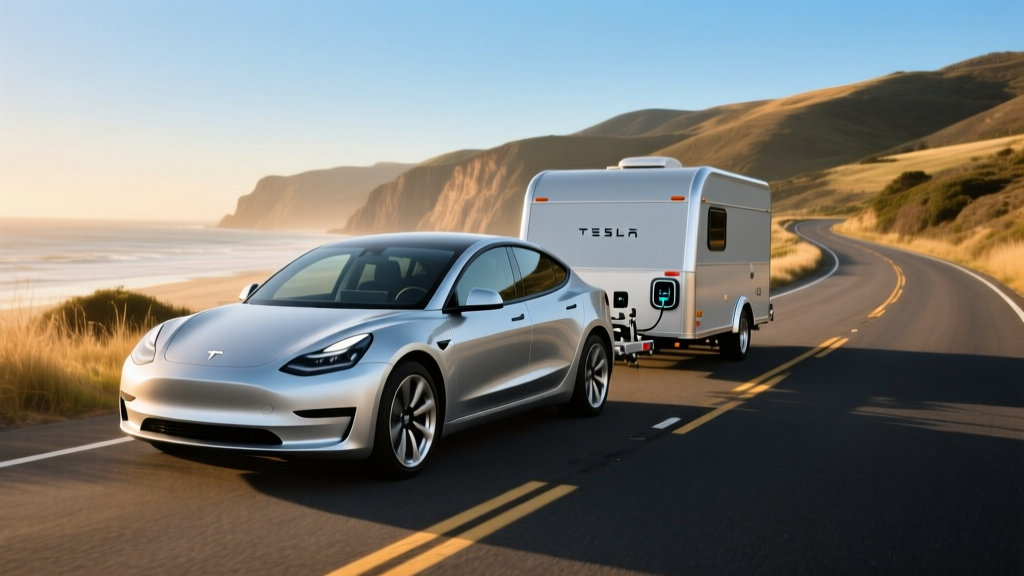
If you've searched for "Tesla Model 3 tow package" hoping to turn your electric sedan into a weekend warrior, you'll find a mix of enthusiasm and confusion online. The reality of towing with a Model 3 in 2026 is more nuanced than a simple yes-or-no answer. Tesla does not offer a factory tow package for the US-market Model 3, yet the vehicle's engineering has evolved enough that light-duty towing is physically possible — and in some international markets, officially rated. Here's a data-driven breakdown of what you can actually expect if you plan to hitch a trailer to a 2026 Model 3.
The Tesla Model 3 Tow Package Situation in 2026
Unlike the Model Y — which ships from the factory with an optional tow hitch rated for up to 3,500 lbs — the US-spec Tesla Model 3 has never received an official tow rating from Tesla for the North American market. In Europe and Australia, however, the Model 3 is homologated with a braked towing capacity of 1,000 kg (approximately 2,200 lbs). This discrepancy exists largely due to differing regulatory frameworks and Tesla's product positioning strategy: the Model Y is marketed as the family/utility vehicle, while the Model 3 occupies the sport-sedan slot.
That hasn't stopped the aftermarket. Companies like EcoHitch and Curt offer bolt-on trailer hitch receivers for the Model 3, typically rated between 2,000 and 3,500 lbs of gross trailer weight. But bolting on a hitch doesn't magically grant Tesla's engineering approval, and it introduces real considerations around range, warranty, and drivetrain stress.
2026 Tesla Model 3: Full Spec Breakdown
Before evaluating towing suitability, let's establish what you're working with. The 2026 Model 3 lineup includes the Rear-Wheel Drive (Standard Range), Long Range AWD, and Performance variants. The Long Range AWD is the most relevant trim for towing due to its dual-motor traction, larger battery, and superior range buffer.
| Specification | RWD (Standard Range) | Long Range AWD | Performance |
|---|---|---|---|
| EPA Range | 272 mi | 363 mi | 315 mi |
| Battery (Usable) | ~57.5 kWh (LFP) | ~75 kWh (NMC) | ~75 kWh (NMC) |
| Drivetrain | RWD, Single Motor | AWD, Dual Motor | AWD, Dual Motor |
| Horsepower | 271 hp | ~384 hp | ~510 hp |
| 0-60 mph | 5.8 sec | 4.2 sec | 2.9 sec |
| MPGe (Combined) | 132 MPGe | 131 MPGe | 121 MPGe |
| kWh/100 mi | 25 | 26 | 28 |
| Max DC Fast Charge | 170 kW | 250 kW | 250 kW |
| 10-80% DC Time | ~25 min | ~22 min | ~22 min |
| Level 2 Home Charge | ~11 kW / ~37 mi/hr | ~11.5 kW / ~44 mi/hr | ~11.5 kW / ~44 mi/hr |
| Base MSRP | $38,990 | $45,990 | $52,990 |
| Battery Warranty | 8 yr / 100,000 mi | 8 yr / 120,000 mi | 8 yr / 120,000 mi |
Source: EPA / fueleconomy.gov and Tesla specifications. Prices exclude destination fee.
Real-World Range: What Changes When You Tow
Now, the critical question for anyone researching a Tesla Model 3 tow package: what happens to range with a trailer attached? Towing is the single most punishing activity for an EV's energy consumption. Based on real-world reports from Model 3 owners towing light trailers (small utility trailers, bike racks with cargo, teardrop campers in the 1,200-1,800 lb range), expect energy consumption to increase by 40-80% depending on trailer aerodynamics and weight.
For the Long Range AWD, that means:
- Light trailer (~1,000 lbs, aerodynamic): Consumption rises from ~26 kWh/100 mi to ~38-40 kWh/100 mi. Effective range: ~190-210 miles.
- Medium trailer (~1,800 lbs, boxy profile): Consumption can spike to 45-50 kWh/100 mi. Effective range: ~150-170 miles.
- Cold weather + trailer: Stack a 25-30% cold-weather loss on top of towing consumption. Effective range can fall to ~110-140 miles — requiring careful route planning around DC fast chargers.
This is why the Model 3's lack of a US tow rating matters practically, not just legally. The vehicle can physically move a light trailer, but you're sacrificing the range advantage that makes the Long Range trim compelling in the first place.
Charging Infrastructure and Towing Logistics
| Charging Level | Power (kW) | Miles Added/Hour | Best For |
|---|---|---|---|
| Level 1 (120V) | ~1.4 kW | ~4-5 mi/hr | Overnight trickle |
| Level 2 (240V, 48A) | ~11.5 kW | ~44 mi/hr | Daily home charging |
| DC Fast (V3 Supercharger) | Peak 250 kW | ~1,000+ mi/hr (peak) | Road trips, towing stops |
When towing, your charging strategy changes fundamentally. The Model 3 Long Range AWD can peak at 250 kW on a V3 Supercharger, adding roughly 175 miles of (non-towing) range in 15 minutes. However, the charging curve tapers significantly above 80% state of charge — a 10-80% session takes about 22 minutes, but 80-100% can add another 20+ minutes.
For towing trips, plan to stay in the 20-80% SoC window for fastest charging. This gives you roughly 100-130 miles of real towing range between stops. On Tesla's Supercharger network, the NACS connector is native, and you won't need adapters. On third-party networks like Electrify America, Tesla's included CCS adapter (standard since late 2024) handles compatibility. One practical note: backing a trailer into a tight Supercharger stall is difficult — seek pull-through charging locations or disconnect the trailer before charging.
Pricing, Tax Credits, and Total Cost
The 2026 Model 3 Long Range AWD — the most practical trim for anyone considering towing — starts at $45,990 before destination. With common options (Ultra Red paint, 19" Nova wheels), an as-tested price of $48,000-$49,000 is typical.
| Trim | Base MSRP | Est. After §30D Credit | §30D Eligible? |
|---|---|---|---|
| RWD (Standard Range) | $38,990 | ~$31,490 | Yes (if sourcing rules met) |
| Long Range AWD | $45,990 | ~$38,490 | Yes (if sourcing rules met) |
| Performance | $52,990 | ~$45,490 | Yes (if sourcing rules met) |
Federal tax credit caveats: The IRS §30D Clean Vehicle Credit provides up to $7,500, split into two halves — $3,750 for meeting critical-minerals sourcing requirements and $3,750 for battery-component sourcing. Tesla's US-built Model 3 has historically qualified for the full credit, but battery-sourcing rules tighten annually. Buyer income caps apply: $150,000 single / $300,000 married filing jointly (modified AGI). The credit can be transferred to the dealer at point of sale as an instant discount. Always verify current-year eligibility on the IRS website before purchasing, as sourcing compliance can shift mid-year.
How Does Towing Affect the Model 3's Drivetrain and Warranty?
Tesla's warranty for the Model 3 Long Range and Performance covers the battery and drive unit for 8 years or 120,000 miles (whichever comes first), with a minimum 70% capacity retention threshold. The RWD model's battery warranty is 8 years / 100,000 miles. The basic vehicle limited warranty is 4 years / 50,000 miles.
Here's the warranty tension: Tesla's owner's manual for US-spec Model 3 vehicles does not include a tow rating, which means towing could be classified as "improper use" if a drivetrain issue arises and Tesla's service team identifies towing as a contributing factor. This is a grey area — owners have reported no issues, but there's no official protection either. The aftermarket hitch itself won't void your warranty, but damage caused by towing (excessive motor heat, suspension wear, structural stress at the hitch mounting points) may not be covered.
The dual-motor AWD system in the Long Range and Performance trims is better suited to towing than the single-motor RWD. Dual-motor models distribute torque across both axles, reducing strain on any single drive unit and providing better stability with a trailer. The RWD Model 3 with its LFP battery also has notably less range to sacrifice — starting at 272 EPA miles, towing could cut real-world range to 130-150 miles, making it impractical for anything beyond very short hauls.
Tech, Interior, and Daily Livability
The refreshed Model 3 (often called "Highland" and its subsequent iterations) brought meaningful improvements in ride quality, cabin insulation, and interior materials. For 2026, the Model 3 continues with:
- 15.4-inch center touchscreen running Tesla's latest software, with navigation, streaming, and vehicle controls
- 8-inch rear touchscreen for rear-seat passengers (climate, media)
- Ambient lighting, ventilated front seats, and premium audio (17 speakers in Long Range/Performance)
- Autopilot (SAE Level 2) standard, with Full Self-Driving (Supervised) available as a $8,000 option or $99/month subscription
- 22 cu ft of cargo volume (trunk + frunk combined) — adequate for groceries but tight compared to a Model Y's 76 cu ft
- Rear legroom of 35.3 inches — sufficient for adults on moderate trips
For towing use, the Model 3's rear visibility is compromised by the sloping trunk lid, making a trailer camera or extended side mirrors advisable. The car lacks a traditional instrument cluster — all information, including trailer-related energy consumption, is displayed on the center screen. Tesla's navigation system will route through Superchargers automatically, but it does not currently factor in towing-reduced range, so manual trip planning remains necessary.
Should You Tow With a Model 3 or Choose a Competitor?
Pros
- Class-leading efficiency (25-28 kWh/100 mi without trailer)
- Access to Tesla's Supercharger network — the most reliable DC fast-charging ecosystem
- Dual-motor AWD provides excellent traction with a light load
- Low center of gravity (battery pack) reduces trailer sway tendency
- Over-the-air updates continuously improve vehicle software
- Strong §30D tax credit eligibility reduces effective price
Cons
- No official US tow rating — warranty and insurance risk
- Range drops 40-80% when towing, requiring frequent charge stops
- 22 cu ft cargo space is limited for a tow-oriented vehicle
- No factory hitch option — aftermarket installation required
- Navigation does not account for towing range reduction
- Rear visibility poor with a trailer attached
If towing is a regular part of your lifestyle — weekly trips with a utility trailer, seasonal boat hauling, or camping with a teardrop — the Tesla Model Y is the more rational Tesla choice. It carries an official 3,500-lb US tow rating, a factory-installed hitch option, and 76 cu ft of cargo volume. The Model Y Long Range starts at approximately $48,990, only $3,000 more than the Model 3 Long Range, and the towing peace of mind is worth the premium.
Outside the Tesla ecosystem, the Hyundai Ioniq 5 (with an optional tow package rated up to 2,300 lbs in some configurations), the Ford Mustang Mach-E (up to 2,300 lbs with the California Route 1 trim and tow package), and the Volkswagen ID.4 (2,700 lbs) all offer factory tow ratings and hitch options with full warranty backing. None match the Model 3's efficiency, but they eliminate the uncertainty of unofficial towing.
Who Is the Tesla Model 3 (With Aftermarket Hitch) Actually For?
- You need a hitch-mounted bike rack or cargo carrier for 1-2 trips per year (under 500 lbs total)
- You occasionally tow a very light utility trailer (under 1,200 lbs) for short distances (under 50 miles)
- You already own a Model 3 and want to add hitch-receiver functionality without buying a second vehicle
- You understand and accept the warranty ambiguity and range-reduction trade-offs
- You tow regularly (monthly or more)
- Your trailer exceeds 1,500 lbs loaded
- You need to tow in cold weather over long distances
- You want full warranty coverage and an official tow rating
Frequently Asked Questions
Does Tesla sell a tow package for the Model 3 in the US?
No. Tesla does not offer a factory tow package or hitch for the US-market Model 3. The European-market Model 3 is rated for 2,200 lbs (1,000 kg) braked towing, but this rating does not apply in North America. Aftermarket hitches from brands like EcoHitch are available but are not endorsed by Tesla.
What is the maximum weight a Tesla Model 3 can tow?
In Europe, the official rating is 2,200 lbs (1,000 kg) for a braked trailer. In the US, there is no official rating. Aftermarket hitches are typically rated for 2,000-3,500 lbs, but the vehicle's actual safe towing capacity depends on drivetrain, suspension, and braking capability — all of which are optimized for passenger use, not towing.
How much range do you lose towing with a Model 3?
Expect a 40-80% range reduction depending on trailer weight, aerodynamics, speed, and temperature. A Model 3 Long Range AWD (363 mi EPA) towing a 1,500-lb trailer in mild weather will likely achieve 160-200 miles of real range. In cold weather, that can drop to 110-140 miles.
Will towing void my Tesla warranty?
Towing with a US-spec Model 3 operates in a warranty grey area. The aftermarket hitch installation itself won't void your warranty, but if Tesla determines that towing contributed to a drivetrain or suspension failure, that specific repair may not be covered under the 8-year/120,000-mile battery and drive unit warranty.
Can I install a hitch on my Model 3 myself?
Some aftermarket hitches are designed for DIY bolt-on installation, requiring basic hand tools and 2-3 hours. However, professional installation is recommended to ensure proper torque specifications and alignment. Expect to pay $300-$600 for professional installation on top of the $200-$400 hitch cost.
Does the Model 3 qualify for the $7,500 federal EV tax credit?
The Model 3 is generally eligible for up to $7,500 under IRS §30D, subject to battery-sourcing requirements that tighten annually. Buyer income caps ($150K single / $300K joint) and the $55,000 sedan MSRP cap apply. The credit can be applied as a point-of-sale discount. Always verify current eligibility before purchase.