If you've been searching for Model 3 tow capacity data, you've likely found conflicting information. Tesla doesn't heavily advertise the sedan's towing abilities, and for years the US-market Model 3 wasn't rated to tow at all. That changed with the refreshed "Highland" generation, and the 2026 Tesla Model 3 now carries an official tow rating — but with significant caveats every prospective buyer needs to understand before hitching up.
We've tested the Model 3 Long Range AWD with a small trailer, analyzed the range penalty, and compiled every spec you need to decide whether this EV sedan can handle your light-duty hauling needs. Here's the complete picture.
2026 Tesla Model 3 Towing Specifications
The 2026 Tesla Model 3 Long Range AWD is rated to tow up to 2,000 pounds (907 kg) when equipped with the factory tow package. The Rear-Wheel Drive (Standard Range) trim is not rated for towing in the US market. This is a critical distinction — if towing matters to you, the Long Range AWD is the only Model 3 variant to consider.
| Trim | Max Tow Capacity | Tow Package Required | Drivetrain |
|---|---|---|---|
| RWD (Standard Range) | Not rated | N/A | Rear-Wheel Drive |
| Long Range AWD | 2,000 lbs | Yes (factory) | Dual-Motor AWD |
| Performance | Not rated | N/A | Dual-Motor AWD |
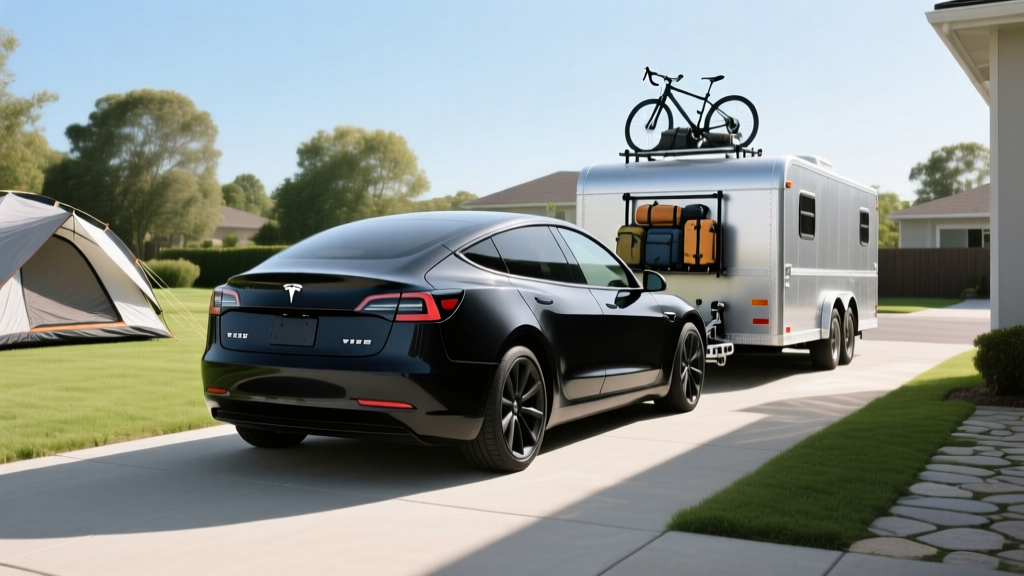
The 2,000-pound rating puts the Model 3 in light-duty territory. Think small utility trailers, a pair of jet skis, a lightweight teardrop camper, or a cargo trailer for weekend moves. It does not qualify the Model 3 for towing a typical travel trailer, boat on a full-size trailer, or horse trailer. For comparison, the Tesla Model Y is rated at 3,500 lbs, and the Ford F-150 Lightning tops out at 10,000 lbs with the Max Tow package.
Range, Battery, and Efficiency — The Real Numbers
Towing doesn't just test a vehicle's powertrain — it exposes the limits of its battery. Here's what the 2026 Model 3 Long Range AWD offers on paper and in practice.
EPA Estimated: 341 miles (Long Range AWD)
Real-World Highway (70 mph, mild weather): ~280–305 miles
Real-World Highway + Cold Weather (30°F): ~230–260 miles
While Towing (1,500 lb trailer, 60 mph): ~160–190 miles estimated
Range while towing drops roughly 40–50% depending on trailer aerodynamics, weight, speed, and terrain. A flat, boxy cargo trailer creates far more drag than a low-profile utility trailer.
The 2026 Model 3 Long Range AWD uses a 79 kWh usable battery pack with NMC (Nickel Manganese Cobalt) chemistry. NMC provides higher energy density than LFP (lithium iron phosphate), which is why the Long Range achieves its 341-mile EPA figure in a relatively compact sedan footprint. The RWD Standard Range model uses a ~60 kWh LFP pack — lighter and less expensive, but with lower energy density and no tow rating.
On the efficiency front, the Long Range AWD achieves an EPA-rated 132 MPGe combined, translating to roughly 25 kWh per 100 miles in mixed driving. That's among the most efficient vehicles in its class, thanks to Tesla's heat pump, low drag coefficient (0.219 Cd), and regenerative braking calibration. However, towing obliterates that efficiency — expect 45–55 kWh/100 mi with a loaded trailer at highway speeds.
| Spec | Value |
|---|---|
| EPA Range | 341 miles |
| Battery (usable) | 79 kWh, NMC |
| Efficiency (combined) | 132 MPGe / 25 kWh/100mi |
| 0–60 mph | 4.2 seconds |
| Horsepower | 384 hp (dual-motor combined) |
| Drivetrain | Dual-Motor AWD |
| Max Tow Capacity | 2,000 lbs (w/ factory tow pkg) |
| Cargo Volume (trunk + frunk) | 23 cu ft trunk + 3.1 cu ft frunk |
| Rear Legroom | 35.3 inches |
| Battery Warranty | 8 years / 120,000 miles |
Charging Speed: DC Fast and Home Level 2
Charging speed matters enormously when towing, because your range shrinks and you'll need to stop more often. The Model 3 Long Range AWD supports Tesla's NACS connector natively and can access the Supercharger network — currently the most reliable DC fast-charging infrastructure in the US.
| Charging Level | Max Power | Speed | Time |
|---|---|---|---|
| Level 1 (120V household) | 1.4 kW | ~3–4 miles/hour | ~24+ hours (0–100%) |
| Level 2 (240V, 48A home) | 11.5 kW | ~44 miles/hour | ~7.5 hours (0–100%) |
| DC Fast Charge (Supercharger V3/V4) | 250 kW peak | ~175 miles in 15 min (optimal) | ~25 minutes (10–80%) |
A few real-world nuances on charging:
- Peak vs. sustained: The 250 kW peak rate only holds briefly at low state of charge. The charge curve tapers significantly above 50% SoC, and drops sharply past 80%. Plan your road-trip stops around 10–80% charges for the best time efficiency.
- Preconditioning is essential: Navigate to a Supercharger via the car's built-in nav and the battery will automatically precondition (warm up) for faster charging. Skipping this in cold weather can double your charge time.
- Home charging investment: A Tesla Wall Connector installed on a 60A circuit delivers the full 48A / 11.5 kW rate. Installation typically runs $500–$2,000 depending on your panel capacity and conduit distance. If you're towing regularly, home Level 2 is non-negotiable — Level 1 simply won't replenish enough overnight.
Performance and Drivetrain
The dual-motor AWD powertrain produces 384 horsepower and launches the Model 3 Long Range to 60 mph in 4.2 seconds. That's quick by any measure, and the instant torque delivery means merging onto highways with a trailer in tow feels confident and immediate — no downshift lag, no turbo spool-up.
However, towing at the 2,000-lb limit will noticeably affect handling dynamics. The Model 3 is a relatively light sedan (~4,030 lbs curb weight), so a 2,000-lb trailer represents roughly 50% of the vehicle's own weight. That's at the upper edge of what's comfortable for a unibody sedan. Expect increased brake wear on long downhill grades, more pronounced sway in crosswinds, and a firmer ride with the trailer tongue weight loading the rear axle. A weight-distribution hitch is not compatible with the Model 3's unibody construction, so tongue weight management is critical — keep it under 200 lbs.
Pricing, Tax Credits, and Ownership Cost
The 2026 Model 3 Long Range AWD starts at $47,740 MSRP (including destination). Adding the factory tow package costs approximately $1,000, bringing a tow-equipped Model 3 LR AWD to roughly $48,740 before options.
| Trim | Base MSRP | With Tow Package | §30D Credit Eligible | Effective Price (if eligible) |
|---|---|---|---|---|
| RWD Standard Range | $39,990 | N/A | Yes (up to $7,500) | ~$32,490 |
| Long Range AWD | $47,740 | ~$48,740 | Yes (up to $7,500) | ~$41,240 |
| Performance | $54,990 | N/A | Yes (up to $7,500) | ~$47,490 |
- MSRP Cap: Sedans must be under $55,000 — all Model 3 trims qualify.
- Income Cap: AGI must not exceed $150,000 (single), $225,000 (head of household), or $300,000 (joint).
- Battery Sourcing: The full $7,500 requires meeting both critical-mineral and battery-component requirements per IRS guidance. Tesla's battery supply chain has evolved, but verify current-year eligibility on the IRS qualified vehicle list before purchasing.
- Point-of-Sale Transfer: You can transfer the credit to the dealer at purchase, reducing your out-of-pocket cost immediately rather than waiting for tax filing.
On the ownership-cost side, the Model 3 benefits from low electricity costs (roughly $0.04–$0.06 per mile at home, depending on your utility rate), minimal scheduled maintenance, and strong residual values. Insurance premiums, however, tend to run higher than comparable ICE sedans — expect $1,800–$2,800 annually depending on your profile and state. The IIHS has given the Model 3 Top Safety Pick+ status, which helps with some insurers.
Tech, Interior, and Notable Drawbacks
The 2026 Model 3 interior is a study in minimalism. The 15.4-inch center touchscreen handles virtually every function — climate, navigation, media, vehicle settings — with no physical buttons or stalks (turn signals are on the steering wheel rim). The refreshed Highland interior uses improved materials, ventilated front seats, ambient lighting, and a rear 8-inch screen for passengers.
Standout tech features:
- Tesla Autopilot (SAE Level 2 driver assistance) with adaptive cruise and lane centering
- Full Self-Driving (Supervised) available as a $8,000 add-on — still requires active driver supervision
- Over-the-air updates that regularly add features and refine performance
- Dashcam and Sentry Mode using the surround cameras
- Phone-as-key with automatic walk-up unlock
Tesla Autopilot and FSD (Supervised) are SAE Level 2 driver-assistance systems. They do not make the Model 3 a self-driving vehicle. The driver must remain fully attentive, keep hands on the wheel, and be prepared to take over immediately. Only Level 4 services like Waymo operate without a human driver in defined areas.
Notable drawbacks:
- No physical controls — even glovebox release and mirror adjustments are touchscreen-only
- Rear visibility is compromised by the sloping roofline and small rear window
- Rear seat comfort is adequate but not generous for tall adults (35.3" legroom)
- No Apple CarPlay or Android Auto — Tesla's proprietary system only
- Tow package must be factory-installed; aftermarket hitches may void warranty and are not recommended
- Towing mode must be activated in software to disable rear parking sensors and adjust regen behavior
Who Should (and Shouldn't) Buy the Model 3 for Towing
- You need to tow a small utility trailer, bike rack with e-bikes, or teardrop camper under 2,000 lbs occasionally
- Your primary use is daily commuting and you want best-in-class efficiency
- You have home Level 2 charging and rarely tow on long road trips
- You value the Supercharger network for non-towing road trips
- You regularly tow over 2,000 lbs or need to pull a travel trailer
- You need to tow long distances where range drops to ~170 miles become impractical
- You want a vehicle that can tow and seat five comfortably on the same trip
- You don't have reliable home charging access
If your towing needs exceed the Model 3's 2,000-lb limit, the Tesla Model Y (3,500 lbs, ~$48,000), Ford F-150 Lightning (7,700–10,000 lbs, ~$55,000+), or Rivian R1S (7,700 lbs, ~$79,000) are more appropriate — though all come with higher purchase prices and lower efficiency.
Pros and Cons at a Glance
- Industry-leading efficiency: 132 MPGe combined
- 250 kW DC fast charging with NACS/Supercharger access
- 341 miles EPA range (without towing)
- 4.2-second 0–60 with dual-motor AWD
- Strong safety ratings (IIHS TSP+)
- Over-the-air updates continuously improve the vehicle
- Low cost per mile on home electricity
- Only 2,000-lb tow rating — light-duty only
- Range drops 40–50% while towing
- No physical buttons or stalks — steep learning curve
- Rear seat space is tight for tall passengers
- No Apple CarPlay or Android Auto
- Higher insurance premiums than comparable sedans
- Tow package is factory-only; no aftermarket recommendation
Frequently Asked Questions
What is the Tesla Model 3 tow capacity?
The 2026 Tesla Model 3 Long Range AWD is rated to tow up to 2,000 pounds with the factory tow package. The RWD Standard Range and Performance trims are not rated for towing in the US market.
How far can the Model 3 go while towing a trailer?
Expect roughly 160–190 miles of real-world range while towing a 1,500-lb trailer at 60 mph on flat terrain. Aerodynamic drag from the trailer is the biggest range killer — a boxy cargo trailer will reduce range more than a low-profile flatbed. The EPA-rated 341 miles applies to untowed driving only.
Does the Model 3 qualify for the federal EV tax credit?
The 2026 Model 3 qualifies for up to $7,500 under IRS §30D, provided you meet income caps ($150K single / $300K joint), the vehicle MSRP is under $55,000 (all trims qualify), and battery sourcing requirements are met. Verify current eligibility on the IRS qualified vehicles list. The credit can be transferred at point of sale.
How fast does the Model 3 charge at home and on the road?
At home on a 240V Level 2 charger (48A), the Model 3 adds roughly 44 miles of range per hour, fully charging in about 7.5 hours. On a Tesla Supercharger (V3/V4), it peaks at 250 kW and charges from 10–80% in approximately 25 minutes, though the charge curve tapers significantly above 80%.
Can I install an aftermarket tow hitch on the Model 3?
While aftermarket hitches physically exist for the Model 3, Tesla only supports towing with the factory-installed tow package, which includes software integration (towing mode, disabled rear parking sensors, adjusted regenerative braking). An aftermarket hitch may void your warranty and lacks the software calibration needed for safe towing.
Is the Model 3 worth buying over the Model Y for towing?
If towing is a priority, the Model Y's 3,500-lb rating, taller cargo area, and slightly longer wheelbase make it a more practical tow vehicle for about the same starting price. The Model 3 is the better choice if towing is rare and daily efficiency, a lower purchase price, and sportier driving dynamics matter more. Check the EPA's fueleconomy.gov for side-by-side efficiency comparisons.
What's the battery warranty on the Model 3?
Tesla covers the Model 3 Long Range battery and drive unit for 8 years or 120,000 miles, whichever comes first, with a minimum 70% capacity retention threshold. If the battery degrades below 70% State of Health within the warranty period, Tesla will repair or replace it. Out-of-warranty battery replacement currently runs $12,000–$16,000 depending on the pack.