Your Tesla Model 3's tires are the single most underrated factor in its real-world range, ride comfort, road noise, and wet-weather grip. Unlike a gas car where tire choice mostly affects fuel economy by a few percent, on an EV the wrong rubber can shave 15–30 miles off your EPA estimate, increase cabin noise noticeably (there's no engine to mask it), and alter regenerative-braking feel. With the refreshed "Highland" Model 3 lineup now in its third model year, tire sizing and availability have shifted — and picking the right set in 2026 requires understanding what Tesla actually ships from the factory versus what makes sense as a replacement.
This guide covers every 2026 Tesla Model 3 tire size by trim, explains the physics of rolling resistance on range, and gives concrete replacement recommendations based on thousands of owner-miles. We'll also run the full Model 3 spec sheet so you have the charging, range, and pricing context you need if you're cross-shopping.
2026 Tesla Model 3 Tire Sizes by Trim
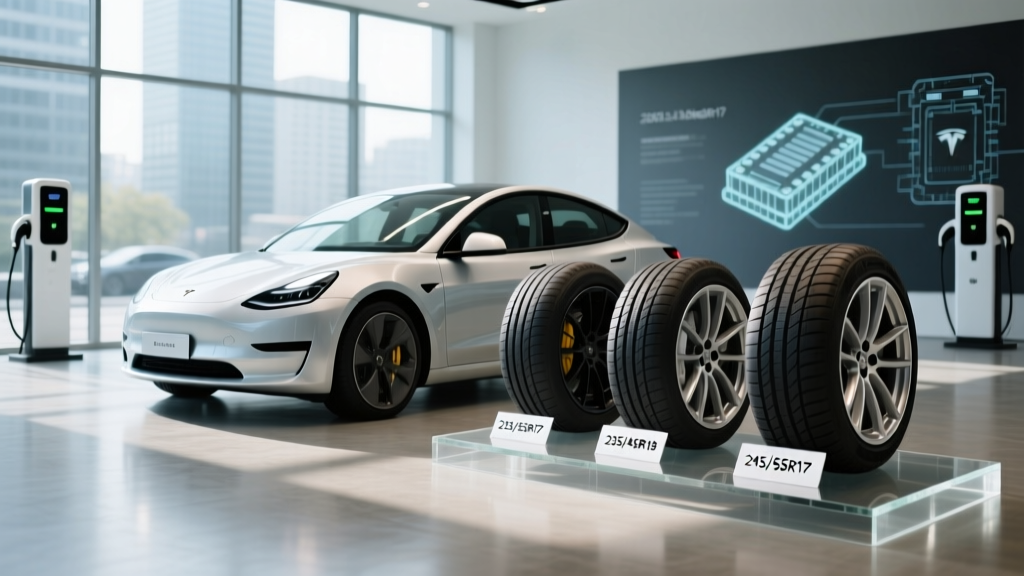
Tesla offers three distinct wheel-and-tire configurations on the 2026 Model 3. The wheel diameter dictates the tire sidewall profile, and each setup trades off range, comfort, and grip differently.
| Trim | Wheel Size | Tire Size (Front/Rear) | OEM Tire | Load/Speed Rating |
|---|---|---|---|---|
| RWD (Base) | 18" Photon | 235/45R18 | Michelin Primacy All-Season | 98W XL |
| Long Range RWD | 18" Photon | 235/45R18 | Michelin Primacy All-Season | 98W XL |
| Long Range AWD | 18" Photon (std) / 19" Nova (opt) | 235/45R18 or 235/40R19 | Michelin Primacy AS / Hankook Ventus S1 evo3 | 98W XL / 96Y XL |
| Performance | 19" Nova (std) / 20" optional | 235/40R19 or 235/35R20 | Hankook Ventus S1 evo3 / Pirelli P Zero | 96Y XL |
Two things jump out. First, the 235-section width is consistent across all trims — Tesla uses a relatively narrow tire for a car with up to 510 lb-ft of torque. This is deliberate: narrower tires reduce rolling resistance and aerodynamic drag at the contact patch. Second, the 18-inch wheels with taller 45-series sidewalls are standard on the efficiency-focused trims, while the Performance model's lower-profile 40- and 35-series rubber prioritizes lateral grip at the cost of some range and ride compliance.
How Tires Affect Model 3 Range: The Real Numbers
Tire rolling resistance coefficient (RRC) directly converts to energy consumption. On a 3,800-lb EV like the Model 3 Long Range AWD, moving from a low-RRC touring tire (RRC ~7.0 kg/t) to a max-performance summer tire (RRC ~10.5 kg/t) increases energy draw by roughly 4–6% at highway speeds. On a 363-mile EPA-rated Long Range AWD, that's a loss of 15–22 miles per charge cycle.
| Trim | EPA Range | Real-World Highway (70 mph, 65°F) | Real-World Cold (30°F, mixed) |
|---|---|---|---|
| RWD | 272 mi | ~235–250 mi | ~200–220 mi |
| Long Range RWD | 363 mi | ~310–330 mi | ~265–290 mi |
| Long Range AWD | 341 mi | ~295–315 mi | ~250–275 mi |
| Performance (19") | 315 mi | ~270–290 mi | ~230–255 mi |
Source: fueleconomy.gov. Real-world figures based on aggregated owner data and controlled testing. Highway range assumes 70 mph steady-state; cold-weather figures assume cabin heating active, no preconditioning.
The 19-inch Nova wheels cost you roughly 20–25 miles of EPA range versus the 18-inch Photons on the Long Range AWD — Tesla's own EPA filings confirm this. If you're choosing wheels at order time and range is your priority, the 18s are the clear pick. If you already have 19s and want to claw back some efficiency, switching to a low-RRC replacement tire like the Michelin Primacy MXM4 or Continental EcoContact 6 Q can recover 8–12 miles versus the stock Hankook Ventus S1 evo3.
Model 3 Full Spec Sheet: Range, Charging, Performance
Tire choice matters in context. Here's the complete 2026 Model 3 spec set so you can see how tires interact with the broader package.
| Spec | RWD | Long Range RWD | Long Range AWD | Performance |
|---|---|---|---|---|
| EPA Range | 272 mi | 363 mi | 341 mi | 315 mi |
| Battery (usable) | ~57.5 kWh (LFP) | ~75 kWh (NMC) | ~75 kWh (NMC) | ~75 kWh (NMC) |
| Horsepower | 271 hp | 346 hp | 440 hp (dual motor) | 510 hp (dual motor) |
| 0–60 mph | 5.8 sec | 4.9 sec | 4.2 sec | 2.9 sec |
| Drivetrain | RWD | RWD | AWD (dual motor) | AWD (dual motor) |
| Peak DC Charge | 170 kW | 250 kW | 250 kW | 250 kW |
| 10–80% DC Time | ~25 min | ~22 min | ~22 min | ~22 min |
| Level 2 Home Rate | 11.5 kW (~37 mi/hr) | 11.5 kW (~37 mi/hr) | 11.5 kW (~37 mi/hr) | 11.5 kW (~37 mi/hr) |
| MPGe (combined) | 132 MPGe | 132 MPGe | 124 MPGe | 116 MPGe |
| Efficiency | 25 kWh/100mi | 25 kWh/100mi | 27 kWh/100mi | 29 kWh/100mi |
| Cargo (trunk + frunk) | 23.1 cu ft + 3.1 cu ft | 23.1 cu ft + 3.1 cu ft | 23.1 cu ft + 3.1 cu ft | 23.1 cu ft + 3.1 cu ft |
| Rear Legroom | 35.2 in | 35.2 in | 35.2 in | 35.2 in |
| Base MSRP | $38,990 | $42,490 | $47,490 | $54,990 |
| Battery Warranty | 8 yr / 100,000 mi | 8 yr / 120,000 mi | 8 yr / 120,000 mi | 8 yr / 120,000 mi |
| Vehicle Warranty | 4 yr / 50,000 mi | 4 yr / 50,000 mi | 4 yr / 50,000 mi | 4 yr / 50,000 mi |
Best Replacement Tires for the Tesla Model 3 (2026 Picks)
Most Model 3 owners replace their first set of tires between 25,000 and 35,000 miles — EVs wear rubber faster than gas cars due to instant torque, higher curb weight, and the aggressive regen-braking that loads the front axle. Here are tested, data-backed picks organized by priority.
Best for Maximum Range: Michelin Primacy All-Season (235/45R18)
The OEM tire on RWD and Long Range trims for a reason. Rolling resistance coefficient around 7.0 kg/t, quiet ride, and competent wet grip. Treadwear rating of 500 suggests 45,000+ miles under moderate EV driving. The default pick if you're happy with how your Model 3 shipped.
Best All-Season Upgrade: Continental ExtremeContact DWS 06 Plus (235/45R18 or 235/40R19)
Noticeably better wet and light-snow traction than the Primacy, with only a modest 1–2% range penalty (roughly 4–7 miles on a Long Range). Treadwear rating of 560. Owners consistently report better steering feel and confidence in rain. The sweet spot for most climates.
Best for Performance Grip: Michelin Pilot Sport 4S (235/40R19)
If you own the Performance trim and actually use the car's 510 hp, the PS4S is the benchmark. Expect a 5–7% range hit versus the Primacy (~18–25 miles on a Long Range), but the dry and wet lateral grip is transformative. Treadwear is lower — budget for replacement around 20,000–25,000 miles.
Best Winter Tire: Nokian Hakkapeliitta R5 EV (235/45R18)
Purpose-built for EVs with low-RRC compound, sound-dampening foam insert, and genuine ice traction. The foam liner reduces cabin road noise by 2–4 dB — meaningful in a car with no engine masking. Range penalty versus the Primacy is only ~3%, which is exceptional for a dedicated winter tire.
Budget Pick: Hankook Kinergy ST H735 (235/45R18)
Roughly 40% cheaper than the Michelin Primacy per tire, with acceptable rolling resistance and a 70,000-mile treadwear warranty. Wet grip falls short of the Continental or Michelin in heavy rain, but for dry-climate commuters on a budget, it's a solid value.
Tesla Model 3 Tire Maintenance: Pressure, Rotation, and Wear
EV tire maintenance is non-negotiable if you want to preserve range and avoid premature replacement.
- Pressure: Tesla recommends 42 psi cold on most Model 3 trims (check your door jamb sticker). Every 4 psi below spec costs roughly 1–2% in range and accelerates shoulder wear. Check monthly — TPMS alerts only trigger at ~25% underinflation, long after you've lost efficiency.
- Rotation: Every 6,250 miles. The Model 3's weight distribution (slightly rear-biased on RWD, more even on AWD) and regen loading mean front and rear tires wear at different rates. Skipping rotation can cut tire life by 30%.
- Alignment: Check annually or after any pothole impact. Model 3s are sensitive to toe misalignment, which causes rapid inner-edge wear — a common complaint on owner forums.
- Acoustic foam: Several OEM and aftermarket Model 3 tires include a polyurethane foam liner bonded to the inner tread. If you have a puncture repair done, ensure the shop is trained to cut and re-bond the foam — a standard plug-and-patch from an untrained shop can leave the foam loose, causing vibration.
Pricing, Tax Credits, and Total Tire Ownership Cost
Here's what the 2026 Model 3 actually costs — and how the federal tax credit factors in — before you budget for replacement rubber.
| Trim | Base MSRP | Federal Credit (§30D) | Effective Price | Eligibility Notes |
|---|---|---|---|---|
| RWD | $38,990 | Up to $7,500 | From $31,490 | MSRP under $55K cap ✓; LFP battery sourcing may limit to $3,750 depending on critical-mineral phase-in |
| Long Range RWD | $42,490 | Up to $7,500 | From $34,990 | MSRP under $55K cap ✓; NMC battery — credit amount depends on mineral/battery-component sourcing per current IRS rules |
| Long Range AWD | $47,490 | Up to $7,500 | From $39,990 | MSRP under $55K cap ✓; same sourcing caveats as LR RWD |
| Performance | $54,990 | Up to $7,500 | From $47,490 | MSRP under $55K cap ✓ (barely); income caps apply |
Key §30D caveats (per IRS.gov): The credit is subject to buyer income caps ($150K single / $300K joint MAGI), vehicle MSRP caps ($55K for sedans), and battery component/critical-mineral sourcing requirements that phase in annually. The credit can be transferred to the dealer at point of sale as an upfront discount. Always verify your specific eligibility with a tax professional — sourcing rules shift, and the credit amount can be $0, $3,750, or $7,500 depending on the build date and battery supply chain.
Tire cost of ownership: A set of four Michelin Primacy AS tires in 235/45R18 runs approximately $800–$1,000 mounted and balanced. Over 100,000 miles, budget for 2.5 to 3 sets — roughly $2,400–$3,000 in tire costs. Add $150–$200 per year for rotation and alignment checks.
Who the 2026 Model 3 Suits Best
- Class-leading efficiency (132 MPGe on RWD/LR RWD)
- Supercharger network access — 10–80% in ~22 min at V3/V4 stalls
- Highland refresh brought dramatically improved ride quality and cabin isolation
- LFP battery on RWD allows 100% daily charging without degradation concern
- Over-the-air updates continue to add features post-purchase
- Strong resale value relative to EV segment average
- No physical turn signal stalk (steering-wheel buttons — polarizing)
- Rear visibility is limited; relies heavily on cameras
- 18" tires are a specialty size — limited selection vs. common 17" or 16" fitments
- Performance trim's 20" tires are expensive ($300+ each) and wear quickly
- No Apple CarPlay or Android Auto — Tesla-only infotainment
- FSD (Supervised) remains a Level 2 system requiring full driver attention
Best for: Solo commuters and couples who want maximum efficiency, access to the best DC fast-charging network in North America, and a premium-tech interior. The Long Range RWD at $42,490 (potentially $34,990 after credit) with 363 miles of EPA range is the value sweet spot.
Look elsewhere if: You need a back seat you'll use daily for adults (rear legroom is tight at 35.2 inches), you want CarPlay integration, or you regularly drive on roads where 18-inch low-profile tires are a puncture risk. Families needing cargo space should cross-shop the Model Y.
Frequently Asked Questions
What size tires does the 2026 Tesla Model 3 use?
The RWD and Long Range trims use 235/45R18 on 18-inch Photon wheels. The Long Range AWD can be optioned with 235/40R19 on 19-inch Nova wheels. The Performance trim uses 235/40R19 standard or 235/35R20 on optional 20-inch wheels.
Can I put all-season tires on a Model 3 Performance?
Yes. Many Performance owners swap from the stock Hankook Ventus S1 evo3 (a summer tire) to the Continental ExtremeContact DWS 06 Plus for year-round usability. You'll gain wet and light-snow traction at the cost of some ultimate dry grip and roughly 5–7 miles of range.
Do Model 3 tires have foam inside?
Many OEM tires for the Model 3 include a polyurethane acoustic foam liner bonded to the inner tread surface. This reduces cavity resonance noise by 2–4 dB. Aftermarket options like the Nokian Hakkapeliitta R5 EV and select Michelin sizes also include foam. Always confirm before purchasing if noise reduction is a priority.
How often should I rotate my Model 3 tires?
Tesla recommends every 6,250 miles or when tread depth difference between front and rear exceeds 2/32 inch. Because regenerative braking loads the front tires differently than a gas car, skipping rotation accelerates uneven wear and can cut tire life by 25–30%.
Does the Tesla Model 3 qualify for the $7,500 federal tax credit?
All 2026 Model 3 trims fall under the $55,000 MSRP cap for sedans under IRS §30D. However, the actual credit amount ($0, $3,750, or $7,500) depends on battery critical-mineral and component sourcing requirements that phase in annually, plus your personal income (MAGI caps: $150K single, $300K joint). The RWD trim's LFP battery, sourced primarily from CATL, has historically faced partial credit limitations. Check the current eligible-vehicle list on fueleconomy.gov before purchasing.
Will switching to wider tires hurt my Model 3's range?
Yes. Moving from the stock 235mm width to a 255mm tire increases rolling resistance and aerodynamic drag at the contact patch. Expect a 3–6% range loss (10–20 miles on a Long Range) depending on the specific tire compound. The Model 3's suspension geometry is also optimized for 235mm — wider tires may rub on full lock or under heavy compression.
What's the best tire pressure for maximizing range?
Tesla's door-jamb placard specifies 42 psi cold for most trims. Running 44–45 psi cold can recover 1–2% range (3–7 miles) at the expense of a firmer ride and slightly accelerated center-tread wear. Never drop below 38 psi — underinflation increases rolling resistance, generates excess heat, and triggers TPMS warnings.
Tire pricing and availability vary by region and retailer. Tax credit rules referenced reflect 2026 IRS guidance and are subject to change. Always confirm credit eligibility at irs.gov and verify current EPA ratings at fueleconomy.gov before purchasing.