Quick Verdict: The Tesla Model 3 in 2026
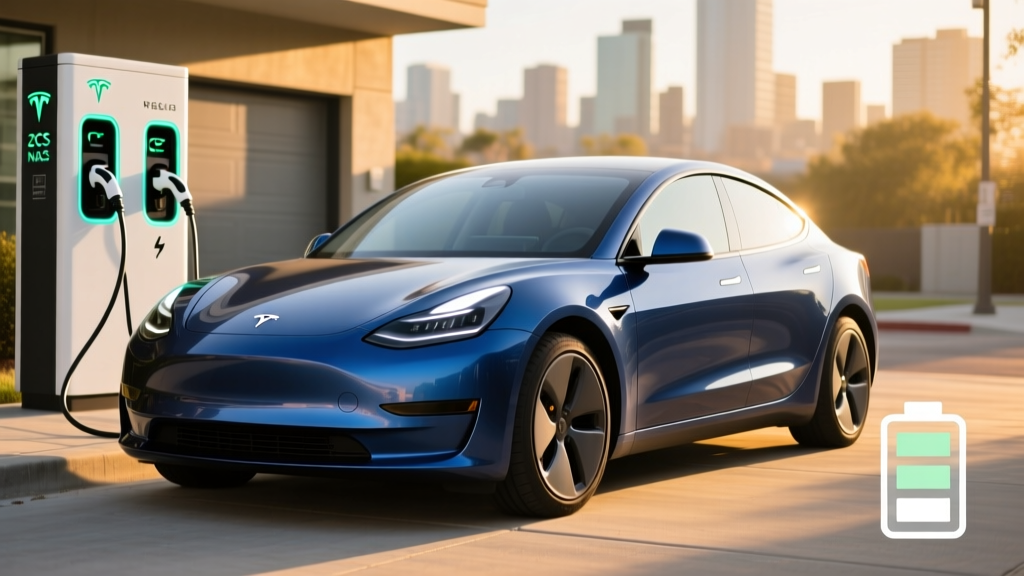
The Tesla Model 3 remains the benchmark compact electric sedan for buyers who prioritize driving dynamics, charging infrastructure access, and over-the-air software updates. For 2026, the refreshed "Highland" generation continues with improved ride quality, a quieter cabin, and ventilated seats — addressing the most common complaints from the pre-2024 model. But the question most buyers search for is straightforward: can you actually claim the federal tax credit on the Tesla Model 3, and what does ownership really look like once you drive off the lot?
This review covers the full ownership picture — EPA range versus real-world miles, DC fast-charging reality, §30D tax credit eligibility, and how the Model 3 stacks up against the Hyundai Ioniq 6, BMW i4, and Polestar 2.
2026 Tesla Model 3 Specifications at a Glance
| Spec | Model 3 RWD | Model 3 Long Range AWD | Model 3 Performance |
|---|---|---|---|
| EPA Range | 272 mi | 341 mi | 315 mi |
| Battery (usable) | ~60 kWh (LFP) | ~75 kWh (NMC) | ~75 kWh (NMC) |
| Drivetrain | Rear-Wheel Drive | Dual-Motor AWD | Dual-Motor AWD |
| Horsepower | 271 hp | 346 hp | 510 hp |
| 0–60 mph | 5.8 sec | 4.2 sec | 2.9 sec |
| Peak DC Fast Charge | 170 kW | 250 kW | 250 kW |
| 10–80% DC Time | ~25 min | ~25 min | ~25 min |
| Level 2 Home Charge | 11.5 kW (~44 mi/hr) | 11.5 kW (~44 mi/hr) | 11.5 kW (~44 mi/hr) |
| MPGe (combined) | 132 MPGe | 130 MPGe | 119 MPGe |
| kWh/100 mi | 25 kWh | 26 kWh | 28 kWh |
| Base MSRP | $38,990 | $44,990 | $52,990 |
| Battery Warranty | 8 yr / 100,000 mi | 8 yr / 120,000 mi | 8 yr / 120,000 mi |
Source: fueleconomy.gov and Tesla official specifications. Prices exclude destination fee.
Real-World Range: What the EPA Sticker Doesn't Tell You
- Model 3 Long Range AWD: EPA 341 mi → Expect ~290–310 mi mixed highway/city in mild weather; ~240–260 mi in sustained sub-30°F cold or at 80+ mph highway speeds.
- Model 3 RWD: EPA 272 mi → Expect ~230–250 mi mixed; ~190–210 mi in cold weather.
- Model 3 Performance: EPA 315 mi → Expect ~265–285 mi mixed; aggressive driving and cold further reduce this.
The Model 3 Long Range's 341-mile EPA figure is genuinely useful for road trips, but range is a moving target. On a 70°F day at 65 mph on flat terrain, you can approach or even slightly exceed the EPA number thanks to Tesla's heat pump and efficient powertrain. Push that to 80 mph on the interstate, and consumption climbs roughly 15–20%, dropping effective range to around 280 miles.
Cold weather is the bigger equalizer. In sustained temperatures below 30°F, expect a 20–30% reduction. The LFP battery in the RWD model is more susceptible to cold-related range loss and slower charging speeds when cold-soaked — preconditioning via the Tesla app before driving or charging is essential to mitigate this. The NMC packs in Long Range and Performance trims handle cold somewhat better but are not immune.
For daily commuting under 80 miles round-trip, even the RWD model's real-world range is more than adequate. For road trips, the Long Range's buffer means fewer charging stops — typically one 20-minute Supercharger session every 250 miles or so.
Charging Speed: DC Fast Charging and Home Setup
| Charging Level | Power | Miles Added per Hour | Typical Use Case |
|---|---|---|---|
| Level 1 (120V outlet) | ~1.4 kW | ~3–5 mi/hr | Overnight trickle; emergency top-up |
| Level 2 (240V home charger) | 11.5 kW | ~44 mi/hr | Daily home charging; full charge in 6–8 hours |
| DC Fast (Supercharger V3/V4) | Up to 250 kW (LR/Perf) Up to 170 kW (RWD) | Up to ~1,000 mi/hr peak | Road trips; 10–80% in ~25 min |
Tesla's Supercharger network remains the most reliable public charging infrastructure in the U.S., with consistent uptime and automatic plug-and-charge billing. The Long Range and Performance models peak at 250 kW on V3 Superchargers, but that peak is sustained only briefly — typically between 10–30% state of charge. From 30–60%, expect roughly 150–180 kW, tapering further to under 50 kW above 80%. This charge curve is normal for NMC chemistry and means the advertised "15 minutes to add 200 miles" applies mostly to low-SoC arrivals.
The RWD model's LFP battery tops out at 170 kW. LFP charges more slowly in general but has one distinct advantage: Tesla recommends regularly charging LFP batteries to 100%, unlike NMC which benefits from an 80% daily limit for longevity. This effectively gives the RWD model more daily-usable range than the raw kWh difference suggests.
For home charging, a Level 2 wall connector on a 60-amp circuit delivers the full 11.5 kW (48 amps continuous). That translates to roughly 44 miles of range per hour of charging — enough to fully replenish any Model 3 overnight. Installation costs typically run $500–$1,500 if your electrical panel has capacity; a panel upgrade can add $1,500–$3,000. Tesla's Wall Connector retails for around $425.
Federal Tax Credit on Tesla Model 3: §30D Eligibility Explained
The federal EV tax credit under IRS §30D offers up to $7,500 for qualifying new EV purchases, and the Tesla Model 3 is currently eligible — but with important conditions that determine whether you personally qualify.
| Trim | Base MSRP | Est. Destination | Max §30D Credit | Effective Price (if eligible) |
|---|---|---|---|---|
| Model 3 RWD | $38,990 | $1,390 | $7,500 | ~$32,880 |
| Model 3 Long Range AWD | $44,990 | $1,390 | $7,500 | ~$38,880 |
| Model 3 Performance | $52,990 | $1,390 | $7,500 | ~$46,880 |
- MSRP Cap: Sedans must be under $55,000 MSRP. The RWD and Long Range qualify. The Performance trim at $52,990 base also qualifies, but adding options (FSD, paint, wheels) can push it over the cap — verify the final MSRP on your build.
- Buyer Income Cap: Modified adjusted gross income (MAGI) must not exceed $150,000 (single), $225,000 (head of household), or $300,000 (joint filers).
- Battery Sourcing: The full $7,500 requires meeting both critical minerals and battery component sourcing thresholds set by the IRS. These thresholds tighten annually. Tesla sources materials from multiple suppliers, and eligibility can shift — always verify current status on the IRS qualified vehicles list before purchasing.
- Point-of-Sale Transfer: As of 2024, you can transfer the credit to the dealer at purchase, reducing your out-of-pocket cost immediately rather than waiting to claim it on your tax return. Tesla supports this at delivery.
- One Vehicle Per VIN: The credit applies once per vehicle VIN, and you cannot have claimed another new EV credit within the prior 3 years.
Critical caveat: Battery sourcing requirements are the most volatile part of §30D eligibility. A vehicle that qualifies in January may not qualify in July if supply chains shift. Always confirm the Model 3's status on the IRS qualified vehicle list within 30 days of your planned purchase date. Consult a tax professional for your specific situation.
Performance, Interior, and Daily Livability
The Model 3's driving experience is still one of the best in its class. The RWD model's 271 hp and 5.8-second 0–60 time is more than adequate for merging and passing, while the Performance model's 2.9-second sprint is supercar territory. The Highland refresh brought a noticeably quieter cabin (acoustic glass all around), improved suspension tuning that soaks up bumps without the crashiness of earlier models, and ventilated front seats — a welcome addition.
Interior dimensions:
- Front legroom: 42.7 inches
- Rear legroom: 35.2 inches
- Cargo (trunk + frunk): 23 cu ft total (19.8 cu ft trunk, ~3.1 cu ft frunk)
The rear seat is tighter than a Hyundai Ioniq 6 or BMW i4 in terms of headroom due to the sloping roofline, and the lack of a traditional instrument cluster (everything is on the 15.4-inch center touchscreen) remains polarizing. The rear-seat entertainment screen added in the Highland refresh is a nice touch for passengers.
Tech and driver assistance: Tesla's infotainment remains best-in-class for responsiveness and features — navigation with real-time Supercharger routing, streaming, Sentry Mode dashcam, and frequent OTA updates. Basic Autopilot (adaptive cruise + lane centering) is standard and is a competent SAE Level 2 driver-assist system. Full Self-Driving (Supervised) is an $8,000 option that adds automated lane changes, traffic light recognition, and city-street navigation — but it remains Level 2 and requires full driver attention at all times. It is not autonomous driving.
How the Model 3 Compares to Key Rivals
The compact EV sedan segment has matured considerably. Here's how the Model 3 Long Range stacks up against three primary competitors:
- Hyundai Ioniq 6 SE Long Range (AWD): EPA 316 mi, ~$48,000 MSRP, 800V architecture enabling 10–80% in ~18 min at 350 kW chargers. Faster charging than the Model 3, but less Supercharger network access (though Hyundai is gaining NACS access). Slightly more rear-seat room.
- BMW i4 eDrive40: EPA 301 mi, ~$57,000 MSRP, premium interior and driving refinement, but more expensive and lower range. Eligible for §30D credit depending on sourcing.
- Polestar 2 Long Range Dual Motor: EPA 276 mi, ~$53,000 MSRP, distinctive Scandinavian design and Google-based infotainment. Less range, higher price, but strong build quality.
The Model 3's advantages are the Supercharger network (still the most seamless road-trip charging experience), class-leading efficiency (kWh/100mi), and the lowest starting price among these rivals. Its disadvantages include the touchscreen-only interface, relatively tight rear seat, and Tesla's panel-gap inconsistency, which has improved but still varies car to car.
Ownership Costs and Warranty
Tesla's battery and drive unit warranty covers 8 years / 100,000 miles on the RWD model and 8 years / 120,000 miles on Long Range and Performance trims, with a minimum 70% capacity retention threshold. The limited vehicle warranty is 4 years / 50,000 miles.
Real-world battery degradation data from fleet aggregators shows Tesla's NMC packs retaining roughly 90% capacity at 100,000 miles, with the degradation curve flattening significantly after the initial 10–15% drop in the first 20,000 miles. LFP packs in the RWD model show even less degradation over equivalent mileage, though long-term (200,000+ mile) data is still accumulating.
Insurance costs for the Model 3 tend to run 15–25% higher than comparable gas sedans due to repair costs and parts pricing. Expect $1,800–$2,800/year depending on your profile and state. Tesla Insurance is available in some states and can be competitive — worth quoting alongside traditional carriers.
Electricity costs for charging vary dramatically by region and whether you charge at home or on public DC fast chargers. At the national average residential rate of ~$0.16/kWh, home charging a Model 3 Long Range costs roughly $12 for a full charge — about $0.045/mile. Public DC fast charging at $0.35–$0.50/kWh raises that to $0.09–$0.13/mile, still below the ~$0.14/mile cost of a 30 MPG gas car at $3.50/gallon.
- Class-leading efficiency (25–28 kWh/100mi)
- Access to Tesla Supercharger network — most reliable U.S. DC charging
- Lowest starting MSRP in the segment
- Frequent OTA updates add features post-purchase
- Strong real-world battery degradation data
- Excellent driving dynamics and one-pedal regen feel
- Everything routed through the center touchscreen (no physical buttons, no gauge cluster)
- Rear seat headroom and legroom tighter than some rivals
- RWD model's LFP battery charges slower and loses more range in cold
- FSD ($8,000) remains Level 2 — expensive for what it delivers
- Insurance premiums above segment average
- Panel gap and paint quality still inconsistent on some builds
Who Should Buy the 2026 Tesla Model 3?
Choose the Model 3 RWD if: You commute under 80 miles daily, can charge at home, want the lowest entry price, and don't regularly drive in extreme cold. The LFP battery's 100% daily charge recommendation gives you the full 272 EPA miles for daily use.
Choose the Model 3 Long Range AWD if: You take regular road trips, live in a cold-weather climate, want dual-motor traction, and value the range buffer for highway driving. This is the sweet-spot trim for most buyers.
Choose the Model 3 Performance if: You want sports-car acceleration in a practical sedan, enjoy track days, and can absorb the higher price that may push close to the $55,000 MSRP cap when options are added.
Look elsewhere if: You need maximum rear-seat space for adults (consider the Ioniq 6 or an SUV), prefer physical controls and a traditional gauge cluster, or want 800V ultra-fast charging for the shortest possible road-trip stops.
Frequently Asked Questions
Does the Tesla Model 3 qualify for the full $7,500 federal tax credit in 2026?
The Model 3 is on the IRS qualified vehicles list, but the full $7,500 depends on meeting critical minerals and battery component sourcing thresholds that change over time. Your personal eligibility also depends on income caps ($150K single / $300K joint) and the vehicle's final MSRP staying under the $55,000 sedan cap. Always verify on the IRS qualified clean vehicles page within 30 days of purchase.
What is the real-world range of the Tesla Model 3 Long Range?
Expect 290–310 miles in mild weather with mixed driving. At sustained 80 mph highway speeds, plan for ~270–280 miles. In sub-30°F cold, expect 240–260 miles. Preconditioning the battery before driving helps preserve range in cold weather.
How fast does the Model 3 charge at home and on road trips?
At home on a Level 2 (240V, 48A) charger, the Model 3 adds ~44 miles of range per hour, fully charging overnight. On a Tesla Supercharger, the Long Range and Performance peak at 250 kW, achieving 10–80% in about 25 minutes. The RWD model peaks at 170 kW with a similar 10–80% time due to its smaller battery. Above 80%, charging slows significantly — plan to charge to 80% and go on road trips.
Is the Tesla Model 3 worth buying over the Hyundai Ioniq 6 or BMW i4?
The Model 3 wins on price, efficiency, and charging network access. The Ioniq 6 charges faster on 350 kW chargers and offers a slightly roomier rear seat. The BMW i4 provides a more premium interior and traditional driving feel at a higher price. If Supercharger access and lowest cost of entry matter most, the Model 3 is the strongest pick. If you prioritize ultra-fast charging or interior luxury, the competitors make a case.
How long will the Model 3 battery last before needing replacement?
Tesla warranties the battery for 8 years / 100,000–120,000 miles (depending on trim) with a 70% minimum capacity retention guarantee. Real-world fleet data shows NMC packs retaining ~90% at 100,000 miles. Full battery replacement outside warranty currently costs $12,000–$16,000 depending on the pack, but most owners never need one within typical ownership periods.
Can I transfer the tax credit to Tesla at the point of sale?
Yes. Under current §30D rules, you can elect to transfer the credit to the dealer (Tesla) at delivery, reducing your purchase price by up to $7,500 on the spot. This is processed through the IRS Energy Credits Online portal before or at delivery. You still need to meet all income and eligibility requirements, and you'll reconcile on your tax return.