The Tesla Model 3 remains the benchmark compact electric sedan in 2026, and its infotainment system — anchored by native Spotify integration, Netflix, and a theater-grade audio setup — is as much a selling point as its industry-leading efficiency. If you've been searching "spotify tesla" to figure out how seamlessly the streaming giant works inside Tesla's minimalist cabin, the short answer is: it's the best in-car Spotify implementation on the market. But a car is more than its stereo. This review covers the full ownership picture — real-world range, DC fast-charge curves, tax credit math, and whether the refreshed Model 3 still beats the Hyundai Ioniq 6 and BMW i4 where it counts.
Quick Verdict: The Model 3 in 2026
The refreshed Model 3 (codenamed "Highland" and carried into 2026 with minor updates) delivers up to 363 miles of EPA range in Long Range AWD trim, charges at up to 250 kW on V3 Superchargers, and offers the lowest cost-per-mile of any premium electric sedan. The Spotify integration is deeply native — not a bolted-on app — and pairs with a 17-speaker audio system that makes it genuinely worthwhile. The trade-offs are familiar: no physical stalks, rear-seat visibility is compromised, and Tesla's panel-gap consistency still lags legacy automakers. For tech-forward commuters and small families who prioritize efficiency and software polish, it remains the default choice.
Range, Efficiency, and the Real-World Reality Check
- Long Range AWD: EPA 363 mi — expect ~300-320 mi on highway road trips at 70-80 mph; ~250-270 mi in sub-30°F winter conditions.
- Rear-Wheel Drive: EPA 341 mi — expect ~280-300 mi highway; ~230-250 mi in freezing weather.
- Performance (Model 3): EPA 315 mi — expect ~260-280 mi highway under spirited driving.
Tesla's heat pump (standard on all 2026 trims) significantly reduces cold-weather cabin-heating energy draw compared to resistive heaters, but lithium-ion chemistry inherently loses 15-25% range below freezing regardless of brand.
The Model 3 Long Range AWD achieves 132 MPGe combined (25 kWh/100 mi) according to fueleconomy.gov, making it one of the most efficient EVs sold in the U.S. The RWD trim hits 137 MPGe combined. For context, the Hyundai Ioniq 6 SE Long Range achieves 140 MPGe — marginally better on paper, though real-world highway parity is close.
| Spec | RWD | Long Range AWD | Performance |
|---|---|---|---|
| EPA Range | 341 mi | 363 mi | 315 mi |
| Battery (usable) | ~60 kWh (LFP) | ~75 kWh (NMC) | ~75 kWh (NMC) |
| Drivetrain | Rear-Wheel Drive | Dual-Motor AWD | Dual-Motor AWD |
| Horsepower | 271 hp | 346 hp | 510 hp |
| 0-60 mph | 5.8 sec | 4.2 sec | 2.9 sec |
| MPGe (combined) | 137 MPGe | 132 MPGe | 119 MPGe |
| Efficiency | 24 kWh/100mi | 25 kWh/100mi | 28 kWh/100mi |
Battery Chemistry: LFP vs. NMC in the Model 3 Lineup
Tesla continues its dual-chemistry strategy in 2026. The base Rear-Wheel Drive trim uses a CATL-sourced lithium iron phosphate (LFP) pack (~60 kWh usable). LFP offers superior cycle life (3,000+ full cycles before significant degradation) and can be safely charged to 100% daily — Tesla actually recommends it. The trade-off: lower energy density (heavier pack for fewer miles) and slower DC fast-charging in cold weather due to LFP's thermal characteristics.
The Long Range and Performance trims use nickel manganese cobalt (NMC) chemistry (~75 kWh usable) from Panasonic and LG Energy Solution. NMC delivers higher energy density and faster peak charge rates, but Tesla recommends daily charging to 80-90% to preserve longevity, reserving 100% for road trips. Both chemistries are covered under Tesla's 8-year/120,000-mile battery warranty (Long Range/Performance) or 8-year/100,000-mile warranty (RWD), guaranteeing ≥70% capacity retention.
Charging Speed: Supercharger Network and Home Level 2
| Charging Level | Power / Rate | Miles Added | Notes |
|---|---|---|---|
| Level 1 (120V) | ~1.4 kW | ~4-5 mi/hr | Emergency/trickle only |
| Level 2 (240V, 48A) | 11.5 kW | ~44 mi/hr | Full charge in ~7-8 hrs |
| DC Fast (V3 Supercharger) | Up to 250 kW | ~175 mi in 15 min | 10-80% in ~25-30 min (LR AWD) |
| DC Fast (V4 Supercharger) | Up to 250 kW | Similar to V3 | V4 currently capped at 250 kW for Model 3 |
The Model 3 Long Range peaks at 250 kW on V3 and V4 Superchargers, but sustained rates matter more than peak numbers. In real-world testing, the charge curve holds above 200 kW from roughly 10-30% State of Charge, then tapers progressively — dropping to ~120 kW around 55% and ~60 kW by 75%. A 10-80% session takes approximately 25-30 minutes in moderate temperatures with battery preconditioning active (triggered automatically when you navigate to a Supercharger).
The LFP-equipped RWD model peaks lower — around 170 kW — and its charge curve tapers earlier. Expect 10-80% in roughly 30-35 minutes. Preconditioning is equally critical for LFP in cold weather; without it, charge rates can be cut in half below 40°F.
At home, a Tesla Wall Connector on a 60-amp circuit delivers 11.5 kW (48 amps), adding roughly 44 miles of range per hour. Installation typically runs $800-$2,000 depending on panel proximity and whether a 200-amp service upgrade is needed — a factor often overlooked in charging-cost discussions. For a full breakdown, consult a licensed electrician for your specific panel configuration.
Spotify, Infotainment, and the Tech Experience
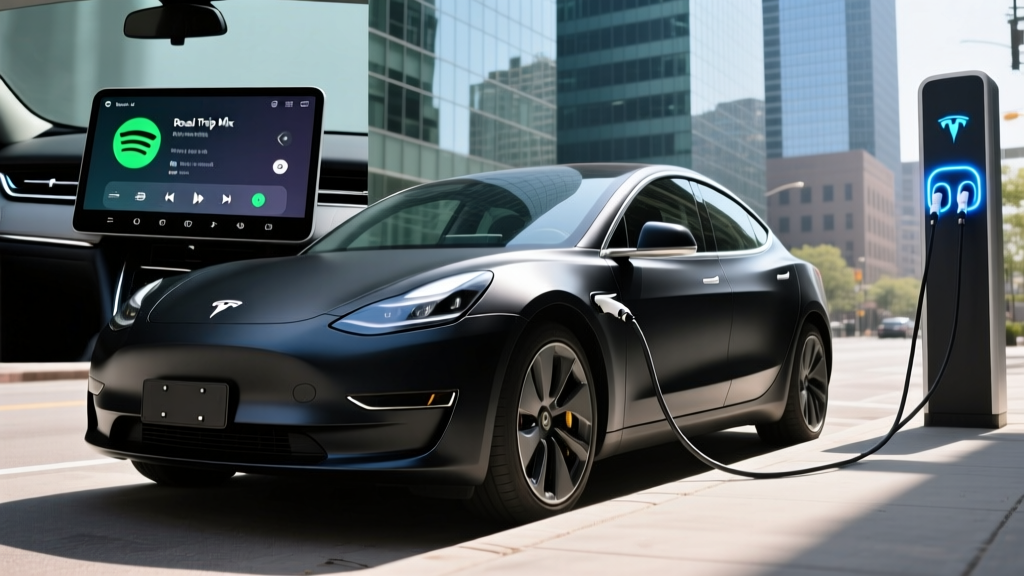
This is where the "spotify tesla" search intent gets its answer. Tesla's Spotify integration is native — not projected through CarPlay (which Tesla still does not support). You log in directly on the 15.4-inch center touchscreen, and the app accesses your full library, playlists, podcasts, and Spotify's algorithmic recommendations. Key advantages over CarPlay-based implementations:
- Voice commands via steering wheel button: "Play my Discover Weekly on Spotify" works without touching the screen.
- Album art and metadata render at full resolution on the Tesla display.
- Audio handoff: Start a podcast on your phone; resume it in the car seamlessly.
- No phone dependency: Spotify streams directly via the car's LTE/5G connection (Premium Connectivity subscription required for high-bitrate streaming; standard connectivity covers basic playback).
The 17-speaker immersive audio system (Long Range and Performance; 14-speaker on RWD) includes dual subwoofers and amplifier channels tuned for the cabin's acoustics. It's legitimately one of the best factory audio systems under $60,000 — and Spotify's higher-quality streams (when enabled) take full advantage of it.
Beyond Spotify, the infotainment suite includes Netflix, YouTube, Disney+ (while parked), Arcade gaming, a full web browser, and over-the-air updates that have historically added meaningful features post-purchase (e.g., improved navigation routing, new UI themes, and enhanced Autopilot capabilities).
Autopilot, FSD (Supervised), and Driver Assistance
Tesla Autopilot and Full Self-Driving (Supervised) are SAE Level 2 driver-assistance systems. They provide steering, acceleration, and braking support on highways and in traffic, but the driver must remain fully engaged, hands on the wheel, and eyes on the road at all times. These are not "self-driving" systems. Level 4 driverless operation (no human needed) is currently limited to geofenced robotaxi services like Waymo.
Standard Autopilot includes Traffic-Aware Cruise Control and Autosteer (lane-centering on marked highways). The $8,000 FSD (Supervised) upgrade adds Navigate on Autopilot (automatic highway interchanges), Auto Lane Change, Smart Summon, traffic light and stop sign recognition, and more assertive city-street driving. Real-world FSD capability in 2026 is impressive in well-mapped suburban areas but still requires frequent interventions in construction zones, unmapped roads, and heavy weather. Treat it as a fatigue-reducer on long highway stretches, not a replacement for attention.
Standard safety features include automatic emergency braking, lane departure warning, blind-spot monitoring, and 360-degree cameras. The Model 3 earned a 5-star overall safety rating from NHTSA and a Top Safety Pick+ from IIHS (ratings carried forward to the structurally unchanged 2026 model year).
Pricing, Trims, and Federal Tax Credit Eligibility
| Trim | Base MSRP | Est. After §30D Credit* | Destination |
|---|---|---|---|
| Rear-Wheel Drive | $38,990 | ~$31,490 | $1,390 |
| Long Range AWD | $45,490 | ~$37,990 | $1,390 |
| Performance | $52,990 | ~$45,490 | $1,390 |
*Federal tax credit estimates assume full eligibility under IRS §30D rules. Actual credit varies.
- MSRP cap: Sedan must be ≤$55,000 (all Model 3 trims qualify).
- Buyer income cap: AGI ≤$150,000 (single) / ≤$300,000 (joint) / ≤$225,000 (head of household).
- Battery sourcing: Critical minerals and battery components must meet phased-in domestic/free-trade-agreement thresholds (check current-year IRS guidance at irs.gov).
- Point-of-sale transfer: You can transfer the credit to the dealer at purchase, reducing your out-of-pocket cost immediately rather than waiting for tax filing.
- Tax liability: The credit is non-refundable — you must owe at least the credit amount in federal taxes (unless transferred at point of sale under the 2024+ rules).
All three Model 3 trims fall under the $55,000 sedan MSRP cap. However, battery-sourcing requirements have tightened annually, and eligibility can shift mid-year. Always verify your specific vehicle's VIN against the IRS qualified-vehicles list before finalizing a purchase. Consulting a tax professional for your individual situation is recommended.
Interior Space, Cargo, and Daily Practicality
The Model 3 is a compact sedan, and its dimensions reflect that. Front legroom is generous at 42.3 inches, but rear legroom (35.1 inches) is tighter than the BMW i4 or Hyundai Ioniq 6 — tall passengers will notice on longer trips. The glass roof creates an airy cabin feel but reduces rear headroom slightly compared to competitors with conventional steel roofs.
Cargo volume is 23 cubic feet (trunk + frunk combined). The rear trunk offers 19.8 cu ft with a wide-opening liftback design that's more practical than a traditional sedan's slot-mailbox opening. The front trunk (frunk) adds ~3.1 cu ft — useful for charging cables, a small bag, or groceries. For comparison, the Ioniq 6 offers 12.3 cu ft total (no meaningful frunk), while the BMW i4 provides 16.6 cu ft. The Model 3's cargo advantage is real and meaningful for weekly grocery runs or airport luggage.
Notable drawbacks: the absence of turn-signal and gear-selector stalks (replaced by steering-wheel buttons and touchscreen controls) requires a genuine adaptation period — most owners adjust within a week, but it's a polarizing choice. The rear-view camera replaces the traditional rearview mirror with a digital feed, which some drivers find less intuitive in low-light conditions.
Pros, Cons, and Who Should Buy
- Class-leading efficiency (132-137 MPGe combined)
- Native Spotify + 17-speaker audio system
- 250 kW DC fast charging with preconditioning
- Access to Tesla Supercharger network (17,000+ U.S. stalls)
- Continuous OTA updates add features post-purchase
- Strong resale value relative to EV segment average
- LFP option for 100% daily charging without degradation anxiety
- No Apple CarPlay or Android Auto support
- Rear-seat space tighter than key competitors
- Stalkless controls require adaptation
- Panel-gap consistency still inconsistent vs. legacy OEMs
- FSD ($8,000) remains Level 2 despite the name
- No heads-up display
- Insurance premiums run 15-30% above segment average
- You want the best native Spotify/infotainment integration in any EV under $55K.
- Efficiency and low cost-per-mile are top priorities.
- You road-trip frequently and value Supercharger network reliability.
- You're a tech-forward buyer who prefers OTA updates over dealer visits.
- Rear-seat passenger comfort is a dealbreaker (Ioniq 6 is roomier).
- You need Apple CarPlay (both competitors offer it).
- Build quality and panel consistency matter more than software features (BMW i4).
Frequently Asked Questions
Does Spotify work natively in Tesla without a phone?
Yes. Tesla's Spotify app streams directly over the car's cellular connection. You log into your Spotify account on the touchscreen, and it works independently of your phone. Premium Connectivity ($9.99/month) enables higher-bitrate streaming; standard connectivity supports basic playback.
What is the real-world highway range of the Model 3 Long Range?
The EPA rates it at 363 miles, but sustained highway driving at 70-80 mph typically yields 300-320 miles in moderate temperatures. In freezing conditions (below 30°F), expect 250-270 miles due to battery chemistry limitations and cabin heating demands — even with the standard heat pump.
How fast does the Model 3 charge on a road trip?
On a V3 Supercharger (250 kW), the Long Range AWD adds approximately 175 miles in 15 minutes under ideal conditions (preconditioned battery, moderate temperature). A 10-80% session takes 25-30 minutes. The LFP-equipped RWD model charges slightly slower — plan for 30-35 minutes for 10-80%.
Does the 2026 Model 3 qualify for the $7,500 federal tax credit?
All trims are under the $55,000 MSRP cap for sedans, and Tesla's battery sourcing has historically met §30D requirements. However, eligibility depends on your income (≤$150K single / ≤$300K joint), the specific VIN's battery-component sourcing (which can change), and current-year IRS rules. Always check the IRS qualified vehicle list before purchasing.
Is the Model 3 worth it over the Ioniq 6 or BMW i4?
For software experience, Supercharger access, and efficiency, yes — the Model 3 leads. For rear-seat comfort, traditional controls, and Apple CarPlay, the Ioniq 6 or i4 may suit you better. Test-drive all three; the stalkless Tesla interface is the single biggest love-it-or-hate-it factor.
What is the battery warranty on the Model 3?
Tesla covers the RWD battery and drive unit for 8 years/100,000 miles. The Long Range and Performance trims are covered for 8 years/120,000 miles. The warranty guarantees ≥70% capacity retention during the coverage period.