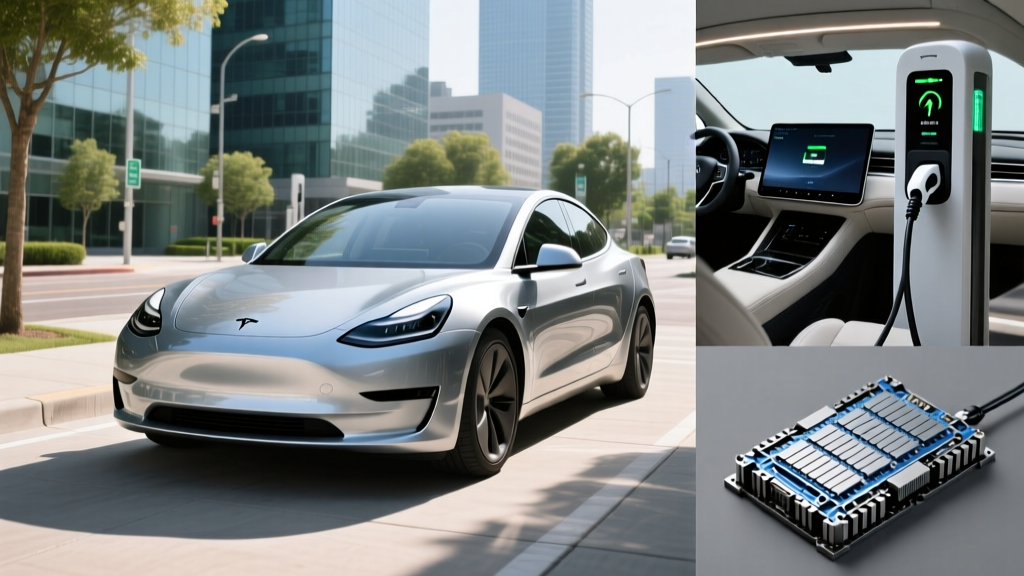
The Tesla Model 3 remains the benchmark compact electric sedan, and the refreshed "Highland" platform has sharpened its dynamics, quieted its cabin, and updated its tech stack. But for buyers comparing it against the Hyundai Ioniq 6, BMW i4, and Polestar 2, the real questions are in the numbers. Below is a data-driven teardown of every 2026 Tesla Model 3 spec, HP figure, range estimate, and charging metric you need before signing a purchase agreement.
2026 Tesla Model 3 Core Specifications at a Glance
| Specification | Model 3 RWD | Model 3 Long Range AWD | Model 3 Performance |
|---|---|---|---|
| Horsepower | 271 hp | 346 hp | 510 hp |
| Torque (lb-ft) | 317 | 389 | 546 |
| Drivetrain | RWD (single motor) | AWD (dual motor) | AWD (dual motor) |
| 0–60 mph | 5.8 sec | 4.2 sec | 2.9 sec |
| EPA Range | 272 mi | 341 mi | 315 mi |
| Battery (usable, est.) | ~57.5 kWh | ~75 kWh | ~75 kWh |
| Battery Chemistry | LFP (CATL) | NMC | NMC |
| MPGe (combined) | 132 MPGe | 134 MPGe | 121 MPGe |
| Efficiency (kWh/100 mi) | 25 | 25 | 28 |
| Top Speed | 125 mph | 125 mph | 163 mph |
| Base MSRP | $38,990 | $45,740 | $52,990 |
| Battery Warranty | 8 yr / 100,000 mi | 8 yr / 120,000 mi | 8 yr / 120,000 mi |
All prices reflect the 2026 model year before destination fees ($1,390) and before any federal or state incentives. Specifications are sourced from fueleconomy.gov and Tesla's official order page.
Range, Battery Chemistry, and Real-World Expectations
The RWD Model 3 uses a lithium iron phosphate (LFP) battery pack supplied by CATL. LFP cells are heavier and less energy-dense than the nickel manganese cobalt (NMC) packs in the Long Range and Performance variants, but they tolerate repeated 100% charging without accelerating degradation. Tesla explicitly recommends charging LFP packs to 100% at least weekly to keep the battery management system calibrated.
The Long Range AWD and Performance trims use NMC chemistry, which offers higher energy density (hence the 341-mile EPA rating) but benefits from a daily charge limit around 80–90% for long-term health.
EPA Sticker: 272 mi (RWD) / 341 mi (Long Range AWD) / 315 mi (Performance)
Expect in practice: On highway road trips at 70–75 mph, plan for roughly 240–255 miles (RWD) and 290–310 miles (Long Range) before needing to stop. In freezing temperatures (below 30°F), range can drop 20–30% due to cabin heating demands and increased battery resistance — bringing the Long Range down to approximately 230–260 miles in harsh winter conditions. The Model 3's standard heat pump mitigates some of this loss compared to older resistive-heater EVs, but cold weather remains an unavoidable physics penalty.
Charging Speeds: DC Fast, Level 2, and Level 1
Charging speed is where the Model 3's engineering shows its maturity. The Long Range and Performance variants peak at approximately 250 kW on a V3 Tesla Supercharger, while the RWD peaks around 170 kW due to its smaller LFP pack and lower C-rate tolerance.
| Charging Level | RWD (LFP) | Long Range / Performance (NMC) |
|---|---|---|
| DC Fast Charge (peak) | ~170 kW | ~250 kW |
| 10–80% DC time | ~25 min | ~22 min |
| Level 2 (240V / 48A) | ~11.5 kW (~44 mi/hr) | ~11.5 kW (~44 mi/hr) |
| Level 2 (240V / 32A Mobile) | ~7.7 kW (~30 mi/hr) | ~7.7 kW (~30 mi/hr) |
| Level 1 (120V / 12A) | ~1.4 kW (~4–5 mi/hr) | ~1.4 kW (~4–5 mi/hr) |
Charging curve reality: The 250 kW peak on Long Range models is not sustained across the full session. Power tapers significantly above ~55% state of charge (SoC), dropping to roughly 100 kW by 70% and below 50 kW past 85%. This is why the 10–80% metric matters more than the peak kW number. Always precondition the battery (the car does this automatically when you navigate to a Supercharger) to hit peak rates — arriving at a charger with a cold battery can halve your charge speed.
The Model 3 uses the NACS (North American Charging Standard) connector natively. With the expanding NACS adoption across Ford, GM, Rivian, and others, Tesla Supercharger access is no longer a Tesla-exclusive advantage, though Tesla owners still benefit from the most integrated plug-and-charge experience on the network.
Performance: HP, Acceleration, and Driving Dynamics
The 2026 Model 3 Performance's 510 hp and 2.9-second 0–60 time place it in supercar territory for under $55,000 — a remarkable value proposition when cross-shopped against a BMW M3 or Audi RS5. But even the base RWD's 271 hp and 5.8-second sprint is brisk for daily driving, easily merging onto highways and passing with confidence.
The Highland refresh brought meaningful chassis and suspension improvements. The Model 3 now rides on frequency-selective dampers, and the cabin is noticeably quieter thanks to acoustic glass all around and 360-degree seals. Steering remains quick but somewhat numb — a characteristic Tesla trait that enthusiasts note but most commuters won't mind.
The Performance trim adds adaptive dampers, a track mode with adjustable torque distribution, and staggered 20-inch wheels with performance tires. It's a genuinely capable track car that can also serve as a daily driver — a dual personality few EVs manage.
Pricing, Trims, and Federal Tax Credit Eligibility
The 2026 Model 3 lineup spans three trims. Here's how pricing breaks down, including the potential impact of the federal EV tax credit under IRS §30D:
| Trim | MSRP | + Destination | Est. After §30D Credit |
|---|---|---|---|
| Model 3 RWD | $38,990 | $40,380 | ~$32,880* |
| Model 3 Long Range AWD | $45,740 | $47,130 | ~$39,630* |
| Model 3 Performance | $52,990 | $54,380 | ~$46,880* |
*Estimated effective price assumes full $7,500 credit eligibility. Actual credit depends on multiple IRS requirements — see checklist below.
- Vehicle MSRP cap: Sedans must be under $55,000 MSRP. The RWD and Long Range qualify; the Performance at $52,990 also clears this threshold.
- Buyer income cap (MAGI): $150,000 (single) / $225,000 (head of household) / $300,000 (married filing jointly).
- Battery sourcing: Critical minerals and battery components must meet phased-in percentage thresholds from US or FTA-partner countries. Tesla's supply chain has adapted, but confirm current-year compliance on Tesla's site or the IRS portal at time of purchase.
- Point-of-sale transfer: As of 2024+, you can transfer the credit to the dealer at purchase, reducing your out-of-pocket cost immediately rather than waiting for a tax refund.
- Final assembly: Must be in North America. The Model 3 is assembled in Fremont, CA and Austin, TX — both qualify.
Tax rules change frequently. Consult a tax professional and verify eligibility on irs.gov before purchasing.
Interior, Cargo, and Technology
The Model 3's cabin is minimalist by design. The 15.4-inch center touchscreen handles virtually all vehicle controls — there is no instrument cluster, no physical speedometer, and no traditional stalks for turn signals or gear selection (these are now integrated into the steering wheel and touchscreen, respectively). This is the most polarizing aspect of the car: some owners adapt within days, while others find it a persistent annoyance.
Cargo and space dimensions:
- Trunk: 21.0 cu ft (including under-floor storage)
- Frunk (front trunk): 3.1 cu ft
- Total cargo: 24.1 cu ft
- Rear legroom: 35.2 inches
- Front legroom: 42.7 inches
- Seating: 5 passengers (though the rear middle seat is narrow)
The cargo volume is competitive with the segment. The frunk is smaller than some rivals (the Ioniq 6 offers 0.5 cu ft more up front), but the Model 3's trunk opening is wide and practical for luggage, groceries, or a stroller.
Standout tech features:
- Ambient lighting with customizable color zones
- Ventilated front seats (new with Highland refresh)
- Rear 8-inch touchscreen for passengers (climate, media, gaming)
- Over-the-air (OTA) software updates adding features post-purchase
- Sentry Mode dashcam recording and remote cabin preconditioning
- Tesla app integration with location-aware climate start
Driver Assistance: Autopilot and FSD (Supervised)
Tesla Autopilot and Full Self-Driving (Supervised) are SAE Level 2 driver-assistance systems. The driver must remain fully engaged, keep hands on the wheel, and monitor the road at all times. These are NOT autonomous or self-driving systems. Tesla's naming of "Full Self-Driving" has been criticized by safety advocates and regulators for potential confusion — treat it as an advanced cruise control + lane centering system, nothing more.
Standard Autopilot includes Traffic-Aware Cruise Control and Autosteer (lane centering on highways). The optional FSD (Supervised) package, currently priced at $8,000 or $99/month, adds automatic lane changes, Navigate on Autopilot (highway on/off-ramp routing), traffic light and stop sign recognition, and enhanced city-street driving. Real-world FSD performance varies widely by geography and road complexity — it handles well-mapped suburban arterials competently but can struggle with construction zones, unusual intersections, and faded lane markings.
According to NHTSA, Tesla vehicles with Autopilot engaged show lower crash rates per mile than the national average, but the data is self-reported and subject to methodological debate. The IIHS has given the Model 3 a Top Safety Pick+ rating, citing excellent crashworthiness and standard front crash prevention.
Warranty Coverage
- Basic vehicle: 4 years / 50,000 miles
- Battery & drive unit (RWD): 8 years / 100,000 miles (minimum 70% capacity retention)
- Battery & drive unit (Long Range / Performance): 8 years / 120,000 miles (minimum 70% capacity retention)
The 70% retention threshold is industry-standard. Real-world degradation data from Tesla fleet analytics suggests most Model 3 packs lose approximately 5–8% capacity in the first 50,000 miles, then degrade very slowly — many owners report 90%+ state of health at 100,000 miles. LFP packs in the RWD may show slightly different degradation curves, with a more linear pattern compared to NMC's initial drop-then-plateau behavior.
Who the Model 3 Suits Best — and Who Should Look Elsewhere
Choose the Model 3 RWD if: You commute under 60 miles daily, can charge at home, want the lowest entry price, and don't need AWD. LFP chemistry means you can charge to 100% nightly without worry.
Choose the Model 3 Long Range AWD if: You take regular road trips, live in a cold climate, or need all-wheel drive. The 341-mile EPA range gives you real-world 280+ mile flexibility between stops.
Choose the Model 3 Performance if: You want supercar acceleration in a practical sedan, plan to attend track days, or simply enjoy the most engaging version of the platform.
Look elsewhere if: You need SUV cargo space or ride height (consider the Model Y), you want Apple CarPlay/Android Auto (Tesla does not support either), you prefer physical buttons and a traditional instrument cluster, or you need a vehicle for towing (the Model 3 is not rated for towing in the US market).
Pros and Cons
- Class-leading efficiency (25 kWh/100 mi on RWD/LR)
- Access to the Tesla Supercharger network (17,000+ stalls in North America)
- Strong OTA update track record — features improve over time
- Highland refresh significantly improved ride quality and NVH
- LFP battery on RWD allows worry-free 100% daily charging
- Performance trim offers 2.9-sec 0–60 for under $55K
- Excellent safety ratings (IIHS Top Safety Pick+)
- No Apple CarPlay or Android Auto support
- Stalkless steering wheel (turn signals, gear selector on screen) is divisive
- Rear seat is tighter than some competitors (Ioniq 6, BMW i4)
- FSD (Supervised) remains Level 2 despite its name — not autonomous
- No heads-up display or traditional instrument cluster
- Repair costs and insurance premiums tend to run higher than segment average
- Minimal dealer network — service relies on mobile rangers and limited service centers
Frequently Asked Questions
What is the real-world range of the 2026 Tesla Model 3?
The EPA rates the Long Range AWD at 341 miles, the RWD at 272 miles, and the Performance at 315 miles. In real-world highway driving at 70+ mph, expect approximately 85–90% of those figures. In freezing weather, plan for a 20–30% reduction. For road trip planning, the Long Range comfortably covers 280–300 miles between Supercharger stops in moderate conditions.
How fast does the Tesla Model 3 charge at home and on the road?
On a Tesla V3 Supercharger (250 kW capable), the Long Range and Performance add roughly 175 miles of range in 15 minutes, reaching 10–80% in about 22 minutes. At home on a 48-amp Level 2 charger (like the Tesla Wall Connector), you'll recover about 44 miles per hour of charging — enough to fully replenish overnight. Level 1 (standard 120V outlet) adds only 4–5 miles per hour and is best used only as a trickle-charge supplement.
How much does the Model 3 cost after federal tax credits?
If you qualify for the full $7,500 §30D credit, the RWD drops to approximately $32,880 (including destination), the Long Range to about $39,630, and the Performance to around $46,880. Eligibility requires meeting income caps ($150K single / $300K joint), the $55K sedan MSRP cap (all trims qualify), and current-year battery sourcing requirements. You can now transfer the credit at point of sale, reducing your purchase price directly.
Is the Tesla Model 3 worth buying vs. the Hyundai Ioniq 6, BMW i4, or Polestar 2?
The Model 3 wins on efficiency, Supercharger network access, and software integration. The Ioniq 6 offers more rear-seat room and 800V charging architecture (10–80% in ~18 min on compatible chargers). The BMW i4 provides a more traditional luxury interior with Apple CarPlay and physical controls. The Polestar 2 has a distinctive Scandinavian design and Google Built-in infotainment. If charging infrastructure reliability and lowest cost-per-mile are your top priorities, the Model 3 remains the strongest all-around package in the segment.
Does the 2026 Tesla Model 3 qualify for the $7,500 federal EV tax credit?
All three Model 3 trims fall under the $55,000 MSRP cap for sedans and are assembled in the US, satisfying the final-assembly requirement. Whether you receive the full $7,500 depends on your modified adjusted gross income, the battery's critical-mineral and component sourcing compliance for the current tax year, and your tax liability. Verify on irs.gov and consult a tax professional before relying on the credit in your budget.
What is the biggest complaint from Model 3 owners?
The most cited frustrations involve the stalkless steering wheel (turn signals via thumb buttons), the lack of Apple CarPlay/Android Auto, and occasional panel-gap inconsistencies from the factory. Insurance costs also tend to be higher than comparable sedans — get a quote before purchasing to avoid surprises.