Tesla's Latest Over-the-Air Evolution
Every Tesla Model 3 on the road today is fundamentally different from the one that rolled off the Fremont assembly line. That's the promise — and occasionally the frustration — of Tesla's over-the-air (OTA) software updates. The 2026 Tesla Model 3 software update cycle has brought meaningful changes to energy management, Autopilot behavior, and user interface refinements that affect how this sedan performs in daily driving. But beneath the software layer sits a thoroughly competent EV with class-leading efficiency, access to the most reliable DC fast-charging network in North America, and a starting price that undercuts most luxury competitors.
This review covers the 2026 Tesla Model 3 lineup — the RWD, Long Range AWD, and Performance trims — with attention to how recent software updates have reshaped the ownership experience, alongside the hard specs that matter: range, charging speed, real-world efficiency, pricing, and federal tax credit eligibility.
The Long Range AWD carries an EPA-estimated 346 miles of range. In real-world highway driving at 70-75 mph, expect roughly 290-310 miles. In cold weather (below 32°F), plan for 240-270 miles due to battery chemistry limitations and cabin heating demand. The RWD trim's 363-mile EPA estimate similarly drops to approximately 300-320 miles on the highway.
2026 Tesla Model 3 at a Glance: Specs by Trim
| Specification | RWD (Base) | Long Range AWD | Performance |
|---|---|---|---|
| EPA Range | 363 mi | 346 mi | 315 mi |
| Battery Capacity (usable) | ~60 kWh (LFP) | ~79 kWh (NMC) | ~79 kWh (NMC) |
| Battery Chemistry | LFP (Lithium Iron Phosphate) | NMC (Nickel Manganese Cobalt) | NMC |
| Horsepower | 271 hp | 346 hp | 510 hp |
| 0-60 mph | 5.8 sec | 4.2 sec | 2.9 sec |
| Drivetrain | RWD (single motor) | AWD (dual motor) | AWD (dual motor) |
| Top Speed | 125 mph | 125 mph | 163 mph |
| EPA Efficiency | 132 MPGe (25 kWh/100mi) | 131 MPGe (26 kWh/100mi) | 119 MPGe (28 kWh/100mi) |
| Max DC Fast Charge | 170 kW | 250 kW | 250 kW |
| 10-80% DC Charge Time | ~30 min | ~25 min | ~25 min |
| Level 2 Home Charge Rate | 11.5 kW (~37 mi/hr) | 11.5 kW (~44 mi/hr) | 11.5 kW (~44 mi/hr) |
| Cargo Volume | 23 cu ft (trunk + frunk combined) | ||
| Rear Legroom | 35.3 inches | ||
| Base MSRP (incl. destination) | $38,990 | $47,740 | $54,990 |
| Battery/Drive Unit Warranty | 8 yr / 100,000 mi | 8 yr / 120,000 mi | 8 yr / 120,000 mi |
Source: fueleconomy.gov and Tesla official specifications. Figures reflect 2026 model year.
What the Latest Tesla Model 3 Software Update Actually Changes
Tesla's 2026 software update cadence has focused on three areas that directly affect daily driving:
Energy Management and Range Optimization
Recent updates refined the thermal management system's preconditioning logic. When navigating to a Supercharger, the battery now preheats or precool more aggressively in extreme temperatures, improving charge acceptance rates. Owners in cold climates report 5-8% faster 10-80% charge times in sub-freezing conditions compared to 2024 software builds. The trip planner also now factors in elevation changes and wind direction more accurately, reducing the "range guesswork" that plagued earlier navigation estimates.
Autopilot and FSD (Supervised) Behavior
The latest FSD (Supervised) builds continue to iterate on urban street driving. It remains a SAE Level 2 system — the driver must monitor the road and keep hands available at all times. Recent updates improved lane-change decisiveness and intersection handling, but phantom braking events on highway overpasses remain a known issue that Tesla has not fully resolved. Basic Autopilot (included standard) continues to offer competent highway lane-keeping and traffic-aware cruise control.
Tesla's Full Self-Driving (Supervised) is an SAE Level 2 driver-assistance system. It does not make the vehicle autonomous. The driver is legally and physically responsible for the vehicle at all times. Only SAE Level 4 services like Waymo operate without a human driver.
User Interface and Quality of Life
The 2026 software cycle added customizable widget layouts on the main display, improved voice command recognition for navigation and media, and a revamped trip energy graph that shows real-time consumption versus the route's predicted profile. The "Tesla Theater" streaming experience while parked now supports additional services, and Sentry Mode received smarter motion detection to reduce false-positive alerts.
Charging Speed and Infrastructure: Still a Tesla Advantage
| Charging Level | Power / Rate | Miles Added per Hour | Best Use Case |
|---|---|---|---|
| Level 1 (120V standard outlet) | ~1.4 kW | ~4-5 mi/hr | Emergency / overnight trickle |
| Level 2 (240V home wall connector) | 11.5 kW | 37-44 mi/hr | Daily home charging |
| DC Fast Charge (V3 Supercharger) | Up to 250 kW (LR/Perf) | ~1,000 mi/hr (peak) | Road trips |
| DC Fast Charge (RWD) | Up to 170 kW | ~700 mi/hr (peak) | Road trips |
The Tesla Supercharger network remains the gold standard for public DC fast charging in North America. As of 2026, Tesla has opened portions of its network to non-Tesla EVs via the NACS connector standard, but Tesla owners still benefit from the most seamless plug-and-charge experience — no app required, no payment fumbling. A Long Range or Performance Model 3 charging at a V3 Supercharger (250 kW peak) will add approximately 175 miles of range in 15 minutes under ideal conditions.
Charging curve reality check: The 250 kW peak rate applies between roughly 10-30% State of Charge. Above 50%, the rate tapers significantly, and above 80%, charging slows to protect battery longevity. Plan your road-trip stops around the 10-80% window for maximum efficiency — charging from 80-100% can take as long as the 10-80% session.
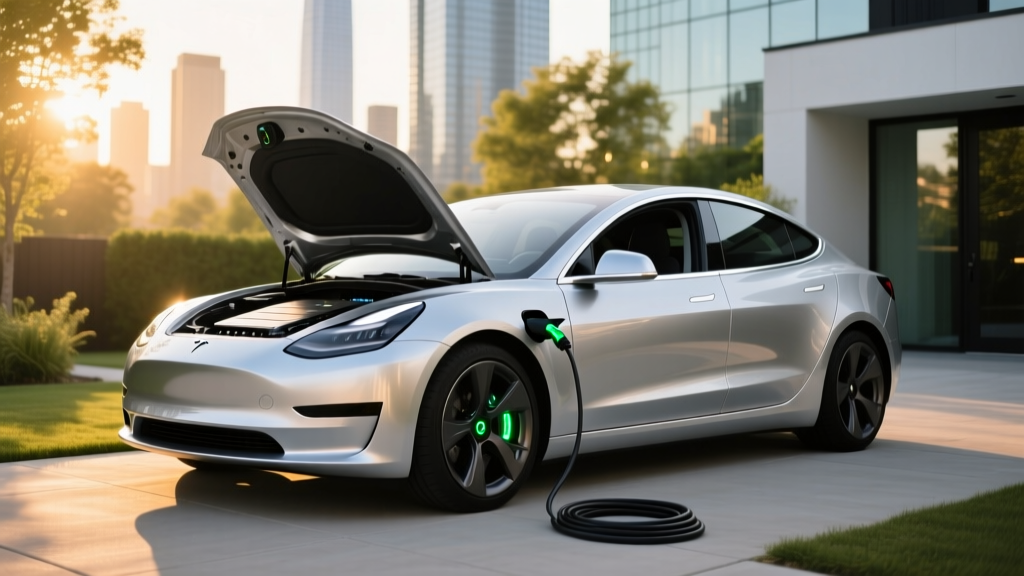
For home charging, Tesla's Wall Connector at $420 (equipment only) delivers up to 11.5 kW on a 60-amp circuit. Most owners find a full overnight charge adds more than enough range for the next day's driving. Installation costs vary widely by region and electrical panel condition, typically ranging from $500 to $2,500 for the electrician's work.
Battery Chemistry: LFP vs. NMC — Which Model 3 Gets Which?
This is one of the most consequential distinctions in the 2026 Model 3 lineup, and it's something many buyers overlook:
| Factor | LFP (RWD Base Model) | NMC (Long Range / Performance) |
|---|---|---|
| Energy Density | Lower (heavier pack for same kWh) | Higher |
| Cycle Life | Longer (3,000+ cycles) | Shorter (~1,500-2,000 cycles) |
| Cold-Weather Performance | Weaker (more range loss below 32°F) | Better |
| Recommended Daily Charge | 100% (Tesla recommends regular full charges) | 80% daily, 100% only for trips |
| Fast-Charge Speed | Slower (170 kW peak) | Faster (250 kW peak) |
| Cost | Lower (reflected in RWD's lower MSRP) | Higher |
The practical implication: if you live in a cold climate and take frequent road trips, the Long Range AWD with its NMC battery and faster charging is the stronger choice. If you're a commuter in a moderate climate who can charge at home every night, the RWD's LFP battery offers exceptional longevity and the freedom to charge to 100% daily without degradation concerns.
Pricing, Trims, and Federal Tax Credit Eligibility
| Trim | Base MSRP | Federal Credit (§30D) | Effective Price (if eligible) |
|---|---|---|---|
| RWD | $38,990 | Up to $7,500 | ~$31,490 |
| Long Range AWD | $47,740 | Up to $7,500 | ~$40,240 |
| Performance | $54,990 | Up to $7,500 | ~$47,490 |
Critical eligibility caveats: The federal §30D tax credit is not guaranteed for every buyer. As of 2026, the following rules apply, per IRS guidelines:
- MSRP Cap: Sedans must have an MSRP at or below $55,000. This means the Model 3 Performance ($54,990) qualifies, but any added options pushing the price above $55,000 would disqualify it.
- Buyer Income Cap: Modified Adjusted Gross Income (MAGI) must not exceed $150,000 (single filers), $225,000 (head of household), or $300,000 (joint filers).
- Battery Sourcing Requirements: A percentage of critical minerals and battery components must be sourced from the U.S. or free-trade-agreement partners. These requirements tighten annually. Verify current-year compliance on the IRS qualified vehicles list before purchasing.
- Point-of-Sale Transfer: As of 2024, eligible buyers can transfer the credit to the dealer at purchase, reducing the upfront cost rather than waiting for a tax refund.
Consult a tax professional to confirm your personal eligibility. State and local incentives may stack on top of the federal credit — check your state's energy office or AFDC incentive database for details.
Interior, Tech, and Daily Practicality
The refreshed Model 3 (introduced for the 2024 model year and carried into 2026) features a noticeably quieter cabin, ventilated front seats, a rear passenger touchscreen, and ambient lighting. The minimalist interior remains polarizing — nearly all vehicle controls are accessed through the 15.4-inch center touchscreen, including climate, mirrors, and glovebox. There are no physical stalks for turn signals or gear selection; these are handled by steering-wheel buttons and the touchscreen.
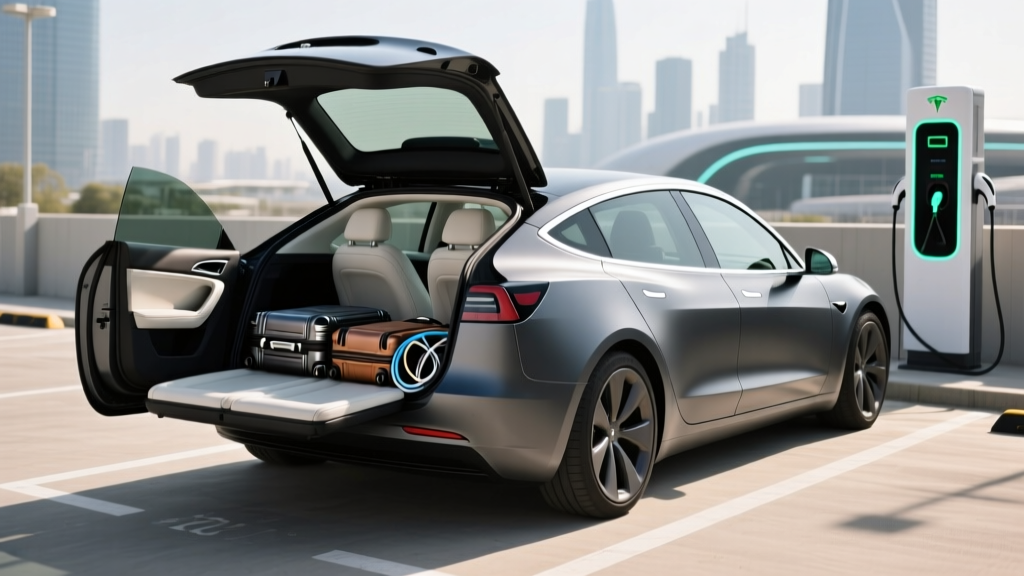
Cargo and passenger space: The Model 3 offers 23 cubic feet of combined storage (trunk plus front trunk/frunk), which is competitive for the compact luxury sedan segment. Rear legroom measures 35.3 inches — adequate for adults on shorter trips but tighter than a midsize SUV. The rear center seat is best suited for a child or short trips due to the raised floor and narrow cushion.
Standout tech: Tesla's infotainment system remains the most responsive and feature-rich in the EV market, with native navigation, streaming, gaming (while parked), and dashcam recording. The Tesla mobile app offers industry-leading remote features: preconditioning, location tracking, Sentry Mode alerts, and software update scheduling.
Notable drawbacks: The absence of Apple CarPlay and Android Auto frustrates some buyers. Turn-signal buttons on the steering wheel (rather than a traditional stalk) require a learning period, and many drivers report frustration during roundabouts or lane-change-heavy commutes. The panoramic glass roof offers no shade, which can make the cabin uncomfortably warm in hot climates without aftermarket tinting or a sunshade.
Pros and Cons: An Honest Assessment
- Best-in-class Supercharger network access
- Exceptional energy efficiency (132 MPGe on RWD)
- LFP battery on RWD offers long cycle life and 100% daily charging
- OTA software updates continuously improve the vehicle
- Industry-leading infotainment and app integration
- Strong resale value relative to most EVs
- Qualifies for full $7,500 federal tax credit (if eligible)
- No Apple CarPlay / Android Auto
- Steering-wheel turn-signal buttons are a learned behavior
- Phantom braking on Autopilot remains unresolved
- Rear seat is tighter than crossover competitors
- No physical climate controls — everything is touchscreen
- Glass roof lacks a built-in shade
- RWD's 170 kW peak charge rate is slower than rivals
Who Should Buy the 2026 Tesla Model 3?
Choose the Model 3 RWD if: You're a commuter with reliable home charging, live in a moderate climate, want the lowest entry price, and value long battery cycle life over fast road-trip charging.
Choose the Model 3 Long Range AWD if: You take regular road trips, live in a cold-weather region, need dual-motor traction, and want the fastest Supercharger charge times.
Choose the Model 3 Performance if: You want sports-car acceleration (2.9 sec 0-60), track capability, and don't mind sacrificing some range for performance.
Look elsewhere if: You need third-row seating, prefer traditional physical controls, want Apple CarPlay, or require a hatchback/wagon cargo configuration (consider the Model Y instead).
Frequently Asked Questions
What is the real-world range of the Tesla Model 3?
The EPA rates the Long Range AWD at 346 miles and the RWD at 363 miles. In real-world highway driving at sustained speeds of 70-75 mph, expect 290-320 miles. Cold weather (below freezing) can reduce range by 20-30%, bringing effective range to 240-270 miles for the Long Range trim. City driving with regenerative braking typically matches or slightly exceeds EPA estimates.
How fast does the Tesla Model 3 charge?
On a V3 Supercharger (DC fast charging), the Long Range and Performance trims peak at 250 kW, achieving a 10-80% charge in approximately 25 minutes. The RWD peaks at 170 kW, taking roughly 30 minutes for 10-80%. At home on a Level 2 Wall Connector (11.5 kW), a full charge takes 6-8 hours depending on trim, adding 37-44 miles of range per hour.
Does the Tesla Model 3 qualify for the federal EV tax credit?
All three trims of the 2026 Model 3 fall under the $55,000 MSRP cap for sedans, making them potentially eligible for up to $7,500 under IRS §30D. However, buyer income limits ($150K single / $300K joint), battery component sourcing requirements, and point-of-sale transfer rules all apply. Always verify eligibility on the IRS qualified vehicles page and consult a tax professional before purchasing.
Is the Tesla Model 3 worth buying vs. competitors?
Against the Hyundai Ioniq 6 (EPA 361 mi, starting ~$37,500) and BMW i4 (EPA 307 mi, starting ~$52,200), the Model 3 holds advantages in charging network access, software integration, and efficiency. The Ioniq 6 offers more rear headroom and physical controls. The BMW i4 provides a more traditional luxury interior and Apple CarPlay. If Supercharger access and software matter most, the Model 3 remains the benchmark. If you value interior refinement or CarPlay, test-drive the alternatives.
How long will the Tesla Model 3 battery last?
Tesla warranties the battery and drive unit for 8 years / 100,000 miles on the RWD and 8 years / 120,000 miles on Long Range and Performance trims, guaranteeing a minimum of 70% capacity retention. Real-world data from high-mileage owners suggests NMC packs typically retain 85-90% capacity at 100,000 miles with proper charging habits. LFP packs in the RWD may outlast NMC in cycle count, though cold-weather range loss is more pronounced.
What does the latest Tesla Model 3 software update add?
The 2026 software updates have improved battery preconditioning for faster cold-weather Supercharging, refined FSD (Supervised) urban driving behavior, added customizable home-screen widgets, enhanced Sentry Mode motion detection, and improved trip energy prediction accuracy. Updates are delivered OTA, typically requiring the vehicle to be parked and connected to Wi-Fi for installation.
For the most current EPA ratings, visit fueleconomy.gov. Tesla specifications and software features are subject to change with OTA updates; verify current features at tesla.com.