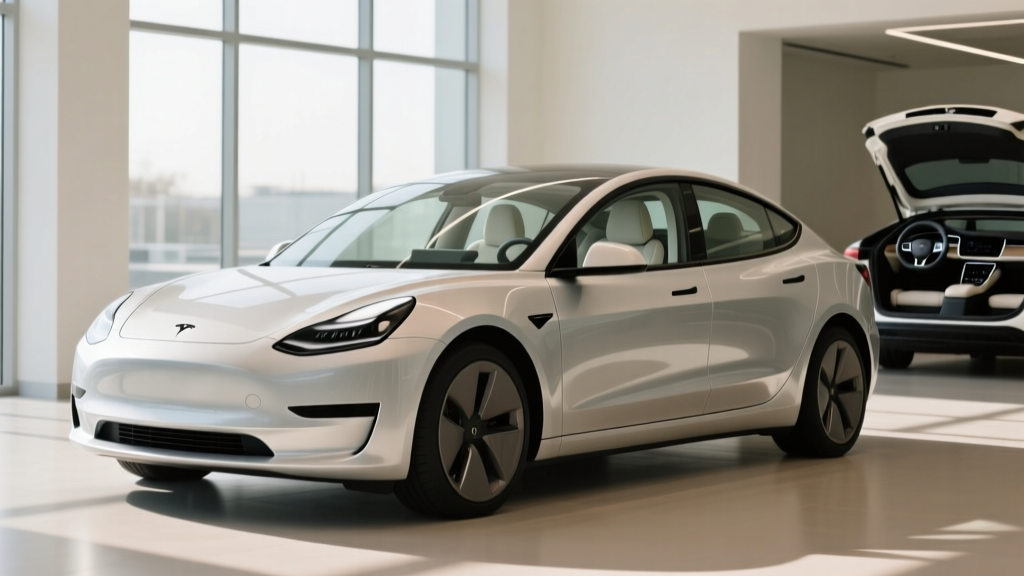
Shoppers searching for the size of Tesla 3 usually have one of two questions: will it fit in my garage, and will it fit my life? The 2026 Tesla Model 3 remains one of the most popular entry-luxury electric sedans on the market, but its sleek fastback silhouette creates real trade-offs in rear headroom and cargo flexibility that buyers need to understand before signing a purchase agreement.
After extensive time behind the wheel, at the charger, and with a tape measure in hand, here is the definitive breakdown of the Model 3's exterior footprint, interior volume, and how its dimensions compare to the EVs it actually competes against — plus the range, charging, and pricing data you need to evaluate the whole package.
Exterior Dimensions: How the Model 3 Fits in the Real World
The Model 3 sits firmly in the compact executive sedan segment, competing on footprint with the BMW 3 Series, Hyundai Ioniq 6, and Polestar 2. It is noticeably smaller than the Tesla Model S and Model Y, which matters for garage fitment and urban parking.
| Dimension | Measurement |
|---|---|
| Overall Length | 184.8 in (4,694 mm) |
| Overall Width (mirrors folded) | 72.8 in (1,849 mm) |
| Overall Width (mirrors out) | 82.2 in (2,089 mm) |
| Height | 56.8 in (1,443 mm) |
| Wheelbase | 113.2 in (2,875 mm) |
| Ground Clearance | 5.5 in (140 mm) |
| Curb Weight (RWD) | 3,862 lbs |
| Curb Weight (Long Range AWD) | 4,034 lbs |
| Turning Circle | 38.8 ft |
The 5.5 inches of ground clearance is on the low side — something to keep in mind if you regularly navigate steep driveways, speed bumps, or unplowed winter roads. The turning circle of 38.8 feet is average for the segment and makes U-turns on two-lane roads manageable but not effortless.
Interior Volume and Passenger Space
This is where the size of Tesla 3 generates the most debate. Front-seat occupants get generous space with excellent outward visibility. The rear seat is where compromises appear, particularly for taller passengers.
| Measurement | Front | Rear |
|---|---|---|
| Headroom | 40.3 in | 37.8 in |
| Legroom | 42.7 in | 35.2 in |
| Shoulder Room | 56.5 in | 54.0 in |
| Hip Room | 53.4 in | 52.4 in |
The 37.8 inches of rear headroom is the critical number. Passengers over 6 feet tall will notice the sloping roofline cutting into head space, especially when sitting upright. The 35.2 inches of rear legroom is adequate for average-height adults on trips around town but will feel tight on long road trips compared to a Hyundai Ioniq 5 (39.4 in rear legroom) or the Model Y (40.9 in). The rear middle seat is best reserved for children — the transmission tunnel hump (housing wiring and structural elements) and narrow shoulder room make it uncomfortable for a third adult.
Cargo Capacity: Trunk, Frunk, and Real-World Utility
The Model 3 uses a traditional sedan trunk opening rather than a hatchback liftgate, which limits its ability to swallow bulky items despite respectable total volume numbers.
| Area | Volume |
|---|---|
| Rear Trunk | 21.0 cu ft |
| Front Trunk (Frunk) | 3.1 cu ft |
| Total Cargo | 24.1 cu ft |
For context, the Tesla Model Y offers 30.2 cu ft behind the rear seats (76.2 cu ft with them folded), and the Hyundai Ioniq 5 provides 27.2 cu ft behind the rear row with its hatchback design. The Model 3's trunk is deep and wide enough for 3–4 roll-aboard suitcases, and the 60/40 split-folding rear seats let you slide in longer items like skis or flat-pack furniture through the pass-through. But the narrow trunk aperture means you cannot load a full-size bicycle or large dog crate the way you could in a hatchback or crossover.
The 3.1 cu ft frunk is useful for charging cables, a small bag of groceries, or a laptop bag — but it is not a substitute for real cargo space.
The 2026 Model 3 Long Range AWD carries an EPA-estimated 363 miles of range. In real-world highway driving at 70–75 mph with climate control active, expect roughly 300–320 miles before needing to charge. In cold weather (below 32°F), range can drop 20–30%, putting realistic winter highway range at approximately 250–280 miles. The RWD model (EPA 272 mi) realistically delivers 220–240 miles on the highway in moderate temperatures.
Range, Battery, and Efficiency by Trim
The 2026 Model 3 lineup offers three configurations, each with a different battery chemistry and range profile.
| Spec | RWD (Standard Range) | Long Range AWD | Performance AWD |
|---|---|---|---|
| EPA Range | 272 mi | 363 mi | 315 mi |
| Battery (Usable) | ~60 kWh (LFP) | ~75 kWh (NMC) | ~75 kWh (NMC) |
| Drivetrain | Rear-Wheel Drive | Dual-Motor AWD | Dual-Motor AWD |
| Horsepower | 271 hp | 346 hp | 510 hp |
| 0–60 mph | 5.8 sec | 4.2 sec | 2.9 sec |
| MPGe (Combined) | 132 MPGe | 125 MPGe | 113 MPGe |
| kWh/100 mi | 25 kWh | 27 kWh | 30 kWh |
| Top Speed | 125 mph | 125 mph | 163 mph |
The RWD model uses a lithium iron phosphate (LFP) battery, which trades some energy density for longer cycle life, lower degradation, and the ability to charge to 100% daily without accelerating wear. Tesla recommends periodic 100% charges on LFP packs for accurate state-of-charge calibration. The Long Range and Performance trims use nickel manganese cobalt (NMC) chemistry, which offers higher energy density (hence the longer range) but benefits from daily charging limits of 80–90% to maximize longevity.
The RWD trim's 132 MPGe combined makes it one of the most efficient EVs in its price class — translating to roughly $0.04–$0.06 per mile on the national average electricity rate of $0.17/kWh when charging at home.
Charging Speed: DC Fast Charging and Home Level 2
Charging speed is where Model 3 ownership either thrives or frustrates, depending on your setup. The 2025 refresh (carried into 2026) brought meaningful improvements to the charging architecture.
| Charging Level | Max Rate | Speed / Time |
|---|---|---|
| Level 1 (120V household) | ~1.4 kW | ~3–4 miles per hour |
| Level 2 (240V home / public AC) | 11.5 kW (48A) | ~37–44 miles per hour; full charge in ~7–9 hrs |
| DC Fast Charge (CCS/NACS) | 250 kW peak | 10–80% in ~25 min (Long Range); ~22 min (RWD) |
A critical detail: the 250 kW peak is just that — a peak. The Model 3 Long Range sustains roughly 170–200 kW between 10% and 45% SoC, then tapers progressively. From 80% to 100%, the rate drops dramatically to protect the battery, adding 15–20 minutes for the final 20%. For road trips, the practical strategy is charging from 10–80% and driving on, which keeps total stop time around 25–30 minutes at a V3 Supercharger or equivalent 250+ kW station.
For home charging, a 48-amp Level 2 wall connector on a 60-amp circuit delivers a full overnight charge for any daily commute. Most Model 3 owners report that home Level 2 charging eliminates range anxiety entirely for weekday driving — the car is always "full" every morning.
The Model 3 uses the NACS (North American Charging Standard) connector natively, giving it seamless access to the entire Tesla Supercharger network — over 6,500 V3/V4 stations across North America as of early 2026. With a simple adapter, CCS stations (Electrify America, EVgo) are also accessible.
Pricing, Trims, and Federal Tax Credit Eligibility
The Model 3's pricing positions it against the Hyundai Ioniq 6, BMW i4, and Polestar 2, with the Long Range variant offering the strongest value proposition for buyers who need real road-trip range.
| Trim | Base MSRP | Est. After §30D Credit | §30D Eligible? |
|---|---|---|---|
| RWD (Standard Range) | $38,990 | ~$31,490 | Yes — qualifies for up to $7,500 |
| Long Range AWD | $45,740 | ~$38,240 | Yes — qualifies for up to $7,500 |
| Performance AWD | $52,990 | ~$45,490 | Yes — qualifies for up to $7,500 |
Federal tax credit caveats: Under IRS §30D rules, the $7,500 credit requires the buyer to meet income caps (modified AGI ≤ $150,000 single / $300,000 joint), the vehicle MSRP must be ≤ $55,000 for sedans (all Model 3 trims qualify), and the battery must meet critical-mineral and battery-component sourcing thresholds that shift annually. As of 2026, Tesla's US-assembled battery supply chain continues to satisfy these requirements, but eligibility can change with supply-chain shifts. The credit can be transferred to the dealer at point of sale as an instant discount. Always confirm current eligibility with your tax professional before purchase.
Technology, Driver Assistance, and Notable Drawbacks
The Model 3's cabin is defined by its 15.4-inch center touchscreen, which handles everything from navigation and media to climate controls and glovebox release. The "Highland" refresh (introduced for the 2025 model year and carried forward) added ventilated front seats, ambient lighting, rear-seat ventilation, a rear touchscreen for passengers, improved sound insulation, and a redesigned steering wheel.
Driver assistance: Basic Autopilot (adaptive cruise + lane centering) is standard. Tesla's Full Self-Driving (Supervised) remains a $8,000 add-on or $99/month subscription. Per SAE classification, FSD is a Level 2 system — the driver must remain fully attentive, hands on or near the wheel, and eyes on the road at all times. It is not autonomous driving.
Autopilot and FSD (Supervised) are SAE Level 2 driver-assistance systems. They do NOT make the Model 3 self-driving. The driver is legally and operationally responsible for the vehicle at all times. Performance degrades in construction zones, heavy rain, faded lane markings, and unmapped roads.
Notable drawbacks:
- No physical instrument cluster — speed and navigation are displayed on the center screen only, which requires glancing right.
- Turn-signal buttons on the steering wheel (replacing the traditional stalk in the Highland refresh) draw consistent complaints from new owners adapting to the change.
- Firm ride quality — improved over pre-2025 models but still firmer than an Ioniq 6 or BMW i4, especially on 19-inch wheels.
- Minimal physical controls — even glovebox release and mirror adjustments are touchscreen-driven.
- No Apple CarPlay or Android Auto — Tesla's proprietary infotainment is the only option.
How the Model 3 Size Compares to Key Competitors
| Spec | Tesla Model 3 LR | Hyundai Ioniq 6 SE | BMW i4 eDrive40 | Polestar 2 LR |
|---|---|---|---|---|
| Length | 184.8 in | 191.1 in | 188.3 in | 181.3 in |
| Rear Legroom | 35.2 in | 35.7 in | 34.7 in | 33.4 in |
| Cargo (Total) | 24.1 cu ft | 12.3 cu ft (trunk) | 16.6 cu ft (liftgate) | 14.4 cu ft (liftgate) |
| EPA Range | 363 mi | 361 mi | 318 mi | 320 mi |
| Base MSRP | $45,740 | $38,650 | $57,900 | $51,300 |
The Ioniq 6 matches the Model 3 on range at a lower price but offers less cargo space and slower DC charging (~240 kW peak, with a flatter curve). The BMW i4 delivers superior ride refinement and a physical instrument cluster but costs significantly more and offers less range. The Polestar 2 is the shortest of the group, with the least rear-seat space.
Warranty and Long-Term Ownership
| Component | Coverage |
|---|---|
| Basic Vehicle | 4 years / 50,000 miles |
| Battery & Drive Unit (RWD) | 8 years / 100,000 miles |
| Battery & Drive Unit (LR / Perf) | 8 years / 120,000 miles |
| Battery Retention Threshold | 70% capacity during warranty period |
Tesla's battery warranty guarantees that the pack will retain at least 70% of its original capacity during the warranty period. In practice, EPA data and owner surveys indicate that Model 3 NMC packs typically degrade 5–8% over the first 100,000 miles, with LFP packs showing even slower degradation thanks to the chemistry's inherent stability. Battery replacement outside of warranty currently ranges from $12,000–$16,000 depending on pack size and labor — a figure that continues to decline as supply chains mature.
Who the Tesla Model 3 Is Best For
- Class-leading 363-mile EPA range (Long Range)
- Best-in-class Supercharger network access
- Industry-leading efficiency (25–30 kWh/100 mi)
- Strong over-the-air update cadence
- LFP option (RWD) allows daily 100% charging
- Excellent safety ratings (IIHS Top Safety Pick+)
- Cramped rear seat for tall passengers
- Sedan trunk limits cargo flexibility vs hatchbacks
- No Apple CarPlay / Android Auto
- Turn-signal buttons require adaptation
- All controls are touchscreen-dependent
- Low ground clearance (5.5 in)
Choose the Model 3 if: You are a 1–2 person household (or a family with young children) who prioritizes driving range, charging convenience, and software-driven tech over rear-seat space and cargo versatility. It is ideal for daily commuters with home charging access and road-trippers who value the Supercharger network.
Look elsewhere if: You regularly carry adult rear-seat passengers, need hatchback cargo flexibility (consider the Model Y, Ioniq 5, or Kia EV6), or prefer physical buttons and Apple CarPlay integration.
- Commuter (under 80 mi/day round trip): RWD trim is the value pick — $31,490 after credit, charges fully overnight on Level 2.
- Road-tripper / single-car household: Long Range AWD is the sweet spot — 363 mi EPA, dual motor for snow/rain confidence.
- Family with teens or frequent rear passengers: Consider the Model Y or Ioniq 5 instead — the Model 3's rear seat is a real limitation.
- Performance enthusiast: Performance trim delivers supercar-rivaling 2.9-sec 0–60 but sacrifices 48 miles of range and $7,250 over the Long Range.
Frequently Asked Questions
What is the real-world range of the Tesla Model 3?
The Long Range AWD is EPA-rated at 363 miles. In real-world highway driving at 70–75 mph in moderate temperatures, expect 300–320 miles. In winter conditions below freezing, that drops to roughly 250–280 miles. The RWD model (272 mi EPA) delivers about 220–240 real-world highway miles.
How fast does the Model 3 charge at home and on the road?
At home on a 240V Level 2 charger (48A), the Model 3 adds roughly 37–44 miles of range per hour, reaching a full charge overnight in 7–9 hours. On a DC fast charger, it peaks at 250 kW and charges from 10–80% in approximately 25 minutes (Long Range) or 22 minutes (RWD), though the rate tapers significantly above 80%.
How much does the Model 3 cost after the federal tax credit?
The RWD starts at $38,990 and drops to approximately $31,490 after the $7,500 §30D credit. The Long Range AWD starts at $45,740 (~$38,240 after credit). Eligibility depends on buyer income (≤$150K single / ≤$300K joint), the vehicle's MSRP cap compliance (sedans ≤$55K — all trims qualify), and battery sourcing requirements. Always verify current rules at IRS.gov.
Does the Tesla Model 3 qualify for the federal EV tax credit?
Yes — as of 2026, all Model 3 trims qualify for the full $7,500 federal tax credit under §30D, provided the buyer meets income limits. The credit can be applied as a point-of-sale discount at the dealer. Battery sourcing and MSRP requirements are currently met by Tesla's US production. Rules can change annually, so confirm before purchasing.
Is the Model 3 big enough for a family?
For a family with one or two young children, yes. The rear seat accommodates child seats well, and the 24.1 cu ft of total cargo handles strollers and groceries. However, families with taller teenagers or those who regularly haul bulky cargo (bikes, large dog crates) will find the Model Y or a midsize EV crossover more practical due to the Model 3's sloping roofline and sedan trunk opening.
Is the Model 3 worth buying over the Hyundai Ioniq 6 or BMW i4?
If Supercharger access, maximum range, and software features are your priorities, the Model 3 Long Range is the strongest overall value at ~$38,240 after the credit. The Ioniq 6 SE undercuts it on price with comparable range but slower charging and a smaller dealer network. The BMW i4 offers a more traditional luxury experience and physical controls but costs $12,000+ more with less range.