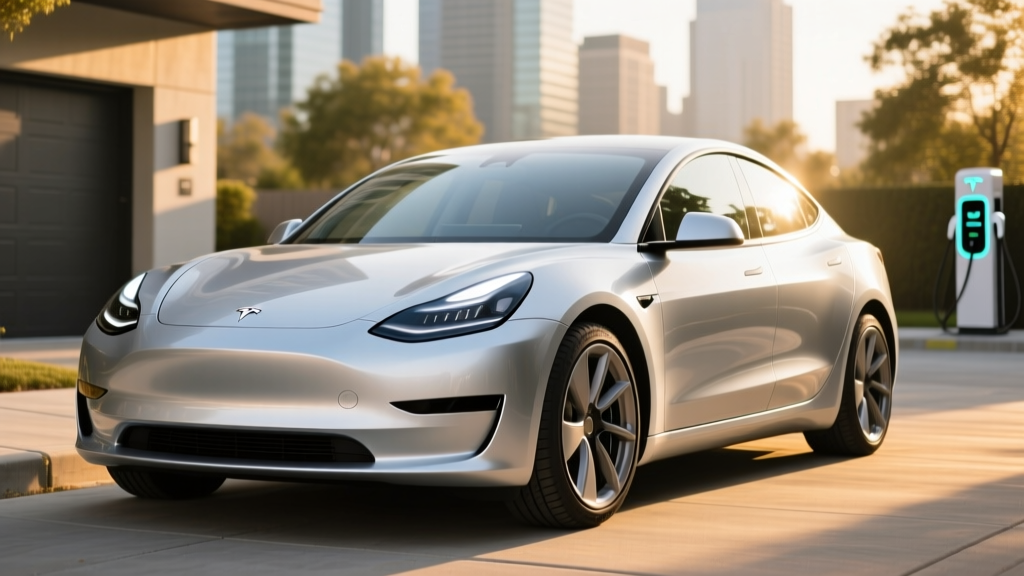
Silver remains one of the most requested exterior colors for the Tesla Model 3, and for good reason: it hides road grime better than black, reflects heat in summer, and carries no upcharge on most trims. But color is just the wrapper. What matters is what's underneath the Quicksilver or Stealth Grey paint of the 2026 Model 3 — a matured, refreshed sedan that competes fiercely with the Hyundai Ioniq 6, BMW i4, and Polestar 2 on range, charging speed, and software.
This review covers the 2026 Tesla Model 3 (Long Range RWD and AWD variants most commonly ordered in silver finishes) with exact EPA data, real-world range expectations, charging curves, and ownership economics. If you're cross-shopping a silver Model 3 against the field, here's what the numbers actually say.
2026 Tesla Model 3 Silver: Quick Spec Overview
| Spec | Long Range RWD | Long Range AWD | Performance AWD |
|---|---|---|---|
| EPA Range | 363 mi | 346 mi | 315 mi |
| Battery (usable) | ~75 kWh (NMC) | ~75 kWh (NMC) | ~75 kWh (NMC) |
| 0–60 mph | 4.9 sec | 4.2 sec | 2.9 sec |
| Horsepower | ~346 hp | ~384 hp | ~510 hp |
| Drivetrain | RWD (single motor) | AWD (dual motor) | AWD (dual motor) |
| Peak DC Charge | 250 kW | 250 kW | 250 kW |
| 10–80% DC Time | ~25 min | ~25 min | ~25 min |
| Level 2 (11.5 kW) | ~44 mi/hr | ~44 mi/hr | ~44 mi/hr |
| MPGe (combined) | 132 MPGe | 125 MPGe | 115 MPGe |
| Base MSRP | $44,130 | $47,130 | $54,630 |
Source: fueleconomy.gov, Tesla.com. MSRP excludes destination.
Real-World Range: What the EPA Sticker Doesn't Tell You
EPA Combined: 363 mi (Long Range RWD) / 346 mi (AWD)
Real-World Expectation: ~290–320 mi highway (70–80 mph); ~250–280 mi in sub-35°F winter; ~340+ mi city/commute with regen.
The Model 3 Long Range's 363-mile EPA figure is among the highest of any non-luxury EV sedan. But EPA tests weight city and highway driving at 55/45, and the Model 3's slick aerodynamics (0.219 Cd) reward steady-speed highway cruising while punishing aggressive acceleration.
In independent highway range tests at 70 mph in 65–75°F conditions, the Long Range AWD typically delivers 300–315 miles before the buffer runs out. Drop to 45 mph in city/suburban driving with regen on, and 340+ miles is realistic. Cold weather (below 35°F) without preconditioning can cut range by 25–30%, bringing real-world winter range closer to 240–260 miles for the AWD model.
The Performance trim trades roughly 30–50 miles of range for its 2.9-second 0–60 sprint and track-oriented suspension. If you're buying a Model 3 for road trips, the Long Range RWD is the efficiency king of the lineup.
Charging Speed: DC Fast, Level 2, and the Supercharger Advantage
| Charging Level | Power / Rate | Miles Added per Hour | Notes |
|---|---|---|---|
| Level 1 (120V) | ~1.4 kW | ~5 mi/hr | Emergency/trickle only |
| Level 2 (240V, 48A) | 11.5 kW | ~44 mi/hr | Full overnight charge in ~8 hr |
| DC Fast (Supercharger V3) | Peak 250 kW | ~170 mi in 15 min | 10–80% in ~25 min |
| DC Fast (CCS via adapter) | Peak ~150–200 kW | Varies by station | Non-Tesla networks; taper more aggressively |
The Model 3 uses the NACS (North American Charging Standard) connector natively. Tesla's Supercharger network remains the gold standard for reliability, with V3 stalls delivering up to 250 kW.
Charging curve reality: The 250 kW peak only holds from roughly 5–25% State of Charge (SoC). Above 40%, the curve tapers to ~150 kW, and above 80% it drops sharply to ~40–60 kW to protect the NMC cells. This means the advertised 10–80% time of ~25 minutes is accurate, but 10–90% takes closer to 40 minutes. For road trips, plan to charge to 80% and go — the last 20% isn't worth the wait.
For home charging, a 48-amp Level 2 wall connector on a 60-amp circuit delivers a full charge overnight. Tesla's Mobile Connector with a NEMA 14-50 outlet is the budget option at ~32A / 7.7 kW (~30 mi/hr).
Pricing, Trims, and Federal Tax Credit Eligibility
| Trim | Base MSRP | Est. After §30D Credit* | Destination |
|---|---|---|---|
| Long Range RWD | $44,130 | ~$36,630 | $1,390 |
| Long Range AWD | $47,130 | ~$39,630 | $1,390 |
| Performance AWD | $54,630 | ~$47,130 | $1,390 |
*§30D Federal Tax Credit Caveats: The $7,500 credit under IRS §30D is NOT automatic. Eligibility requires:
- MSRP Cap: Sedans must be ≤$55,000 (all Model 3 trims qualify)
- Income Cap: AGI ≤$150,000 single / $225,000 head of household / $300,000 joint
- Battery Sourcing: Critical minerals and battery components must meet phased-in percentages — verify on Tesla's checkout page at time of order
- Point-of-Sale Transfer: You can transfer the credit to the dealer for an upfront price reduction (effective 2024+)
The Model 3's North American final assembly (Fremont, CA) satisfies the assembly requirement, but battery-sourcing rules tighten annually. Always confirm eligibility in the tax year you take delivery — and consult a tax professional for your specific situation.
Interior, Cargo, and Daily Usability
The 2026 Model 3 "Highland" refresh addressed the biggest complaints of earlier years: ride harshness, cabin noise, and rear-seat comfort. Acoustic glass all around, revised dampers, and ventilated front seats are now standard.
Cargo: 23 cu ft trunk + rear frunk (roughly 3.1 cu ft). That's competitive with the Ioniq 6 (11.2 cu ft trunk but larger frunk) and significantly more usable than the Polestar 2's liftback.
Passenger space: Front legroom is generous at 42.2 inches; rear legroom is 35.3 inches — adequate for adults on short trips but tighter than a Hyundai Ioniq 5 or BMW i4. The low roofline cuts headroom for anyone over 6 feet in the rear.
Infotainment: All controls route through a 15.4-inch center touchscreen. No instrument cluster, no physical stalks (turn signals are on the steering wheel rim). This remains polarizing: minimalist enthusiasts love it; traditionalists find it distracting. The rear 8-inch screen for climate and media is a welcome addition for passengers.
Autopilot, FSD, and Driver Assistance
SAE Level 2 — Driver Supervision Required. Tesla Autopilot and FSD (Supervised) are NOT self-driving systems. You must keep hands on the wheel and eyes on the road at all times. Only Waymo and Zoox robotaxi services operate at Level 4.
Standard Autopilot includes Traffic-Aware Cruise Control and Autosteer (lane centering) on divided highways. The optional Full Self-Driving (Supervised) package ($8,000 or $99/mo subscription as of 2026) adds Navigate on Autopilot, Auto Lane Change, Autopark, and Smart Summon.
FSD has improved substantially in city driving via end-to-end neural networks, but it still makes unpredictable decisions at unprotected left turns, construction zones, and complex intersections. It's a compelling assist system for long highway stretches — not a replacement for an attentive driver.
Pros, Cons, and Who Should Buy a Silver Model 3
Pros
- Class-leading EPA range (363 mi on LR RWD)
- Supercharger network reliability
- 250 kW peak DC charging, 10–80% in ~25 min
- OTA updates continuously add features
- Strong resale value vs. competitors
- Silver paint hides dirt, reflects heat — no upcharge
Cons
- No physical stalks or buttons — steep learning curve
- Rear seat legroom tight for tall adults
- FSD is expensive and still Level 2 only
- No Apple CarPlay / Android Auto
- NMC battery degrades faster than LFP if charged to 100% daily
Choose the Model 3 Silver if: You want maximum range in a sedan, rely on road-trip charging infrastructure, and prefer Tesla's software ecosystem.
Look at the Ioniq 6 or BMW i4 instead if: You need physical controls, rear-seat space for adults, or prefer Apple CarPlay integration.
Battery Warranty and Longevity
Tesla covers the Model 3 Long Range battery and drive unit for 8 years / 120,000 miles (whichever comes first), with a guaranteed minimum 70% capacity retention over that period. The NMC chemistry in Long Range and Performance models is energy-dense but slightly more prone to degradation than the LFP cells in the RWD Standard Range model.
Longevity tip: Set your daily charge limit to 80% and only charge to 100% for road trips. Avoid leaving the car at 100% SoC for extended periods. Data from fleet analytics firm Recurrent shows Model 3 batteries retaining ~90% capacity at 100,000 miles when charged responsibly.
Frequently Asked Questions
What is the real-world range of the Tesla Model 3 Long Range?
Expect ~300–315 miles at highway speeds (70 mph) in mild weather, ~340+ miles in city driving, and ~240–260 miles in sub-freezing winter conditions. The EPA 363-mile figure assumes a mix of city and highway driving at moderate temperatures.
How fast does the Model 3 charge at home and on the road?
On a 48-amp Level 2 home charger (11.5 kW), it adds ~44 miles per hour, fully charging overnight in ~8 hours. On a Tesla V3 Supercharger, it peaks at 250 kW and charges 10–80% in ~25 minutes. Charging above 80% slows dramatically.
Does the 2026 Tesla Model 3 qualify for the $7,500 federal tax credit?
It can — all trims fall under the $55,000 sedan MSRP cap. But buyer income limits ($150K single / $300K joint) and battery-sourcing requirements apply. Verify on IRS.gov and Tesla's checkout page before ordering.
Is the Model 3 worth it vs. the Hyundai Ioniq 6 or BMW i4?
The Model 3 wins on range, Supercharger access, and software. The Ioniq 6 offers an 800V architecture for faster charging (10–80% in 18 min at 350 kW) and physical controls. The BMW i4 delivers superior build quality and Apple CarPlay but less range and higher pricing.
Is silver a good color for the Model 3?
Quicksilver and Stealth Grey are popular for practical reasons: they hide road dust and minor scratches better than solid black or white, and they reflect solar heat, reducing cabin temperatures in summer. Neither carries an upcharge on most trims.