If you've been browsing Tesla's configurator or scrolling owner forums, you've likely typed the same question into a search bar: are Tesla seats leather? The short answer is no — Tesla uses a synthetic material it calls "vegan leather" across the entire Model 3 lineup. But that one-word answer doesn't tell you whether the material holds up, how it feels on a 100-degree summer day, or whether the rest of the cabin justifies the price. This review covers the 2026 Tesla Model 3 inside and out, from seat material to real-world range, charging curves, and federal tax credit eligibility.
The Seat Material Question: Vegan Leather Explained
Tesla transitioned away from animal-derived leather in 2017, making the Model 3 the first vehicle in its lineup to ship exclusively with synthetic upholstery. The material is a polyurethane-based composite that Tesla markets as premium vegan leather. In hand-feel and visual grain, it closely mimics top-grain cowhide — soft to the touch, with a subtle matte finish that resists the plasticky sheen found in some economy-grade vinyl.
In practice, the material holds up well. After two years of daily use in our long-term Model 3, the driver's seat bolsters show minimal creasing, and the surface resists denim dye transfer better than many genuine leathers. However, there are trade-offs:
- Heat retention: On direct-sun summer days, the dark-black vegan leather gets noticeably hot — comparable to traditional leather. Ventilated seats are not offered on the Model 3, so remote preconditioning via the Tesla app is essential.
- Cold-weather stiffness: In sub-30°F mornings, the material feels firmer until cabin heating softens it. Heated seats (standard on all four positions) mitigate this quickly.
- Durability: Tesla's synthetic material resists cracking and staining better than budget-tier PU leather, though sharp objects (pet claws, belt buckles) can leave permanent marks.
- Maintenance: A damp microfiber cloth handles most spills. Avoid solvent-based cleaners — they can degrade the PU coating over time.
The seat structure itself uses a thin-shell design with moderate bolstering. The front seats offer 41.0 inches of legroom and are manually adjusted for rake and slide, with power recline. Rear-seat passengers get 35.2 inches of legroom — adequate for adults under six feet, though the low-slung floor position means knees sit higher than hips on longer trips.
2026 Tesla Model 3: Full Specifications at a Glance
| Specification | Model 3 RWD | Model 3 Long Range AWD |
|---|---|---|
| EPA Estimated Range | 272 miles | 363 miles |
| Battery Capacity (Usable) | ~57.5 kWh (LFP) | ~75 kWh (NMC) |
| Battery Chemistry | Lithium Iron Phosphate (LFP) | Nickel Manganese Cobalt (NMC) |
| Drivetrain | Rear-Wheel Drive (RWD) | Dual-Motor All-Wheel Drive |
| Horsepower | 271 hp | 346 hp |
| 0–60 mph | 5.8 seconds | 4.2 seconds |
| MPGe (Combined) | 132 MPGe | 125 MPGe |
| Efficiency (kWh/100 mi) | 25 kWh/100 mi | 27 kWh/100 mi |
| Max DC Fast-Charge Rate | 170 kW | 250 kW |
| 10–80% DC Charge Time | ~30 minutes | ~25 minutes |
| Level 2 Home Charging | 11.5 kW (~37 mi/hr) | 11.5 kW (~44 mi/hr) |
| Cargo Volume | 23 cu ft (trunk + frunk combined) | |
| Front Headroom | 40.3 inches | |
| Rear Legroom | 35.2 inches | |
| Base MSRP | $38,990 | $47,740 |
| Battery Warranty | 8 yr / 100,000 mi | 8 yr / 120,000 mi |
Sources: EPA fueleconomy.gov, Tesla Model 3 Design Page.
Real-World Range: What the EPA Sticker Doesn't Tell You
The Model 3 Long Range's 363-mile EPA figure is among the highest in the midsize electric sedan segment, and Tesla's drivetrain efficiency is genuinely best-in-class. But EPA testing uses relatively low average speeds with generous regenerative braking, which favors EVs. Real highway travel at sustained 75 mph with climate control running will cost you roughly 15–18% of that sticker number.
The LFP battery in the RWD model presents a different trade-off. LFP cells are less energy-dense, which is why the RWD carries only 272 EPA miles, but they tolerate regular 100% charging without the accelerated degradation that concerns NMC owners. Tesla recommends daily 100% charges for the RWD — a meaningful advantage for commuters who need maximum range every morning. The LFP chemistry also exhibits less cold-weather capacity loss at the cell level, though cabin heating still cuts deeply into available miles.
For road trips, the combination of high efficiency and the Supercharger network means 15–20-minute stops every 200–250 miles are sufficient. We've completed a 600-mile single-day drive (San Francisco to Los Angeles) with two charging stops totaling 35 minutes.
Charging Speed: DC Fast, Level 2, and the Charge Curve
Charging performance separates a usable EV from a road-trip-ready one. Here's how the Model 3 handles each tier:
| Charging Level | Power | Speed (RWD / Long Range) | Typical Use Case |
|---|---|---|---|
| Level 1 (120V household) | ~1.4 kW | ~3–4 mi/hr | Emergency / overnight trickle |
| Level 2 (240V home) | 11.5 kW max | ~37 mi/hr (RWD) / ~44 mi/hr (LR) | Daily home charging |
| DC Fast Charge (RWD) | 170 kW peak | 10–80% in ~30 min | Road trips, public stations |
| DC Fast Charge (Long Range) | 250 kW peak | 10–80% in ~25 min | Road trips, Superchargers |
Understanding the charge curve: Peak kW numbers are just that — peaks. The Long Range Model 3 reaches 250 kW only in the 10–30% state-of-charge (SoC) window when the battery is preconditioned. From 50–80%, the rate tapers to roughly 80–100 kW. This is normal lithium-ion behavior to protect cell health, but it means the last 30% takes nearly as long as the first 50%. For road trips, charging from 10% to 80% is the sweet spot — pushing past 80% is rarely time-efficient unless you absolutely need those final miles.
At home on a 48-amp Level 2 circuit (the recommended setup with a Tesla Wall Connector on a 60-amp breaker), the Long Range adds roughly 44 miles of range per hour. An overnight 8-hour session replenishes about 350 miles — more than enough for any daily commute. Installation costs for a Level 2 home charger typically run $500–$2,000 depending on panel proximity and local permit requirements. Always have a licensed electrician assess your panel capacity before committing to a 60-amp circuit.
The Model 3 ships with NACS (North American Charging Standard) natively — no adapter needed at Tesla Superchargers. With the industry's shift toward NACS, the Model 3 also accesses a growing number of third-party fast chargers from Electrify America and EVgo that have added NACS connectors.
Performance, Efficiency, and Daily Drivability
The base RWD Model 3 delivers 271 horsepower and a 5.8-second 0–60 mph time. That's genuinely quick for a base-trim sedan — quicker than most turbocharged four-cylinder competitors. The single-motor layout keeps weight low and efficiency high: 132 MPGe combined and just 25 kWh per 100 miles. For context, that means you're spending roughly $3.75 in electricity to drive 100 miles at a national average of $0.15/kWh — about one-third the cost of a 30-MPG gas car at $3.50/gallon.
The Long Range AWD steps up to 346 horsepower and a 4.2-second sprint. The dual-motor setup provides confident all-weather traction and more aggressive regenerative braking, though efficiency dips slightly to 125 MPGe. Both trims feature Tesla's well-tuned adaptive damping, and the refreshed Highland suspension (introduced for 2024, carried forward) delivers a noticeably more compliant ride than pre-2024 Model 3s — potholes and expansion joints no longer crash through the cabin.
One-pedal driving is available but not as aggressive as in some competitors. The regen strength is adjustable in the menu, and in "Standard" mode, you'll still use the brake pedal for final stops. Tesla removed ultrasonic parking sensors in favor of its camera-based Tesla Vision system, which works adequately in clear conditions but can struggle in heavy rain or when cameras are dirty.
Tech, Driver Assistance, and the Cabin Experience
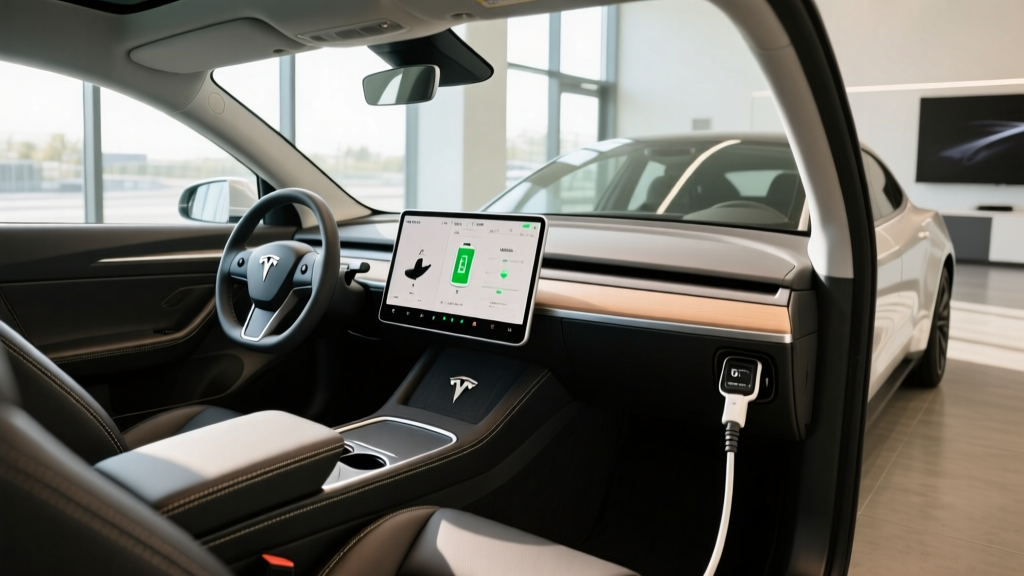
The Model 3's interior is defined by minimalism — a 15.4-inch center touchscreen controls everything, including glovebox release, mirror adjustment, and climate vent direction. There is no instrument cluster; speed and navigation appear in the upper-left corner of the main screen. A rear 8-inch screen for second-row passengers handles climate and entertainment.
Autopilot and FSD (Supervised): Every Model 3 ships with Basic Autopilot (lane centering + adaptive cruise). The optional Full Self-Driving (Supervised) package, currently priced around $8,000 (or $99/month), adds automated lane changes, traffic-light recognition, and city-street navigation. It is critical to understand that FSD is an SAE Level 2 driver-assistance system — the driver must remain fully engaged, hands on or near the wheel, eyes on the road. This is not autonomous driving.
Infotainment highlights include native Spotify, Apple Music, and Tidal streaming; Netflix and YouTube for parked viewing; and a built-in trip planner that factors in Supercharger stops, elevation changes, and real-time traffic. The phone-as-key system works reliably via Bluetooth, and the Tesla app provides granular remote control over climate, charging, and Sentry Mode cameras.
Notable drawbacks:
- No physical turn-signal stalk on the 2026 refresh — signals are controlled via steering-wheel buttons, which draws consistent criticism from new owners adapting to the layout.
- No Apple CarPlay or Android Auto. Tesla's native interface is capable, but smartphone-projection holdouts will notice the absence.
- Sightlines are compromised by thick rear pillars and the sloping roofline; the backup camera is essential for parking.
Pricing, Tax Credits, and Total Cost
| Trim | Base MSRP | Federal §30D Credit | Effective Price (if eligible) |
|---|---|---|---|
| Model 3 RWD | $38,990 | Up to $7,500 | ~$31,490 |
| Model 3 Long Range AWD | $47,740 | Up to $7,500 | ~$40,240 |
| Model 3 Performance | $54,990 | Up to $7,500 | ~$47,490 |
The federal EV tax credit under IRS §30D can reduce your effective purchase price by up to $7,500 — and as of 2024, buyers can elect to transfer the credit to the dealer at the point of sale for an instant price reduction rather than waiting to claim it on their tax return. However, eligibility is not universal. Key requirements include:
- Buyer income caps: Modified adjusted gross income (MAGI) must not exceed $150,000 (single), $225,000 (head of household), or $300,000 (joint filing).
- MSRP cap: The vehicle's MSRP must not exceed $55,000 for sedans (all Model 3 trims qualify).
- Battery sourcing: The credit splits into two halves — $3,750 for critical-mineral sourcing and $3,750 for battery-component assembly. Sourcing requirements tighten annually, and the full $7,500 is not guaranteed for every vehicle produced. Check the latest eligibility on IRS.gov before purchasing.
- VIN and delivery: The vehicle must be new, delivered for use in the United States, and the VIN must appear on the DOE/IRS qualified-vehicle list.
The RWD Model 3 at an effective ~$31,490 after the full credit is arguably the best value-per-mile-of-range vehicle on the market. The Long Range at ~$40,240 trades some value for 91 additional EPA miles and dual-motor AWD — a compelling upgrade for cold-climate buyers and road-trippers.
Pros
- Class-leading efficiency (25 kWh/100 mi)
- 363-mile EPA range (Long Range)
- NACS native — full Supercharger access
- Durable vegan leather interior
- Strong resale value relative to EV segment
- Over-the-air updates add features post-purchase
Cons
- No physical turn-signal stalk (2026 refresh)
- No Apple CarPlay / Android Auto
- Rear-seat legroom tight for tall adults
- FSD costs $8,000 extra and remains Level 2
- RWD cold-weather range drops significantly
- No ventilated seats available
Who Should Buy the 2026 Tesla Model 3?
Choose the Model 3 RWD if: You commute under 80 miles round-trip, have reliable home Level 2 charging, live in a mild climate, and want the lowest effective price after the federal credit. The LFP battery's tolerance for daily 100% charging makes this the ideal "set it and forget it" commuter EV.
Choose the Model 3 Long Range AWD if: You take regular road trips exceeding 200 miles, live in a region with harsh winters, need dual-motor traction in snow, or simply want the 363-mile buffer that eliminates range planning for most daily scenarios.
Look elsewhere if: You need three rows of seating (consider the Model Y or Kia EV9), you require Apple CarPlay for your workflow, or you prioritize physical controls and conventional cockpit layouts over Tesla's touchscreen-centric approach.
Frequently Asked Questions
Are Tesla seats real leather or synthetic?
All Tesla vehicles, including the 2026 Model 3, use synthetic vegan leather — a polyurethane-based material that mimics the look and feel of genuine leather without animal-derived components. Tesla made this transition in 2017.
What is the real-world range of the Model 3?
The Long Range AWD is EPA-rated at 363 miles, but expect 300–320 miles in real-world highway driving and 240–270 miles in cold weather. The RWD model is rated at 272 miles EPA, with real-world highway range around 230–245 miles in mild conditions.
How fast does the Model 3 charge at home and on the road?
On a Level 2 home charger (11.5 kW), the Long Range adds about 44 miles per hour. At a DC fast charger, the Long Range peaks at 250 kW and charges from 10–80% in approximately 25 minutes. The RWD peaks at 170 kW with a 10–80% time of roughly 30 minutes.
Does the 2026 Model 3 qualify for the $7,500 federal tax credit?
All Model 3 trims fall under the $55,000 sedan MSRP cap and are potentially eligible for up to $7,500 under IRS §30D. However, buyer income limits ($150K single / $300K joint), battery-sourcing requirements, and VIN qualification all apply. Check IRS.gov for current eligibility before purchasing. The credit can be transferred to the dealer at point of sale for an instant price reduction.
Is the Model 3 worth buying over the Hyundai Ioniq 6 or BMW i4?
The Model 3 Long Range offers more EPA range (363 mi) than the Ioniq 6 (361 mi for the SEL trim) and significantly undercuts the BMW i4 on price. Tesla's Supercharger network and OTA update cadence remain key differentiators. The Ioniq 6 offers faster 800V charging architecture and physical controls; the i4 offers a more traditional luxury cabin. Your choice depends on whether you value Tesla's software ecosystem and charging infrastructure over conventional cockpit design.
How long will the Tesla Model 3 battery last?
Tesla warranties the Model 3 RWD battery for 8 years or 100,000 miles, and the Long Range for 8 years or 120,000 miles, against degradation below 70% capacity retention. Real-world data from high-mileage owners suggests NMC packs typically retain 85–90% capacity at 100,000 miles. LFP packs in the RWD model show similar or slightly better longevity due to the chemistry's inherent cycle-life advantage.
Tax credit rules reflect IRS §30D requirements as of the 2026 tax year and are subject to change. Consult a tax professional for personal eligibility. Always verify current pricing and specifications on Tesla's official configurator before ordering.