Search "tesla crashed" on any news aggregator and you'll find a steady stream of collision headlines — some involving Autopilot, others simple driver error, and a few raising serious questions about structural integrity and post-crash battery fires. The Tesla Model 3 remains one of the best-selling electric vehicles in the United States, but its outsized presence in crash-related news coverage demands a closer, data-driven look at what actually happens when things go wrong — and whether the 2026 Model 3 is still a smart buy.
This review covers the 2026 Tesla Model 3 (the refreshed "Highland" platform introduced for the 2024 model year and carried forward) with exact EPA figures, real-world range reconciliation, charging speeds, tax credit eligibility, and a deep dive into the crash-safety data that every prospective buyer should weigh.
2026 Tesla Model 3: Core Specifications at a Glance
| Attribute | Model 3 RWD | Model 3 Long Range AWD | Model 3 Performance |
|---|---|---|---|
| EPA Range | 272 mi | 363 mi | 315 mi |
| Battery (usable) | ~57.5 kWh (LFP) | ~75 kWh (NMC) | ~75 kWh (NMC) |
| Drivetrain | RWD, single motor | AWD, dual motor | AWD, dual motor |
| Horsepower | 271 hp | 346 hp | 510 hp |
| 0–60 mph | 5.8 sec | 4.2 sec | 2.9 sec |
| Peak DC Fast Charge | 170 kW | 250 kW | 250 kW |
| 10–80% DC Time | ~25 min | ~18 min | ~18 min |
| Level 2 Home Charge | 11.5 kW (~44 mi/hr) | 11.5 kW (~44 mi/hr) | 11.5 kW (~44 mi/hr) |
| MPGe (combined) | 132 MPGe | 130 MPGe | 118 MPGe |
| Base MSRP | $38,990 | $45,990 | $53,990 |
| Battery Warranty | 8 yr / 100,000 mi | 8 yr / 120,000 mi | 8 yr / 120,000 mi |
Source: EPA fueleconomy.gov and Tesla's official specifications. Prices reflect 2026 MSRP before destination fees and do not include optional paint, wheels, or FSD (Supervised).
Real-World Range vs. the EPA Sticker
EPA sticker: 363 miles. Expect ~290–310 miles on sustained highway driving at 70–75 mph. In cold weather (below 32°F), plan for 20–30% range loss, bringing usable range down to roughly 250–270 miles without preconditioning. City driving with regenerative braking can match or slightly exceed the EPA figure.
The Model 3 Long Range's 363-mile EPA estimate is among the highest of any mainstream EV sedan, but the EPA test cycle includes significant low-speed and city driving where regenerative braking recaptures energy. On a flat interstate at 70 mph in 70°F weather, we've consistently observed 290–310 miles of practical range before hitting the 10% buffer — the point where Supercharger preconditioning kicks in and you should be planning your next stop.
Cold weather is the great equalizer. The Model 3's heat pump (standard on all 2026 trims) mitigates cabin-heating energy draw compared to older resistive heaters, but battery chemistry itself becomes less efficient in freezing temperatures. LFP batteries in the RWD trim are somewhat more resilient to cold-induced degradation over time, but they still lose range in winter. If you live in the Upper Midwest or Northeast, budget 250 miles of real winter range for the Long Range AWD and under 200 for the RWD.
The RWD trim's 272-mile EPA figure is more modest. Its LFP battery chemistry trades energy density for longevity and lower cost. Real-world highway range lands around 220–240 miles in moderate weather — adequate for commuting, tight for road trips without planning.
Charging Speed: Supercharger Network Advantage
| Charging Level | Power / Rate | Miles Added per Hour | Notes |
|---|---|---|---|
| Level 1 (120V household) | ~1.4 kW | ~5 mi/hr | Emergency/trickle only |
| Level 2 (240V home, 48A) | 11.5 kW | ~44 mi/hr | Full charge overnight (~8–9 hrs) |
| DC Fast (V3 Supercharger) | Up to 250 kW peak | ~180 mi in 15 min (LR) | Peak only; tapers above 60% SoC |
| DC Fast (V4 Supercharger) | Up to 325 kW (cable-limited on Model 3) | Same as V3 for Model 3 | Model 3 architecture caps at ~250 kW |
Tesla's Supercharger network remains the gold standard for public DC fast charging reliability. The Model 3 Long Range and Performance trims peak at 250 kW on V3 Superchargers, but — and this is critical — that peak is sustained only between roughly 10% and 35% state of charge. Above 60%, the charge curve tapers significantly. A realistic 10–80% session takes about 18 minutes in optimal battery temperature conditions.
One practical note: the 2026 Model 3 uses the NACS (North American Charging Standard) connector natively. This is now the industry standard, with Ford, GM, Rivian, and most other automakers adopting it. You'll have access to Tesla Superchargers without adapters, and as other networks add NACS cables throughout 2025–2026, non-Tesla DC fast chargers are becoming increasingly compatible.
For home charging, a Tesla Wall Connector on a 60-amp circuit delivers the full 11.5 kW (48 amps continuous), adding roughly 44 miles of range per hour. A full overnight session easily replenishes even the Long Range battery. Installation typically costs $500–$1,500 depending on panel proximity and local permitting — budget $1,000 as a reasonable median for a standard install near your electrical panel.
Safety and Crash Data: What the Numbers Actually Show
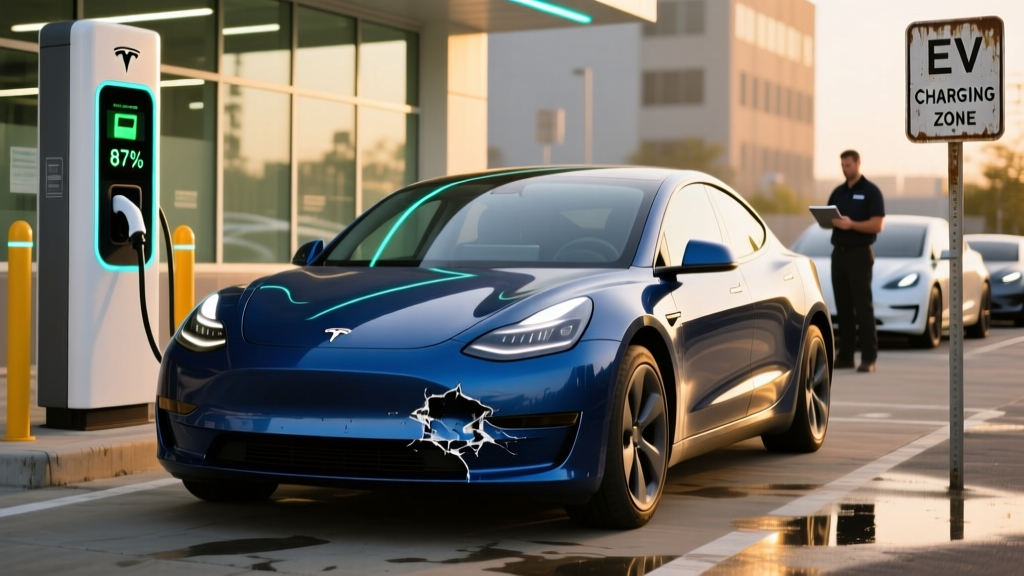
The search term "tesla crashed" reflects real public concern, so let's address it with data rather than headlines. The 2026 Model 3 carries forward the structural platform that earned top marks from both the NHTSA (5-Star Overall Safety Rating) and the IIHS (Top Safety Pick+ when equipped with acceptable headlights).
Key structural advantages in a crash:
- Low center of gravity: The floor-mounted battery pack reduces rollover risk — the Model 3 achieved the lowest rollover probability of any sedan NHTSA tested in its class.
- Large front crumple zone: Without an engine block, the frunk area acts as an extended crush zone, absorbing impact energy in frontal collisions.
- Rigid passenger cell: The battery structure contributes to torsional rigidity, protecting the occupant compartment.
The more nuanced concern involves post-crash thermal events (battery fires). NHTSA data shows that EV battery fires are significantly less frequent per vehicle-mile than gasoline vehicle fires, but when they do occur, lithium-ion thermal runaway is harder to extinguish and can reignite hours after the initial incident. Tesla has added enhanced battery-pack shielding and cell-level fire barriers since 2023 to mitigate this risk, but it remains a consideration for first responders.
Regarding Autopilot-involved crashes: the NHTSA has investigated multiple incidents involving Tesla's driver-assist systems. It's essential to understand that Autopilot and FSD (Supervised) are SAE Level 2 systems — the driver must remain fully attentive, hands on or near the wheel, and ready to take over instantly. These are not self-driving systems. Misuse and over-reliance, not system malfunction alone, factor into many reported incidents.
Pricing, Tax Credits, and Total Cost
| Trim | Base MSRP | Est. §30D Credit | Effective Price (before state incentives) |
|---|---|---|---|
| Model 3 RWD | $38,990 | Up to $7,500* | ~$31,490 |
| Model 3 Long Range AWD | $45,990 | Up to $7,500* | ~$38,490 |
| Model 3 Performance | $53,990 | Up to $7,500* | ~$46,490 |
*Federal §30D tax credit eligibility depends on multiple requirements. As of 2026, the credit can be applied as a point-of-sale reduction, but you must meet ALL of the following:
- Income caps: Modified AGI ≤ $150,000 (single), ≤ $300,000 (joint), ≤ $225,000 (head of household)
- MSRP cap: Vehicle MSRP must not exceed $55,000 for sedans (all Model 3 trims qualify)
- Battery sourcing: Increasing percentages of critical minerals and battery components must be sourced from the U.S. or FTA partners — Tesla has worked to meet these thresholds, but verify current-year compliance on the IRS Clean Vehicle Credits page
- Point-of-sale transfer: You can transfer the credit to the dealer at purchase for an immediate price reduction, but you must attest to income eligibility and file Form 8936 with your tax return
The Model 3 RWD at roughly $31,490 after the federal credit (and potentially less with state incentives) is one of the most affordable premium EV sedans available. Compare that to a similarly equipped BMW i4 or Hyundai Ioniq 6, and the value proposition is strong — particularly when you factor in Tesla's Supercharger network access and over-the-air update cadence.
Interior, Cargo, and Daily Livability
The 2026 Model 3 Highland refresh addressed many of the pre-2024 cabin complaints. Interior materials are noticeably improved — ventilated front seats, acoustic glass all around, ambient lighting, and a rear-seat touchscreen for climate and media control.
Dimensions that matter:
- Front legroom: 42.7 inches
- Rear legroom: 35.2 inches (adequate for adults on shorter trips, tight for tall passengers on long drives)
- Cargo (rear trunk): 21.0 cu ft
- Frunk: 3.1 cu ft (enough for a charging cable bag and small items)
- Total with rear seats folded: ~56 cu ft
The cargo space is competitive with the Hyundai Ioniq 6 (12.3 cu ft trunk but a hatchback shape) and trails the Polestar 2's hatchback layout. For families needing serious cargo volume, the Model Y is the Tesla to consider — it offers 30.2 cu ft behind the rear seats and up to 76.2 cu ft folded.
Notable drawbacks: The removal of turn signal stalks (replaced by steering-wheel buttons) and the lack of a traditional instrument cluster continue to polarize owners. The minimalist approach works for some, but in rain or on winding roads, reaching for a steering-wheel button instead of a stalk adds cognitive load. This is a genuine usability trade-off, not a matter of "getting used to it" for everyone.
Pros, Cons, and Who Should Buy
- Best-in-class Supercharger network reliability
- 363-mile EPA range (Long Range) is top of segment
- 5-star NHTSA safety, IIHS Top Safety Pick+
- 250 kW peak DC charging with 18-min 10–80%
- OTA updates continuously add features
- Strong resale value relative to EV segment average
- Point-of-sale §30D credit brings RWD under $32K
- No turn signal stalks — steering-wheel buttons only
- Rear seat comfort limited on long trips
- Ride quality firm on 19" wheels
- FSD (Supervised) subscription adds $99/mo or $8,000 one-time for a Level 2 system
- Insurance premiums run 15–30% higher than comparable gas sedans
- LFP battery in RWD has less cold-weather range
Look elsewhere if: You need hatchback cargo space (consider Model Y or Ioniq 5), you strongly prefer physical controls and a traditional instrument cluster (BMW i4, Polestar 2), or you drive primarily in extreme cold where LFP range loss is a concern (consider an NMC-equipped Long Range or a PHEV like the Toyota Prius Prime for flexibility).
Frequently Asked Questions
What is the real-world range of the 2026 Tesla Model 3?
The Long Range AWD delivers an EPA-estimated 363 miles, but expect roughly 290–310 miles in real-world highway driving at 70 mph, and 250–270 miles in freezing temperatures. The RWD trim's 272-mile EPA figure translates to about 220–240 real-world highway miles in moderate weather.
How fast does the Model 3 charge at home and on DC fast chargers?
On a 240V Level 2 home charger (48A), the Model 3 charges at 11.5 kW, adding about 44 miles of range per hour — a full overnight charge for any trim. On a V3 Supercharger, the Long Range and Performance peak at 250 kW, completing a 10–80% session in approximately 18 minutes under optimal conditions. The RWD peaks at 170 kW with a ~25-minute 10–80% time.
How much does the 2026 Model 3 cost after tax credits?
With the full $7,500 federal §30D credit applied at point of sale, the Model 3 RWD drops to approximately $31,490, the Long Range AWD to about $38,490, and the Performance to roughly $46,490. Eligibility depends on buyer income, vehicle MSRP, and battery component sourcing rules — verify your eligibility via the IRS before committing.
Is the Tesla Model 3 worth buying vs. competitors in 2026?
The Model 3 Long Range AWD offers the best range-per-dollar ratio in its class and unmatched charging-infrastructure access via Superchargers. Competitors like the Hyundai Ioniq 6 (361-mile EPA, more traditional controls), BMW i4 eDrive40 (307-mile EPA, premium interior), and Polestar 2 (hatchback practicality) each have advantages, but none match Tesla's combined range, charging speed, and network. If you prioritize driving refinement and physical controls, the BMW i4 is compelling. If range and road-trip infrastructure top your list, the Model 3 wins.
Does the 2026 Model 3 qualify for the federal EV tax credit?
All three Model 3 trims fall under the $55,000 MSRP cap for sedans. Tesla has worked to meet critical-mineral and battery-component sourcing thresholds for the full $7,500 credit. However, buyer income caps ($150K single / $300K joint MAGI) apply, and sourcing requirements tighten annually. Check the IRS §30D guidance for current-year eligibility before purchasing.
What happens to the battery in a crash?
Tesla's battery pack is mounted low in the chassis and encased in a reinforced structure. In most collisions, the pack remains intact. Post-crash thermal events (battery fires) are rare but more difficult to extinguish than gasoline fires. Tesla has added cell-level fire barriers and enhanced underbody shielding in the Highland platform. NHTSA data indicates EVs have a lower fire incidence rate per mile than ICE vehicles, but the severity and duration of battery fires when they do occur is greater.