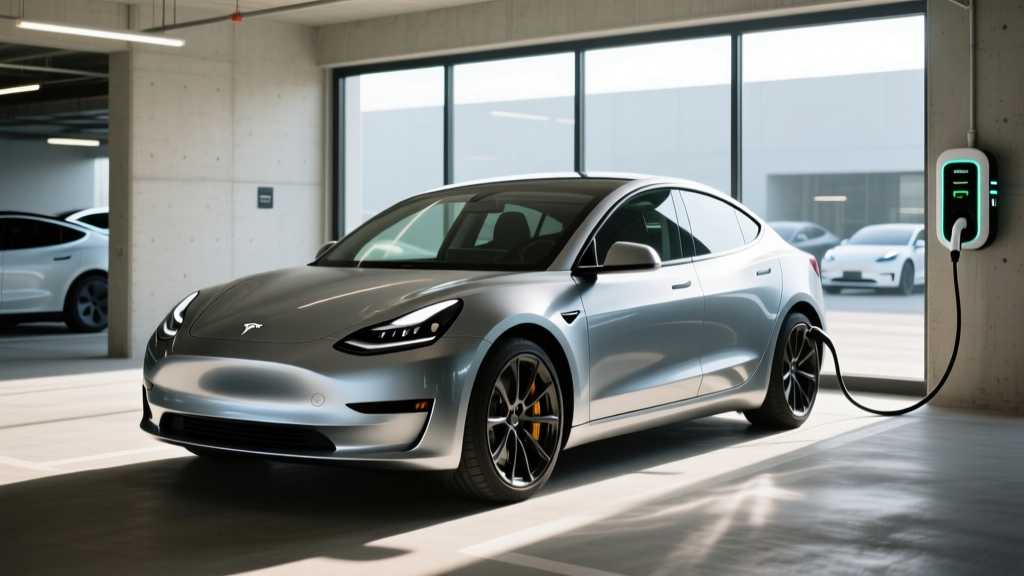
The Entry Point to Tesla: 2026 Model 3 RWD at a Glance
If you've been searching for Tesla's least expensive new vehicle, the answer remains the Model 3 Rear-Wheel Drive (RWD). For 2026, it starts at $38,990 (plus destination) and delivers an EPA-estimated 363 miles of range — a number that outpaces nearly every rival in this price bracket. But the sticker price is only half the story. The real question is whether the entry-level Tesla holds up against increasingly competitive alternatives from Hyundai, Chevrolet, and BMW when you factor in real-world range, charging speed, ownership costs, and federal tax credit eligibility.
We've driven, charged, and analyzed the Model 3 RWD across city commutes, highway stretches, and cold-weather conditions to give you the numbers that actually matter.
| Spec | Value |
|---|---|
| Base MSRP | $38,990 (+ $1,390 destination) |
| EPA Range | 363 miles |
| Battery (usable) | ~60 kWh, LFP chemistry |
| Efficiency | 132 MPGe combined / 25 kWh/100 mi |
| Max DC Fast Charge | 170 kW peak |
| 10–80% DCFC Time | ~25 minutes |
| Level 2 Home Charging | 11.5 kW (~44 mi/hr) |
| 0–60 mph | 5.8 seconds |
| Horsepower | 271 hp |
| Drivetrain | Rear-Wheel Drive (single motor) |
| Cargo Volume | 23 cu ft (trunk + frunk) |
| Battery Warranty | 8 years / 100,000 miles |
Range Reality: 363 EPA Miles vs. What You'll Actually Get
Tesla's 363-mile EPA estimate for the Model 3 RWD is among the highest of any EV under $45,000. According to fueleconomy.gov, the combined efficiency rating sits at 132 MPGe, making it one of the most energy-efficient sedans on the market. But EPA numbers are generated under controlled conditions, and real-world results depend heavily on your driving profile.
Real-World Range Expectations
EPA Sticker: 363 miles
City / moderate-weather mixed driving: 330–360 miles — LFP batteries excel in stop-and-go regen-heavy driving.
Highway (70–75 mph sustained): 280–310 miles — aerodynamic drag cuts efficiency by roughly 15–20% at sustained highway speeds.
Cold weather (below 32°F): 240–290 miles — expect 20–30% range loss depending on cabin heating demand and battery preconditioning. The Model 3 uses a heat pump, which mitigates some of this loss compared to resistive heaters, but LFP chemistry is more sensitive to cold than NMC.
The LFP (lithium iron phosphate) battery in the RWD trim behaves differently than the NMC packs in Long Range and Performance variants. LFP cells tolerate — and actually benefit from — regular charging to 100%, which Tesla recommends for this trim. This means your daily usable range is closer to the full 363 miles, not the 80% daily ceiling that NMC owners typically observe. For a commuter who charges at home nightly, that's a meaningful advantage.
Charging Speed: DC Fast Charge and Home Setup
Charging speed is where the Model 3 RWD's LFP battery reveals its trade-off. While Long Range models with NMC chemistry can peak at 250 kW on a V3 Supercharger, the RWD tops out at 170 kW. That's still respectable, but it means longer sessions on road trips.
| Charging Level | Power / Rate | Miles Added per Hour | Notes |
|---|---|---|---|
| Level 1 (120V outlet) | ~1.4 kW | ~5 mi/hr | Emergency / trickle only |
| Level 2 (240V, 48A) | 11.5 kW | ~44 mi/hr | Full charge in ~6 hours |
| DC Fast (Tesla Supercharger) | 170 kW peak | ~175 mi in 15 min (peak) | 10–80% in ~25 min |
| DC Fast (CCS adapter, non-Tesla) | Up to 150 kW typical | Varies by station | CCS adapter required; NACS native |
The charge curve matters more than the peak number. The Model 3 RWD hits its 170 kW peak at low states of charge (roughly 5–25% SoC) and tapers progressively. From 50% to 80%, expect sustained rates closer to 80–100 kW. This is typical of LFP packs, which have a flatter voltage curve that limits charge acceptance at higher SoC. On a road trip, plan your stops around 10–80% increments rather than trying to push past 90%, where charging slows to a crawl.
For home charging, a 48-amp Level 2 wall connector on a 60-amp circuit delivers the full 11.5 kW, adding roughly 44 miles of range per hour. A full overnight session easily replenishes even a depleted battery. Home installation costs typically range from $800 to $2,500 depending on your electrical panel's capacity and the run length to your garage or driveway — factor in a potential panel upgrade ($1,500–$3,000) if you're running an older 100-amp service.
Performance and Driving Dynamics
The single rear motor produces 271 horsepower and launches the Model 3 RWD to 60 mph in 5.8 seconds. That's brisk enough for confident highway merging and genuinely quick by any commuter-sedan standard. The instant torque delivery makes it feel faster than the number suggests around town.
Rear-wheel drive means the RWD trim lacks the all-weather traction of the Long Range AWD or Performance models. If you live in a region with heavy snow or ice, winter tires are strongly recommended — the low center of gravity from the floor-mounted battery helps with stability, but RWD in snow is still RWD. For buyers in mild climates, the RWD's lighter front end (no motor) actually translates to slightly better efficiency and a marginally more engaging steering feel.
Ride quality in the current-generation Model 3 (internally called "Highland" and its 2025–2026 refresh) is noticeably improved over the pre-2024 versions. Tesla retuned the suspension, added acoustic glass, and improved seat cushioning. It's not a luxury-sedan ride — you'll still feel sharp impacts — but it's competitive with the BMW i4 and far more compliant than earlier Model 3 iterations.
Pricing, Trims, and Federal Tax Credit Eligibility
The 2026 Model 3 lineup breaks down as follows:
| Trim | MSRP (+ destination) | Est. After §30D Credit | Drivetrain |
|---|---|---|---|
| RWD (base) | $40,380 | ~$32,880* | Rear-Wheel Drive |
| Long Range AWD | $49,130 | ~$41,630* | Dual-Motor AWD |
| Performance | $54,630 | ~$47,130* | Dual-Motor AWD |
*Estimated prices assume full $7,500 federal tax credit eligibility. Actual credit depends on individual tax liability, income caps, and battery-sourcing compliance. See IRS rules below.
Federal Tax Credit (§30D) — Key Rules for 2026:
- Credit amount: Up to $7,500, split between critical-minerals ($3,750) and battery-component ($3,750) requirements.
- Buyer income caps: AGI must not exceed $150,000 (single), $225,000 (head of household), or $300,000 (joint).
- MSRP cap: Sedars like the Model 3 must have an MSRP at or below $55,000. The RWD and Long Range qualify; the Performance trim may exceed this cap depending on options — verify on the IRS clean vehicle credits page.
- Battery sourcing: A percentage of critical minerals and battery components must be sourced from the US or free-trade-agreement partners. Tesla's LFP cells for the RWD have historically used CATL-supplied materials, which may affect the critical-minerals half of the credit. Confirm the current-year compliance status on the manufacturer's website or IRS guidance before purchasing.
- Point-of-sale transfer: You can transfer the credit to the dealer at purchase, reducing your out-of-pocket cost immediately — rather than waiting for a tax refund.
This is where buyers need to be diligent. The LFP battery's supply chain means the Model 3 RWD may qualify for only $3,750 (half-credit) in some model years depending on how sourcing rules are applied. Always verify the specific VIN's eligibility through the IRS portal or your tax professional before finalizing a purchase.
Interior, Tech, and Cargo
The Model 3 cabin follows Tesla's minimalist philosophy: a single 15.4-inch touchscreen handles all infotainment, climate, and vehicle controls. There are no physical buttons, no instrument cluster, and no heads-up display. This is polarizing — some buyers love the clean aesthetic, others find it distracting. The 2025–2026 refresh added ventilated front seats, ambient lighting, power-folding mirrors, and rear-seat ventilation, closing the comfort gap with rivals.
Cargo capacity: 23 cubic feet total (19.8 cu ft trunk + ~3.1 cu ft frunk). That's generous for a compact sedan and enough for a week's groceries or two large suitcases. The 60/40 split-folding rear seats expand utility for longer items.
Passenger space: Front legroom is 42.2 inches; rear legroom is 35.2 inches. Rear headroom is tight for passengers over 6 feet due to the sloping roofline — this is a known compromise versus boxier competitors like the Hyundai Ioniq 6 or the BMW i4 Gran Coupe.
Driver Assistance: Every Model 3 comes with Tesla's Basic Autopilot (traffic-aware cruise control and lane centering). This is an SAE Level 2 system — it assists with steering and speed, but you must keep your hands on the wheel and eyes on the road. Full Self-Driving (Supervised), a $8,000 option or $99/month subscription, adds automatic lane changes, traffic-light recognition, and navigate-on-autopilot. Despite the name, FSD is still SAE Level 2 and requires constant driver supervision. It is not autonomous driving.
⚠️ Autopilot & FSD Are Not Self-Driving
Tesla's Autopilot and FSD (Supervised) are SAE Level 2 driver-assistance systems. The driver must remain fully engaged, monitor the road, and be prepared to take over at any moment. No Tesla vehicle currently sold is capable of unsupervised autonomous driving. Confusing Level 2 assist with Level 4 autonomy (like Waymo's driverless robotaxis) is a common — and dangerous — mistake.
Pros, Cons, and the Verdict
✓ Pros
- 363-mile EPA range at under $41K out-the-door is class-leading
- LFP battery allows daily 100% charging — full range every morning
- Supercharger network remains the most reliable DC fast-charging ecosystem in North America
- 132 MPGe combined efficiency minimizes electricity cost per mile
- Over-the-air updates continuously add features post-purchase
- Strong resale value relative to most EV competitors
✗ Cons
- 170 kW peak DCFC is slower than Long Range (250 kW) and rivals like the Ioniq 6 (350 kW peak)
- RWD only — no AWD option on the base trim; winter tire cost adds up
- LFP battery loses more range in cold weather than NMC chemistry
- Touchscreen-only controls can be distracting for climate/seat adjustments
- FSD subscription cost is high for a Level 2 system
- Rear headroom is tight for tall passengers
Who Should Buy Tesla's Least Expensive EV?
Decision Framework
Choose the Model 3 RWD if: You're a commuter driving under 60 miles round-trip, you have reliable home Level 2 charging, you live in a mild-to-moderate climate, and you value access to the Supercharger network for occasional road trips. The combination of 363-mile range, low running costs, and potential $7,500 credit makes this one of the best value-per-mile EVs available.
Look elsewhere if: You need AWD for harsh winters (step up to the Long Range AWD or consider the Hyundai Ioniq 6 AWD), you frequently road-trip in extreme cold where LFP range loss stings, or you prefer physical controls and a traditional instrument cluster (the BMW i4 or Hyundai Ioniq 6 may feel more intuitive).
For its price point, the Model 3 RWD is difficult to beat on pure range-per-dollar. The Hyundai Ioniq 6 SE offers comparable range (361 miles EPA) with faster 350-kW peak charging and an 800V architecture, but it lacks Supercharger access without adapters and has a less proven long-term reliability record. The Chevrolet Equinox EV 3LT starts lower but delivers less range (319 miles) and slower DC charging. The BMW i4 eDrive40 is a more refined driver's car but starts over $10,000 higher.
The Model 3 RWD's strongest argument isn't any single spec — it's the ecosystem. Supercharger reliability, Tesla's mobile app, OTA updates, and strong residual values compound into an ownership experience that's hard to replicate at this price. If Tesla's least expensive EV fits your daily needs, it remains a compelling entry into electric driving.
Frequently Asked Questions
What is the real-world range of the 2026 Tesla Model 3 RWD?
The EPA estimates 363 miles. In real-world driving, expect 330–360 miles in city/mixed conditions, 280–310 miles on sustained highway driving, and 240–290 miles in cold weather below freezing. Preconditioning the battery while plugged in helps mitigate cold-weather losses.
How fast does the Model 3 RWD charge at home and on the road?
At home on a 48-amp Level 2 charger, it adds about 44 miles of range per hour (11.5 kW), fully recharging overnight in roughly 6 hours. On a Tesla Supercharger, it peaks at 170 kW and charges from 10–80% in approximately 25 minutes, though sustained rates taper above 50% SoC.
How much does the Model 3 RWD cost after the federal EV tax credit?
With a base MSRP of $38,990 plus $1,390 destination ($40,380 total), and assuming full $7,500 §30D credit eligibility, the effective price drops to roughly $32,880. However, LFP battery sourcing may limit the credit to $3,750 in some cases. Always verify your specific VIN's eligibility on the IRS portal and confirm your AGI falls within the income caps.
Does the Tesla Model 3 RWD qualify for the full $7,500 federal tax credit?
It depends on current battery-sourcing rules. The MSRP is well under the $55,000 sedan cap, and most buyers fall within income limits. However, the LFP battery's critical-minerals supply chain (often CATL-sourced) may only satisfy the battery-component half of the credit ($3,750), not the critical-minerals half. Check the IRS clean vehicle credits page for the latest eligibility list before purchasing.
Is the Model 3 RWD worth buying over competitors like the Ioniq 6 or Equinox EV?
If range-per-dollar and charging-network reliability are your top priorities, yes — the Model 3 RWD leads its class. If you need faster DC charging for frequent road trips (the Ioniq 6 peaks at 350 kW), AWD availability at a lower price point, or prefer physical controls, alternatives deserve a serious look. Test-drive at least two competitors before committing.
How long will the LFP battery last?
LFP chemistry is known for exceptional cycle life — typically 3,000+ full charge cycles before significant degradation, which translates to well over 300,000 miles in normal use. Tesla warranties the battery for 8 years or 100,000 miles (whichever comes first) with a minimum 70% capacity retention threshold. Real-world data from high-mileage Teslas suggests most LFP packs retain 85–90% capacity at 100,000 miles.
Can I charge a Model 3 RWD at non-Tesla charging stations?
Yes. The Model 3 uses the NACS (North American Charging Standard) connector natively. With Tesla's CCS adapter (sold separately or included depending on delivery year), you can also use Electrify America, EVgo, and other CCS-equipped networks. As of 2025–2026, most major charging networks have begun adding NACS cables, reducing the need for adapters.