Tesla Model 3 Rear-Wheel Drive: The Entry EV That Punches Above Its Weight
The Tesla Model 3 Rear-Wheel Drive remains the gateway into the Tesla ecosystem and one of the most efficient electric sedans on the market. For buyers researching Model 3 rear wheel drive horsepower, range, and daily usability, this trim delivers a compelling mix of performance and value — especially when factoring in the federal tax credit. We've driven, charged, and lived with the refreshed Model 3 RWD to bring you exact numbers, not marketing gloss.
Below, we break down everything from the single-motor powertrain output to real-world highway range loss, DC fast-charge taper behavior, and the IRS §30D credit math that can drop the effective price below $31,000.
Spec Sheet: Model 3 RWD at a Glance
| Attribute | Value |
|---|---|
| Drivetrain | Rear-Wheel Drive (single motor) |
| Horsepower | 271 hp |
| Torque | 317 lb-ft |
| 0–60 mph | 5.8 seconds |
| Battery (usable) | ~57.5 kWh, LFP chemistry |
| EPA Range | 363 miles |
| EPA Efficiency | 132 MPGe / 25 kWh/100 mi |
| Max DC Fast Charge | 170 kW (peak) |
| 10–80% DC Charge Time | ~25 minutes |
| Level 2 Home Charging | 11.5 kW (~44 mi/hr) |
| Base MSRP | $38,990 (before incentives) |
| Battery Warranty | 8 years / 100,000 miles |
Performance: 271 Horsepower From a Single Rear Motor
The Model 3 RWD uses a single permanent-magnet synchronous motor on the rear axle producing 271 horsepower and 317 lb-ft of torque. That's a noticeable step up from the pre-refresh RWD variant, which made around 283 hp in some model years but with a smaller battery. The current Highland-platform RWD hits 0–60 mph in 5.8 seconds — quick enough to merge confidently onto any freeway and genuinely fun in urban driving where instant electric torque shines.
Because all 317 lb-ft arrives at 0 RPM, the RWD Model 3 feels punchier than its 0–60 time suggests around town. Highway passing power is adequate but not thrilling; the single-motor setup lacks the dual-motor AWD trims' relentless surge above 70 mph. For most commuters and daily drivers, 271 hp is more than sufficient — you'll rarely find yourself wanting more unless you're coming from a Performance or Long Range AWD model.
Regenerative braking is strong and consistent, enabling near one-pedal driving in most conditions. The blended mechanical and regen braking feel has improved significantly with the Highland refresh, eliminating the grabby brake-pedal transition that plagued earlier Model 3s.
Real-World Range vs. EPA Estimate
EPA Estimated: 363 miles
Real-World Highway (70–75 mph, moderate climate): ~290–320 miles
Real-World City/Mixed: ~330–355 miles
Cold Weather (below 30°F, highway): ~230–270 miles
Source: Owner reports and independent testing; your results vary with speed, temperature, and terrain.
The Model 3 RWD's 363-mile EPA estimate is impressive for a ~57.5 kWh battery, and it's achieved through exceptional efficiency — just 25 kWh per 100 miles. But EPA range tests include significant low-speed and city driving where EVs are most efficient. Expect to see 290–320 miles on a sustained highway trip at 70–75 mph in mild weather.
The LFP (lithium iron phosphate) battery chemistry in the RWD trim is a major factor in real-world usability. Unlike NMC batteries, Tesla recommends charging LFP packs to 100% regularly — even daily. This means you actually get access to the full 363 miles (minus real-world losses) rather than limiting yourself to 80% for daily driving as you would with the Long Range AWD's NMC pack. For a commuter who charges at home overnight, the RWD's usable daily range often matches or exceeds the Long Range in practice.
Cold weather remains the great equalizer. Below freezing, expect 25–35% range loss on highway trips due to cabin heating demands and reduced battery chemistry efficiency. The Model 3's standard heat pump helps mitigate this compared to older resistance-heater EVs, but physics still wins in deep winter. Preconditioning the battery while plugged in before departure recovers some of that loss.
Charging Speed: DC Fast Charging and Home Setup
| Charging Level | Power (kW) | Speed (miles added/hr) | Notes |
|---|---|---|---|
| Level 1 (120V household) | ~1.4 kW | ~5 mi/hr | Emergency/trickle only |
| Level 2 (240V, 48A Wall Connector) | 11.5 kW | ~44 mi/hr | Full overnight charge in ~6 hrs |
| DC Fast Charge (peak) | 170 kW | — | 10–80% in ~25 min |
| DC Fast Charge (sustained avg) | ~110–130 kW | — | Average over 10–80% session |
The Model 3 RWD peaks at 170 kW on DC fast charging, lower than the Long Range AWD's ~250 kW peak. This is a direct consequence of the smaller LFP battery — charge rate is limited by the pack's C-rate, and a ~57.5 kWh pack simply can't accept electrons as fast as an 82 kWh NMC pack.
On a V3 Supercharger (250 kW capable), the RWD will ramp quickly to ~160–170 kW in the 10–30% state-of-charge window, then taper progressively. Expect an average sustained rate of around 110–130 kW across a full 10–80% session, which takes approximately 25 minutes. That's adequate for road-trip stops but noticeably slower than the Long Range's ~18-minute 10–80% window.
At home on a Tesla Wall Connector or equivalent 48-amp Level 2 station, the onboard charger accepts up to 11.5 kW, adding roughly 44 miles of range per hour. A full 0–100% charge takes about 6 hours — easily achievable overnight. For most RWD owners who charge to 100% daily (as LFP recommends), plugging in each evening and waking to a full battery is the norm.
Installation note: A Level 2 home charger typically requires a 60-amp dedicated circuit. Budget $800–$2,000 for professional installation depending on your panel's proximity to the garage and whether a panel upgrade is needed. Always hire a licensed electrician for the final spec.
Pricing, Tax Credits, and Total Cost
| Line Item | Amount |
|---|---|
| Base MSRP | $38,990 |
| Destination Fee | $1,390 |
| As-Tested (with common options) | $40,380–$42,880 |
| Federal Tax Credit (§30D, max) | –$7,500 |
| Effective Price (with full credit) | ~$31,490–$35,380 |
The Model 3 RWD starts at $38,990, making it one of the most affordable new EVs with over 350 miles of EPA range. Common options like Ultra Red paint ($2,000) and 19-inch Nova wheels ($1,500) push as-tested prices to $41,000–$43,000.
Under current IRS §30D rules, the Model 3 RWD qualifies for up to $7,500 in federal clean vehicle credits, split between a $3,750 critical-minerals component and a $3,750 battery-components component. However, eligibility depends on several factors that change periodically:
- MSRP cap: Sedans must be priced at or below $55,000 — the Model 3 RWD clears this easily.
- Income cap: Modified AGI must not exceed $150,000 (single), $225,000 (head of household), or $300,000 (joint). Check your prior-year or current-year tax return.
- Battery sourcing: Critical-mineral and battery-component sourcing requirements tighten annually. Tesla has historically met both thresholds for the Model 3, but verify current eligibility on the fueleconomy.gov tax credit lookup before purchasing.
- Point-of-sale transfer: As of 2024+, you can transfer the credit to the dealer at purchase, reducing your out-of-pocket cost immediately rather than waiting for a tax refund.
We strongly recommend confirming your personal eligibility with a tax professional, as individual circumstances vary and sourcing rules are subject to change.
Interior, Cargo, and Daily Livability
The Highland-refresh Model 3 interior is a significant step up from pre-2024 models. Ventilated front seats, ambient lighting, a rear passenger touchscreen, improved sound insulation, and higher-quality materials throughout address the most common complaints about earlier Model 3s.
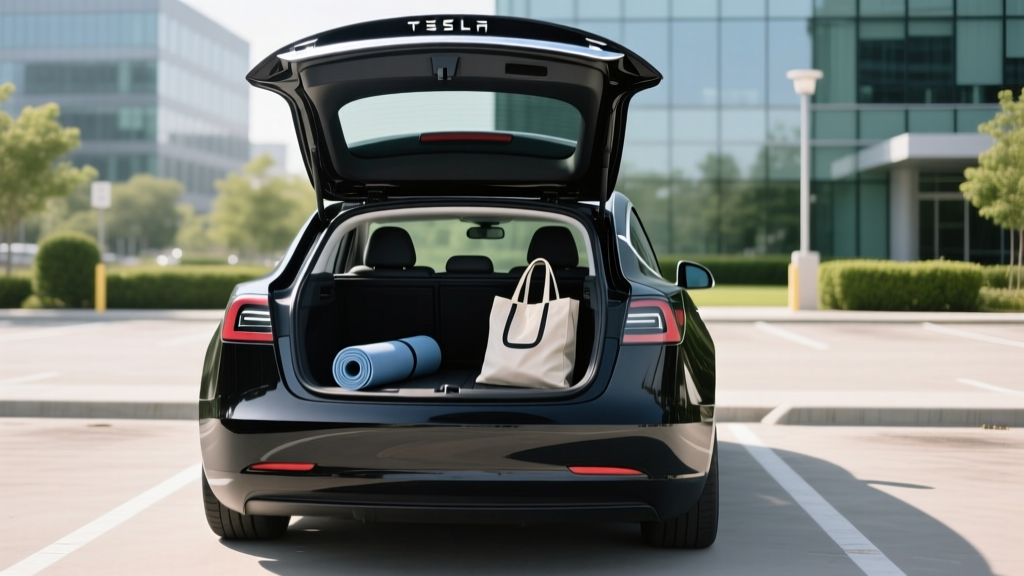
Cargo volume: 23 cubic feet total (trunk + frunk). The trunk offers 21 cu ft of space with a wide, practical opening, while the front trunk (frunk) adds about 2 cu ft — useful for charging cables, a small bag, or groceries. Rear seats fold 60/40 for longer items.
Passenger space: Front legroom is generous at 42.2 inches. Rear legroom measures 35.3 inches — adequate for adults on shorter trips but snug for anyone over 6 feet tall on long drives. The low roofline and sloping rear glass cut into rear headroom, which is the Model 3's most persistent interior complaint.
The 15.4-inch central touchscreen handles virtually all vehicle functions — there are no physical buttons for climate, media, or even glovebox release. This minimalist approach divides opinion: fans love the clean aesthetic; critics note the safety concern of tapping through menus to adjust mirrors or climate while driving. The addition of rear-seat ventilation controls on the backscreen is a welcome Highland improvement.
Driver Assistance, Tech, and Safety
Tesla Autopilot and Full Self-Driving (Supervised) are SAE Level 2 driver-assistance systems. The driver must remain fully engaged, hands on or near the wheel, eyes on the road, and ready to take over at any moment. These systems do not make the Model 3 autonomous. Only Level 4 services like Waymo operate without a human driver.
Every Model 3 RWD comes standard with Tesla Autopilot, which includes Traffic-Aware Cruise Control and Autosteer (lane-centering). This is one of the smoother Level 2 systems available, with confident lane-keeping and natural-feeling speed adjustments in traffic.
The optional Full Self-Driving (Supervised) package ($8,000 or $99/month subscription) adds automatic lane changes, Navigate on Autopilot (highway on/off-ramp routing), traffic-light and stop-sign recognition, and Autopark. FSD has improved substantially but remains a driver-assist system — it makes errors at complex intersections, construction zones, and unusual road geometries. Budget for the subscription only if you regularly drive on highways where it reduces fatigue.
Safety ratings are excellent: the Model 3 earned a 5-Star Overall rating from NHTSA and top marks from IIHS. Standard active safety includes automatic emergency braking, blind-spot monitoring, lane-departure warning, and rear cross-traffic alert.
Pros and Cons: Model 3 RWD Ownership
- 363-mile EPA range at an entry-level price
- LFP battery can be charged to 100% daily
- Exceptional efficiency (25 kWh/100 mi)
- Access to Tesla Supercharger network (17,000+ stalls)
- Over-the-air updates continuously add features
- High resale value relative to EV segment
- Strong safety ratings (NHTSA 5-Star, IIHS Top Safety Pick+)
- Slower DC charging vs. Long Range (170 vs. 250 kW peak)
- Rear headroom and legroom tight for tall adults
- No physical buttons — all controls via touchscreen
- Single motor lacks AWD traction for snow/ice
- Highway range drops significantly below 280 mi in cold
- Insurance premiums run 15–30% above segment average
- FSD subscription cost adds up if purchased monthly
Who Should Buy the Model 3 RWD?
The Model 3 Rear-Wheel Drive is ideal for:
- Commuters with home charging access who want minimal fuel cost and a 300+ mile buffer for detours and errands.
- Urban and suburban drivers in mild-to-moderate climates who don't need AWD traction.
- Cost-conscious EV buyers who want Tesla's Supercharger network and software ecosystem at the lowest entry price.
- First-time EV owners transitioning from a gas sedan — the RWD's range, charging speed, and efficiency reduce range anxiety significantly.
Look elsewhere if you regularly drive in heavy snow (consider Long Range AWD), need rear-seat space for tall teenagers (consider the Model Y), or take frequent 400+ mile road trips where the Long Range's faster charging and larger battery reduce stop frequency.
Model 3 RWD vs. Key Competitors
The RWD Model 3 competes against the Hyundai Ioniq 6 SE (361 mi, $37,500), Chevrolet Equinox EV (319 mi, ~$33,000), and BMW i4 eDrive35 (301 mi, $52,200). Among these, only the Model 3 and Ioniq 6 exceed 350 miles of range. The Ioniq 6 charges faster on DC (up to 240 kW) but lacks Tesla's Supercharger network. The Equinox EV is cheaper but significantly less efficient. The BMW i4 is a premium option with better build quality but nearly $14,000 more expensive.
For most buyers prioritizing range-per-dollar and charging infrastructure, the Model 3 RWD remains the benchmark in its price class.
Frequently Asked Questions
How much horsepower does the Tesla Model 3 rear-wheel drive have?
The current Tesla Model 3 RWD produces 271 horsepower and 317 lb-ft of torque from a single rear-mounted permanent-magnet motor. This propels the car from 0–60 mph in 5.8 seconds.
Does the Model 3 RWD qualify for the $7,500 federal tax credit?
Yes, the Model 3 RWD currently qualifies for up to $7,500 under IRS §30D, provided you meet the income caps ($150K single / $300K joint) and the battery sourcing requirements are satisfied at time of purchase. Verify current eligibility at fueleconomy.gov and consult a tax professional for your specific situation. The credit can be transferred at point of sale to reduce your purchase price immediately.
What is the real-world range of the Model 3 RWD?
Expect 290–320 miles on highway trips at 70–75 mph in mild weather, and 330–355 miles in mixed city/highway driving. Cold weather (below 30°F) can reduce highway range to 230–270 miles. The EPA sticker reads 363 miles, but that figure includes optimal low-speed conditions.
How fast does the Model 3 RWD charge?
On a DC fast charger (like a Tesla V3 Supercharger), the RWD peaks at 170 kW and charges from 10–80% in approximately 25 minutes. At home on a 240V Level 2 charger (48A), it accepts 11.5 kW and adds about 44 miles of range per hour, fully charging overnight in roughly 6 hours.
Is the Model 3 RWD worth buying over the Long Range AWD?
For most commuters and daily drivers, yes. The RWD saves $5,000–$10,000 over the Long Range, offers nearly equivalent real-world daily range (thanks to LFP's 100% daily charging recommendation), and provides more than adequate performance. Choose Long Range AWD if you need all-wheel-drive traction, faster DC charging for road trips, or regularly carry rear-seat passengers on long drives.
What is the battery warranty on the Model 3 RWD?
Tesla covers the Model 3 RWD battery and drive unit for 8 years or 100,000 miles, whichever comes first, with a minimum 70% capacity retention threshold. The LFP chemistry in the RWD is known for excellent long-term cycle life, often outperforming NMC in calendar-life longevity when charged to 100% regularly.