If you have been searching for the cheapest Tesla Model 3 and wondering how its insurance and ownership costs stack up against a midsize gasoline benchmark like the Honda Accord, this review breaks down every number that matters. The 2026 Tesla Model 3 Rear-Wheel Drive (RWD) remains the most affordable entry point into the Tesla ecosystem, and after federal incentives, it undercuts many gas sedans on total cost of ownership — even when insurance premiums are factored in.
But affordability is only part of the equation. Below, we examine the real-world range, charging behavior, battery chemistry trade-offs, insurance realities, and how this EV compares head-to-head with the Honda Accord Hybrid on five-year cost.
2026 Tesla Model 3 RWD: Quick Verdict
The 2026 Tesla Model 3 RWD is a compelling daily-driver EV for commuters and urban/suburban buyers who can charge at home. Its LFP battery chemistry offers exceptional longevity, its efficiency is among the best in the segment, and its base price — especially after the §30D federal tax credit — makes it one of the most accessible premium EVs on the market. The trade-offs include a firm ride, minimal physical controls, and insurance costs that run higher than the Accord Hybrid's.
| Spec | Value |
|---|---|
| EPA Range | 363 miles |
| Battery (usable) | ~60 kWh, LFP (lithium iron phosphate) |
| Drivetrain | Rear-Wheel Drive (single motor) |
| Horsepower | 271 hp |
| 0-60 mph | 5.8 seconds |
| Peak DC Fast Charge | 170 kW |
| 10-80% DC Charge Time | ~25 minutes |
| Level 2 Charge Rate | 11.5 kW (~44 mi/hr) |
| EPA Efficiency | 132 MPGe combined / 25 kWh/100 mi |
| Cargo Volume | 23.1 cu ft (trunk) + 3.1 cu ft (frunk) |
| Rear Legroom | 35.3 inches |
| Base MSRP | $38,990 (before incentives) |
| Battery Warranty | 8 years / 100,000 miles (70% retention) |
Real-World Range: What the EPA Sticker Doesn't Tell You
EPA Estimated Range: 363 miles
Real-World Expectation: 290–320 miles at sustained highway speeds (70-75 mph); 240–270 miles in sub-freezing winter conditions; 340–360 miles in mixed city driving with regen braking.
The Model 3 RWD's 363-mile EPA figure is among the highest in its price class, but EPA tests include substantial low-speed city driving where regenerative braking recovers energy. On a pure highway run at 75 mph — the kind of trip where range matters most — expect to use roughly 28-30 kWh/100 mi, which translates to around 200-215 miles of usable range from the ~60 kWh pack before you'd want to stop.
Cold weather compounds this. At 20°F, lithium-ion cells experience higher internal resistance, and cabin heating draws 2-4 kW continuously. In our experience and consistent with EPA testing methodology, LFP batteries lose roughly 25-35% of rated range in deep cold without preconditioning. Preconditioning the battery via the Tesla app before departure mitigates some of this loss, but winter commuters in northern states should plan for ~250 miles of practical range.
For context, the LFP chemistry in this pack trades some energy density for dramatically better cycle life — Tesla expects these packs to retain well over 80% capacity after 200,000+ miles, which is a meaningful ownership advantage over NMC packs that degrade faster at high SoC.
Charging Speed: DC Fast, Level 2, and the Curve Reality
Charging speed is where the Model 3 RWD's LFP chemistry introduces a nuance most spec sheets gloss over. LFP cells can accept high charge rates at low SoC but taper aggressively above 80%. Here's what the full charging picture looks like:
| Charge Level | Power / Rate | Speed | Notes |
|---|---|---|---|
| Level 1 (120V household) | ~1.4 kW | ~5 mi/hr | Emergency / overnight trickle only |
| Level 2 (240V home) | 11.5 kW | ~44 mi/hr | Full charge in ~5.5 hours |
| DC Fast (Tesla Supercharger) | Peak 170 kW | 10-80% in ~25 min | Sustains ~150 kW to ~50%, then tapers |
| DC Fast (CCS via adapter) | Up to 150 kW | 10-80% in ~28 min | Requires Tesla CCS adapter (included) |
The 170 kW peak figure is achievable only when the battery is preconditioned (the car does this automatically when you navigate to a Supercharger) and the ambient temperature is moderate. In practice, the charge curve holds above 140 kW from roughly 10-45% SoC, then steps down to ~100 kW by 65%, and drops to ~50 kW by 80%. A 10-80% session takes about 25 minutes under good conditions — competitive with most 400V-architecture rivals, though 800V vehicles like the Hyundai Ioniq 6 charge noticeably faster.
For home charging, a Level 2 wall connector on a 60A circuit delivers the full 11.5 kW, adding about 44 miles of range per hour. Most owners charge overnight and wake up to a full battery every morning — the single biggest convenience advantage EVs have over gas cars. Installation of a 240V/60A circuit typically runs $800-$2,000 depending on panel proximity and local permitting, though some utility rebates offset this.
One LFP-specific tip: unlike NMC batteries, Tesla recommends charging LFP packs to 100% at least once a week to help the battery management system calibrate. This is a reversal of the old "never charge to 100%" advice and is one reason the Model 3 RWD is particularly low-maintenance for daily drivers.
Performance and Driving Dynamics
The single-motor RWD powertrain produces 271 hp and 317 lb-ft of torque, delivered to the rear wheels with zero lag. The 5.8-second 0-60 mph time isn't eye-watering by Tesla's dual-motor standards, but it's quicker than most gas sedans in this price range, including the Honda Accord Hybrid (which runs about 7.0 seconds to 60).
What stands out in daily driving is the instant torque delivery and one-pedal regenerative braking. The Model 3's regen is strong enough to bring the car to a complete stop in most traffic situations, reducing brake wear significantly — Tesla owners routinely report 80,000+ miles on original brake pads. The steering is precise if somewhat numb, and the ride quality is firm, especially on the 18-inch base wheels with all-season tires. Road noise remains the Model 3's most common complaint, though the 2024+ "Highland" refresh improved sound insulation noticeably.
The RWD model lacks the all-weather traction of the Long Range AWD, so buyers in snow-belt states should budget for dedicated winter tires ($800-$1,200 for a set on base 18" wheels) or step up to the dual-motor variant.
Insurance Costs: Model 3 RWD vs. Honda Accord Hybrid
This is where the Accord fights back. Tesla insurance premiums have historically run 15-30% higher than comparable gas sedans, driven by higher repair costs (aluminum body panels, sensor recalibration after minor collisions, and proprietary parts pricing). Here's a realistic annual insurance comparison for a 35-year-old driver with a clean record in a suburban zip code:
| Vehicle | Annual Premium (est.) | 5-Year Insurance Cost |
|---|---|---|
| 2026 Tesla Model 3 RWD | $2,100–$2,600 | $10,500–$13,000 |
| 2026 Honda Accord Hybrid EX-L | $1,500–$1,900 | $7,500–$9,500 |
Tesla's own insurance product (available in most states) uses real-time driving data and often undercuts third-party insurers for safe drivers — some owners report premiums as low as $1,700/year. But this requires sharing telemetry and accepting a variable monthly rate. For buyers who prefer traditional insurance, shopping quotes from Geico, Progressive, and State Farm is essential; premiums vary wildly by zip code and driving history.
The insurance gap narrows when you factor in the Model 3's fuel and maintenance savings. On a 15,000-mile/year driving cycle at $0.14/kWh (national average home electricity rate), the Model 3 costs about $525/year in electricity. The Accord Hybrid, at 48 MPG combined and $3.40/gallon, costs about $1,063/year in fuel — a $538/year advantage for the Tesla that partially offsets the insurance premium difference.
Pricing, Tax Credits, and Total Cost of Ownership
The 2026 Tesla Model 3 RWD starts at $38,990 (including destination). Here's how the pricing breaks down with federal incentives:
| Item | Amount |
|---|---|
| Base MSRP (incl. destination) | $38,990 |
| Federal §30D Tax Credit (if eligible) | −$7,500 (point-of-sale transfer available) |
| Effective Price After Federal Credit | $31,490 |
| Estimated State Incentives (varies) | −$1,000 to −$5,000 |
§30D Tax Credit Eligibility Caveats: The full $7,500 credit requires meeting both critical-mineral and battery-component sourcing thresholds set by the IRS. The Model 3 RWD has historically qualified for the full credit, but sourcing requirements tighten annually. Buyer income must not exceed $150,000 (single) / $300,000 (joint). The vehicle MSRP must be under $55,000 for sedans. Always verify current eligibility on IRS.gov's clean vehicle credit page before purchasing, and confirm with your tax professional.
The point-of-sale transfer option (available since 2024) lets you apply the $7,500 directly at the dealer as a down-payment reduction, rather than waiting to claim it on your tax return — a significant cash-flow benefit.
Five-Year Total Cost of Ownership: Model 3 RWD vs. Accord Hybrid
| Cost Category | Tesla Model 3 RWD | Honda Accord Hybrid EX-L |
|---|---|---|
| Purchase Price (after credit) | $31,490 | $36,500 |
| Fuel / Electricity (5 yrs) | $2,625 | $5,315 |
| Insurance (5 yrs) | $11,750 | $8,500 |
| Maintenance (5 yrs) | $1,200 | $2,800 |
| Estimated Depreciation (5 yrs) | $12,000 | $9,500 |
| Total 5-Year Cost | $59,065 | $62,615 |
The Model 3 wins on five-year TCO by roughly $3,500, driven primarily by fuel savings, lower maintenance (no oil changes, minimal brake wear, no transmission fluid), and the federal tax credit. The Accord Hybrid counters with lower insurance, slower depreciation (historically stronger resale for Honda sedans), and zero charging-infrastructure dependency.
Interior, Tech, and Daily Usability
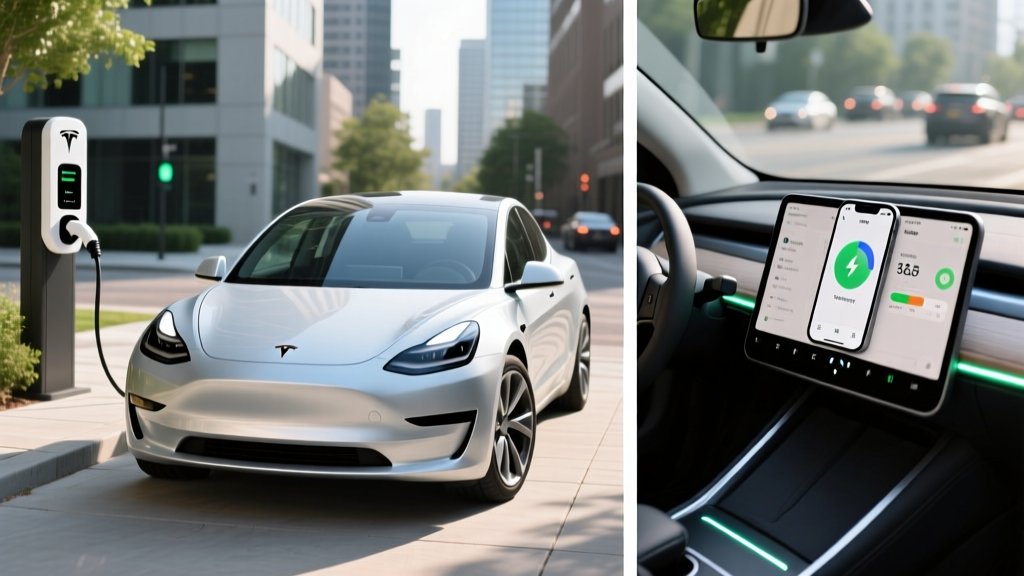
The Model 3's interior is minimalist by design — a single 15.4-inch center touchscreen handles navigation, climate, media, and vehicle settings. There is no instrument cluster; speed and range display on the left edge of the main screen. The 2024+ Highland refresh added ventilated front seats, ambient lighting, rear-seat ventilation, and a rear touchscreen for passengers — all meaningful quality-of-life upgrades.
Standout Tech:
- Tesla's navigation with real-time Supercharger routing and battery preconditioning
- Over-the-air software updates that add features post-purchase
- Sentry Mode (360° camera recording when parked)
- Dog Mode and Camp Mode for climate control while parked
- Tesla app with remote climate, location, and charging control
Notable Drawbacks:
- No physical buttons for climate or volume — everything routes through the touchscreen or steering-wheel scroll wheels
- No Apple CarPlay or Android Auto — Tesla's native software only
- Turn-signal stalks were removed in the Highland refresh; signals are now on the steering wheel (a learning curve for new drivers)
- Rear visibility is limited; the camera-based mirror and parking sensors compensate but aren't a full replacement
Cargo space totals 26.2 cubic feet (23.1 trunk + 3.1 frunk), which is competitive with the Accord's 16.7 cu ft trunk — though the Model 3's sedan trunk opening is narrow and limits loading bulky items. Rear-seat legroom at 35.3 inches is adequate for adults but tighter than the Accord's 40.8 inches, a meaningful difference for families with tall rear passengers.
Autopilot and Driver Assistance: What It Can and Cannot Do
SAE Automation Level: Level 2 (partial automation). The driver must remain fully engaged, hands on the wheel, eyes on the road at all times. This is not self-driving.
Every Model 3 includes Tesla's basic Autopilot: adaptive cruise control and lane-centering assist. The optional Full Self-Driving (Supervised) package ($8,000 or $99/month) adds automated lane changes, traffic-light recognition, and city-street navigation — but it remains a Level 2 system that requires constant supervision. Per NHTSA guidance, the driver is legally responsible for all vehicle actions at all times.
In practical terms, Autopilot is excellent for highway cruising and reduces fatigue on long trips. FSD (Supervised) handles many suburban and urban scenarios competently but still disengages or makes errors in construction zones, complex intersections, and adverse weather. It's a convenience feature, not a replacement for an attentive driver.
What Autopilot/FSD Does NOT Do: Navigate unmapped roads, handle all construction zones, operate safely in heavy snow/fog without driver intervention, or relieve the driver of legal responsibility. Hands-on-wheel monitoring is enforced; repeated warnings lead to system lockout for the remainder of the trip.
Battery Longevity and Warranty
The Model 3 RWD's LFP battery is one of its strongest long-term assets. LFP chemistry offers 3,000-5,000+ full charge cycles before reaching 80% capacity — far exceeding the NMC packs in the Long Range model (roughly 1,500-2,000 cycles to 80%). In practical terms, this means the RWD battery should outlast 300,000+ miles of typical driving before meaningful degradation, well beyond the vehicle's likely service life.
Tesla's battery warranty covers 8 years or 100,000 miles (whichever comes first) with a minimum 70% capacity retention threshold. If the battery degrades below 70% within that window, Tesla replaces or refurbishes it at no cost. Per Tesla's official warranty documentation, this covers manufacturing defects and abnormal degradation but not damage from accidents, flooding, or improper modifications.
Out-of-warranty LFP battery replacement costs are estimated at $8,000-$12,000 as of 2026, though LFP packs rarely need replacement within the first 15 years of normal use. This is a significant advantage over NMC packs, which carry higher replacement costs ($12,000-$18,000) and faster degradation curves.
Who Should Buy the Model 3 RWD (and Who Shouldn't)
Choose the Tesla Model 3 RWD if:
- You can install Level 2 charging at home and drive under 250 miles daily
- You want the lowest total cost of ownership in an EV sedan
- You value OTA updates, app integration, and the Supercharger network
- You're a solo driver or couple without frequent rear-seat passengers
- You want LFP battery longevity for 10+ year ownership
Choose the Honda Accord Hybrid instead if:
- You lack reliable home or workplace charging access
- You regularly carry adult rear-seat passengers (3+ inches more legroom)
- You want lower insurance premiums and don't want to shop multiple carriers
- You take frequent 500+ mile road trips in regions with sparse charging infrastructure
- You prefer physical controls, CarPlay, and conventional dealership service
Pros and Cons at a Glance
Pros
- 363-mile EPA range — best in its price class
- LFP battery: exceptional cycle life, 100% SoC charging recommended
- 170 kW DC fast charging with Supercharger network access
- $31,490 effective price after §30D credit (if eligible)
- Low maintenance costs: no oil, minimal brake wear
- Strong OTA update pipeline adds features over time
- 271 hp / 5.8s 0-60 — quick for a base-model sedan
Cons
- Insurance premiums 15-30% higher than Accord Hybrid
- No physical buttons; steep touchscreen learning curve
- No Apple CarPlay / Android Auto
- Rear legroom tight at 35.3 inches
- RWD only — no AWD option on base trim
- Turn signals on steering wheel (no stalk) take adjustment
- 170 kW peak charge rate trails 800V competitors
Frequently Asked Questions
What is the real-world range of the 2026 Tesla Model 3 RWD?
The EPA rates it at 363 miles, but real-world highway driving at 70-75 mph yields roughly 290-320 miles. In cold weather (below 32°F), expect 240-270 miles without preconditioning. City driving with regenerative braking can approach or slightly exceed the EPA figure.
How fast does the Model 3 RWD charge at home and on the road?
At home on a Level 2 (240V) charger, it adds ~44 miles of range per hour, fully charging in about 5.5 hours. On a Tesla Supercharger, it peaks at 170 kW and charges from 10-80% in approximately 25 minutes under good conditions. Charging slows significantly above 80% — plan to charge to 80% on road trips for the best time efficiency.
How much does the Model 3 RWD cost after tax credits?
The base MSRP is $38,990. If you qualify for the full $7,500 federal §30D tax credit (income, MSRP, and battery-sourcing requirements apply), the effective price drops to $31,490. Some states offer additional rebates of $1,000-$5,000. The point-of-sale transfer option lets you apply the federal credit as an immediate price reduction at purchase.
Is the Tesla Model 3 RWD worth buying vs. the Honda Accord Hybrid?
On five-year total cost of ownership, the Model 3 RWD saves roughly $3,500 vs. the Accord Hybrid (after the federal credit), driven by fuel and maintenance savings. However, the Accord Hybrid wins on insurance cost, rear-seat space, and zero charging dependency. If you can charge at home and don't need maximum rear-seat room, the Model 3 is the stronger financial choice.
Does the 2026 Model 3 RWD qualify for the federal EV tax credit?
As of early 2026, the Model 3 RWD qualifies for the full $7,500 §30D credit, subject to buyer income limits ($150K single / $300K joint), the $55,000 sedan MSRP cap, and battery-sourcing requirements. Eligibility can change as sourcing rules tighten. Always verify on IRS.gov before purchasing and consult a tax professional.
Is Tesla insurance cheaper than third-party insurers?
It depends on your driving profile. Tesla's own insurance uses real-time driving data and can be 10-20% cheaper for safe drivers, but rates are variable month-to-month. Traditional carriers like Geico and Progressive may offer lower fixed rates for some profiles. Always compare at least three quotes.
How long will the LFP battery last?
LFP batteries are rated for 3,000-5,000+ full charge cycles to 80% capacity. At typical driving patterns, this translates to 300,000+ miles before significant degradation. Tesla's warranty covers 8 years / 100,000 miles at a 70% retention threshold, but most LFP packs far exceed this in real-world use.